1
Need structured transaction intelligence?
Access enriched bank data with merchant identification and categorisation.
Book Demo NowTable of Contents
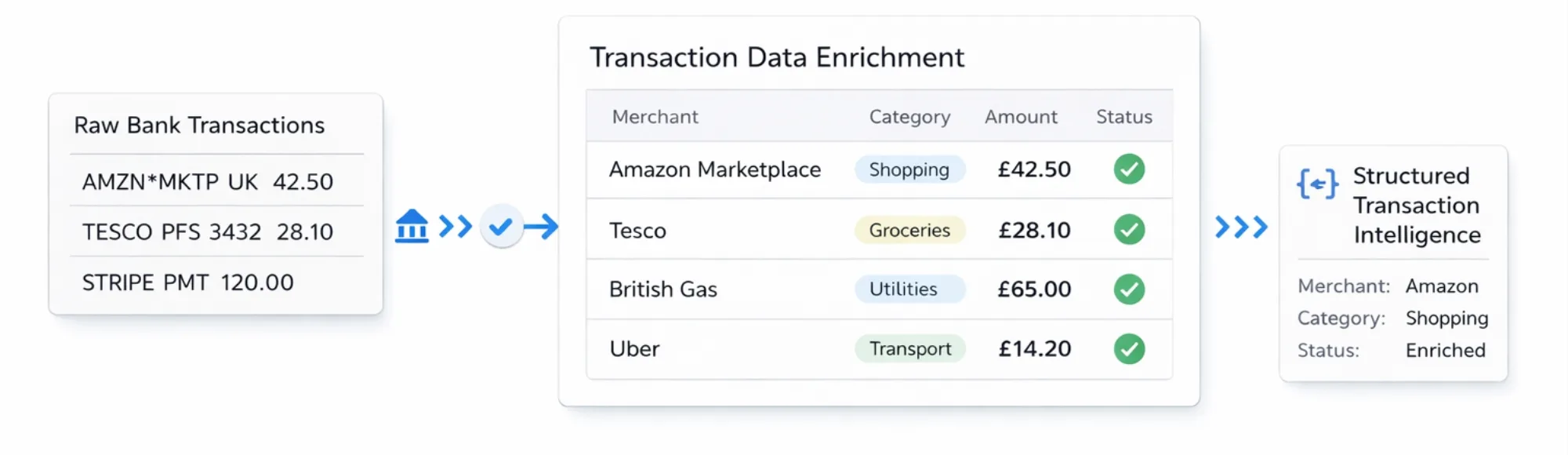
Raw bank transactions arrive as cryptic strings. “CHECKCARD 0423 SQSP* WEEBLY SF CA” tells platforms nothing about merchant identity, business category, or transaction context. UK platforms building financial features cannot automate workflows when transaction data lacks structure.
Transaction data enrichment transforms unclear feeds into actionable intelligence. Finexer provides merchant identification, automatic categorisation, and structured metadata enabling platforms to build reconciliation, underwriting, and compliance features without parser maintenance overhead.
This explains how platforms access enriched transaction data, what capabilities eliminate manual processing, and why infrastructure beats internal development for transaction enrichment operations.
Key Takeaways
Why do raw bank transactions break platform operations?
Unstructured feeds cause risk engine failures, incorrect affordability calculations, and reconciliation overhead consuming finance team hours.
What does transaction data enrichment deliver?
Merchant identification from 100M+ global database, automatic categorisation with 95%+ accuracy, counterparty intelligence, and structured metadata at <100ms latency.
Why choose APIs over building enrichment internally?
Internal development underestimates merchant variation complexity. Engineering capacity diverted to parser maintenance cannot build product features.
What should platforms prioritise when evaluating providers?
Merchant identification accuracy, categorisation reliability, UK bank coverage, real-time enrichment capability, FCA-authorised infrastructure.
Where does Finexer fit operationally?
FCA-authorised AIS infrastructure providing enriched transaction feeds from 99% of UK banks with merchant identification and categorisation powered by 100M+ merchant database.
Why do raw bank transactions break platform operations?
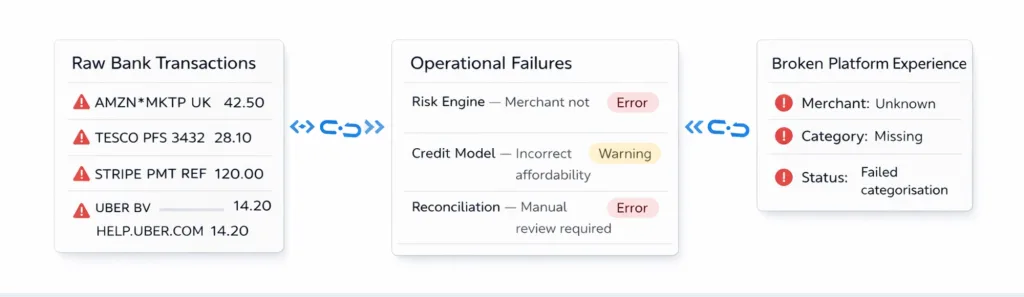
Transaction feeds from banks arrive unstructured. Merchant names appear as cryptic codes. Categories don’t exist. Business intelligence remains impossible.
Operational failures created:
- Risk engines misfire on unidentified merchants
- Credit models calculate wrong affordability metrics
- Accounting reconciliation consumes finance team hours
- User dashboards display confusing descriptions
- Compliance checks fail without proper categorisation
Platforms building fintech products, embedded finance features, or SaaS with financial capabilities face identical problems. Raw transaction enrichment access without processing cannot power product features.
What does transaction data enrichment deliver?
Finexer’s enrichment transforms raw feeds into structured intelligence:
Merchant identification: Clean merchant names from 100M+ global database. “AMZN*MKTP UK” becomes “Amazon Marketplace” with full business details.
Transaction categorisation: 95%+ accuracy automatic classification. Groceries, transport, utilities assigned instantly with detailed subcategories.
Counterparty intelligence: Business vs personal transactions separated. Supplier identification, payment type classification, recurrence pattern detection.
Structured metadata: Complete business information including location, contact details, category hierarchy, and transaction characteristics.
This happens at <100ms latency in real-time, not batch-processed hours later. Platforms receive structured data immediately rather than cleaning retrospectively.
How does transaction enrichment infrastructure work?
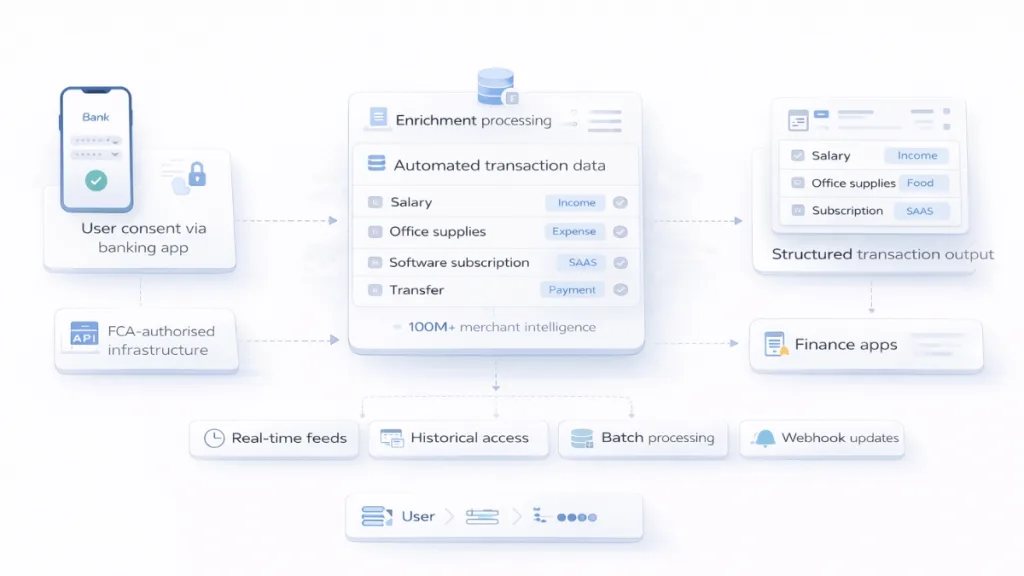
Modern enrichment operates through consent-based architecture:
User authenticates via banking app. Platform accesses transaction feed through Finexer’s FCA-authorised infrastructure. Enrichment layer processes raw data using 100M+ merchant database. Structured output delivered to product systems.
APIs return enriched transactions:
- Real-time for ongoing transaction feeds
- Historical for account analysis (up to 7 years)
- Batch processing for high-volume operations
- Webhook notifications for immediate updates
Both real-time and historical capabilities matter. Platforms need current intelligence and complete account context.
What does strong enrichment infrastructure provide?
Merchant identification accuracy: 100M+ merchant database covers global businesses. Long-tail specialist handling uncommon merchants where generic systems fail.
Categorisation reliability: 95%+ accuracy trained on 10B+ real transactions. Personal and business categorisation with detailed subcategories.
Real-time enrichment: <100ms P50 latency fits payment authorisation flows. Sub-200ms for fraud and compliance checks.
UK bank coverage: 99% connectivity through FCA-authorised Open Banking. Virtually all user accounts work regardless of institution.
Historical data support: Backfill enriched transactions up to 7 years. Complete account analysis for creditworthiness assessment.
Structured API outputs: JSON responses with categorised fields. Merchant details, location data, business hierarchy, transaction type.
Platforms building on unregulated infrastructure inherit compliance risk. Finexer operates through FCA-authorised channels providing regulatory protection.
Why do APIs beat internal development?
Internal development costs exceed estimates. Merchant name variations number in thousands. International merchants require separate rules. Data patterns drift as banks change formatting.
Engineering reality:
- Initial rules cover 80% of cases
- Remaining 20% consume months of effort
- Long-tail merchant complexity emerges at scale
- Maintenance overhead increases with user growth
- Pattern recognition requires ML infrastructure
Engineering capacity diverted to parser maintenance cannot build product features. Platforms need transaction enrichment working immediately, not in six months.
The merchant intelligence challenge: Generic descriptions like “CHECKCARD 0423” provide no context. Enrichment APIs using 100M+ merchant databases solve problems internal teams cannot address efficiently.
Common Evaluation Mistakes
| Mistake | Why It Matters | What to Look For |
|---|---|---|
| Building parsers internally | Underestimates merchant variation complexity | Pre-trained enrichment with 100M+ merchant database |
| Batch-only processing | Delays real-time features | Sub-100ms latency for authorisation flows |
| Limited merchant coverage | Long-tail merchants remain unidentified | 100M+ global merchant database with specialist accuracy |
| Screen-scraping infrastructure | Compliance risk, breaks during updates | FCA-authorised Open Banking connectivity |
| No historical enrichment | Cannot analyse complete account history | 7-year historical data backfill support |
Which Platforms Need Transaction Data Enrichment?
- Fintech platforms: Lending, wealth management requiring accurate transaction analysis for risk assessment with merchant-level intelligence.
- Accounting SaaS: Automated bookkeeping, expense categorisation needing clean feeds with 95%+ categorisation accuracy.
- SME tools: Cash flow forecasting, spend analytics requiring categorised history for business intelligence dashboards.
- Embedded finance: Applications adding financial features without building enrichment infrastructure from scratch.
For SME-focused platforms, transaction enrichment APIs provide business expense pattern categorisation.
What I Feel About Transaction Data Enrichment
After observing platforms implement transaction data enrichment, the difference between successful and struggling implementations is clear.
Successful platforms treat enrichment as infrastructure they consume. They invest engineering effort in product features, user experience, and business logic-not building merchant name parsers.
Struggling platforms underestimate long-tail merchant complexity. They build initial rules covering 80% of cases, then spend months addressing remaining variations. Maintenance overhead becomes the biggest operational burden.
Categorisation accuracy matters critically. Incorrect categories break user dashboards, miscalculate affordability, and undermine trust. Platforms cannot afford trial-and-error approaches when users evaluate financial products.
The infrastructure decision compounds over time. Platforms building parsers internally discover new edge cases monthly. Maintenance overhead increases as user base grows and merchant variety expands.
Where Finexer Fits
Finexer provides FCA-authorised access to enriched bank transaction data:
Data Enrichment API capabilities:
- Merchant identification from 100M+ global database
- Transaction categorisation with 95%+ accuracy
- Real-time enrichment at <100ms latency
- Historical data access up to 7 years
- FCA-authorised infrastructure
- 99% UK bank coverage
- Usage-based pricing
- 3-5 weeks onboarding support
- White-label ready
- Saves up to 90% vs internal development
Structured transaction feeds from 99% of UK banks with categorisation and merchant normalisation at ingestion.
API-first delivery with JSON-structured outputs matching platform integration requirements.
Finexer does not make credit decisions or provide compliance advice. We provide enriched data access that platforms integrate for financial product features.
What is transaction data enrichment?
Transaction data enrichment converts raw bank feeds into structured data with merchant identification, categorisation, and metadata enabling product features without parser maintenance.
How does a transaction data enrichment API work?
Platforms access bank transactions via FCA-authorised Open Banking, receive enriched data through APIs with merchant intelligence and categorisation added at <100ms latency.
Does transaction enrichment work with all UK banks?
Yes, with 99% UK bank coverage through Open Banking infrastructure, virtually all user accounts work regardless of banking institution.
What happens to transaction data security?
Finexer provides 95%+ accuracy using 100M+ merchant database, with specialist handling for long-tail merchants where generic systems fail.
How long does integration take for transaction data enrichment APIs?
Typically 3-5 weeks with dedicated onboarding assistance, though timelines vary based on platform architecture complexity.
Access enriched transaction data with merchant identification and automated categorisation from 100M+ global database.
About the Author

Ravi Ranjan
Ravi Ranjan is Co founder & CEO of Finexer