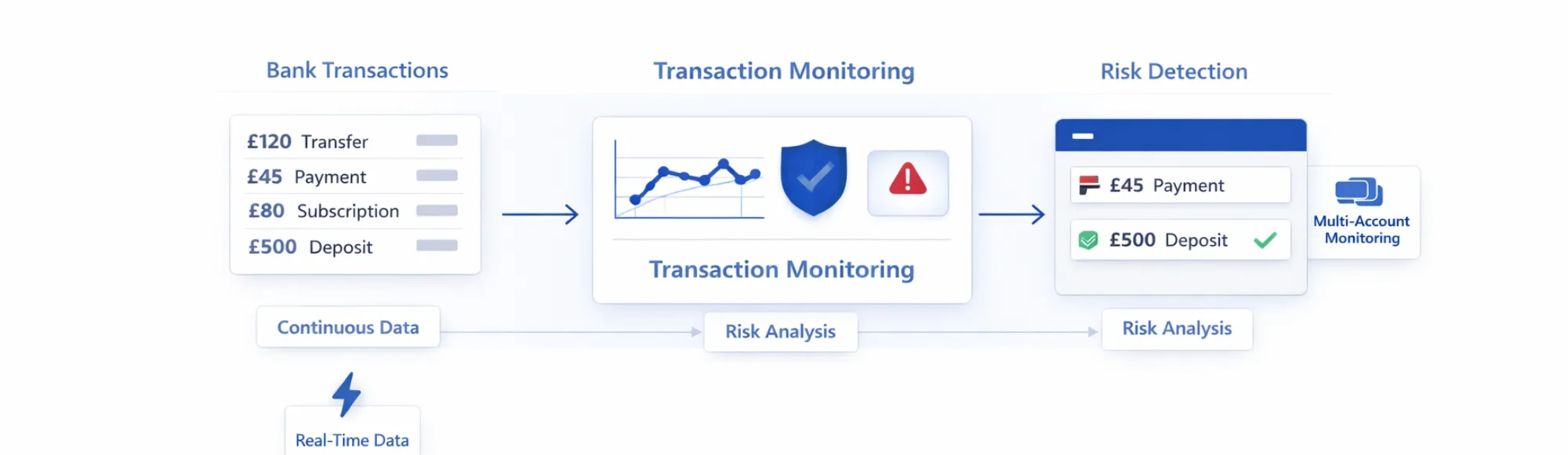
Building transaction monitoring into your compliance workflow?
Finexer gives UK platforms FCA-authorised bank transaction data – structured, consent-based, audit-ready.
In my experience working with compliance-focused platforms, the failure point in transaction monitoring solutions is almost never the monitoring logic. The rules are well-designed. The risk thresholds are calibrated. The reporting workflows are in place.
The failure point is the data.
Transaction monitoring solutions built on manually uploaded bank statements, monthly batch imports, or fragmented single-account feeds analyse an incomplete picture of financial activity. Suspicious patterns that span multiple accounts or emerge over weeks of transaction history are invisible to systems that only see part of the data.
Effective transaction monitoring solutions require continuous, structured, multi-account bank data streams. That is what this blog addresses.
This blog is written for Compliance Leads, Risk teams, and Product Managers at LawTech platforms, accounting tools, insolvency practices, insurtech providers, and utility billing platforms that need reliable bank transaction data to power monitoring and compliance reporting workflows.
TL;DR
Transaction monitoring solutions analyse financial transactions to detect suspicious activity, compliance risks, and irregular behaviour. The transaction monitoring process depends on continuous, structured bank transaction data – not periodic statement uploads. Finexer provides FCA-authorised AIS infrastructure delivering continuous bank transaction feeds for UK platforms building transaction monitoring solutions and compliance reporting workflows.
Key Takeaways
What are transaction monitoring solutions?
Transaction monitoring solutions are software systems that continuously analyse financial transaction data to detect suspicious activity, AML risks, and behavioural anomalies. These systems require structured, continuous bank transaction feeds to operate reliably – not periodic manual data collection.
What is the transaction monitoring process?
The transaction monitoring process involves four stages – financial data collection, transaction pattern analysis, risk detection, and compliance reporting. Each stage depends on the quality and continuity of the bank transaction data entering the system.
Why do transaction monitoring solutions fail with manual data collection?
Manual bank statement uploads introduce data latency, coverage gaps, and formatting inconsistencies. Monitoring systems operating on manually collected data cannot detect patterns that emerge between collection cycles – creating compliance blind spots that expose platforms to regulatory risk.
What bank data does a transaction monitoring solution need?
Transaction monitoring solutions need transaction history, counterparty details, merchant identifiers, transaction category codes, account balance data, and multi-account coverage – all delivered continuously via structured API feeds, not periodic static imports.
What does Finexer provide for transaction monitoring solutions?
Finexer provides FCA-authorised AIS infrastructure delivering structured bank transaction data – including merchant identifiers, category codes, and counterparty details – covering 99% of UK banks with real-time webhooks for continuous monitoring data feeds.
What Are Transaction Monitoring Solutions?
Transaction monitoring solutions are systems that continuously retrieve and analyse financial transaction data to identify patterns indicating suspicious activity, money laundering risk, or regulatory compliance issues.
The platforms I work with that implement transaction monitoring solutions are typically operating under AML obligations – LawTech firms conducting client due diligence, insolvency practices assessing financial history, insurtech platforms reviewing claims activity, or accounting tools flagging unusual client transactions.
What distinguishes effective transaction monitoring solutions from ineffective ones is not the sophistication of the detection logic. It is the completeness and continuity of the data feeding that logic.
“Transaction monitoring solutions are only as reliable as the data stream behind them. A monitoring system operating on weekly batch imports has weekly blind spots – which is not a compliance-grade monitoring cadence.” – Paul, Finexer
What Is the Transaction Monitoring Process?
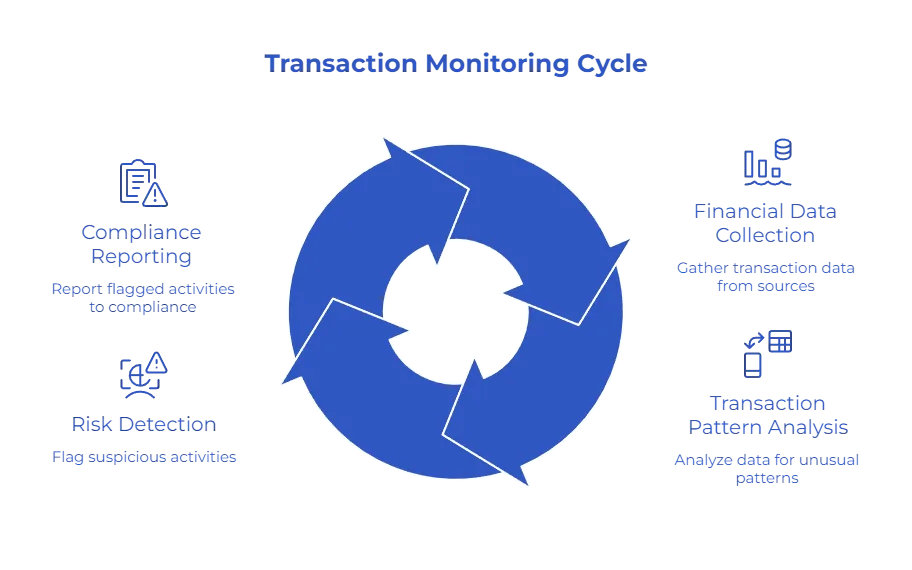
The transaction monitoring process follows four stages. Each stage has a data dependency that determines whether the stage produces reliable outputs.
Stage 1 – Financial Data Collection
The monitoring system retrieves bank transaction data from source. This is where most transaction monitoring solutions break down in practice.
Reliable data collection for monitoring requires:
- Continuous transaction feeds – not periodic batch imports
- Multi-account coverage – not single-account connections
- Structured, consistently formatted transaction records
- Counterparty details and merchant identifiers per transaction
- Balance data for account-level activity monitoring
Without all of these, the transaction monitoring process starts with an incomplete dataset. Everything downstream reflects that incompleteness.
Stage 2 – Transaction Pattern Analysis
The monitoring system analyses transaction behaviour to identify patterns that deviate from expected financial activity.
Pattern analysis examines:
- Transaction frequency and volume changes over time
- Counterparty risk – payments to unusual or high-risk entities
- Amount structuring – repeated transactions below reporting thresholds
- Rapid fund movement across accounts
- Inconsistencies between stated income and observed transaction activity
The accuracy of pattern analysis depends directly on the depth and continuity of transaction history available. Shallow history produces shallow analysis.
Stage 3 – Risk Detection
Monitoring logic flags transactions or account behaviour that meets defined risk criteria. Flagged activity is surfaced for compliance team review – either through automated alerts or structured review queues.
Risk detection in transaction monitoring solutions typically covers:
- Unusually large single transactions relative to account history
- Structuring patterns – multiple transactions designed to avoid reporting thresholds
- Dormant account sudden activity
- Payments inconsistent with client financial profile
Stage 4 – Compliance Reporting
Flagged transactions reviewed by compliance teams result in either clearance or escalation. Where escalation is required, transaction monitoring solutions support Suspicious Activity Report generation under UK AML obligations.
The audit trail behind the transaction monitoring process – data source, access timestamp, consent record, review log – supports regulatory examination if required.
Automated transaction monitoring using bank APIs covers how automation reduces manual review workload within the monitoring process.
How Should Platforms Evaluate Transaction Monitoring Solutions Infrastructure?
| Data Requirement | Why It Matters for Monitoring | What to Look For |
|---|---|---|
| Continuous Transaction Feed | AML monitoring requires current activity – batch imports create compliance gaps | Real-time webhooks; event-driven transaction delivery; live balance data |
| Multi-Account Coverage | Suspicious patterns often span multiple accounts – single-account feeds miss them | Multi-account AIS access; cross-account transaction aggregation; 99% UK bank coverage |
| Structured Data Output | Monitoring algorithms require consistently formatted inputs to detect patterns reliably | Structured JSON; merchant IDs; category codes; counterparty details; standardised schema |
| Transaction History Depth | Pattern detection requires sufficient history to identify behavioural baselines | Up to 7 years transaction history; configurable lookback periods per account |
| Consent and Audit Trail | Compliance reporting requires verifiable records of data access and consent | FCA-compliant consent flows; access logs; granular permissions; instant revocation |
| FCA Authorisation | UK platforms must use regulated AIS providers for compliant bank data access | FCA-authorised AIS; GDPR-compliant; regulated under Payment Services Regulations 2017 |
How Does Finexer Enable Transaction Monitoring Solutions?
Finexer is FCA-authorised to provide account information services – delivering structured bank transaction data for UK platforms building transaction monitoring solutions and compliance reporting workflows.
What Finexer’s AIS provides for transaction monitoring:
- Structured bank transaction data from 99% of UK bank accounts
- Real-time webhooks delivering transaction events as they occur
- Merchant identifiers and transaction category codes per transaction
- Counterparty account details for risk assessment workflows
- Transaction history up to 7 years for behavioural baseline and pattern depth
- Multi-account data access from a single consent-based API connection
- FCA-compliant consent flows with granular permissions and instant revocation
- Usage-based pricing
Real-time transaction monitoring for fintech platforms covers the real-time data infrastructure layer in detail.
What I Feel
The compliance teams I work with understand the transaction monitoring process well. What they struggle with is justifying monitoring investment when the data feeding the system is demonstrably incomplete.
If a platform’s transaction monitoring solution runs on monthly statement uploads, it is not a monitoring solution – it is a monthly review process with a compliance label on it.
Continuous bank data streams are not a premium upgrade to transaction monitoring solutions. They are the minimum data standard that makes the transaction monitoring process operationally meaningful for AML compliance purposes.
Common Use Cases

LawTech Platforms
LawTech platforms – including insolvency practices – use Finexer’s AIS to access continuous client bank transaction feeds for source-of-funds monitoring and ongoing financial activity surveillance. The transaction monitoring process for legal compliance requires bank-verified data with a clear consent and access audit trail – supporting regulatory examination if required.
Accounting & ERP Platforms
Accounting platforms use continuous AIS transaction feeds to flag unusual client financial activity before it affects financial reporting accuracy. Transaction monitoring solutions built on live bank data detect anomalies – large unexplained transactions, sudden activity pattern changes – at the point they occur rather than weeks later during manual review.
Insolvency Platforms
Insolvency practices use Finexer’s AIS to monitor client financial behaviour across all connected accounts during case assessment. The transaction monitoring process for insolvency requires deep transaction history and multi-account coverage – both available through Finexer’s AIS infrastructure – to identify asset movement and financial activity patterns relevant to case analysis.
Insurtech Platforms
Insurtech platforms use AIS transaction data to identify irregular payment patterns during claims processing. Continuous transaction feeds enable monitoring logic to compare claimed financial circumstances against observed bank account activity – supporting fraud detection workflows without manual financial document review.
Utility Billing Platforms
Utility platforms use AIS bank transaction data to monitor customer payment behaviour and detect billing anomalies. Transaction monitoring solutions built on continuous bank feeds identify missed recurring payments, unusual account activity changes, and payment pattern shifts that indicate billing risk – earlier and more reliably than end-of-month manual reconciliation.
What are transaction monitoring solutions used for in UK platforms?
Transaction monitoring solutions are used to continuously analyse financial transactions for suspicious activity, AML risks, and irregular behaviour. UK platforms under AML obligations use these systems to monitor client financial activity, detect compliance risks, and generate Suspicious Activity Reports where required under the Money Laundering Regulations 2017.
What is the transaction monitoring process for compliance platforms?
The transaction monitoring process involves four stages – collecting structured bank transaction data, analysing patterns for anomalies, detecting and flagging risk indicators, and generating compliance reports. Each stage depends on continuous, structured bank data feeds rather than periodic manual imports to produce reliable monitoring outputs.
Is Finexer suitable for platforms building transaction monitoring solutions?
Yes. Finexer is FCA-authorised and provides AIS infrastructure covering 99% of UK banks – delivering structured bank transaction data with merchant identifiers, category codes, and up to 7 years of transaction history. Platforms integrate Finexer’s AIS to power continuous transaction monitoring solutions with real-time webhooks and multi-account data coverage.
Build compliant transaction monitoring on continuous, verified bank data.
About the Author

Paul Lucraft
Paul Lucraft is a payments industry strategist and advisor with more than two decades of experience across banking, card networks, and financial services infrastructure. His expertise covers fraud prevention, payment risk management, financial strategy, and the operational development of card payment systems. He previously held senior roles at Mastercard Europe where he served as General Manager for the UK and Ireland, overseeing fraud risk, operational governance, and payment network strategy across the region. Earlier in his career, Paul worked at Lloyds TSB and TSB Bank leading fraud strategy, credit collections, and card business finance operations.