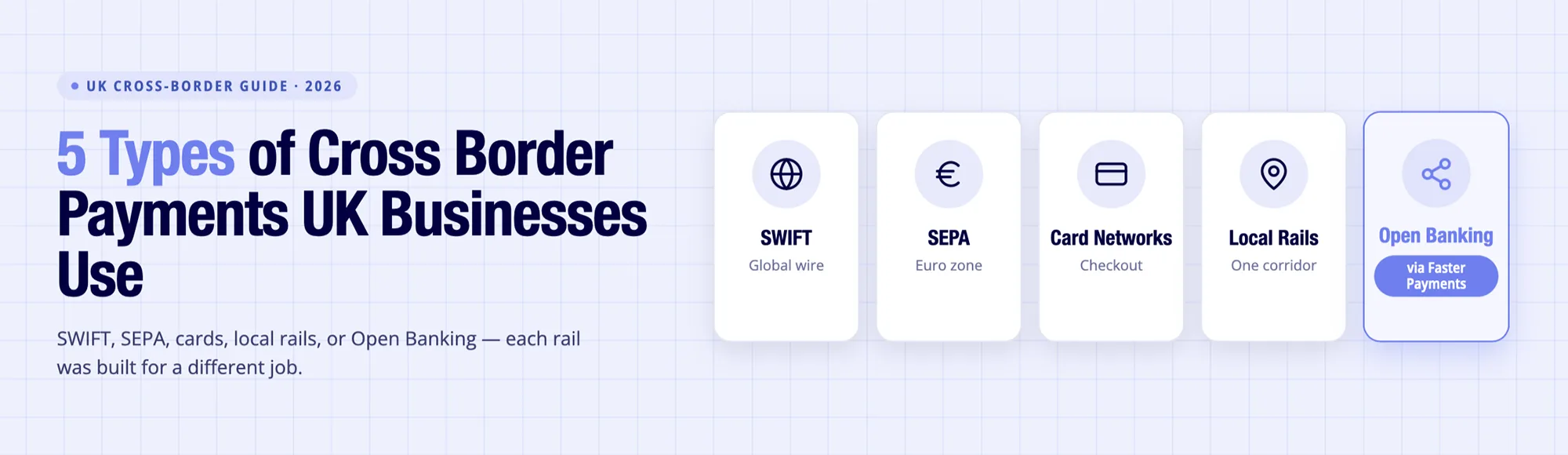
Brief: There are five main types of cross border payments: SWIFT (global, 2-5 days), SEPA (euros only, 41 countries), card networks (consumer-facing), local rails (one corridor each, like US ACH or Indian UPI), and API-based Open Banking (UK domestic GBP, instant via Faster Payments). Each one was built for a different job. Match the rail to the job, and most of the cost and delay disappear.
Most UK businesses pick a payment rail by accident. SWIFT becomes the default for everything: German suppliers, US contractors, Dutch sellers. It fits some of those jobs. For others, it adds days and fees that a better-matched rail would not. The five types of cross border payments are not interchangeable.
They differ on cost, speed, coverage, and purpose. This guide walks through the main cross border payment methods in plain terms, shows which job each rail was built for, and covers where Open Banking honestly fits.
What Are Cross Border Payments?
Cross border payments are payments in which the sender and recipient hold accounts in different countries or currencies. The money crosses at least one border. That usually means currency conversion, extra rules, and more banks in the chain.
There are two ways to classify the types of cross border payments. The Bank of England splits them by size and purpose: wholesale (large payments between financial institutions) and retail (payments by businesses and individuals). You can also split them by who pays whom:
| Who Pays Whom? | Example |
|---|---|
| Business to business (B2B) | A UK firm pays a German supplier |
| Business to person (B2C) | A platform pays overseas contractors |
| Person to business (C2B) | An international customer pays at checkout |
| Person to person (C2C) | Consumer remittance between individuals |
This guide covers business payments. The third way to classify, and the most practical one, is by rail: the actual cross border payment methods that move the money. That gives us the five rails below. Together, they form the international payment systems most UK businesses will ever touch.
The 5 Types of Cross Border Payments
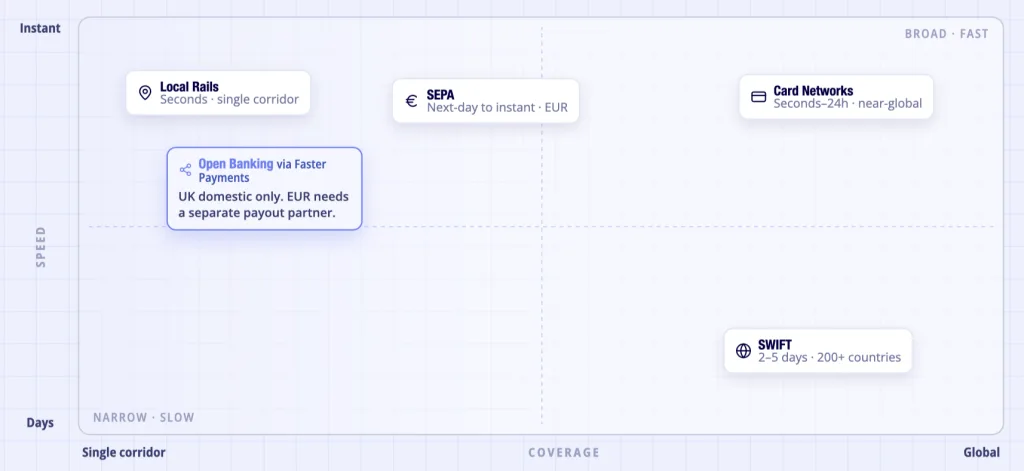
Each of these types of cross border payments has a different job. The wrong default costs time and money.
| Type | Best For | Speed | Cost | Coverage |
|---|---|---|---|---|
| SWIFT wire transfer | High-value B2B outside Europe | 2-5 business days | High: fees at each bank in the chain | 200+ countries |
| SEPA / SEPA Instant | Euro payments within Europe | Next day / under 10 seconds | Low | 41 countries including the UK |
| Card networks | Consumer payments at checkout | Seconds to 24 hours | Medium: interchange and FX fees | Near-global |
| Local payment rails | One specific corridor | Seconds to minutes | Low within the corridor | Country-specific |
| API-based (Open Banking, via Faster Payments) | Outbound GBP payouts from the UK | Instant via Faster Payments | Low: no middleman banks | UK domestic; EUR via separate payout partner |
If you’re comparing specific providers rather than infrastructure types, our international payment gateway comparison explains how platforms such as Wise, Airwallex, Stripe, Adyen and Finexer differ across coverage, APIs and payment capabilities.
1. SWIFT Wire Transfers
SWIFT is a messaging network linking 11,500+ banks across 200+ countries. It does not move money itself. It sends payment instructions between banks, and the banks settle through chains of middlemen called correspondent banks. Each middleman can take a fee, so the recipient may get less than was sent. Settlement takes 2-5 business days on most routes.
SWIFT is the right choice when nothing local exists: high-value transfers to markets outside Europe, or corridors with no direct rail. Its tracking is improving too, since SWIFT finished moving to the ISO 20022 data standard in November 2025. Among cross border payment methods, it trades speed for reach.
2. SEPA and SEPA Instant
SEPA covers euro payments across 41 countries, and the UK is still a member after Brexit. Standard SEPA settles next business day. SEPA Instant targets under 10 seconds, and EU providers must offer it under rules taking effect from 2026. For euro invoices to European suppliers, SEPA is almost always cheaper and faster than SWIFT. Among the types of cross border payments, it is the clearest bargain.
The condition: Euros only, and you need a euro account with an IBAN.
3. Card Networks
Visa, Mastercard and Amex run their own global rails, separate from bank transfers. They were built for consumers paying at checkout, and that is still where they fit best. For paying suppliers or contractors who have bank accounts, cards are usually the expensive route: interchange fees, FX spreads and chargeback risk add up. They are among the costliest cross border payment methods for B2B work. Card push products like Visa Direct can work for payouts where the recipient has no easy bank details, but they are not the default for UK B2B payouts.
4. Local Payment Rails
Every big economy runs its own domestic payment system: ACH and FedNow in the US, UPI in India, PIX in Brazil, BECS in Australia. Within their home corridor, these are fast and cheap. The limit is that each one covers a single country. A platform paying into 15 countries needs 15 connections, or a provider that bundles them.
5. API-Based Payments and Open Banking
This is the newest of the five types of cross border payments. API-based payments sit on top of a rail and handle the work around it: starting the payment, tracking it, and matching it back to your records. The rail underneath varies by corridor. For UK outbound payouts, Open Banking Payment Initiation moves GBP between UK accounts directly, instant via Faster Payments, with no card network or correspondent chain on the domestic leg.
Be clear about the boundary: Open Banking covers the UK domestic GBP leg only. Sending euros needs a separate arrangement with licensed payout partners. Anyone claiming global Open Banking coverage is overclaiming.
Matching the Types of Cross Border Payments to the Job
The pattern is simple once you realise it.
- Euro invoice to a European supplier: SEPA
- High-value transfer to a market with no local option: SWIFT
- International customers at checkout: cards
- Volume payouts into one country: that country’s local rail.
- Outbound GBP payouts from a UK platform: Open Banking via Faster Payments.
Most businesses use two or three of these cross border payment methods, not one. The mistake is not choosing badly. It is never choosing at all, and letting SWIFT handle jobs it was never built for. Pick from the types of cross border payments by job, not by habit.
For platforms processing large payout batches, it’s also worth understanding how global mass payouts break at scale and the operational challenges that emerge as payment volumes grow.
Where Open Banking Fits in the International Payment Systems Landscape?
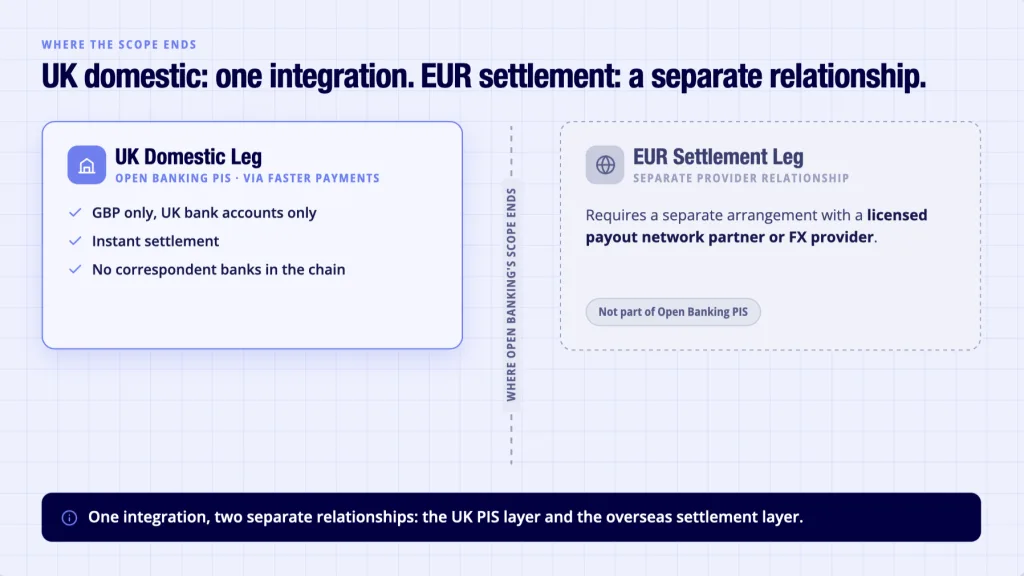
Open Banking is not a replacement for SWIFT or SEPA.
It solves one specific problem: UK platforms sending money out at volume, where the domestic leg is slow and blind on older international payment systems.
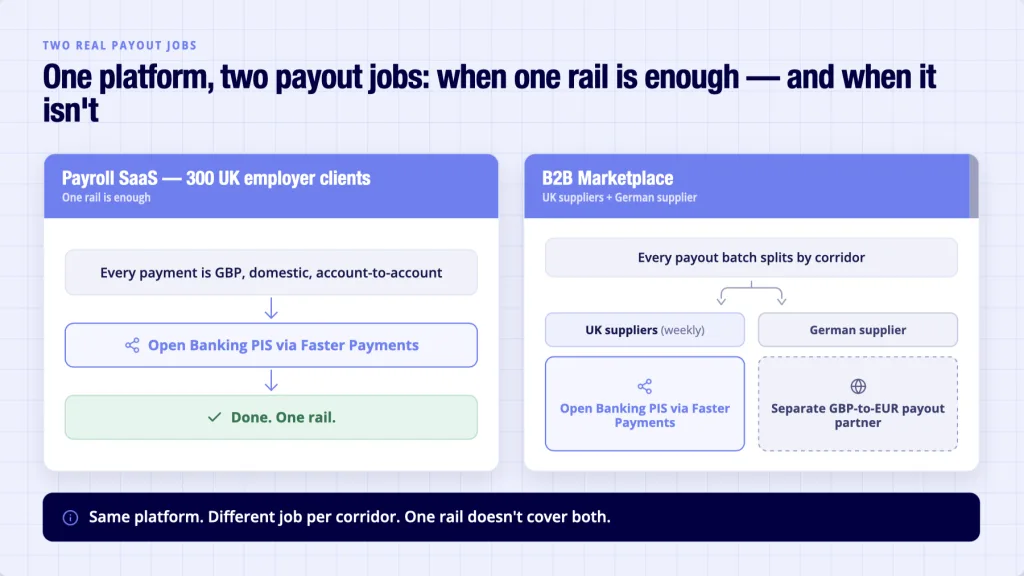
A payroll platform paying 300 UK employer clients needs no SWIFT at all. Every payment is GBP, account to account, with a webhook confirming each one. A marketplace settling UK suppliers gets the same, and pairs it with a licensed payout partner for its German suppliers’ euro leg. Used this way, it earns its place among the types of cross border payments without pretending to replace the rest.
A Payroll SaaS platform serving 300 UK employers, for example, may benefit from a dedicated overseas payroll payments guide when evaluating the most suitable payout infrastructure for international salary disbursements. If you’re assessing Open Banking providers for the domestic funding leg, our A2A payments provider checklist outlines the technical and operational criteria to evaluate before integrating.
Finexer provides API infrastructure for UK-origin payouts: covering UK-side funding, payout initiation, status tracking, and payout reconciliation. For platforms replacing SWIFT on domestic GBP flows, the international payments API layer is where the difference shows day to day. The scale is already mainstream: Open Banking Limited recorded 37.46 million payment transactions in March 2026. What Finexer provides, specifically:
- Batch initiation with a webhook per payment
- Reconciliation references are built into every payout
- FCA-authorised (FRN925695) as both AISP and PISP
- 99% UK bank coverage
- Usage-based pricing, 3-5 weeks of onboarding support
Payout initiation and per-payout status tracking through a single API, giving finance teams real-time visibility into every payment.
Conclusion
The five types of cross border payments each earn their place on a different job. SWIFT for reach. SEPA for euros. Cards for checkout. Local rails for single corridors. Open Banking for outbound UK payouts. Map your payments to the right rail once, and the cost and delay that felt permanent mostly is not.
Which of the types of cross border payments is cheapest?
It depends on the corridor. Across cross border payment methods, cost follows fit. SEPA is the cheapest for euros in Europe. Local rails win inside their own country. Open Banking is cheapest for outbound GBP within the UK. SWIFT usually costs the most, and is worth it only where nothing better reaches.
What is the difference between SWIFT and SEPA?
SWIFT reaches 200+ countries in any currency but takes 2-5 days, with fees taken along the way. SEPA covers euros only, across 41 European countries, next day or under 10 seconds. For euro payments in Europe, SEPA nearly always wins. They are different international payment systems built for different jobs.
What are international payment systems?
The networks that move money across borders. Each one maps to one of the types of cross border payments above. The main ones: SWIFT for global bank messaging, SEPA for euros in Europe, card networks for consumer payments, local rails like ACH and UPI for single corridors, and API layers that manage payments on top of those rails.
How does Open Banking fit into cross border payments?
It handles the UK domestic leg. Open Banking starts GBP payments between UK accounts, instant via Faster Payments, with no middleman banks. For the euro leg, a separate licensed payout partner does the settlement. It is one of the cross border payment methods, not all of them
If outbound GBP payouts are the job on your desk, Finexer’s team can walk you through the API against your real payment volume
Explore with AI
About the Author

Ravi Ranjan
Ravi Ranjan is Co founder & CEO of Finexer