Flexible recurring payments. Customer-controlled consent. Open Banking payment infrastructure.
VRP workflows for platforms replacing rigid Direct Debit models.
A variable recurring payments Open Banking example starts here. A customer sets up a Direct Debit for their utility bill. The bill varies every month. The Direct Debit is fixed.
One of them has to give way.
Usually it is the customer – paying a fixed amount, running a credit on the account, or managing the difference manually. It’s a design compromise that has existed for decades because no better infrastructure was available.
Variable recurring payments change this – not by making Direct Debit more flexible. By replacing the fixed-amount constraint at the infrastructure level.
This blog covers what a variable recurring payment Open Banking example actually looks like in practice – across savings, utilities, lending, subscriptions, and financial inclusion use cases.
“VRP get described as a smarter Direct Debit. That framing is technically accurate but operationally undersells it. The real change is consent architecture. With VRP, the customer defines the rules. The payment amount varies within those rules. The business collects what is actually owed. That is a different model from anything that existed before.” – Ravi, Finexer
TL;DR
Variable recurring payments (VRPs) are Open Banking-enabled payments where the amount, timing, or frequency can vary within a consent framework the customer controls. Unlike Direct Debit, where the business sets the collection parameters, VRP gives the customer defined boundaries – a maximum amount, a time window, a purpose category – and the payment initiator operates within those boundaries. Real-world variable recurring payments Open Banking examples include automated savings sweeps, variable utility bill collection, usage-based subscription billing, flexible loan repayments, and overdraft protection transfers.
Key Takeaways
What is a variable recurring payment Open Banking example in practice?
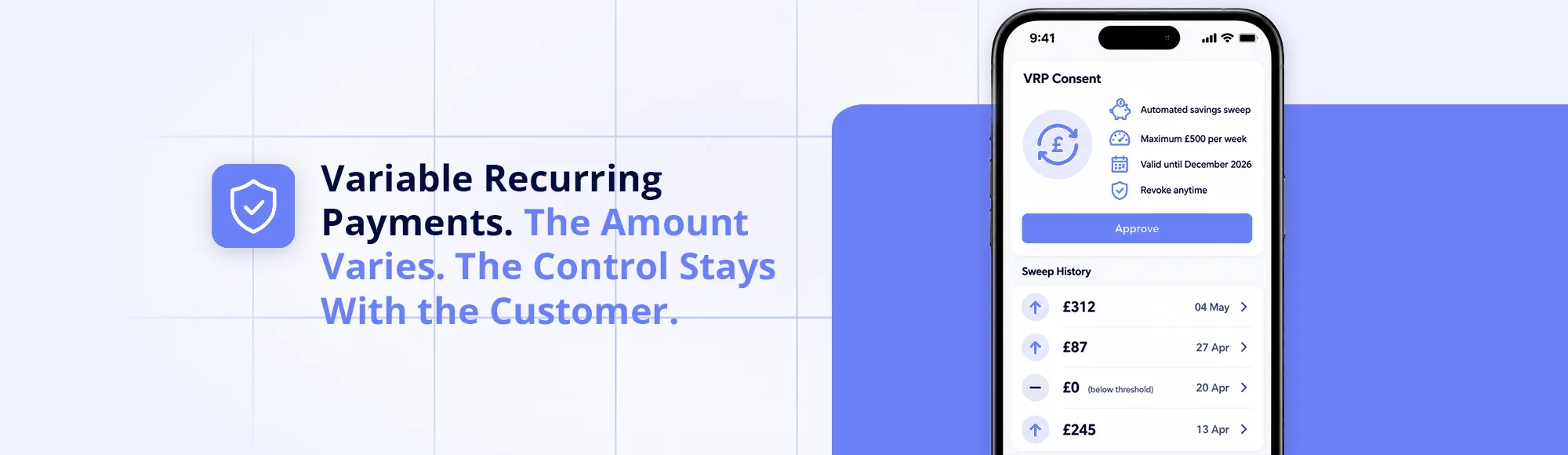
The clearest example: a customer authorises a savings app to transfer excess balance each week, up to a cap they set. The amount varies – £340 one week, £87 the next. Consent set once. The app initiates within those parameters. No standing order, no manual action.
How do VRPs differ from Direct Debit?
Direct Debit is creditor-controlled – the business sets the amount. The customer can cancel but can’t vary mid-cycle. VRP is customer-controlled – the payer defines maximum amount, time window, and purpose. The initiator can only collect within those boundaries. That reversal of control is the structural difference.
How does Open Banking support financial inclusion through VRPs?
VRPs reduce payment failure risk for customers with variable income – the amount aligns with what’s actually affordable, not a fixed mandate. For customers on irregular incomes, fixed mandates are a primary source of arrears. VRPs keep payment obligations and payment capacity aligned.
What Is a Variable Recurring Payment and Why Does It Matter?
How Does a VRP Work Differently From a Standing Order or Direct Debit?
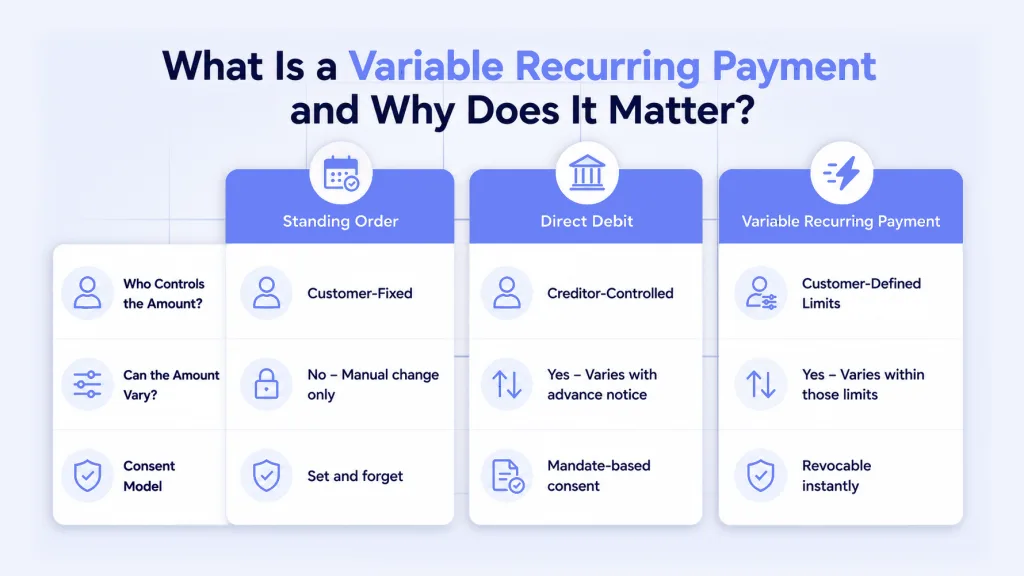
Three recurring payment models exist in UK consumer and business finance. Each handles variability differently.
A standing order is fixed by definition. The customer sets the amount, the recipient, and the frequency. It never changes unless the customer manually changes it. It has no awareness of what is owed.
A Direct Debit is set by the creditor. The business collects the agreed amount on a schedule. The customer consents once and the business can vary the amount with advance notice. Control sits with the creditor.
A variable recurring payment sits between them – but with a critical difference in consent architecture.
How VRP consent works:
- The customer grants consent via their bank using Open Banking
- They define the parameters: maximum amount per payment, maximum frequency, date range, and purpose
- The payment initiator – a platform, app, or service – can initiate payments that fall within those parameters
- The customer can revoke or modify consent at any time through their bank
The payment amount varies. Control stays with the customer.
| Payment Type | Who Controls the Amount? | Can the Amount Vary? | Customer Consent Model |
|---|---|---|---|
| Standing Order | Customer | Only by manual change | Set once, no ongoing oversight |
| Direct Debit | Creditor | Yes, with advance notice | Mandate signed, creditor-controlled |
| Variable Recurring Payment | Customer (within set parameters) | Yes, within customer-defined limits | Consent with defined boundaries, revocable instantly |
The variable recurring payments technical framework sets out the OBIE consent standards that govern how maximum amounts, frequencies, and revocation work in production.
What Do Real Variable Recurring Payments Open Banking Examples Look Like?
Which Use Cases Show VRPs Working in Practice?
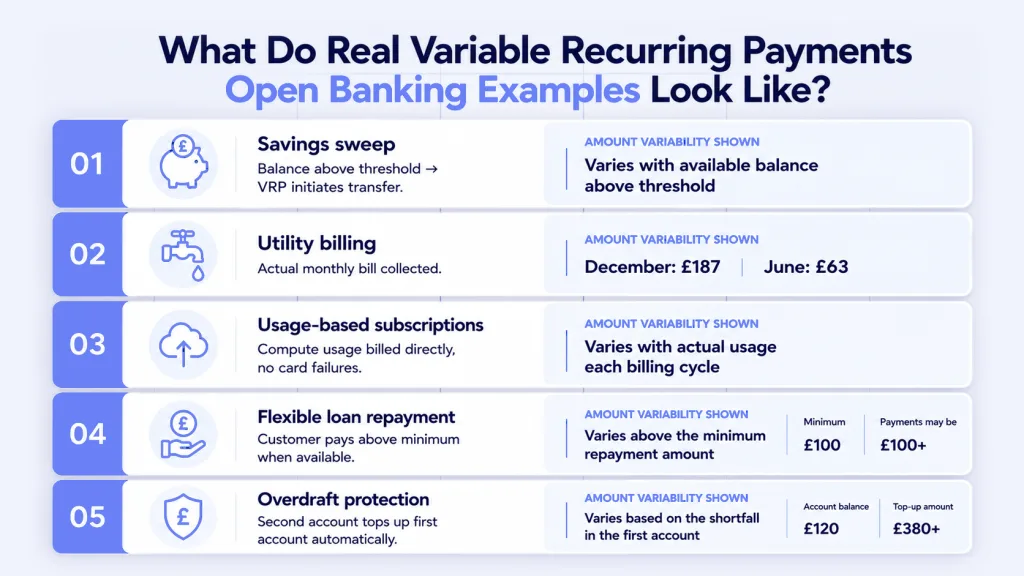
These are not hypothetical. Each variable recurring payments Open Banking example below represents a live or emerging commercial VRP deployment in the UK Open Banking ecosystem.
1. Automated savings sweeps
A customer authorises a fintech savings app to transfer excess balance from their current account to a savings account each week.
The parameters: maximum £500 per sweep, once per week, valid for 12 months.
The app checks the balance on Friday evening. If it is above a threshold the customer set, it initiates a VRP transfer for the difference – up to £500. One month the sweep is £340. The next one is £87. The next it is zero because the balance stayed below the threshold.
The customer set the rule once. The payment amount varied every time. No standing order could do this. No Direct Debit would apply here. This is the clearest variable recurring payments Open Banking example: one consent, variable amounts, customer in control.
2. Utility bill collection
An energy supplier’s monthly bill varies by usage. In December it is £187. In June it is £63.
Traditional Direct Debit handles this with a fixed estimated average – the customer either overpays in summer or underpays in winter, requiring annual reconciliation.
With VRP, the supplier collects the actual amount each month within a maximum cap the customer agreed to at setup. December: £187. June: £63. No reconciliation needed. No credit buildup. No awkward catch-up payment.
3. Usage-based subscription billing
A cloud platform bills customers based on compute usage. Billing varies monthly. Some customers have unpredictable usage spikes.
Card billing fails at the worst moment – when the customer has high usage and a card approaching its limit. Direct Debit requires advance notice of amount changes. VRP allows the platform to collect the actual usage amount each billing cycle within a maximum the customer consented to. No card expiry failures. No advance notice requirement for variable amounts.
4. Flexible loan repayments
A lender offers repayment flexibility – customers can pay more than the minimum when they can afford to, without setting up a new payment instruction each time.
A VRP consent allows the customer to authorise repayments up to a maximum per month. In months where they can afford more, the lender can initiate a higher payment. In months where they pay the minimum, the VRP sits within consent. The customer controls the ceiling. The lender works within it.
For lending and credit platforms, this variable recurring payments Open Banking example represents a fundamentally different risk model. Variable recurring payments that flex with repayment capacity change the lender-borrower relationship structurally.
5. Overdraft protection transfers
A customer has two accounts at different banks. When one account approaches zero, a second account is authorised to top it up automatically via VRP.
This is the “sweeping” use case – currently the most commercially active VRP category in the UK, as it does not require regulatory approval beyond the existing Open Banking framework. The variable recurring payment Open Banking example here is a financial safety net the customer controls entirely.
Platforms building on an Open Banking payment API for VRP alongside standard payment initiation need both to sit in the same PIS infrastructure layer – not separate integrations.
How Do VRPs Support Open Banking Financial Inclusion?
Why Do Variable Recurring Payments Matter for Customers With Variable Income?
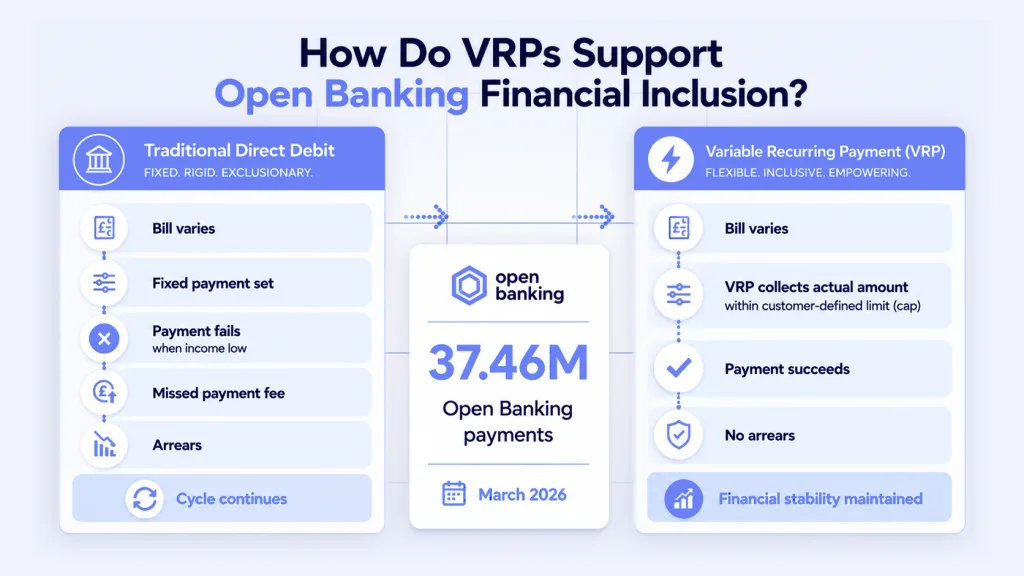
Fixed recurring payments are a primary driver of payment failure for customers on low or irregular incomes.
A fixed Direct Debit of £150 per month for a utility bill fails in months where £150 is not available. The failure triggers a missed payment. The missed payment may trigger a default fee. The default fee makes next month harder. A pattern that starts with a cash flow timing problem compounds into arrears.
Variable recurring payments change this dynamic structurally.
The customer authorises a maximum. The payment initiator collects what is actually owed, within that maximum. If the bill is £120 that month, £120 is collected – not £150. If the customer needs to reduce the maximum cap for a month, they can do so through their bank.
Why this matters for open banking financial inclusion:
- Payment amounts align with actual obligations rather than fixed estimates
- Customers with irregular income can set payment caps that reflect their realistic capacity
- Failed payment rates reduce when payment amounts flex with affordability
- Customers maintain control – they can adjust consent without cancelling the whole arrangement
- Lenders and utility providers see lower arrears rates when payment amounts are genuinely affordable
According to Open Banking Limited’s API performance data, the UK saw 37.46 million Open Banking payments in March 2026, with VRP transactions representing a growing share. The infrastructure exists. The inclusion use case depends on platforms choosing to build flexibility into their payment design.
Open banking financial inclusion isn’t a regulatory aspiration. It’s a product design decision that variable recurring payments infrastructure now makes possible – for any platform choosing to build flexibility into their collections model.
Open Finance for fintechs extends this inclusion logic further – connecting variable income data, spending patterns, and affordability signals into product decisions that VRP alone cannot make.
How Does Finexer Support Variable Recurring Payment Workflows?
What Does Finexer Provide for VRP Infrastructure?
Finexer is not a collections platform. It doesn’t manage Direct Debit mandates, handle arrears, or guarantee payment collection outcomes.
Finexer provides FCA-authorised Open Banking PIS infrastructure – the payment initiation layer that platforms use to build variable recurring payment workflows.
The problem this blog describes – fixed payment constraints creating friction, failure, and exclusion – is a payment architecture problem. VRP addresses it at the infrastructure level. Finexer provides that infrastructure.
What Finexer’s VRP infrastructure supports:
- Consent management – customer-defined parameters: maximum amount, frequency, date range, and purpose
- Variable amount initiation within customer-set consent boundaries
- Revocable consent – customers can modify or cancel at any time through their bank
- Per-payment webhook status – initiated, confirmed, or failed – at each lifecycle stage
- Failure notification with reason code – near-immediately on failed initiation
VRP is not Direct Debit with a variable amount field. The consent is different, the architecture is different, and the relationship between payer and payee is different.
- Usage-based pricing, no setup fees, deployment measured in weeks
- FCA-authorised (FRN 925695)
In B2B Open Banking payments workflows, VRP sits alongside one-off Pay by Bank and Bulk Payout – each handling a different payment pattern within the same PIS infrastructure layer.
What I Feel
Variable recurring payments get presented as a technical upgrade. The marketing tends to lead with “flexible billing” and “no card expiry failures.”
Those are real benefits. They are not the most important one.
The most important change VRPs introduce is consent reversibility at the infrastructure level. A customer can revoke a Direct Debit. It requires calling the bank, waiting for confirmation, and hoping the collection does not run in the window between the call and the cancellation.
A Variable recurring payments consent can be revoked through the customer’s banking app. Immediately. Before the next payment runs.
That level of customer control doesn’t just improve UX. It changes the power dynamic in recurring payment relationships. The customer is not locked in. They are choosing, continuously, to maintain the consent.
Platforms that build variable recurring payments infrastructure on this model – treating VRP consent as a signal of ongoing customer satisfaction rather than a locked mandate – will build better recurring payment relationships than those treating it as a more flexible Direct Debit.
“The platforms that will do most with variable recurring payments aren’t the ones treating VRP as a cheaper Direct Debit. They’re the ones that redesign the customer relationship around revocable consent – where the payment continuing is evidence that the customer is still satisfied, not evidence that they haven’t cancelled yet.” – Ravi, Finexer
Common Use Cases
Fintech Savings Platforms
Savings apps use variable recurring payments via Open Banking sweeping to automate transfers from a customer’s current account when their balance exceeds a threshold. The sweep amount varies with every variable recurring payments transfer – more in months where the customer spends less, less (or zero) in tighter months. One consent setup. Ongoing automated savings using variable recurring payments without a fixed standing order.
Utility and Energy Billing Platforms
Utility providers use VRP to collect actual monthly bill amounts rather than estimated averages. Customers set a maximum cap at consent. The provider collects within it. Winter bills are higher, summer bills lower – without annual reconciliation or credit buildup on fixed Direct Debits.
Lending and Affordability-Focused Products
Lenders offering flexible repayment build variable recurring payments into their product to allow customers to pay more than the minimum when they can, within a maximum they set. This is a variable recurring payments Open Banking example that directly addresses financial inclusion: payment amounts flex with affordability rather than against it.
Subscription and Usage-Based Platforms
SaaS and cloud platforms with variable monthly billing use variable recurring payments to collect actual usage amounts without the advance notice requirement of Direct Debit amount changes. No card expiry failures. No failed payment notifications for customers whose usage spiked beyond their card limit.
What is an example of a variable recurring payment?
The simplest variable recurring payments Open Banking example is an automated savings sweep: a customer authorises a savings app to transfer excess balance each week, up to a maximum they set. The amount varies with the current balance. The customer set consent once. The app initiates transfers within those parameters. No manual action after setup.
Which banks support VRPs in the UK?
The nine largest UK banks – including Barclays, HSBC, Lloyds, NatWest, Santander, Nationwide, Monzo, and others – are required under the CMA9 framework to support VRP sweeping (same-customer transfers between accounts). Commercial VRP (third-party collections) is being rolled out progressively and support varies by institution and use case. The Open Banking Implementation Entity (OBIE) maintains current coverage data at openbanking.org.uk.
What are the main differences between VRP and Direct Debit?
Direct Debit is creditor-controlled – the business sets the collection amount. The customer can cancel but cannot vary mid-cycle. VRP is customer-controlled – the payer defines maximum amount, frequency, and purpose at consent. The initiator can only collect within those parameters. VRP consent is revocable instantly through the customer’s bank app. Direct Debit cancellation requires a bank call and confirmation.
Variable recurring payments. Flexible consent. Open Banking infrastructure
About the Author

Ravi Ranjan
Ravi Ranjan is Co founder & CEO of Finexer