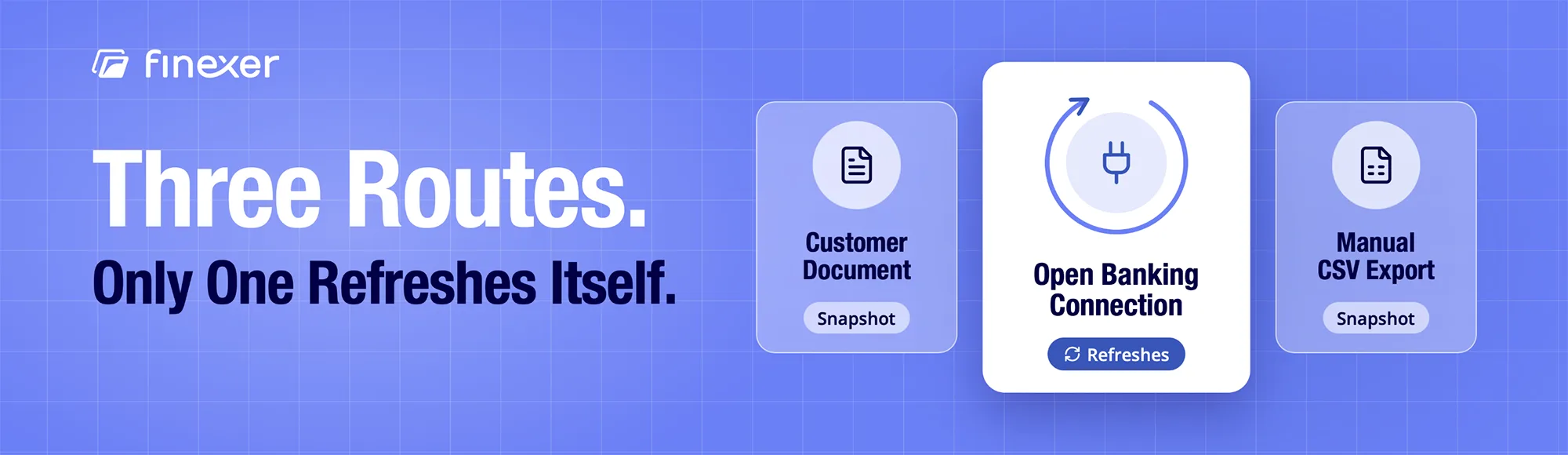
There are three legitimate routes to pull banking transactions with consent: a direct consented Open Banking connection, a customer-supplied document or a manual export. Only Open Banking can refresh transaction data without asking the customer for another file. If recurring reconciliation matters, make that distinction before choosing an integration route.
| Route | Freshness | Structure | Customer Effort | Audit Trail | Refreshes? |
|---|---|---|---|---|---|
| Open Banking AIS | Real-time | Structured | Low after connection | Strong | Yes |
| Customer document | Point-in-time | Varies | Medium | Document record | No |
| Manual export | Point-in-time | Usually CSV | High | File record | No |
Open Banking gives a platform account, balance and transaction data through an authorised Account Information Service Provider (AISP). A statement or CSV gives a snapshot that becomes dated as banking activity changes.
What does consent actually allow?
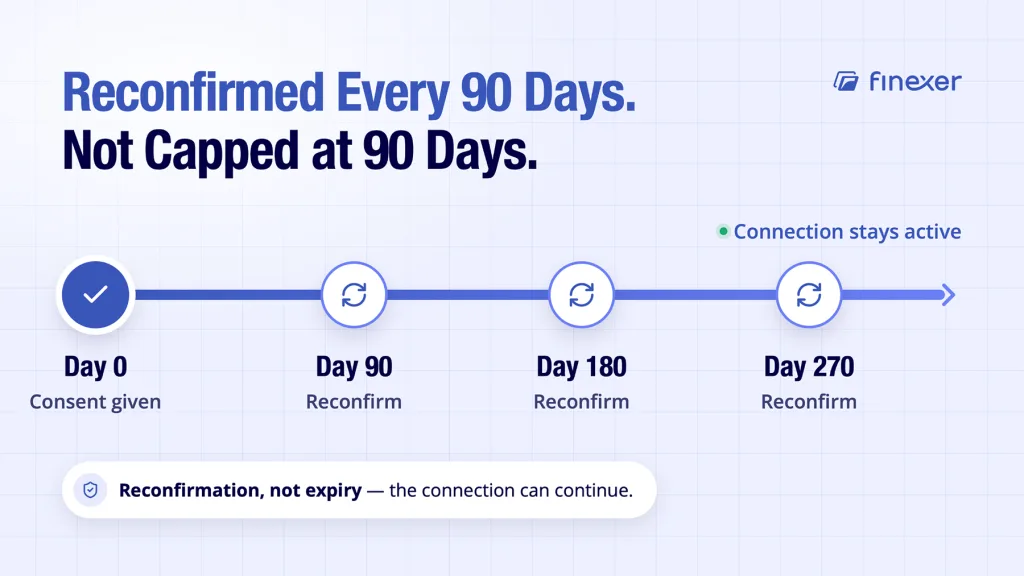
Consent allows an authorised AISP to access the customer’s designated payment accounts and associated transactions for the agreed purpose and duration. The customer must give explicit consent, and the provider must explain what data is requested and why. The agreed scope can cover selected accounts and transaction information, rather than giving unrestricted access to everything a customer holds.
The customer must reconfirm consent with the AISP at least every 90 days for continued access. This does not mean consent is capped at 90 days. Open Banking Standards distinguish reconfirmation from bank re-authentication, which may only be required in permitted circumstances.
How can you pull banking transactions with consent?
Open Banking connects the platform to the bank through an API after the customer authorises access. The bank authenticates the customer, while the AISP receives the permitted banking data.
For accounting SaaS, this changes the workflow. Instead of waiting for customers to download statements, the product can receive transaction information for reconciliation as new activity becomes available. Finexer’s Data product returns real-time transaction data through webhooks.
The UK ecosystem shows the scale of this model. Open Banking Limited reported 18.81 million user connections and 2.81 billion API calls in June 2026.
Why should credential-based scraping be excluded?
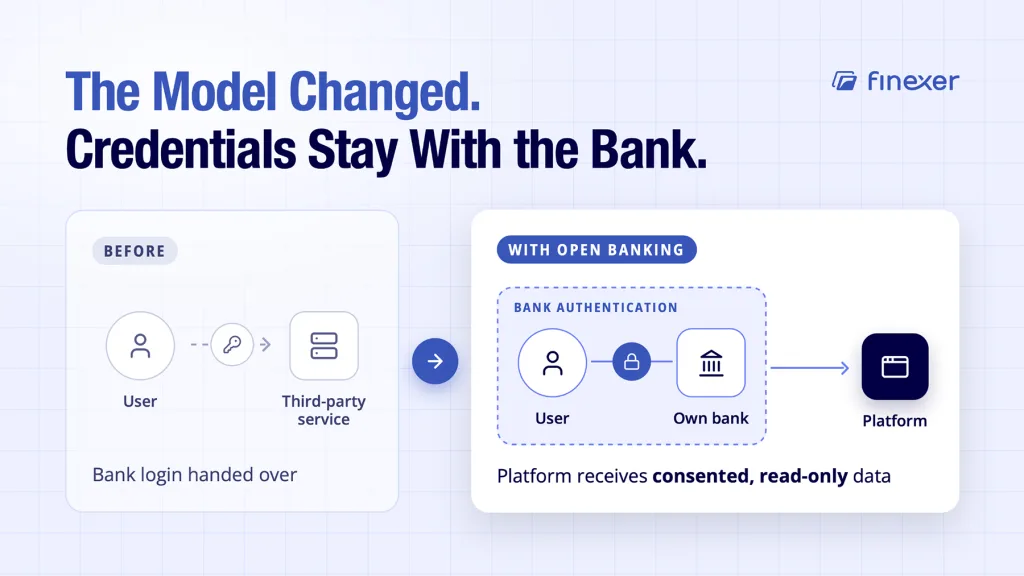
Credential-based scraping is not a fourth route here because Open Banking changed the access model. Customers authenticate with their bank during the authorised connection flow, rather than handing banking credentials to another service.
The regulatory model separates access from payment initiation. AIS provides read-only access to account information, while Payment Initiation Service (PIS) initiates payments. The FCA states that both services require explicit customer consent and appropriate authorisation or registration.
For a platform buyer, the distinction is important. If the requirement is to pull banking transactions with consent, the relevant capability is AIS. PIS does not retrieve transaction data, and AIS does not move money.
How do the main Open Banking providers compare?
For buyers comparing providers, the question is not simply who connects to banks. It is whether coverage, regulatory position, API model and product fit match the platform’s needs.
| Provider | Positioning | Relevant Distinction |
|---|---|---|
| Finexer | UK-focused AIS + PIS infrastructure | Data and payments through one integration |
| TrueLayer | AIS + PIS | Large UK provider with strong developer documentation |
| Yapily | AIS + PIS | Broader European coverage and developer-first positioning |
| Plaid | AIS + PIS | Worldwide institutional reach with a strong US footprint |
| Tink | AIS + PIS | Broad European coverage and data capabilities |
| Salt Edge | AIS + PIS, global | Global Open Banking infrastructure, with AIS and PIS across a broad international footprint |
For a UK platform, broader geographic coverage is not automatically a better fit. A UK-focused provider may suit a product whose customers are primarily UK-based and whose team values UK-specific regulatory and integration considerations.
How does Finexer pull banking transactions with consent?
Finexer’s Data product provides read-only access to customer banking data through Open Banking. The customer authorises the connection with their bank, and Finexer acts as the API layer between the bank and the platform.
For a platform replacing manual statement collection, this means the product can request permitted transaction data rather than repeatedly asking users for files. Finexer supports multiple bank accounts within one consent and provides structured JSON per transaction.
Relevant Finexer details include the following:
- FCA-authorised AISP and PISP, FRN 925695.
- Almost all major UK banks, including high-street, challenger and business accounts.
- Up to 7 years of transaction history where the connected bank supports that depth.
- Real-time banking data delivered through webhooks.
For wider context on banking transaction data, the pillar explains how transaction information fits within the broader AIS model.
If your platform already handles accounting workflows, the commercial decision can sit alongside questions such as those about Xero pricing, when deciding which functions belong in-house.
Teams assessing open banking data sharing can also use that framework to understand consent, data permissions and customer control.
For teams ready to assess the integration, Finexer’s banking data API provides the product route for consented AIS access.
What should a platform choose?
Choose Open Banking AIS for your platform when the product needs current transaction information, structured data and repeat access after customer consent. Use documents or exports when a one-off snapshot is sufficient or when a customer cannot connect through Open Banking.
The key decision is not how to obtain one statement. It should shape product requirements from day one. That distinction affects product design, reconciliation workflows, customer effort and manual handling.
Can a customer upload a bank statement instead?
Yes. A customer-supplied statement can provide a point-in-time record, but it does not create an ongoing connection for refreshed transaction data.
How often must Open Banking consent be reconfirmed?
The customer must reconfirm consent with the AISP at least every 90 days. The consent itself can be longer-lived or ongoing, subject to its agreed terms.
Does AIS move money?
No. AIS provides read-only access to account information. Payment initiation is handled separately through PIS.
Stop building workflows around stale files.
Finexer’s Data product gives platforms consented access to current banking data, so transaction information can feed the product where it is needed.
Explore with AI
About the Author

Ravi Ranjan
Ravi Ranjan is Co founder & CEO of Finexer