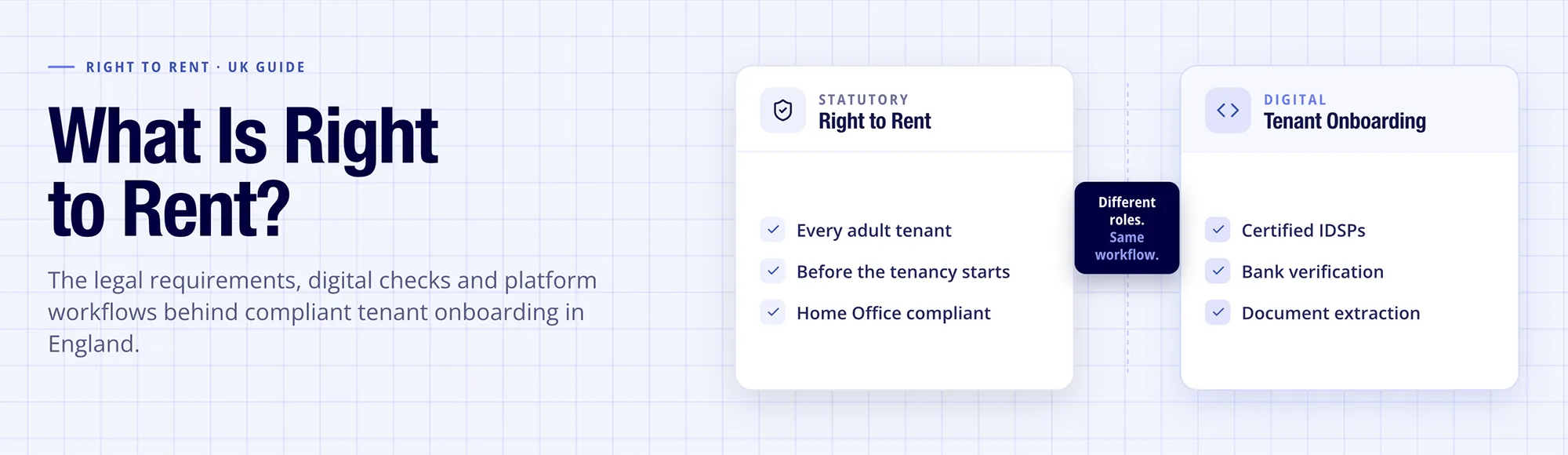
Build Your Complete Tenant Verification Workflow.
Add bank-based verification and document extraction alongside your certified Right to Rent IDSP — one connected, auditable workflow.
Digital tenant onboarding is changing how landlords and lettings platforms handle compliance. One of the most important requirements is Right to Rent, which landlords in England must complete before a tenancy begins.
As more property transactions move online, many teams are asking not only what is right to rent, but also how certified digital checks, audit trails, and broader verification workflows fit together without creating compliance gaps.
TL;DR: What is right to rent, and why does it matter before handing over the keys? In England, landlords must verify every adult tenant’s legal right to rent before a tenancy begins. Drawing on Finexer’s experience supporting digital verification workflows for UK lettings platforms, this guide explains how certified IDSPs perform eligible right to rent checks, where additional verification fits into onboarding, and where Finexer complements, but does not replace, statutory Home Office checks.
“Digital property transactions are becoming the expectation rather than the exception. The important distinction for platforms is understanding which parts of tenant onboarding require certified identity verification and which can be supported by other regulated verification technologies. Mixing those responsibilities creates compliance risk.”
Clare, Regulatory & Compliance Specialist at Finexer
Why Is Right to Rent Becoming a Platform Challenge?
Right to Rent is a legal requirement in England for landlords and letting agents. Before granting a tenancy, they must check that adults have the right to rent a property, using either manual or digital checks depending on the case.
For an independent landlord handling a handful of properties, completing these checks may be straightforward. For lettings platforms processing hundreds of applications each week, the challenge is different. Identity documents, financial checks, verification records and audit trails must all move through a consistent workflow that satisfies legal requirements without slowing the customer journey.
This guide explains what is right to rent, the documents and digital checks involved, how certified Identity Service Providers (IDSPs) fit into the process, and where complementary verification technologies such as Finexer’s bank-based verification and document data extraction support modern tenant onboarding without replacing statutory Right to Rent checks.
Why Does Right to Rent Exist?
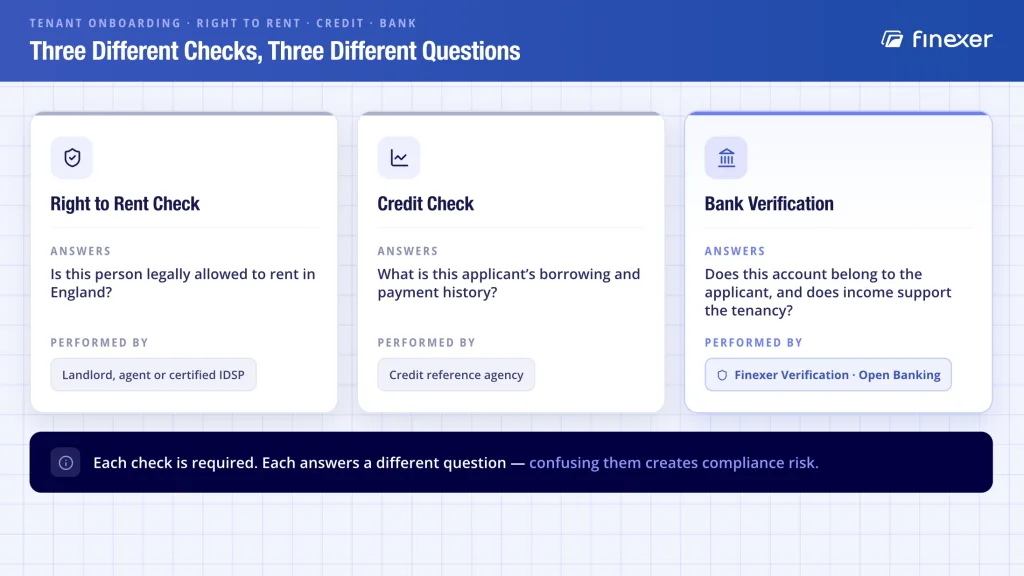
What is right to rent in practice? It is the check that confirms whether a person is legally allowed to rent a property in England. It is different from a credit check, which looks at borrowing risk rather than rental eligibility.
Rather than relying on declarations made by applicants, landlords must complete prescribed identity checks using accepted documentation or approved digital services where applicable.
Landlords must complete checks before occupation and retain sufficient evidence showing that those checks were carried out correctly.
For lettings platforms, the challenge is less about checking documents than building a repeatable, auditable onboarding workflow. Onboarding hundreds of applicants every week while maintaining a complete audit trail becomes considerably more demanding. A right to rent check usually sits alongside identity and rent affordability checks, rather than replacing them.
Finexer supports that workflow through digital verification capabilities such as bank-based name verification and document data extraction, but Finexer is not a certified Home Office IDSP for Right to Rent checks. Certified providers remain necessary for the Right to Rent identity verification element.
The Compliance Challenge Facing Lettings Platforms?
Every tenancy begins with trust, but every tenancy also begins with compliance.
Whether a lettings platform manages hundreds or tens of thousands of tenant applications, every adult occupier must pass the required Right to Rent check before a tenancy starts. Missing that obligation exposes landlords and letting agents to regulatory consequences, while inconsistent record keeping makes future audits harder.
The difficulty is rarely understanding the law. The difficulty is building a workflow that allows property managers, landlords and applicants to complete verification consistently without relying on email attachments, manual document reviews and disconnected systems.
As digital property transactions continue to expand across England, tenant onboarding is increasingly becoming a workflow problem rather than simply an administrative task.
Who Must Carry Out Right to Rent Checks?
The responsibility normally rests with landlords, although many appoint letting agents to carry out checks on their behalf through formal agreements.
The checks apply to every prospective adult occupier aged 18 or over, regardless of nationality.
This is one of the most commonly misunderstood aspects of the legislation. The requirement does not apply only to overseas nationals. Every adult tenant must be checked before the tenancy begins, with the acceptable evidence depending on that individual’s immigration status and documentation.
For platforms building tenant onboarding journeys, this means every adult applicant should enter an identical verification workflow before tenancy creation proceeds.
What Are the Right to Rent Requirements?
The right to rent requirements specify who must be checked, when checks must occur and what evidence landlords can rely upon.
In practice, landlords or their appointed agents must:
- Verify every adult occupier aged 18 or over.
- Complete checks before the tenancy begins.
- Review original documentation or complete an eligible digital verification process.
- Keep evidence demonstrating when and how the check was completed.
- Carry out follow-up checks where required for tenants with time-limited permission to remain.
Accepted evidence varies according to the applicant’s circumstances but commonly includes:
- Valid passport.
- Immigration status documentation.
- Visa documentation.
- Biometric Residence Permit (BRP) or equivalent Home Office digital status where applicable.
The exact documents accepted are determined by Home Office guidance and may change over time, which is one reason many platforms prefer integrating specialist verification providers rather than managing document interpretation internally.
How Does a Traditional Right to Rent Check Work?
The traditional process follows a relatively straightforward sequence.
The applicant presents acceptable documentation. The landlord or agent examines the documents, confirms that photographs and personal details appear consistent, records the date the check took place and stores copies for future reference.
At small portfolio sizes, this process is manageable. Scale introduces complexity: multiple applicants, multiple adult occupants, different immigration statuses, different document types, different expiry dates and different property managers.
Without standardised workflows, consistency becomes difficult to maintain.
What Changed With Digital Right to Rent?
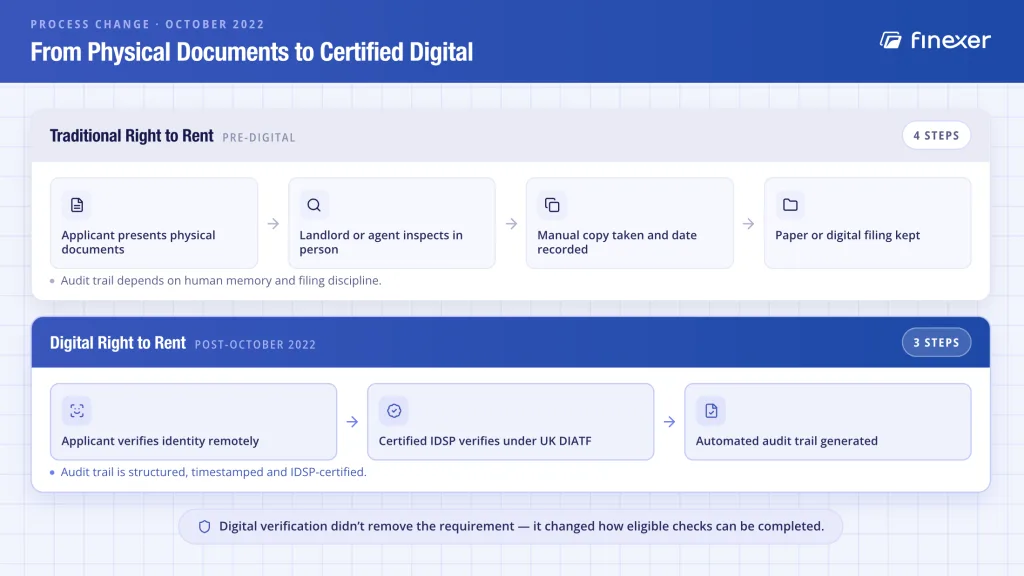
Digital Right to Rent allows eligible identity checks to be completed through certified Identity Service Providers rather than relying solely on physical document inspection.
A significant change arrived in October 2022, when certified providers operating under the UK Digital Identity and Attributes Trust Framework became eligible to conduct digital identity verification for British and Irish passport holders for Right to Rent purposes.
This does not remove compliance responsibilities. Instead, it changes how eligible identity verification may be completed. For lettings platforms, digital verification reduces reliance on manual document handling while producing a more consistent audit trail across large application volumes.
What Is an IDSP?
An Identity Service Provider (IDSP) is an organisation certified to perform digital identity verification for specified government-recognised purposes.
Within Right to Rent workflows, certified IDSPs can verify eligible identities under the Home Office framework using digital identity technology rather than manual document inspection.
Examples of organisations active in this area include:
- TrustID
- Yoti
- Homeppl
Each provides digital identity verification capabilities designed specifically to satisfy the relevant Right to Rent identity requirements. The important point for software builders is that certification matters. Not every verification provider is an IDSP, even if it offers identity verification technology.
The Lettings Platform Challenge
Meeting Right to Rent obligations is only one part of tenant onboarding. Product teams must also design a workflow that brings together multiple verification services without creating friction for applicants or operational overhead for landlords.
In many platforms, identity verification, document collection, affordability checks, bank verification and tenancy records are handled by separate systems. Documents may be uploaded through one interface, financial checks completed through another, and compliance records stored elsewhere. As application volumes grow, these disconnected processes make it harder to maintain a complete audit trail and provide a consistent user experience.
The engineering challenge is therefore one of orchestration rather than compliance alone. Modern lettings platforms increasingly combine specialist providers into a single onboarding journey, allowing each verification technology to perform the task it is designed for while presenting applicants with one coherent workflow.
Digital verification technologies support this architecture when each service is used for its intended purpose. Certified IDSPs perform statutory Right to Rent identity verification, while complementary services such as bank verification, document data extraction and financial verification automate adjacent stages of the onboarding process.
How Is UK Government Policy Shaping Digital Property Verification in 2026?
The UK Government’s June 2026 announcement on accelerating digital homebuying reinforced a broader direction of travel: property transactions are becoming more digital, with greater emphasis on interoperable identity verification, trusted digital credentials and reusable verification across the property lifecycle.
Although homebuying reforms and Right to Rent are separate regulatory areas, they reflect the same operational challenge facing PropTech platforms.
Identity verification can no longer be treated as a standalone task completed through email attachments and manual document reviews. Instead, platforms increasingly need structured onboarding workflows that produce reliable audit trails while integrating multiple verification services into a single user journey.
For product managers, this means thinking beyond individual compliance checks and designing onboarding processes that remain consistent from tenant application through tenancy management.
How Digital Verification Fits into Tenant Onboarding ?
Digital verification combines several independent checks into a single onboarding workflow.
A typical tenant journey may include the following:
- Identity verification through a certified IDSP for Right to Rent.
- Document validation and extraction.
- Financial verification.
- Bank account verification.
- Affordability assessment.
- Tenancy creation.
- Ongoing property management.
Each component answers a different compliance or operational question.
Identity verification answers: “Is this person who they claim to be?”
Financial verification answers: “Does their financial information support the tenancy application?”
Bank verification answers: “Does this bank account belong to the applicant?”
Confusing these different checks creates unnecessary compliance risk because each serves a distinct purpose.
Platforms looking to incorporate Open Banking verification UK into tenant onboarding can combine bank-based verification with identity workflows, reducing manual data entry while maintaining a structured audit trail. For broader property operations, rental property accounting software UK can sit alongside verification tools to keep tenancy, payments, and accounting data connected.
Where Finexer Verification Fits?
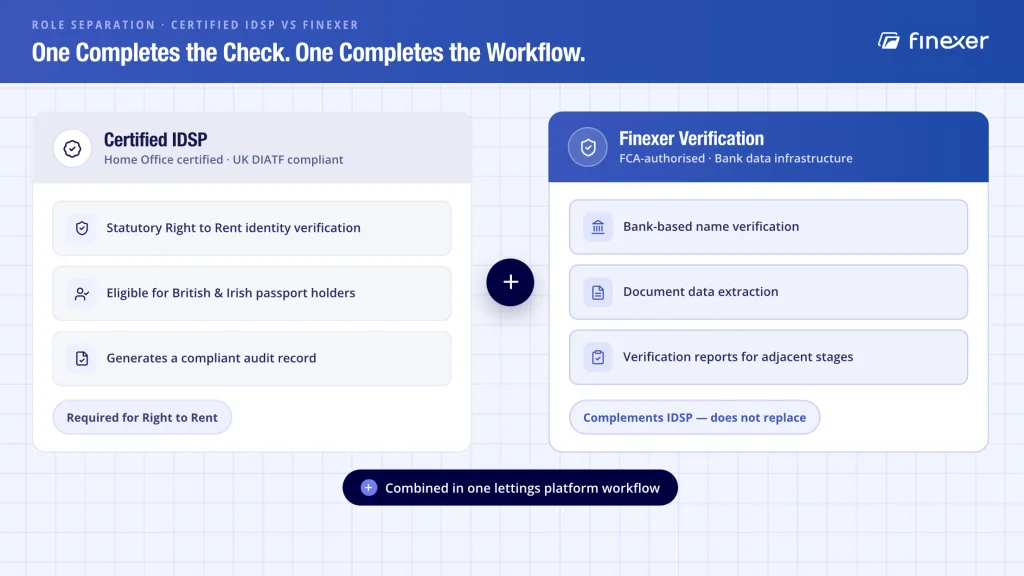
Digital checks can reduce manual document handling, but they still need the right workflow, audit trail, and decision record. The aim is to keep the process compliant while reducing admin. Finexer Verification supports digital tenant onboarding by providing income verification capabilities that complement, not replace, Home Office Right to Rent identity checks.
Finexer is not a certified Identity Service Provider (IDSP) for Home Office Right to Rent checks and should never be presented as one.
Instead, Finexer provides a digital verification layer that platforms can integrate alongside certified identity providers.
For example, a lettings platform might use Finexer to support the following:
- Bank-based name verification
- Document data extraction
- Verification reports
- Bank account holder verification
These capabilities help automate parts of the broader tenant onboarding journey while leaving the statutory Right to Rent identity verification to certified providers.
Platforms evaluating bank account verification UK solutions often combine this capability with their existing onboarding flow to reduce manual verification work after identity has already been confirmed.
Which Providers Handle the Right to Rent IDSP Requirement?
Certified Identity Service Providers perform the statutory digital identity verification required for eligible Right to Rent checks.
Examples include:
- TrustID
- Yoti
- Homeppl
These organisations are certified under the UK Digital Identity and Attributes Trust Framework to perform eligible digital Right to Rent identity verification.
Finexer serves a different role. Rather than replacing certified IDSPs, Finexer supports the wider onboarding workflow by supplying verification capabilities that platforms can integrate before and after identity verification.
Understanding this separation allows product teams to build compliant onboarding journeys without assigning regulatory responsibilities to the wrong technology provider.
A Typical Lettings Platform Workflow
Modern tenant onboarding increasingly combines several specialist services rather than relying on one provider for every compliance requirement.
| Stage | Technology / Provider |
|---|---|
| Tenant application | Lettings platform |
| Right to Rent identity verification | Certified IDSP (e.g. TrustID, Yoti or Homeppl) |
| Document extraction | Finexer Verification |
| Bank-based name verification | Finexer Verification |
| Financial verification | Income verification software |
| Affordability assessment | Rent affordability check |
| Property management and accounting | Lettings platform + rental property accounting software |
This layered approach allows every specialist service to perform the task it was designed for while giving applicants a smoother onboarding experience
Where Finexer Supports Platform Builders
If your platform still relies on manual document uploads, spreadsheet-based verification records and disconnected onboarding tools, the challenge is usually not one missing feature. It is the absence of a connected verification workflow.
Finexer Verification helps platforms integrate bank-based verification and document data extraction into tenant onboarding without replacing certified Right to Rent providers.
Relevant capabilities include:
- FCA-authorised verification infrastructure.
- Bank-based name verification.
- Document data extraction.
- Verification reports.
- White-label integration for platform builders.
- 3–5 weeks onboarding support.
- 99% UK bank coverage.
The statutory Right to Rent identity verification remains the responsibility of a certified IDSP where digital checks are used. Finexer complements that process by supporting adjacent verification activities within the wider onboarding journey.
What are the Right to Rent requirements?
The Right to Rent requirements include checking every adult occupier before the tenancy starts, reviewing acceptable evidence of their right to reside, recording the check and retaining evidence for compliance purposes.
Can Right to Rent checks be completed digitally?
Yes. Eligible applicants can complete digital Right to Rent identity verification through certified Identity Service Providers operating under the UK Digital Identity and Attributes Trust Framework.
Is Finexer a certified Right to Rent IDSP?
No. Finexer is not a certified Home Office Identity Service Provider for Right to Rent checks. Finexer provides a digital verification layer that supports broader tenant onboarding workflows alongside certified IDSPs.
What documents are accepted for Right to Rent?
Accepted evidence depends on the applicant’s circumstances but commonly includes a valid passport, visa documentation, immigration status documentation and Biometric Residence Permit (BRP), together with other documents recognised in current Home Office guidance.
How do lettings platforms automate tenant verification?
Most modern platforms combine several specialist technologies. Certified IDSPs perform the statutory Right to Rent identity verification, while complementary services such as Finexer Verification support bank-based verification, document data extraction and other onboarding activities.
Building digital tenant onboarding?
Finexer’s Verification infrastructure supports bank-based verification and document workflows alongside certified Right to Rent providers within your lettings platform.
Explore with AI
About the Author

Clare Pearson
Clare Pearson is a senior payments professional with extensive experience across the global financial services and payments industry. She specialises in Open Banking, payment infrastructure, and financial technology transformation, with expertise spanning product delivery, operational strategy, regulatory compliance, and large-scale payments programmes. Clare currently serves as a Non-Executive Director at Finexer and a panel member for the Payment Systems Regulator (PSR), advising on the development of payment systems policy and innovation