
HMRC is rolling out Making Tax Digital for ITSA from April 2026. Manual spreadsheets, PDFs, and CSV uploads won’t meet quarterly digital reporting requirements whilst platforms using bank-verified transaction data solve this immediately.
Accountants, landlords, and sole traders face identical pain: chasing bank statements quarterly, manually categorising thousands of transactions, and verifying income without bank-verified sources. Making Tax Digital for ITSA requires ongoing access to structured financial records through compliant infrastructure, not annual one-off spreadsheet exports that break under quarterly frequency.
Understanding Making Tax Digital for ITSA requirements now enables platforms to build compliant infrastructure before the April 2026 deadline.
What Is Making Tax Digital for ITSA?
Making Tax Digital for Income Tax Self Assessment mandates quarterly digital updates to HMRC replacing annual self-assessment. Sole traders and landlords earning above £50,000 annually must submit income and expense records digitally through HMRC MTD ITSA software.
The regulation requires digital record-keeping and API-based submission. Manual processes fail under quarterly frequency.
| Requirement | Manual Approach | Making Tax Digital for ITSA |
|---|---|---|
| Reporting frequency | Annual | Quarterly |
| Data submission | PDF / CSV uploads | API-based digital submission |
| Record-keeping | Spreadsheets | Digital software with bank connectivity |
| Transaction verification | Manual categorisation | Bank-verified automated feeds |
| Income tracking | Year-end reconciliation | Ongoing real-time visibility |
Platforms need automated data collection infrastructure, not spreadsheets.
Platforms need automated data collection infrastructure, not spreadsheet templates. Making Tax Digital for ITSA compliance depends on proper infrastructure supporting quarterly frequency.
Understanding Making Tax Digital for Income Tax requirements
Why Do Accountants Struggle with Making Tax Digital for ITSA Compliance?
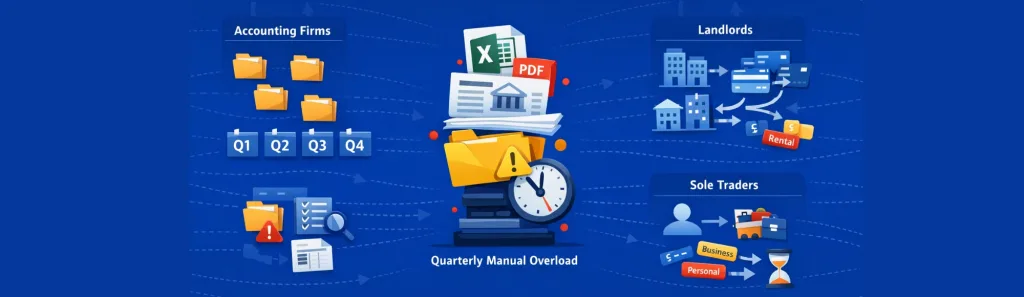
Quarterly reporting creates operational bottlenecks. Traditional workflows relied on annual bank statement collection. Making Tax Digital for ITSA requires continuous transaction visibility that manual processes cannot provide.
Specific pain points emerge across practice types:
For accounting firms:
- Chasing clients for quarterly bank statements consumes hours weekly
- Manual transaction categorisation across multiple client accounts introduces errors
- Income verification without bank-verified data creates audit risk
- Incomplete financial records delay HMRC submissions and create client friction
- Client onboarding requires explaining ongoing data access needs
For landlords using Making Tax Digital for Income Tax Self Assessment:
- Rental income flows through multiple bank accounts requiring reconciliation
- Property expense categorisation spans diverse transaction types
- Manual tracking of tenant payments becomes unsustainable quarterly
- Mixed personal and rental transactions need separation
For sole traders:
- Business and personal account transactions require ongoing classification
- Cash flow tracking needs real-time visibility, not annual snapshots
- Expense categorisation accuracy matters for quarterly submissions
Manual reconciliation doesn’t scale under quarterly deadlines. Platforms need infrastructure delivering ongoing bank-verified transaction access.
Read MTD for landlords specific requirements
What Should HMRC MTD ITSA Software Actually Provide?

Platforms evaluating MTD for ITSA compliance infrastructure should prioritise capabilities over features:
Bank-verified transaction access – Direct connectivity to client bank accounts through consent-based open banking, not manual uploads
Historical transaction data – Access to up to 7 years of transaction history for baseline income analysis and trend identification
Ongoing data feeds – Continuous transaction monitoring enabling quarterly reporting without manual intervention
Structured outputs – Categorised transaction data ready for accounting platform consumption, not raw bank feeds
FCA-authorised infrastructure – Compliance through properly regulated AIS connectivity reducing firm liability
HMRC MTD ITSA software cannot operate on spreadsheet exports. Quarterly reporting frequency under Making Tax Digital for ITSA mandates automated data pipelines, not manual processes.
Explore MTD-compliant software requirements
What Common Mistakes Do Platforms Make Preparing for Making Tax Digital for ITSA?
Platforms building HMRC MTD ITSA software capabilities encounter predictable implementation issues:
Enriching data after storage instead of at ingestion – Platforms storing raw bank transactions then categorising retrospectively create reconciliation nightmares. Making Tax Digital for ITSA workflows require enriched data at point of capture.
Relying only on manual client data uploads – Asking clients to export bank statements quarterly introduces delays and incompleteness. Consent-based automated access eliminates upload dependency.
No historical backfill capability – Platforms lacking historical transaction access cannot establish income baselines for affordability assessment or trend analysis.
Inadequate consent audit trails – FCA compliance requires documented user consent for ongoing bank data access. Platforms without proper consent management inherit regulatory risk.
Building bank connectivity in-house – Internal development teams underestimate complexity of maintaining connections to hundreds of UK banks. Infrastructure providers handle this operational burden.
Successful Making Tax Digital for ITSA implementations prioritise automated infrastructure over manual workflows.
How Does Finexer Support Making Tax Digital for ITSA Workflows?
Finexer provides the bank data layer enabling platforms to build MTD for ITSA capabilities:
- Consent-based access to client bank accounts through FCA-authorised infrastructure
- Transaction data from 99% of UK banks covering client account diversity
- Historical transaction access up to 7 years supporting income verification
- Structured transaction feeds delivered via APIs for accounting platform integration
- Ongoing consent management ensuring continuous data access for quarterly reporting
- 3-5 weeks of onboarding assistance ensuring integration aligns with compliance timelines
Finexer does not perform tax calculations or HMRC submissions. The platform enables accountants and tax software providers to access verified financial data supporting MTD for ITSA compliance.
See how platforms implement Making Tax Digital infrastructure
Which Platforms Need HMRC MTD ITSA Software Infrastructure?
Accounting firms – Practices serving landlords and sole traders requiring automated client data collection
Tax software providers – Platforms adding HMRC MTD ITSA software submission capabilities needing verified data
Practice management tools – Software enabling accountants to collect financial data and prepare submissions
Fintech platforms – Applications building accounting features for self-employed users
Platforms need infrastructure providing continuous access to client financial data for quarterly compliance. Making Tax Digital for ITSA readiness separates manual workflows from automated solutions.
Follow HMRC’s MTD for ITSA implementation steps
What I Feel Like
After working with accounting platforms and tax software providers preparing for Making Tax Digital for ITSA, the difference between successful and struggling implementations is clear.
Successful platforms treat bank data access as infrastructure they build upon. They invest engineering effort in HMRC API integration, client onboarding flows, and tax calculation logic. Not in building bank connectivity or managing data consent.
Struggling platforms underestimate data access complexity. They assume bank statements can be collected quarterly through email requests. The operational burden becomes client communication and manual data entry, not software development.
Making Tax Digital for ITSA compliance isn’t solved by software alone. It requires continuous access to verified transaction data. Platforms relying on manual processes discover quarterly deadlines create unsustainable workload.
How do I set up Making Tax Digital?
Register for MTD through HMRC, choose compatible software, connect bank accounts for automated data collection, and submit quarterly updates digitally.
What are the disadvantages of Making Tax Digital?
Initial setup requires software adoption and learning, quarterly reporting increases administrative frequency compared to annual filing, and businesses need compatible technology infrastructure.
Can I use Excel for Making Tax Digital for Income Tax?
No, Excel alone doesn’t meet MTD requirements as HMRC mandates API-based digital submission through approved software, though Excel can supplement record-keeping.
How to file self-assessment tax online?
Use HMRC-recognised MTD software connecting to your bank accounts, submit quarterly digital updates through the platform, then complete final annual declaration via HMRC portal.
Does HMRC MTD ITSA software work with all UK banks?
Platforms using open banking infrastructure with 99% UK bank coverage ensure compatibility with virtually all client accounts. Making Tax Digital for Income Tax Self Assessment requires broad bank connectivity supporting diverse client portfolios regardless of banking provider.
Ready for MTD ITSA Compliance?
See how Finexer enables platforms to access bank-verified data for Making Tax Digital
Book Demo NowAbout the Author

Ravi Ranjan
Ravi Ranjan is Co founder & CEO of Finexer