Table of Contents
UK platforms building reconciliation, verification, and financial reporting features need reliable API to get bank transactions without manual statement uploads or screen scraping. Accounting software, lending platforms, and payroll systems require continuous access to transaction data that doesn’t break during critical workflows.
Most platforms face operational failures when transaction APIs disconnect unexpectedly. Consent expiry disrupts data feeds without warning. Screen scraping delivers incomplete data that creates reconciliation errors. Manual fallback processes destroy user experience and prevent scaling.
This blog explains how platforms evaluate transaction API infrastructure, what causes connectivity failures, and how reliable open banking infrastructure eliminates operational bottlenecks that break financial features.
Key Takeaways
What problem does this solve?
Platforms cannot access bank transactions reliably when APIs depend on screen scraping or require manual statement uploads from users.
Why does infrastructure quality matter?
Unreliable transaction APIs create feature failures. Reconciliation breaks. Verification workflows become manual. Platform reliability suffers when data feeds disconnect.
What breaks with poor providers?
Screen scraping stops working during bank updates. Consent management fails silently. Transaction data arrives incomplete. Features requiring financial data become unreliable.
What should platforms evaluate before integration?
FCA authorisation status, UK bank coverage, API reliability metrics, consent lifecycle management, transaction data completeness, historical access depth.
Where does Finexer fit operationally?
Finexer provides FCA-authorised infrastructure enabling API to get bank transactions securely. Platforms integrate once and access transaction data through open banking. Platforms build reconciliation, verification, and reporting features on top.
Why do platforms need an API to get bank transactions?
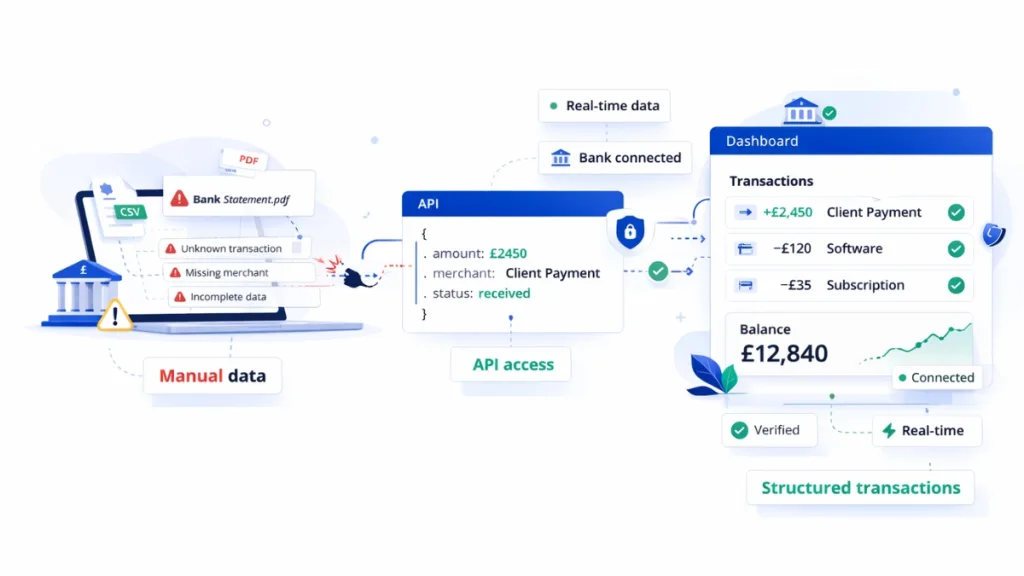
Platforms cannot build financial features without transaction-level bank data access. Reconciliation requires matching payments against invoices. Verification needs income analysis from transaction history. Financial reporting depends on current account activity.
Manual statement uploads prevent automation. Users download PDFs from multiple banks. Different file formats require custom parsing. Reconciliation becomes manual when transaction data needs user intervention to access.
Screen scraping creates fragile connections that break during bank updates. Authentication logic changes without notice. Transaction feeds deliver incomplete data. Engineers spend time maintaining bank-specific connection code instead of building features.
Generic data aggregators lack platform-specific requirements. Accounting platforms need detailed merchant information for categorisation. Lending platforms require complete transaction history for underwriting. Payroll platforms need real-time balance verification before payment runs.
Who needs transaction API infrastructure?
Accounting platforms need:
- Continuous transaction feeds for automated reconciliation
- Detailed merchant data for expense categorisation
- Real-time balance updates for cash flow reporting
- Historical transactions for past period matching
Lending platforms require:
- Complete transaction history for income verification
- Cash flow analysis for underwriting decisions
- Real-time account monitoring during loan lifecycle
- Pattern analysis for credit risk assessment
Payroll platforms depend on:
- Account balance verification before payment execution
- Transaction matching for reconciliation
- Real-time confirmation of salary payments
- Historical data for audit purposes
Lawtech platforms use:
- Transaction history for source of funds verification
- Complete account records for compliance checks
- Audit trails for client money handling
- Real-time monitoring for suspicious activity
PropTech platforms leverage:
- Tenant income verification from transaction patterns
- Rent affordability assessment from cash flow analysis
- Payment reliability checks from historical data
- Real-time account monitoring for rent payments
What happens when transaction APIs fail?
Reconciliation features stop working when transaction feeds break. Finance teams cannot match payments against invoices. Month-end close extends while teams wait for manual statement uploads.
Verification workflows become manual when the API to get bank transactions disconnects. Lending platforms cannot assess affordability automatically. Onboarding delays increase when income verification requires manual review.
Financial reporting shows stale data when transaction updates stop arriving. Users see outdated balances that lead to incorrect business decisions. Platform reliability decreases when features requiring current data fail.
Support costs increase when transaction connectivity requires constant maintenance. Engineers troubleshoot bank-specific failures instead of building product features. User complaints grow about broken features and unexpected re-authentication requests.
Competitive disadvantage emerges when platforms offering reliable transaction access win clients. Users abandon platforms requiring manual processes that modern alternatives automate.
What infrastructure prevents transaction API failures?
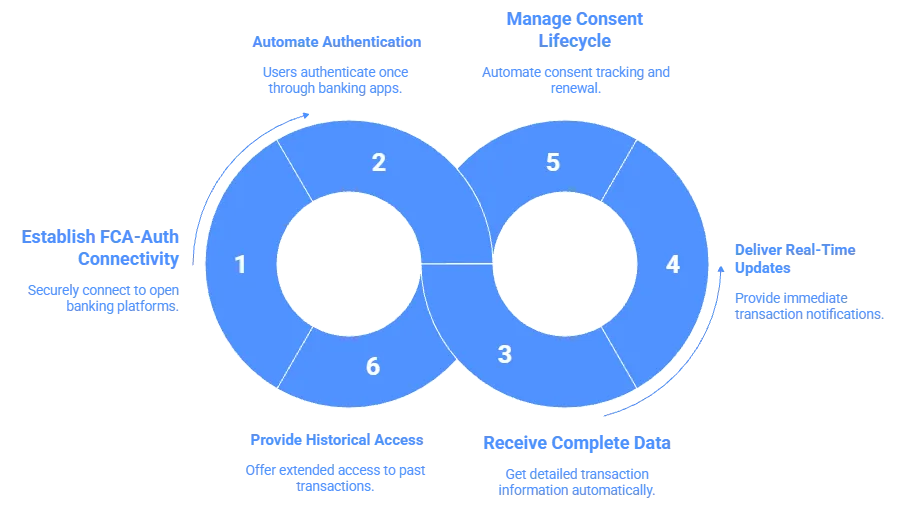
- Platforms need FCA-authorised open banking connectivity providing secure transaction access. Each platform user authenticates bank accounts once through banking apps. Platforms receive transaction data automatically without managing authentication complexity.
- Transaction feeds must deliver complete data including merchant details, amounts, dates, and reference information. Generic descriptions prevent accurate categorisation. Incomplete data creates reconciliation errors that require manual intervention.
- Real-time updates are essential when business decisions depend on current information. Batch-only feeds deliver yesterday’s data that leads to incorrect financial reporting. Platforms need continuous transaction streams with immediate notifications.
- Consent lifecycle management must be automated. Platforms cannot ask users to re-authenticate repeatedly without destroying experience. Permission tracking needs visibility into expiry dates with proactive renewal.
- Historical transaction access should extend beyond 90 days. Reconciliation often requires matching older invoices. Underwriting decisions improve with complete financial history. Short retention limits prevent comprehensive analysis.
According to banking API integration guidance, reliable infrastructure eliminates operational overhead that prevents platform scaling.
How does Finexer enable reliable transaction API access?
Finexer provides FCA-authorised infrastructure enabling secure API to get bank transactions for UK platforms.
Key capabilities:
- 99% UK bank coverage
- FCA-authorised infrastructure
- Real-time webhooks
- Up to 7 years historical data
- Usage-based pricing
- White-label ready
- 2-3x faster integration
- 3-5 weeks onboarding support
- Saves up to 90% on transaction costs
Platforms integrate transaction APIs once through REST endpoints. Users authenticate accounts through secure open banking flows. Platforms receive structured transaction data in consistent JSON format regardless of source bank.
Real-time webhooks notify platforms when new transactions occur. Balance updates arrive immediately. Transaction feeds continue automatically without polling or manual refresh.
Consent management is automated with clear expiry tracking. Users receive notifications before permissions expire. Re-authentication happens smoothly without disrupting active features.
Historical transaction data extends up to seven years depending on bank support. Platforms access complete financial history for comprehensive analysis without manual statement collection.
Transaction data includes structured fields enabling accurate categorisation. Merchant names, transaction types, and reference information arrive consistently formatted across all UK banking institutions.
For platforms requiring comprehensive transaction data, reliable infrastructure removes operational bottlenecks.
Transaction API evaluation checklist
| Evaluation Criteria | Why It Matters | What to Look For |
|---|---|---|
| FCA authorisation | Unauthorised providers create compliance exposure | Direct FCA authorisation for account information services |
| Bank coverage | Users cannot connect unsupported accounts | 99% UK coverage including challengers and building societies |
| API reliability | Connection failures break product features | Proven uptime metrics with real-time monitoring |
| Transaction completeness | Missing data creates reconciliation errors | Structured fields with merchant details and references |
| Real-time updates | Batch feeds deliver outdated information | Webhook notifications for immediate transaction visibility |
| Historical depth | Limited access prevents comprehensive analysis | 7-year transaction retrieval capability |
Platforms building transaction API infrastructure should confirm providers support their specific use cases.
What we see in practice
Most platforms underestimate the operational cost of maintaining transaction API connectivity. Screen scraping works initially but creates constant overhead when authentication breaks across different banks.
Bank connection failures increase during high-volume periods. Platforms discover reliability problems when user numbers grow and edge cases emerge. Support costs increase faster than revenue when teams troubleshoot broken feeds constantly.
Consent expiry creates unexpected user friction when platforms lack proper tracking. Users receive re-authentication requests that damage experience and increase abandonment rates.
Transaction data quality varies significantly by provider. Incomplete merchant information prevents accurate categorisation. Missing reference fields create reconciliation errors that require manual intervention.
Platforms that scale successfully treat transaction API infrastructure as foundational capability. They focus engineering on business logic and user experience rather than maintaining bank connectivity.
For platforms requiring enriched transaction data, reliable infrastructure determines feature quality.
Common use cases

Accounting platforms:
- Automated reconciliation matching payments against invoices
- Expense categorisation using merchant transaction details
- Cash flow reporting from real-time balance updates
- Multi-entity consolidation across client accounts
Lending platforms:
- Income verification from transaction pattern analysis
- Cash flow assessment for underwriting decisions
- Credit risk scoring from spending behaviour
- Real-time account monitoring during loan lifecycle
Payroll platforms:
- Balance verification before salary payment execution
- Payment reconciliation against executed transfers
- Audit trail maintenance for payroll compliance
- Multi-currency payment tracking for global teams
Lawtech platforms:
- Source of funds verification for AML compliance
- Client account monitoring for regulatory requirements
- Transaction audit trails for client money handling
- Suspicious activity detection from pattern analysis
PropTech platforms:
- Tenant income verification from salary deposits
- Rent affordability assessment from spending patterns
- Payment reliability checks from historical data
- Real-time rent payment tracking and confirmation
What is an API to get bank transactions?
An API to get bank transactions enables platforms to retrieve bank account transaction data programmatically through secure open banking connections. Platforms access structured transaction feeds without manual statement uploads.
How do platforms access bank transactions via API?
Platforms integrate FCA-authorised API for bank transactions through REST endpoints. Users authenticate accounts via banking apps. Platforms receive transaction data automatically with user consent.
Why do platforms need transaction API access?
Features requiring financial data fail without reliable transaction access. Reconciliation, verification, and reporting depend on continuous transaction feeds that manual processes cannot provide at scale.
What makes transaction API infrastructure reliable?
Reliable infrastructure provides consistent transaction feeds, automated consent management, complete transaction data, comprehensive UK bank coverage, and real-time updates without frequent disconnections.
Can platforms build transaction API connectivity internally?
Platforms can build business logic and features, but bank connectivity requires FCA authorisation. Most platforms use authorised infrastructure providers rather than applying for their own licenses.
Access reliable API to get bank transactions with FCA-authorised infrastructure and comprehensive UK bank coverage.
About the Author

Ravi Ranjan
Ravi Ranjan is Co founder & CEO of Finexer