
Still relying on payslips and PDFs for income checks?
Finexer delivers verified bank transaction data – accurate, consent-based, API-ready.
Payslips can be edited. PDFs can be fabricated. Employer letters take days to arrive.
For PropTech platforms, payroll tools, and LawTech workflows, none of these methods provide the verified income visibility that financial assessment actually requires. Traditional verification of income creates a structural accuracy problem at the point of decision.
At Finexer, I work with UK PropTech platforms, payroll infrastructure teams, and LawTech tools that have moved away from document-based income checks. The shift to Open Banking-connected income verification APIs changes the quality of financial data available for assessment – not just the speed of collecting it.
This blog is written for Product Leads, Finance Operations teams, and Compliance teams evaluating income verification api options for affordability assessment, onboarding, and financial verification workflows. It explains why traditional verification of income fails modern platforms and how bank transaction data provides the verified income signals that financial decisions require.
TL;DR
Traditional income verification relies on unverifiable documents. An income verification api using Open Banking AIS provides bank-verified transaction data for financial assessment – identifying salary deposits, income patterns, and financial behaviour directly from source. Finexer provides FCA-authorised income verification api infrastructure covering 99% of UK banks for PropTech, payroll, LawTech, and accounting platforms.
Key Takeaways
Why do traditional income verification methods fail financial assessment workflows?
Payslips, PDFs, and employer letters cannot be verified at source. They are static, easily altered, and provide no visibility into ongoing financial behaviour beyond the submission date.
What does an income verification api provide that documents cannot?
Bank-verified transaction data identifying salary deposits, income frequency, spending patterns, and financial stability signals – drawn directly from the applicant’s live bank account with consent.
How does Open Banking improve verification of income accuracy?
Open Banking AIS retrieves transaction records directly from the bank. Income signals are identified from real financial activity, not self-reported documents – reducing fraud risk and improving assessment accuracy.
Which platforms benefit most from an income verification api?
PropTech platforms running affordability checks, payroll tools verifying contractor income, LawTech platforms conducting source-of-funds assessments, and accounting platforms verifying client financial positions.
How does Finexer enable income verification for UK platforms?
Finexer provides FCA-authorised Open Banking AIS infrastructure that delivers verified bank transaction data for income pattern identification, salary detection, and financial behaviour analysis via API.
Why Does Traditional Verification of Income Fall Short?

Document-based income verification was built for a different era. It assumes applicants submit accurate records and that those records reflect current financial reality. Neither assumption holds reliably.
Payslips and bank statements are part of any income verification workflow. But document-only approaches carry a structural gap – a PDF cannot confirm whether the figures it shows match actual account activity.
Beyond accuracy risk, the structural problems compound:
- Documents are static snapshots – they show one moment, not ongoing income stability
- Employer letters become outdated the moment employment changes
- Self-employed income is inconsistent and poorly represented by single documents
- Multiple income sources are fragmented across different document types
- Gaps in financial history are invisible without continuous transaction data
“Documents confirm what was reported. Verified bank transaction data confirms what actually occurred. Both together give platforms a complete picture.” – Ravi, Finexer
How income and balance verification works through Open Banking provides useful context on why transaction-level data changes income assessment accuracy.
What Does an Income Verification API Actually Provide?

An income verification api using Open Banking AIS does not just speed up document collection. It replaces the document entirely with verified bank transaction data.
For financial assessment workflows, this changes what is detectable:
Salary and Income Signal Identification
Regular salary deposits are identifiable from transaction patterns. Frequency, amount, and source consistency can all be detected from bank transaction history. Platforms can identify primary income, secondary income, and benefit payments as distinct signals. This is not possible from a single payslip submission.
Financial Behaviour Analysis
Bank transaction data reveals spending patterns alongside income. Outgoings relative to income, recurring financial commitments, and cash flow behaviour are all visible from the same data feed. Teams can assess affordability from actual financial behaviour, not stated figures.
Continuous Verification of Income
A document submitted at onboarding reflects one moment. An income verification api connected to live bank data provides ongoing visibility. For longer assessment cycles or ongoing financial monitoring, continuous transaction feeds remove the need for repeat document submissions.
How Does the Consent Flow Work for Income Verification APIs?
Understanding the consent process matters for platforms building applicant-facing workflows. Open Banking income vThe consent process matters for platforms building user-facing verification workflows. Open Banking income verification uses a structured consent flow.
- Platform initiates a consent request via the income verification api
- User is redirected to their bank’s authentication screen
- Strong Customer Authentication is completed – via mobile banking app or biometric
- User grants consent for specific data access – transaction history, account balances, or both
- Verified transaction data is returned to the platform via API
- Consent remains active for the agreed period and can be revoked instantly
Consent is granular. Users specify exactly which accounts and data types are shared. Revocation is instant – platforms lose access to new data immediately.
Finexer’s verification infrastructure supports white-label consent flows-allowing platforms to maintain their own branding throughout the authentication process.
How Should Platforms Evaluate an Income Verification API?
| Criteria | Why It Matters | What to Look For |
|---|---|---|
| UK Bank Coverage | Incomplete coverage creates income data gaps for users with smaller banks | 99% UK bank coverage; CMA9 and beyond; consistent data across institutions |
| Transaction History Depth | Income pattern analysis requires sufficient historical data to identify consistency | Up to 7 years of transaction history; configurable lookback periods |
| Income Signal Detection | Raw transaction data needs structured income identification to be useful | Salary deposit detection; income frequency analysis; multi-source income support |
| Consent and SCA Compliance | UK regulatory requirements mandate explicit, granular consent with SCA | SCA-compliant flows; granular and revocable permissions; FCA-authorised access |
| White-Label Capability | Branded consent flows maintain user trust and platform consistency | White-label authentication screens; customisable consent journey |
| Integration Speed | Faster deployment reduces time-to-value for product teams | 3-5 weeks onboarding support; comprehensive documentation |
How Does Finexer Enable Income Verification API for UK Platforms?
Finexer provides FCA-authorised Open Banking AIS infrastructure that gives PropTech platforms, payroll tools, LawTech teams, and accounting platforms direct access to verified bank transaction data for income verification workflows.
Key capabilities:
- Verified bank transaction data from 99% of UK bank accounts via AIS connectivity
- Up to 7 years of transaction history for income pattern analysis and affordability assessment
- Real-time transaction feeds via webhooks for continuous verification of income monitoring
- Structured transaction outputs with merchant identification and category codes
- SCA-compliant consent flows with granular permissions and instant revocation
- White-label authentication supporting branded user journeys within platform products
- 3-5 weeks onboarding support
- Usage-based pricing
Platforms receive structured transaction data that income detection logic can run against – identifying salary deposits, recurring income patterns, and financial behaviour signals without manual document review.
For self-employed users, the same transaction feed surfaces irregular income patterns, business revenue deposits, and cash flow behaviour that payslips cannot capture.
What We See in Practice
The income verification shift I see most often is not driven by a technology decision – it is driven by a data quality problem that becomes impossible to ignore at scale.
PropTech platforms that run manual document checks on hundreds of tenants a month hit the ceiling first. LawTech firms conducting source-of-funds checks on complex cases hit it next. Payroll platforms onboarding self-employed contractors who cannot provide consistent payslips hit it constantly.
The document-based approach was never reliable. It was just the only option available. An income verification api removes that constraint – verified bank transaction data reflects what actually happened in the account, not what was submitted in a PDF.
Platforms transitioning from document-based verification of income to Finexer’s API infrastructure report:
- Faster application completion without document upload steps
- Improved risk assessment accuracy from verified transaction data
- Better coverage for self-employed and multi-income applicants
- Reduced manual review workload for underwriting teams
Common Use Cases
Proptech & Real Estate Platforms
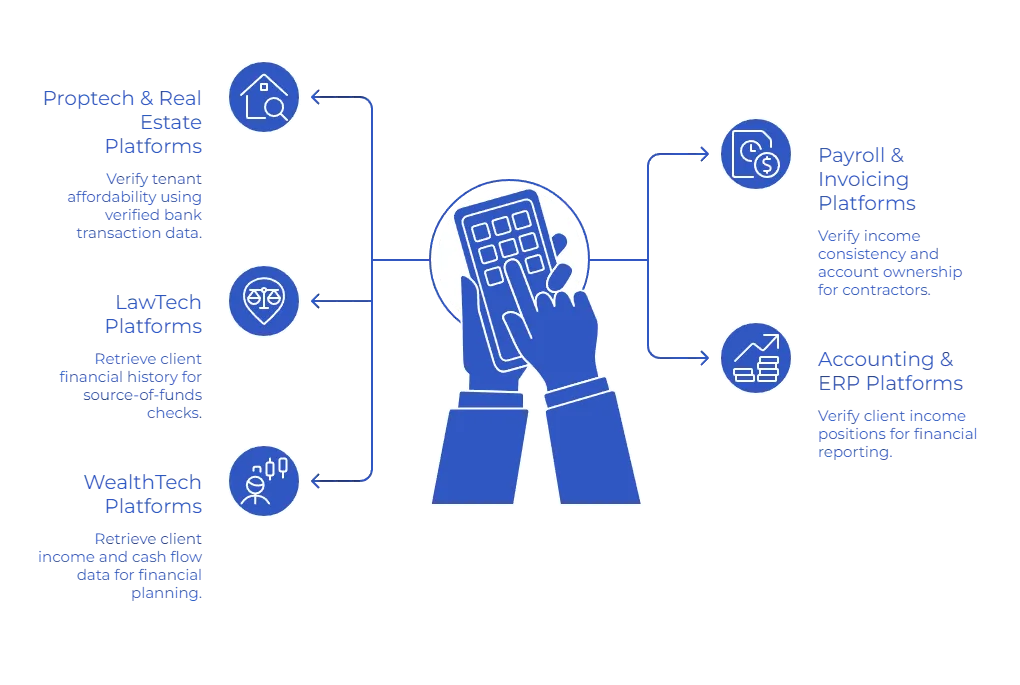
PropTech platforms use Finexer’s income verification api to retrieve verified tenant bank transaction data for affordability assessment during rental onboarding. Salary deposit patterns, recurring commitments, and spending behaviour are identifiable from transaction history – replacing manual payslip and bank statement requests with consent-based bank data that reflects actual financial activity.
Payroll & Invoicing Platforms
Payroll platforms use AIS transaction data to verify income consistency and account ownership for contractor onboarding. Self-employed contractors who cannot provide standard payslips are assessable from their actual transaction history – income deposits, payment patterns, and business revenue signals all visible from the same bank data feed.
LawTech Platforms
LawTech platforms – including insolvency practices – use income verification api access to retrieve verified client financial history for source-of-funds checks and financial assessment during case opening. Bank-verified income data supports compliance documentation requirements with a clear consent and access audit trail.
Accounting & ERP Platforms
Accounting platforms use AIS transaction data to verify client income positions for financial reporting and advisory workflows. Verified income patterns from bank transaction history give accountants accurate financial data without relying on client-submitted documents that may be incomplete or inconsistent.
WealthTech Platforms
WealthTech platforms use Finexer’s income verification api to retrieve client income and cash flow data across connected bank accounts. Verified salary deposits, investment income, and recurring financial commitments inform financial planning workflows – giving advisers an accurate income picture without manual document collection from clients.
How does an income verification api differ from traditional payslip checks?
An income verification api retrieves verified bank transaction data directly from the applicant’s bank account via Open Banking AIS. This provides real financial activity rather than self-submitted documents – eliminating falsification risk and enabling ongoing income monitoring beyond the initial onboarding point.
Can an income verification api handle self-employed applicants?
Yes. Bank transaction data surfaces irregular income deposits, business revenue patterns, and cash flow behaviour that payslips cannot capture. This makes Open Banking-based verification of income significantly more useful for self-employed, freelance, and multi-income applicants across PropTech, payroll, and LawTech platforms.
Is Finexer’s income verification api suitable for regulated UK platforms?
Yes. Finexer is FCA-authorised. Its Open Banking AIS infrastructure operates within the UK regulatory framework with SCA-compliant, GDPR-compliant consent management. Platforms access verified bank transaction data through granular, revocable consent workflows.
Build accurate risk assessment on verified income data, not documents.
About the Author

Ravi Ranjan
Ravi Ranjan is Co founder & CEO of Finexer