Building financial data pipelines into your accounting platform?
Finexer gives UK platforms FCA-authorised AIS access – structured bank transaction feeds, real-time webhooks, API-ready.
Every accounting platform I work with has the same architectural pattern somewhere in its financial data pipeline. A scheduled job runs at midnight. It pulls a CSV from a bank export folder, reformats the columns, and imports the transactions into the accounting system. If the export fails, or the format changes, or the user forgot to run the export – the reconciliation breaks silently until someone notices.
This is not a data problem. It is a financial data integration problem. The pipeline exists, but it depends on a manual step that was never designed to be reliable at scale.
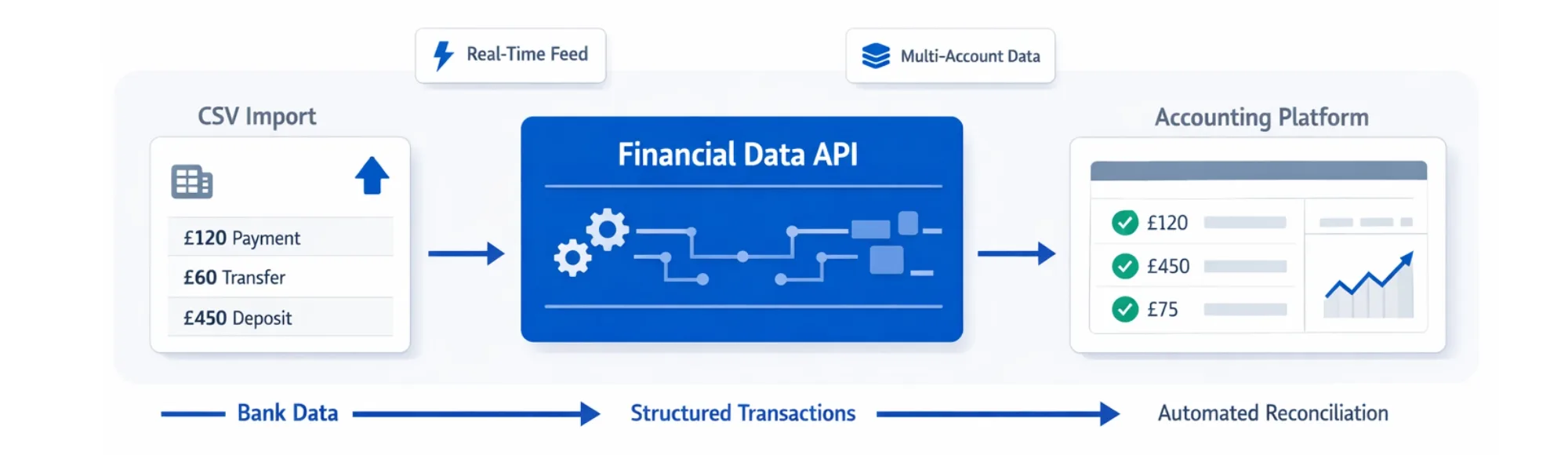
Financial data integration using Open Banking AIS replaces this architecture entirely. Bank transaction data flows directly into the accounting system via API – structured, continuous, and bank-verified. The midnight CSV job disappears. The manual step is gone.
This blog explains how financial data integration works for accounting and ERP platforms, what the accounting integration pipeline looks like in practice, and where Finexer fits as the infrastructure layer.
TL;DR
Financial data integration connects accounting systems directly to bank transaction data via Open Banking AIS APIs – replacing manual CSV imports with continuous, structured financial data feeds. Accounting integration built on direct bank connectivity gives platforms verified transaction data, automated reconciliation, and accurate financial records without manual data collection steps. Finexer provides FCA-authorised AIS infrastructure covering 99% of UK banks for accounting and ERP platform financial data integration.
Key Takeaways
What is financial data integration for accounting platforms?
Financial data integration connects accounting software to bank transaction data automatically via API – so financial records update from live bank data rather than manually uploaded CSV exports or PDF statements. It eliminates the data collection step between the bank and the accounting system.
What is accounting integration in an Open Banking context?
Accounting integration via Open Banking AIS allows accounting platforms to retrieve bank transaction data directly from source with user consent – replacing manual imports with structured, continuous financial data feeds that feed reconciliation, reporting, and financial analysis workflows automatically.
Why do CSV imports fail as financial data integration infrastructure?
CSV imports depend on a manual export step that introduces latency, format inconsistencies, and silent failure modes. A CSV exported on Monday reflects Monday’s bank data – not Tuesday’s. Financial data integration via AIS delivers transactions as they settle, not when someone remembers to run an export.
What data does financial data integration deliver for accounting systems?
Bank transaction history with merchant identifiers, transaction category codes, account balance data, and counterparty details – all in structured JSON format, consistent across every UK bank the user holds accounts with.
What does Finexer provide for accounting platform financial data integration?
Finexer provides FCA-authorised AIS infrastructure covering 99% of UK banks – delivering structured bank transaction data with merchant identifiers, category codes, and real-time webhooks for continuous financial data integration into accounting and ERP systems.
What Is Financial Data Integration?

Financial data integration is the process of connecting financial systems so that financial information flows automatically between them – without manual data collection, reformatting, or import steps.
For accounting platforms, this means connecting directly to bank transaction data via AIS APIs. Instead of users exporting CSV files and uploading them, the accounting system retrieves structured transaction data from the bank automatically – on a continuous basis as transactions settle.
What financial data integration delivers that CSV imports cannot:
- Current data – transactions arrive as they settle, not in the next scheduled import cycle
- Bank-verified data – retrieved directly from source, not from a document the user exported
- Consistent format – same JSON schema regardless of which UK bank the account is held with
- No manual step – the export, download, reformat, upload process disappears entirely
“Financial data integration is not about making CSV imports faster. It is about removing the CSV import entirely. The accounting system should never be waiting for data that the bank already has.” – Yuri, Finexer
Why Manual Financial Data Imports Break at Scale
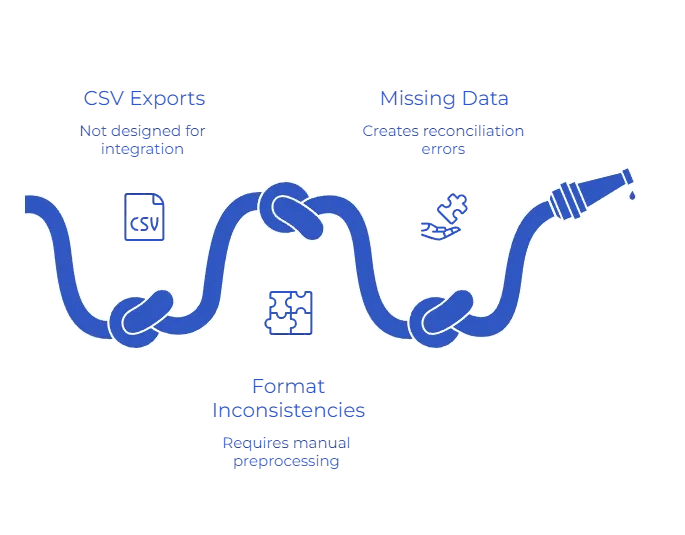
CSV Exports Are Not Designed for Continuous Integration
A CSV export is a point-in-time snapshot of bank data. It reflects what was in the account when the export was generated – not current account activity. For accounting platforms, this means reconciliation always runs on data that is at least one export cycle old.
As client volume increases, the manual export process does not become more reliable. It becomes harder to manage – more files, more format variations, more opportunities for silent failures that are only discovered during month-end review.
Format Inconsistencies Require Manual Preprocessing
Every UK bank exports CSV files differently. Column headers, date formats, amount representations, and reference field structures all vary across institutions. Accounting integration built on CSV imports requires bank-specific parsing logic for every supported institution – logic that breaks when banks update their export formats.
AIS financial data integration standardises this at the infrastructure layer. The same JSON schema arrives regardless of which UK bank the transaction came from.
Missing Data Creates Reconciliation Errors
CSV exports frequently miss transactions – particularly for accounts that were not exported in the correct date range, or where the user selected the wrong account during export. Reconciliation built on incomplete data produces reconciliation errors that require manual investigation to trace back to the missing import.
Guide to real-time financial data for UK platforms covers the data currency requirements for financial workflows in detail.
How Does Financial Data Integration Work in Practice?
Open Banking AIS is the infrastructure layer that makes reliable financial data integration possible at scale.
The financial data integration workflow:
- User connects their bank account via FCA-compliant AIS consent flow
- Finexer AIS retrieves structured transaction data from the connected bank
- Real-time webhook delivers transaction events to the accounting platform as they occur
- Accounting system receives structured JSON – merchant ID, amount, category, timestamp, balance
- Reconciliation logic runs against live bank data automatically
- Financial records update without manual data collection or import steps
One integration. Continuous financial data flow. No CSV exports in the pipeline.
Open Banking financial data platform integration covers the broader platform integration architecture this workflow sits within.
How Should Platforms Evaluate Financial Data Integration Infrastructure?
| Criteria | Why It Matters | What to Look For |
|---|---|---|
| Data Continuity | Accounting integration requires transactions as they settle – not import cycle batches | Real-time webhooks; continuous transaction feeds; live balance data |
| Schema Consistency | Automated field mapping requires the same data structure across all UK banks | Structured JSON; merchant IDs; category codes; standardised schema |
| UK Bank Coverage | Financial data integration gaps create incomplete accounting records | 99% UK bank coverage; CMA9 and challenger banks included |
| Transaction History Depth | Onboarding existing clients requires historical data beyond current period | Up to 7 years transaction history; configurable lookback periods |
| Multi-Account Support | Business clients operate across multiple accounts and banks simultaneously | Multi-account AIS connectivity; cross-bank aggregation; single consent flow |
| FCA Authorisation | UK platforms must use regulated AIS providers for compliant bank data access | FCA-authorised AIS; GDPR-compliant; consent-based with instant revocation |
How Does Finexer Enable Financial Data Integration?
Finexer is FCA-authorised to provide account information services – delivering structured bank transaction feeds for UK accounting and ERP platforms building automated financial data integration pipelines.
What Finexer’s AIS provides for financial data integration:
- Structured bank transaction data from 99% of UK bank accounts
- Real-time webhooks delivering transaction events as they occur
- Merchant identifiers and transaction category codes per transaction
- Account balance data – current and available per connected account
- Transaction history up to 7 years for historical accounting integration and onboarding
- Multi-account connectivity from a single consent-based API connection
- FCA-compliant consent flows with granular permissions and instant revocation
- White-label capability for branded bank connection journeys
- Usage-based pricing
What I Feel
The financial data integration architecture question I get most from accounting platform teams is framed as a reliability question – will the data arrive consistently, in the same format, every time?
That is exactly the right question. CSV imports are brittle because the manual step in the middle is inconsistent. AIS financial data integration is reliable because the pipeline has no manual step – the bank sends the data, Finexer standardises it, the accounting system receives it.
The platforms that build accounting integration on direct bank data connectivity stop debugging import failures. They start building on data they can trust.
Common Use Cases
Accounting & ERP Platforms
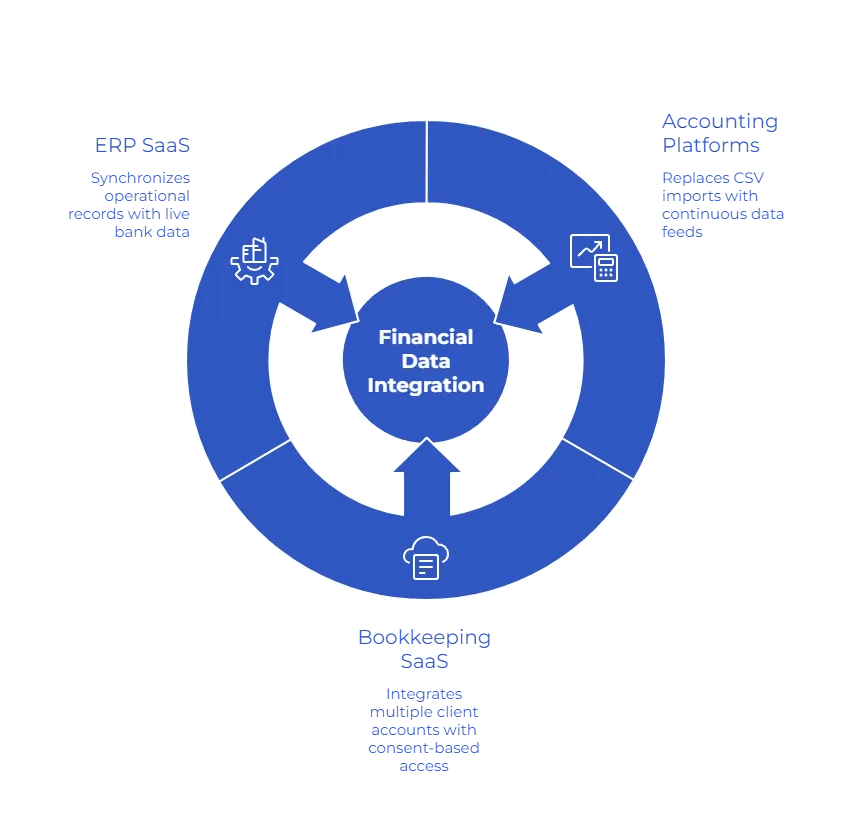
Accounting platforms use Finexer’s AIS to replace scheduled CSV bank imports with continuous financial data integration – receiving structured transaction feeds directly from client bank accounts. Reconciliation runs automatically against current bank data. Month-end close processes that previously required manual data collection run against a complete, continuously updated transaction dataset.
Bookkeeping SaaS Platforms
Bookkeeping platforms integrate Finexer’s AIS for accounting integration across multiple client accounts – replacing the manual bank statement collection request with consent-based bank data access. Structured merchant identification and category codes reduce manual transaction categorisation workload, allowing bookkeepers to review exceptions rather than process every transaction entry.
ERP SaaS Platforms
ERP platforms use financial data integration to synchronise operational records with live bank transaction data – keeping payment confirmations, supplier settlements, and cash position data current without manual import cycles. Financial reporting reflects current bank activity rather than the last completed import.
What is financial data integration for accounting software?
Financial data integration for accounting software connects the accounting system directly to bank transaction data via Open Banking AIS APIs – replacing manual CSV imports with continuous, structured bank transaction feeds. Accounting systems receive verified transaction data as it settles, enabling automated reconciliation and accurate financial records without manual data collection.
What is accounting integration via Open Banking AIS?
Accounting integration via Open Banking AIS allows accounting platforms to retrieve bank transaction data directly from financial institutions with user consent. The platform receives structured JSON outputs – merchant identifiers, amounts, category codes, and timestamps – in a consistent format across all connected UK banks, without manual export or upload steps.
Is Finexer suitable for accounting platforms building financial data integration?
Yes. Finexer is FCA-authorised and provides AIS infrastructure covering 99% of UK banks – delivering structured bank transaction data with merchant identifiers, category codes, and up to 7 years of transaction history. Accounting platforms integrate Finexer’s AIS to replace manual CSV imports with continuous financial data integration pipelines.
Replace manual imports with automated financial data integration.
About the Author

Yuri
Yuriy Yakushko is a fintech founder and software engineer with over 20 years of experience building financial technology. He’s passionate about creating scalable, secure infrastructure that helps businesses modernise how they access financial data and manage payments.