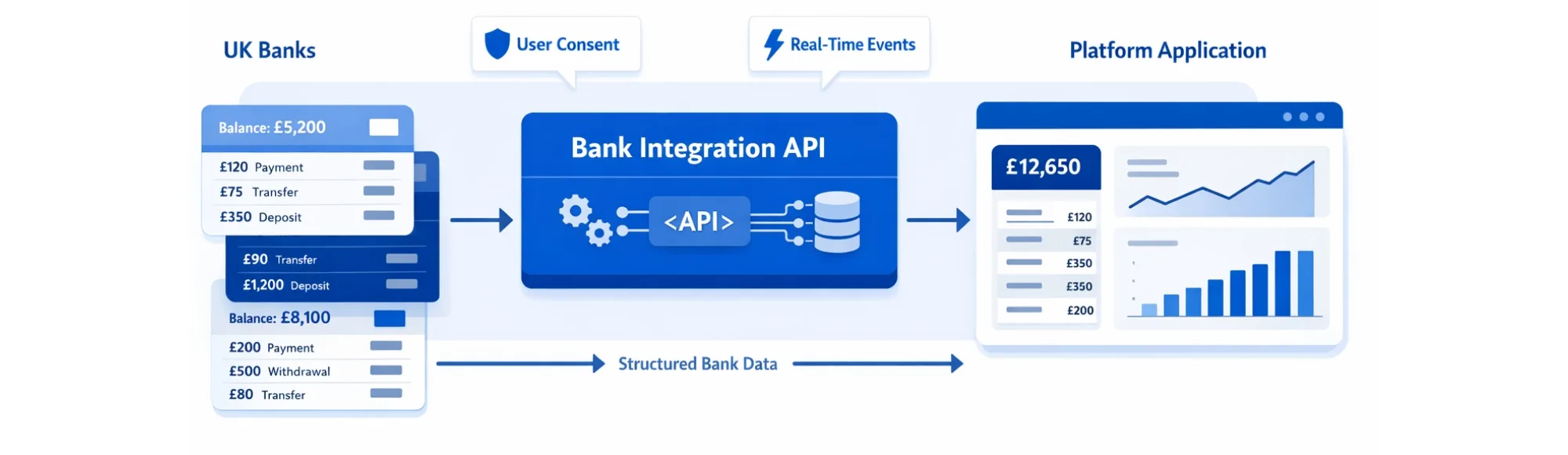
Need reliable bank data infrastructure for your platform?
Finexer gives UK platforms FCA-authorised AIS and PIS access – structured, real-time, API-ready.
Every platform I work with that handles financial data eventually reaches the same architectural decision point. The product needs bank transaction data – for reconciliation, verification, affordability assessment, or payment confirmation. The question is how to get it reliably without building and maintaining direct connections to every UK bank the platform’s users might hold accounts with.
That is the problem a bank integration api solves. Not as a developer convenience – as a fundamental infrastructure decision that determines what the platform can and cannot automate.
At Finexer, I work with UK accounting platforms, LawTech tools, EPOS systems, and payroll infrastructure that have made this decision. The consistency I see is that platforms which treat bank connectivity as core infrastructure build more reliable financial workflows than those that treat it as a secondary feature.
This blog explains what a bank integration api does, why api and open banking infrastructure changed the bank connectivity landscape, and how Finexer fits as the regulated infrastructure layer.
TL;DR
A bank integration api connects software platforms to banking systems – enabling financial data retrieval via AIS or payment initiation via PIS with user consent. Api and open banking regulation standardised this access across UK banks, removing the need for individual bank integrations. Finexer provides FCA-authorised infrastructure covering 99% of UK banks for platforms building financial data workflows.
Key Takeaways
What is a bank integration api?
A bank integration api is a secure interface that allows software platforms to retrieve financial data from banks programmatically – accessing transaction history, account balances, and financial activity with user consent. In the UK, this access operates through FCA-authorised Open Banking infrastructure.
How does api and open banking infrastructure work together?
Api and open banking infrastructure provides a standardised, regulated framework for bank data access. Platforms integrate once through an FCA-authorised provider who handles bank relationships, authentication, and data standardisation – returning consistent structured outputs regardless of which UK bank the user holds their account with.
Why do platforms need a bank integration api rather than direct bank connections?
Direct bank connections require separate integrations per institution, ongoing maintenance, and security certifications per connection. A single bank integration api covers all supported UK banks – engineering teams maintain one connection rather than dozens.
What financial workflows depend on bank integration api access?
Reconciliation automation, financial verification, affordability assessment, source-of-funds checks, payment confirmation, and financial reporting all require structured bank transaction data delivered continuously and consistently.
What does Finexer provide for bank data infrastructure?
Finexer provides FCA-authorised AIS for bank transaction data access and PIS for payment initiation – covering 99% of UK banks through a single integration with real-time webhooks, structured JSON outputs, and white-label consent flows.
What Is a Bank Integration API?
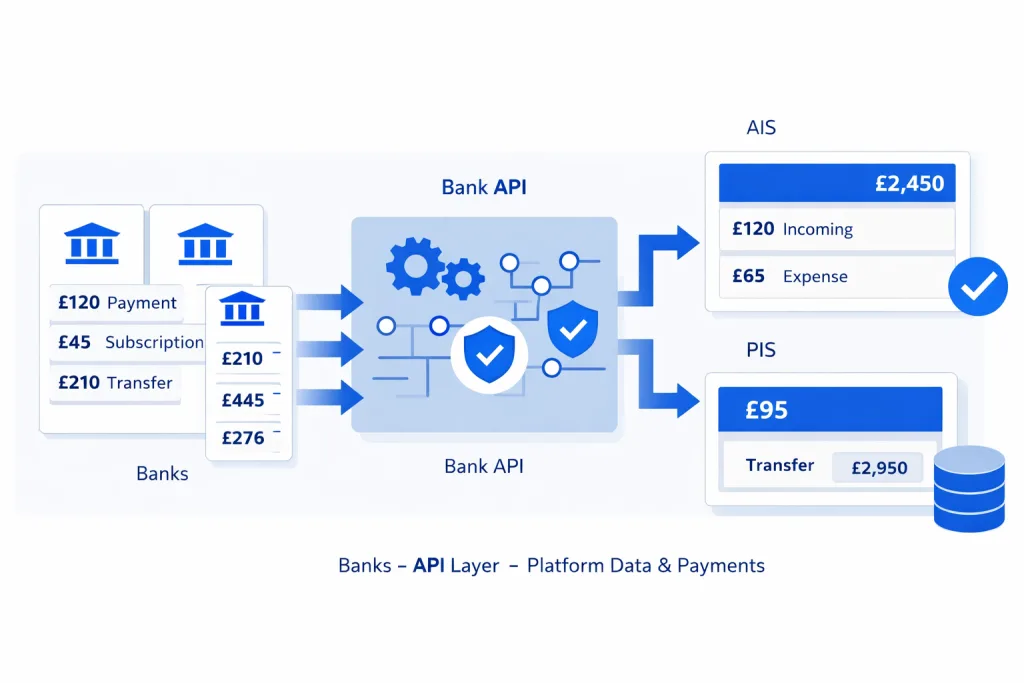
A bank integration api is the infrastructure layer that sits between a software platform and the banking systems its users hold accounts with. It provides programmatic access to financial data – transaction history, account balances, payment records – without the platform building or maintaining direct bank connections.
In the UK, this operates through the Open Banking framework. FCA-authorised providers maintain connections to UK banks and expose a standardised api that platforms integrate against. The platform connects once. The provider handles bank authentication, data retrieval, and output standardisation behind the scenes.
Two services define what this infrastructure delivers:
- AIS – Account Information Services – read-only access to bank transaction data and account balances
- PIS – Payment Initiation Services – initiates account-to-account payments directly from a user’s bank account
“A bank integration api is not about making bank data easier to access. It is about making it structurally possible for platforms to build reliable financial workflows at all.” – Yuri, Finexer
Why Did Direct Bank Connections Fail for Most Platforms?
Before api and open banking infrastructure became the standard, platforms needed bank data had two options – ask users to upload documents, or build direct integrations with each bank separately.
Direct bank integrations were not viable for most platforms. Each UK bank exposed different interfaces with different authentication requirements, data formats, and update cycles. A platform supporting ten banks needed ten separate integrations – each requiring individual security certification and ongoing maintenance.
The result was fragmented, inconsistent financial data across an engineering overhead that grew with every additional bank supported.
Api and open banking regulation changed this. The FCA-regulated framework mandated that major UK banks expose standardised API access to authorised third-party providers. Platforms no longer negotiate with individual banks – they integrate through a single regulated layer that covers the whole market.
Open banking api integration guide covers the regulatory framework behind this standardisation in detail.
How Does Bank Integration API Access Work in Practice?
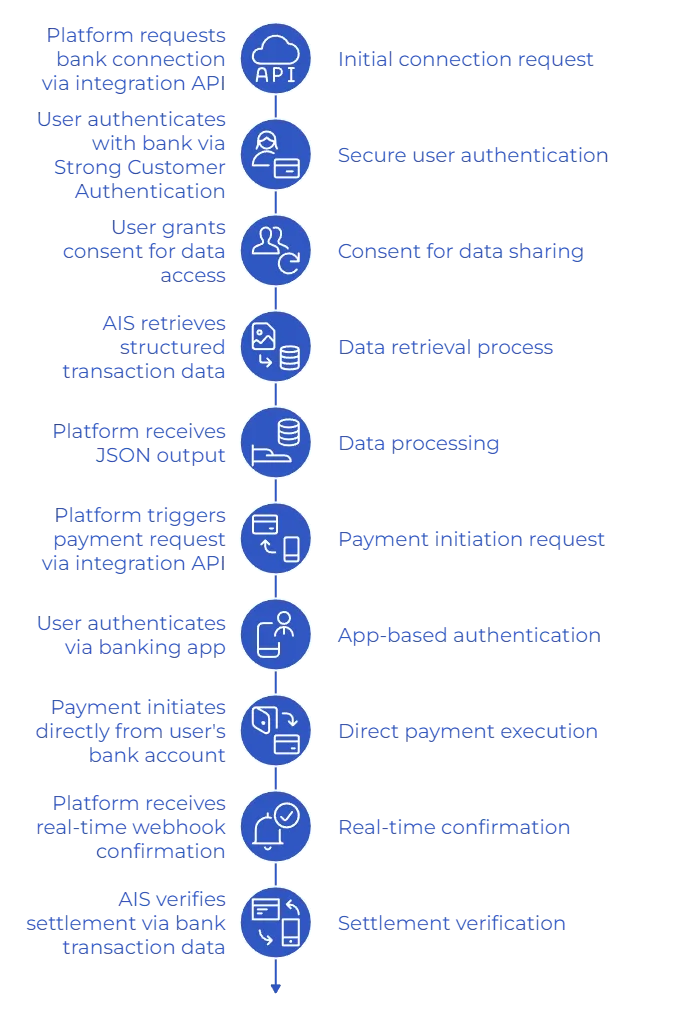
AIS data retrieval workflow:
- Platform requests bank connection via the integration api
- User authenticates with their bank via Strong Customer Authentication
- User grants consent for specific data – transactions, balances, or both
- AIS retrieves structured transaction data from the connected bank
- Platform receives JSON output – merchant ID, amount, category code, timestamp
- Data feeds directly into platform workflows without manual processing
PIS payment initiation workflow:
- Platform triggers payment request via the integration api
- User authenticates via their banking app
- Payment initiates directly from user’s bank account
- Platform receives real-time webhook confirmation
- AIS verifies settlement via bank transaction data
The platform never sees bank credentials. One integration covers all supported UK banks consistently.
Bank api integration for UK platform products covers platform-level implementation examples in detail.
How Should Platforms Evaluate Bank Integration API Infrastructure?
| Criteria | Why It Matters | What to Look For |
|---|---|---|
| UK Bank Coverage | Coverage gaps mean some users cannot connect their accounts | 99% UK bank coverage; CMA9 and challenger banks included |
| AIS and PIS Combined | Platforms needing both data and payments benefit from one unified integration | Single integration for AIS and PIS; unified infrastructure layer |
| Data Structure Quality | Workflow automation requires consistent structured outputs across all banks | Structured JSON; merchant IDs; category codes; standardised schema |
| Real-Time Webhooks | Live financial workflows need transaction and payment events as they occur | Webhook-driven events; real-time payment confirmation; live balance data |
| Transaction History Depth | Verification and reporting workflows need historical data beyond 90 days | Up to 7 years transaction history; configurable lookback periods |
| FCA Authorisation | UK platforms must use regulated providers for compliant bank data access | FCA-authorised AIS and PIS; GDPR-compliant; consent-based access |
How Does Finexer Provide Bank Integration API Infrastructure?
Finexer is an FCA-authorised Open Banking provider offering unified AIS and PIS infrastructure for UK platforms – one bank integration api covering bank data access and payment initiation across 99% of UK banks.
What Finexer provides:
- AIS connectivity covering 99% of UK bank accounts
- PIS for Pay by Bank and account-to-account payment initiation
- Real-time webhooks for live transaction and payment events
- Structured JSON outputs with merchant identification and category codes
- Transaction history up to 7 years for verification and reporting workflows
- FCA-compliant consent flows with granular permissions and instant revocation
- White-label capability for branded bank connection journeys
- Usage-based pricing
Banking api integration guide and bank with api for UK platforms cover the integration architecture in detail.
API for bank transactions UK infrastructure covers transaction data retrieval specifics.
What I Feel
The infrastructure decision I see product teams delay most often is not a technical hesitation – it is a scope question. They want to solve one data problem and are not sure whether a full bank integration api is the right investment for a single use case.
In practice, api and open banking infrastructure unlocks more than the initial use case suggests. Platforms that integrate for reconciliation almost always extend to verification and reporting within months. The infrastructure is in place. The consent flow is built. The data is arriving.
The platforms I work with that plan for that expansion from the start get significantly more product value from the same integration.
Common Use Cases
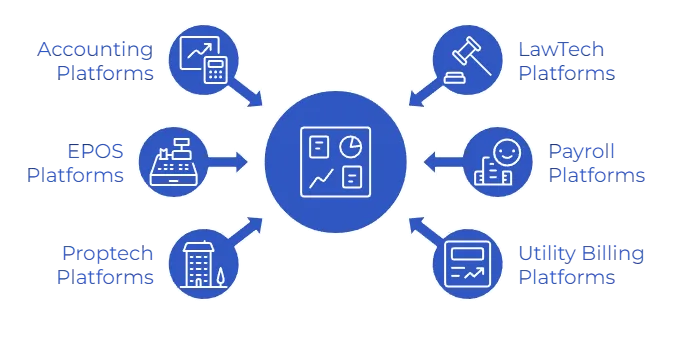
Accounting & ERP Platforms
Accounting platforms use Finexer’s AIS to replace manual CSV bank imports with direct transaction feeds – powering reconciliation and financial reporting from continuous, bank-verified data. One integration covers all client bank accounts regardless of which UK institution they bank with.
LawTech Platforms
LawTech platforms – including insolvency practices – use AIS to retrieve verified client financial history for source-of-funds verification and KYC compliance. Bank-verified transaction data from a consent-based connection replaces manually submitted statements with a full access audit trail.
EPOS & Payment Platforms
EPOS platforms use Finexer’s PIS to accept Pay by Bank at checkout and AIS to confirm settlement – removing card processor intermediaries and delivering real-time payment confirmation via webhook.
Payroll & Invoicing Platforms
Payroll platforms use PIS to initiate contractor disbursements within the platform workflow. Invoice platforms use PIS to enable Pay by Bank invoice settlement – removing the external banking portal step from the payment process entirely.
Proptech & Real Estate Platforms
PropTech platforms use AIS to retrieve tenant financial history for affordability assessment – replacing manual payslip and statement requests with consent-based bank data that reflects actual financial activity across all connected accounts.
Utility Billing Platforms
Utility platforms use PIS for Request-to-Pay billing and AIS to verify customer payment receipt – replacing manual payment tracking with bank-confirmed transaction data per billing cycle.
What is a bank integration api for UK software platforms?
A bank integration api is a secure interface connecting software platforms to banking systems – enabling bank transaction data retrieval via AIS or payment initiation via PIS with user consent. In the UK, this operates through FCA-authorised Open Banking infrastructure, giving platforms standardised access across all supported UK banks through one integration.
How does api and open banking infrastructure benefit platforms?
Api and open banking infrastructure provides a regulated, standardised framework for bank data access. FCA-authorised providers maintain connections across UK banks and expose a unified api – platforms integrate once and receive consistent structured transaction data and payment capabilities regardless of which UK bank the user banks with.
Is Finexer suitable as a bank integration api provider for UK platforms?
Yes. Finexer is FCA-authorised and provides AIS and PIS infrastructure covering 99% of UK banks – with structured JSON outputs, real-time webhooks, up to 7 years of transaction history, and white-label consent flows. Platforms integrate once through Finexer and access the full UK banking market.
Build reliable financial workflows on a single bank integration api.
About the Author

Yuri
Yuriy Yakushko is a fintech founder and software engineer with over 20 years of experience building financial technology. He’s passionate about creating scalable, secure infrastructure that helps businesses modernise how they access financial data and manage payments.