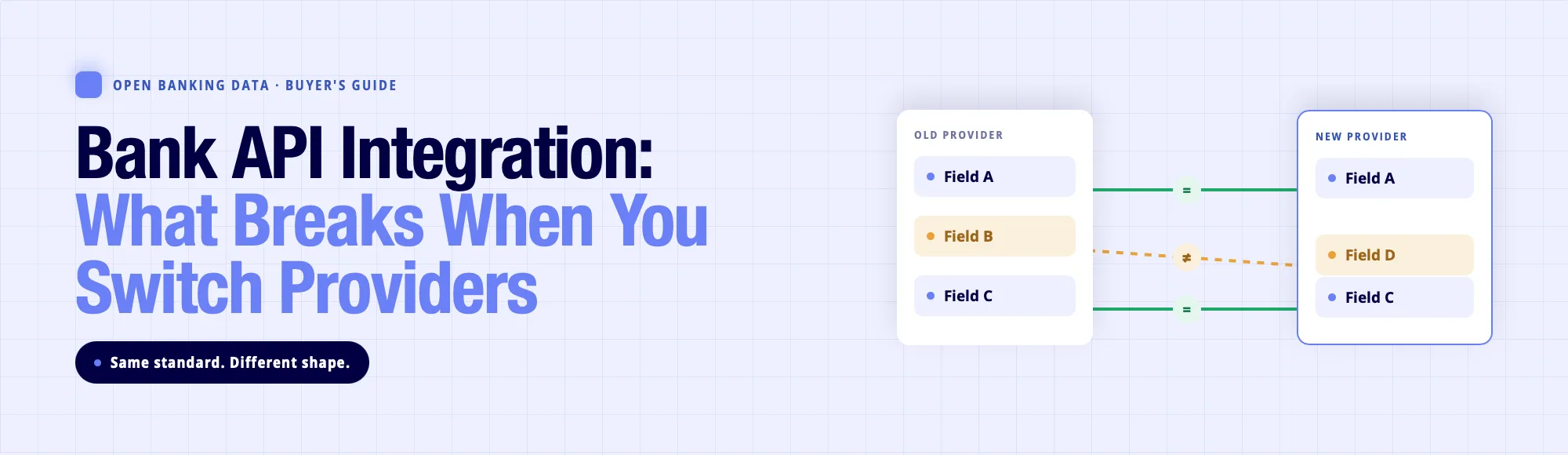
Migrating bank API integration isn’t a rebuild. It’s a minefield with a due date.
See what actually breaks when platforms switch providers, and how Finexer’s Data API absorbs the format differences your old integration was quietly handling.
Key Takeaways: Switching bank API integration providers is more complex than a first-time implementation because differences in data formats, normalisation and provider-specific behaviour can break downstream systems even when both APIs support Open Banking standards. This guide explains the most common migration pitfalls, what to evaluate before switching providers and how UK engineering and product teams can migrate with minimal disruption and future-proof their integrations.
A platform’s engineering team spends six weeks migrating off their current bank API integration provider. Go-live day arrives. Three banks return transaction categories in a format nobody tested for, and reconciliation silently miscategorises 4,000 transactions before anyone notices.
That’s not a hypothetical situation. It’s the most common bank API integration migration failure UK platforms report, and it happens because switching providers is a fundamentally different problem from building a bank API integration from scratch.
By Yuri, Technical Lead at Finexer
“When I work with engineering teams migrating bank API integration, the failure point is almost never the new provider’s documentation. It’s the format quirks their old provider was silently normalising, which nobody wrote down anywhere.”
Why Migrating Bank API Integration Is Harder Than Building One
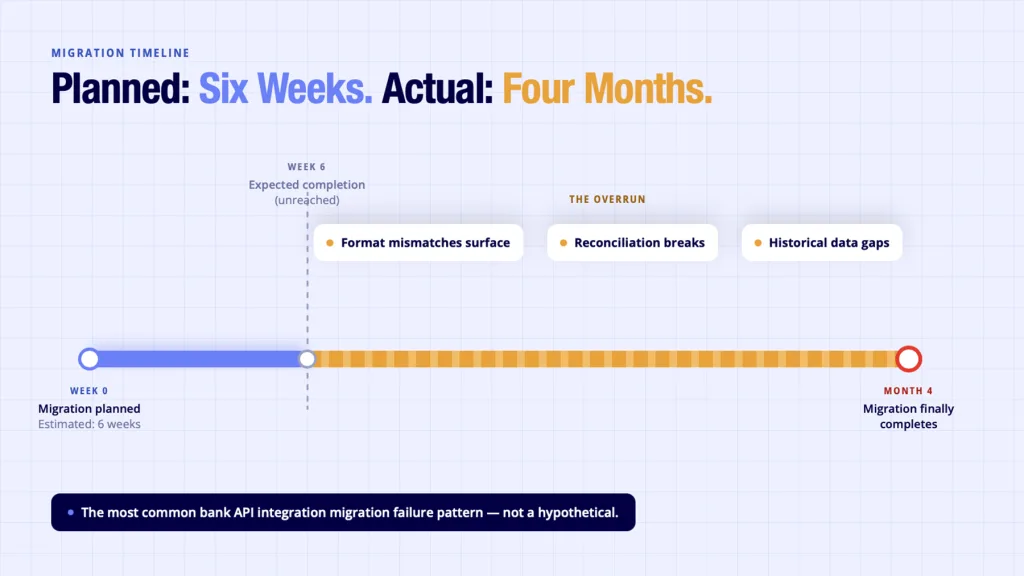
A first-time bank API integration has one unknown: how the provider’s API behaves. A migration has two: how the old provider’s bank integration API behaved, and how much of that behaviour your platform’s code has come to depend on without anyone realising it.
Over months or years, engineering teams build workarounds for a provider’s specific quirks: a particular date format, a category taxonomy, a way of handling partial refunds. None of that gets documented as “provider-specific.” It just becomes “how our reconciliation works.” A migration exposes every one of those assumptions at once, on a deadline, in production.
This is why our sister guide, the banking API integration guide, covers greenfield setup step by step, while this page exists specifically for platforms already running an integration and switching away from it.
The Real Cause of Migration Failures: Format Divergence, Not Downtime
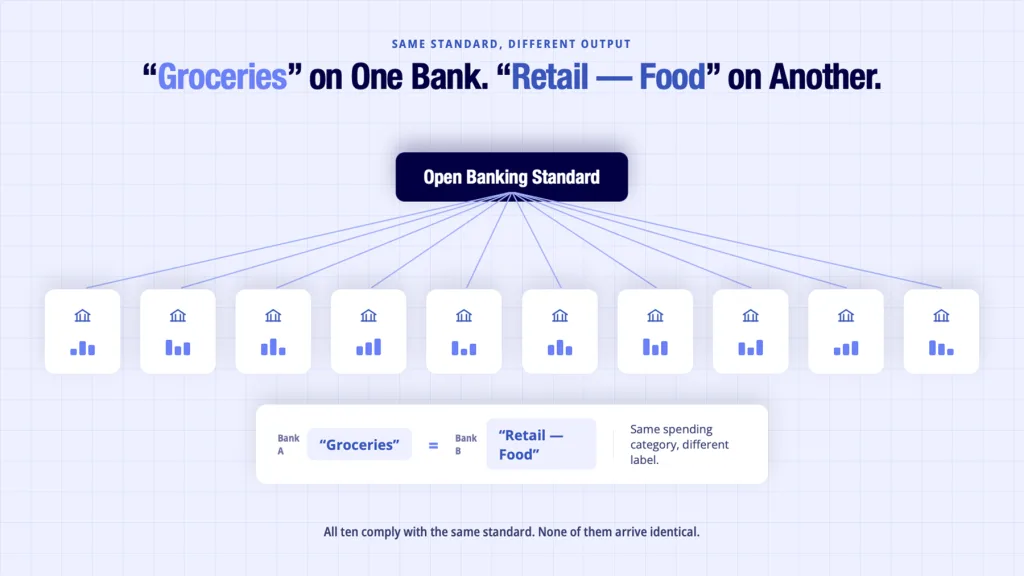
Ten UK banks implementing the same Open Banking standard still produce ten different practical data outputs, because the standard specifies the fields, not the exact formatting, categorisation depth or edge-case handling within them.
Industry data from Group107 attributes roughly 30% of bank integration failures to mismatched data formats between systems, not to outages or authentication problems. During a migration, this risk compounds: the new provider may format merchant names, transaction categories or timestamps differently from the old one, and every downstream system built against the old format quietly breaks.
A transaction categorised as “Groceries” under one provider’s taxonomy might arrive as “Retail – Food” under another’s. If a platform’s reconciliation logic hard-codes category strings, that single formatting difference cascades into every automated match failing simultaneously, not gradually.
What a Migration-Ready Bank API Integration Needs to Handle
Five requirements separate a migration that goes cleanly from one that surfaces problems in production.
| Migration Requirement | What to Evaluate |
|---|---|
| Format-difference mapping before go-live | Has the team compared the old provider’s field formats with the new provider’s, transaction by transaction, before cutover? |
| Parallel running instead of a hard cutover | Can both integrations run simultaneously against live data for a defined period so discrepancies surface before they matter? |
| Historical data continuity | Does the new provider retrieve sufficient transaction history to preserve existing reconciliation records? |
| Vendor lock-in awareness | Is the platform built against the provider’s proprietary response format, or against an internal, provider-agnostic schema? |
| Consent re-authentication planning | Will users need to re-authorise bank access after migration, and has that consent journey been mapped? |
Most teams plan for the first requirement. Very few plan for the fourth, which is exactly the one that makes the next migration, three years hence, just as painful as this one.
Direct Bank Connections vs Aggregator: The Lock-In Question
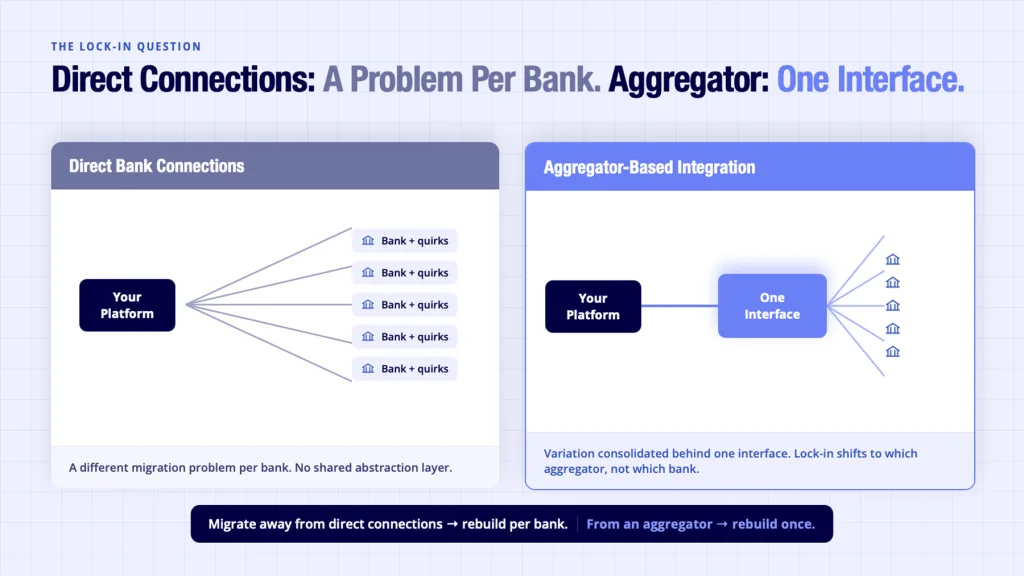
Platforms that built direct connections to individual banks face a different migration problem: there’s no single provider to switch away from; there are ten, twenty or fifty separate integrations, each with its own format quirks baked into the platform’s code.
An aggregator-based bank API integration consolidates that variation behind one interface, so a future migration means renegotiating one relationship instead of dozens. For a full comparison of how providers differ on this exact point, bank API platforms compared covers coverage, format consistency and switching costs across the market.
The Gap: Why “Same Standard” Doesn’t Mean “Same Output”
Every provider in this space can accurately claim to support Open Banking’s AIS standard. What that claim doesn’t cover is how much normalisation work happens on top of the raw bank response before it reaches the platform.
A provider that passes bank data through with minimal processing looks identical on a feature list to one that normalises formats extensively, until a migration forces a side-by-side comparison and the platform discovers how much invisible cleanup its previous provider was doing.
The right infrastructure needs to normalise that variation centrally, not leave the platform’s engineering team to rebuild it for every bank and every migration.
Finexer’s Data API: Built to Absorb Format Variation, Not Just Retrieve Data
Platforms migrating bank API integration need a provider that normalises format differences centrally, so the platform’s own code doesn’t inherit a new set of quirks with every switch.
Finexer’s Data API retrieves transaction history, account balances and account details directly from a UK bank once the customer authenticates and consents, returning per-transaction structured JSON transaction data, normalised across banks, rather than passing through raw, bank-specific formatting.
For platforms wanting the full technical specification of what this API returns, the AIS API reference covers the field-level detail; for a broader look at bank integration API options beyond Finexer specifically, bank integration API covers the wider landscape.
- Structured JSON transaction data, normalised across banks
- Up to 7 years of transaction history, supporting continuity during a provider switch
- Low-latency webhooks for new transaction events
- Access to a user’s multiple accounts from a single consent
- Almost all UK banks covered
- FCA-authorised AISP and PISP (FRN925695)
- 3–5 weeks onboarding support
What Is Bank Integration API in Practice?
Bank integration API refers to the regulated connection layer that retrieves account and transaction data or initiates payments between a software platform and a UK bank, standardised under Open Banking.
In a migration context, the practical distinction that matters is between raw APIs, which surface each bank’s formatting differences directly to the platform, and normalised APIs, which absorb those differences into a single consistent schema before the platform ever sees them. Which type of API a platform is migrating to determines how much of its own reconciliation and matching code needs rewriting.
How long does a bank API integration migration take?
A migration typically takes longer than a first-time integration, because it requires mapping format differences against the old provider in addition to standard integration work. Running both providers in parallel against live data before cutover, rather than switching all at once, is the main factor that extends timelines but reduces production risk.
Should a platform migrate to a direct bank connection or an aggregator?
Direct connections avoid a third-party layer but multiply the number of separate integrations a platform maintains, one per bank, each with its own quirks to track. An aggregator consolidates that variation into a single interface, which generally simplifies any future migration compared with unwinding several direct connections at once.
What causes most bank API integration migrations failures?
Format mismatches between the old and new provider’s data output account for roughly 30% of integration failures, more than outages or authentication issues combined, according to Group107 data. These mismatches surface in transaction categorisation, date formatting and how partial or duplicate transactions are represented.
Does switching bank API providers mean users have to re-consent?
In most cases, yes, since Open Banking consent is tied to the specific provider a user originally authorised, not portable between providers. Planning the re-consent user journey ahead of migration, rather than treating it as a technical afterthought, is one of the more commonly underestimated steps in a switch.
See how Finexer’s Data API absorbs the bank-by-bank format variation your platform’s next migration would otherwise have to rebuild from scratch
Explore with AI
About the Author

Yuri
Yuriy Yakushko is a fintech founder and software engineer with over 20 years of experience building financial technology. He’s passionate about creating scalable, secure infrastructure that helps businesses modernise how they access financial data and manage payments.