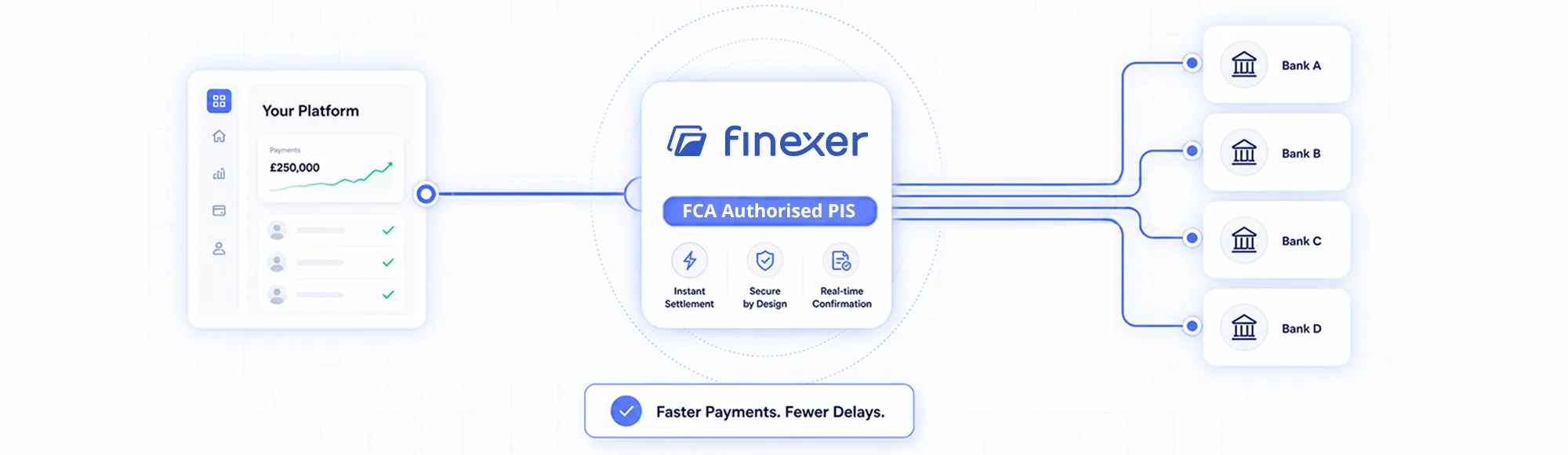
Real-time bank data. Strong UK coverage. Developer-ready integration.
API banking platform infrastructure for fintech, accounting SaaS, Lawtech, and payment platforms.
API banking platform selection is one of the most consequential infrastructure decisions a product team makes.
Get it wrong and you are rebuilding the integration six months into a product launch. You are dealing with inconsistent bank data that breaks reconciliation. You are managing coverage gaps that cause user drop-off after go-live.
Get it right and the financial layer of your product works. Quietly. Reliably. At scale.
UK Open Banking processed 2.54 billion API calls in March 2026. The platforms generating that volume are not the ones with the most impressive API documentation. They are the ones whose integrations held up in production.
This blog covers what actually separates a good API banking platform from a great one – and compares the top five UK providers against the criteria that matter for developers and product teams.
TL;DR
An API banking platform provides access to bank transaction data (AIS) and payment initiation (PIS) via APIs. The open banking platform with the best API is not the one with the most endpoints – it is the one whose data arrives structured, whose coverage holds across UK banks, and whose integration reaches production in weeks rather than months. Finexer, TrueLayer, Yapily, Salt Edge, and Plaid are the five providers most relevant for UK platform teams in 2026. Each differs on UK-first focus, enrichment depth, and what breaks in real workflows.
Key Takeaways
What is an API banking platform?
An API banking platform is regulated infrastructure that allows applications to connect to bank systems via APIs – retrieving transaction data (AIS) and initiating payments (PIS) with user consent. It handles FCA authorisation, bank connectivity, authentication, and data structure on behalf of the platform integrating it. The platform builds on it rather than building the bank connections themselves.
What makes an open banking platform the best API choice for developers?
Four criteria that matter in production – not in the sandbox:
- Integration speed – how long from API key to first live transaction. Documentation quality matters less than onboarding support quality.
- Data quality at delivery – does transaction data arrive structured with merchant IDs and category codes, or raw bank strings requiring normalisation?
- UK bank coverage depth – do the coverage numbers hold across challenger banks and business accounts, not just the CMA9?
- Production reliability – webhook delivery consistency, uptime, and what happens when a bank changes its authentication flow
How should product teams evaluate API banking platforms before committing?
Ask these questions – not the ones in the documentation:
- What does the transaction data look like after the bank sends it? Is enrichment applied before it reaches me?
- Which UK banks are not covered, and what is the user experience when someone connects an unsupported account?
- What is the time from API access to first live payment or data retrieval in a real product?
- Who handles it when a bank changes its auth flow in production?
What Actually Breaks in API Banking Platform Integrations?
Why Do Most API Banking Integrations Fail in Production?
The sandbox always works. That is its job.
Production surfaces what sandboxes cannot: real bank behaviour, real coverage gaps, and real data quality.
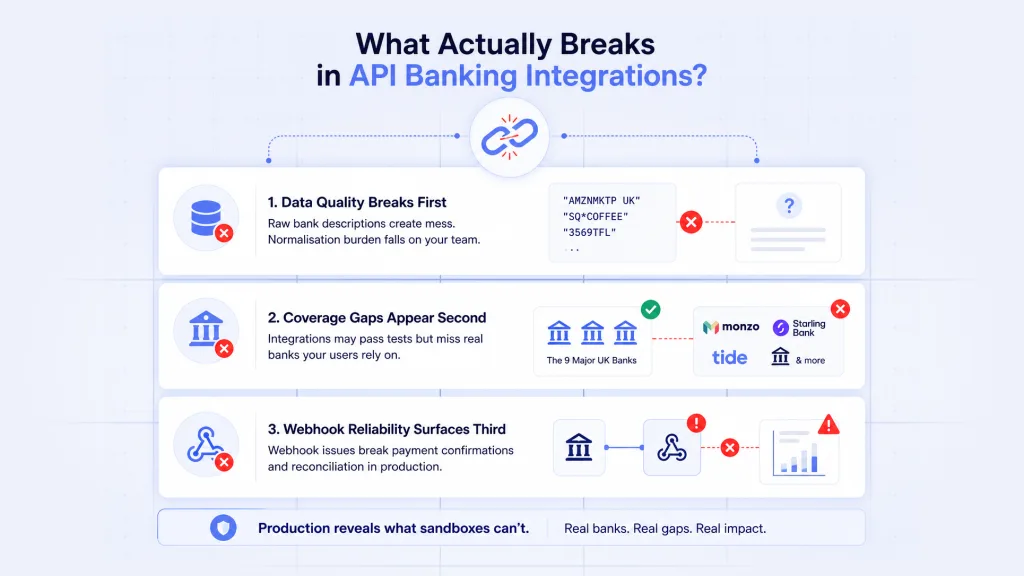
Data quality breaks first:
Bank transaction descriptions are raw strings. “AMZNMKTP UK”, “SQ*COFFEE”, “3569TFL”. An API banking platform that passes these through without enrichment pushes the normalisation problem to the platform’s engineering team. That team did not sign up to build a merchant classification engine.
Coverage gaps appear second:
An API banking platform that covers the CMA9 (the nine largest UK banks) passes most integration tests. It does not cover Monzo Business, Starling, Tide, or dozens of building societies that real users hold accounts with. The coverage gap appears in production drop-off metrics – not in the integration documentation.
Webhook reliability surfaces third:
Real-time payment confirmation depends on webhook delivery. If a bank changes its session handling and the provider does not absorb that change, the platform’s reconciliation breaks. The engineering team that integrated the API is now debugging a bank-specific authentication change they cannot control.
| What Breaks | Sandbox Signal | Production Reality |
|---|---|---|
| Transaction data quality | Structured test data returns correctly | Raw bank strings require normalisation layer |
| Bank coverage | CMA9 banks pass all integration tests | Challenger + business accounts cause user drop-off |
| Authentication flows | Consistent across sandbox environments | Each bank implements SCA differently in production |
| Webhook reliability | Webhooks deliver consistently in test | Timing and retry behaviour varies by bank |
“The API banking platform evaluation question is not ‘does this API work?’ It is ‘does this API work for the specific banks my users have accounts with, with the data quality my product needs, when a bank changes something in production?’ That is a very different question.” – Yuri, Finexer
Open banking data networks and fintech providers covers how open banking provider architecture affects data quality and coverage depth in real platform integrations.
Top 5 API Banking Platforms for UK Product Teams
How Do the Leading UK API Banking Platforms Compare?
1. Finexer
Finexer is an FCA-authorised UK-only API banking platform providing AIS and PIS in a single integration. It is built and maintained in-house – no third-party aggregation – which means direct control over coverage depth, data quality, and what happens when a bank changes its authentication flow.
What it delivers in production:
- Data quality at source – merchant IDs and category codes applied per transaction before data reaches the platform. No normalisation layer required.
- 99% UK bank coverage – high street, challenger, and business accounts. Not just CMA9.
- Real-time webhooks – per-transaction delivery, consistent across payment methods
- Up to 7 years of transaction history – configurable per integration
- Structured JSON – consistent schema across virtually every major UK bank
- PIS – Pay by Bank, Payment Links, VRP, Bulk Payout with embedded references
- Usage-based pricing, no setup fees, no minimum commitments
- 3-5 weeks to production with active onboarding support
- Deploys 2-3x faster than market alternatives
Best for: Accounting SaaS, Lawtech, EPOS, payroll, and billing platforms building UK-first financial workflows where data quality and coverage depth matter most.
Fintech infrastructure and API platforms covers how Finexer’s API architecture compares to broader fintech infrastructure providers on integration depth and UK coverage.
2. TrueLayer
TrueLayer is the UK’s largest Open Banking payment network by volume – processing over 20 million users as of December 2025. It is payments-first: Pay by Bank, VRP, and payouts at scale. Data access is available but secondary to its payment infrastructure focus.
What it delivers in production:
- Strong UK and EU payment infrastructure
- 98% UK bank coverage, 95%+ payment success rate
- Data access alongside payment initiation
- Enterprise-grade payment volumes at scale
- Better suited to platforms at payment volume than early-stage product builds
Best for: E-commerce, iGaming, and financial services platforms processing high UK and EU payment volumes where payment initiation at scale is the primary use case.
3. Yapily
Yapily is a pan-European API banking platform offering AIS, PIS, and LLM-powered data enrichment across the UK and 19 European markets. Its Data Plus product applies AI-driven categorisation across consumer and business accounts.
What it delivers in production:
- UK and EU coverage in a single integration
- 140 transaction categories for business accounts, 90 for consumer
- Recurring transaction identification and income analysis
- Strong fit for enterprise fintechs needing EU alongside UK
Best for: Enterprise platforms requiring UK and EU coverage, or deep business account categorisation across European markets.
4. Salt Edge
Salt Edge is a global API banking platform covering 5,000+ banks across 50+ countries (some 2026 sources cite higher figures as coverage expands). Its enrichment layer applies merchant identification against a database of 25M+ merchants. It also provides PSD2 compliance infrastructure for banks.
What it delivers in production:
- Broad global coverage for cross-border platforms
- Enrichment applicable to existing transaction data from other sources
- PSD2 compliance tooling for banks and financial institutions
- Better suited to multi-geography than UK-first
Best for: Cross-border platforms needing enrichment and connectivity across multiple markets, or banks requiring PSD2 compliance infrastructure.
5. Plaid
Plaid is a global financial data network enriching 500M+ transactions daily. Its UK coverage is available but its architecture and pricing are optimised for the US market. UK enrichment is available for platforms expanding internationally.
What it delivers in production:
- 12,000+ institution connections globally
- Strong US and Canada coverage; UK available
- ML-powered enrichment at global scale
- Limited UK-specific customisation compared to US offering
Best for: US-first or global platforms needing broad international coverage alongside the UK.
Banking API integration guide for platform developers covers how to evaluate and integrate an API banking platform for accounting SaaS, Lawtech, and payment platform use cases.
| Provider | UK Focus | AIS + PIS | Enrichment at Source | Deployment |
|---|---|---|---|---|
| Finexer | UK-only, 99% coverage | Both together | Yes – merchant IDs + category codes | 3-5 weeks |
| TrueLayer | UK + EU (20 markets) | PIS-first | Limited | Enterprise timeline |
| Yapily | UK + EU (19 countries) | Both | AI-driven, post-delivery | Volume tiers |
| Salt Edge | Global (50+ countries) | Both | Post-processing | Custom |
| Plaid | US-first, UK available | Both | ML, post-processing | Custom |
How Do You Choose the Right API Banking Platform?
What Is the Practical Evaluation Framework for Platform Teams?
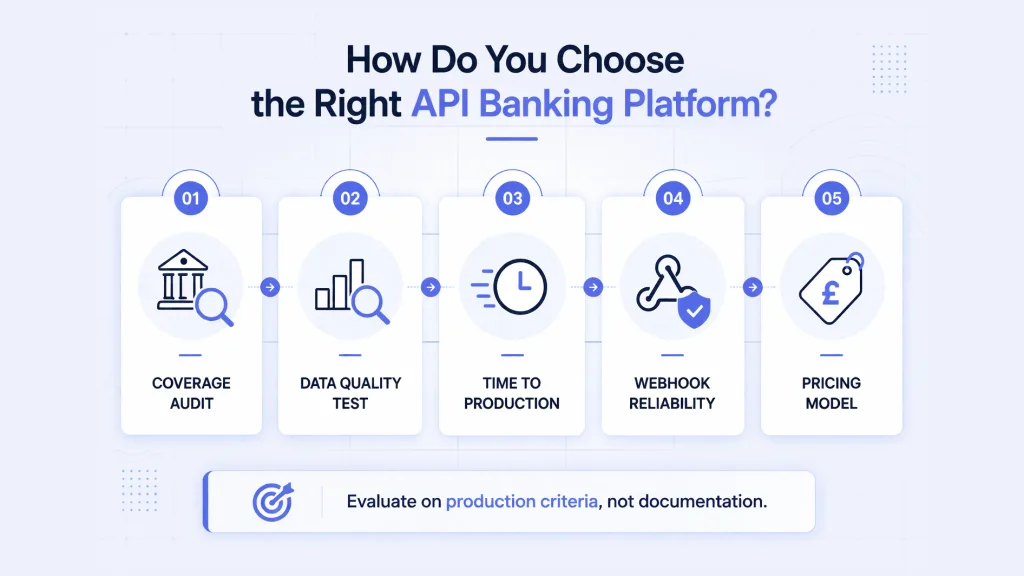
Stop evaluating on documentation. Start evaluating on production criteria.
Step 1 – Coverage audit: Get the full bank list. Not the headline number – the actual list. Check your target user’s most common banks. Check business account coverage specifically. The coverage gap that matters is the one your user hits.
Step 2 – Data quality test: Request a sandbox token for a real bank account. Look at what the transaction data actually looks like. Are merchant IDs present? Are category codes applied? Or are you looking at raw reference strings?
Step 3 – Time to production: Ask for case studies showing time from API access to first live transaction. Not the theoretical integration timeline – the actual one, including onboarding support, authentication edge cases, and bank-specific behaviour.
Step 4 – Webhook reliability: Ask what happens when a bank changes its authentication flow. Who detects it? Who fixes it? Does the platform engineering team find out via support ticket or via failed webhook alerts?
Step 5 – Pricing model: Usage-based with no minimum commitment scales with product development. Fixed monthly fees or minimum commitments create pressure before the product has validated its use case.
“The best API banking platform for a UK product team is the one whose production data matches what the sandbox showed. That sounds obvious. In practice, it is the most common gap between integration and working product.” – Yuri, Finexer
Top 5 open banking apps and platforms for UK developers covers how open banking platforms are rated by developer teams on integration experience, data quality, and production reliability.
What I Feel
Every API banking platform evaluation starts the same way.
Developers review the documentation. Product managers compare the feature lists. Someone builds a sandbox demo and it works.
Six months later, three of those teams are rebuilding their integration.
The sandbox demo is not the test. The test is: what does transaction data look like from a real Monzo Business account at 2am when the bank changed its session handling two weeks ago?
The API banking platform that answers that question reliably is the one worth building on.
Common Use Cases
Accounting SaaS
Real-time AIS bank data with merchant IDs and category codes at source. No normalisation layer. Structured JSON is consistent across virtually every UK bank. Reconciliation runs on clean data from the first transaction.
Lawtech Platforms
Direct-from-bank transaction history with consent logs per retrieval. Up to 7 years of history for source of funds checks. SCA at bank level – data provenance traceable to the bank, not to a client-prepared document.
EPOS Platforms
Pay by Bank and QR code payments via PIS. Webhook confirmation per transaction. Zero chargebacks. No card network intermediaries. Settlement via Faster Payments.
Fintech Builders
Usage-based API pricing that scales with product development, not against it. 3-5 weeks to production. Merchant enrichment applied at source. A product team can test, validate, and go live without a commercial commitment before the use case is proven.
How do I know if an API banking platform will work in production?
Test beyond the sandbox. Request a token linked to a real bank account and inspect the raw transaction data. Ask for the full UK bank list – not the headline number. Ask for actual time to first live transaction in a recent case study. Ask who handles it when a bank changes its authentication flow. Those answers reveal production reliability.
What is the open banking platform with the best API for UK product teams?
For UK-first platforms, Finexer provides AIS and PIS in a single integration with near-universal UK bank coverage, enrichment at source, and usage-based pricing with no setup fees. For payment volume at scale across the UK and EU, TrueLayer leads. For European multi-market coverage, Yapily. For global cross-border, Plaid or Salt Edge.
How long does it take to integrate an API banking platform?
Integration timelines vary significantly by provider. Enterprise-focused providers typically require 3-6 months to production due to commercial onboarding, technical integration, and bank-specific customisation. UK-focused providers like Finexer are designed for 3-5 weeks to production with active onboarding support. The actual determinant is not the API documentation complexity but the provider’s support during the bank-specific edge cases that arise in production.
Build on an API banking platform designed for production, not just sandbox.
About the Author

Yuri
Yuriy Yakushko is a fintech founder and software engineer with over 20 years of experience building financial technology. He’s passionate about creating scalable, secure infrastructure that helps businesses modernise how they access financial data and manage payments.