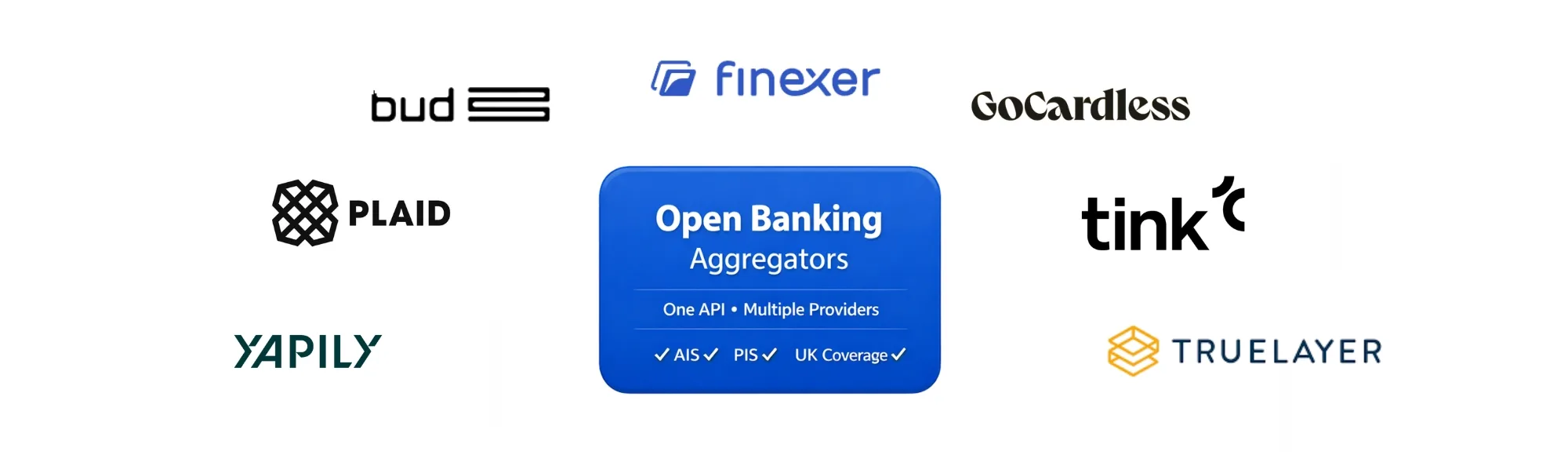
Wrong aggregator choice costs platforms months of re-integration.
Evaluate UK providers on coverage, data quality, and workflow fit – not just API docs.
Open banking aggregators in the UK are the infrastructure layer that lets platforms access bank data and initiate payments without integrating with each bank individually. For product teams building financial workflows, the choice of api aggregator determines data reliability, integration complexity, and how well the product performs at scale.
The UK market has several established providers, each with different strengths across bank coverage, data structuring, payment capabilities, and onboarding complexity. Platforms that underestimate this decision typically face broken bank feeds, reconciliation gaps, and costly re-integrations after go-live.
This guide covers the 7 best open banking aggregators in the UK, how they differ, and what product teams should evaluate before committing to an integration.
TL;DR
Open banking aggregators connect platforms to UK bank data and payment initiation through a single API. Key providers include Plaid, Tink, Yapily, TrueLayer, Finexer, GoCardless, and Bud – each with different strengths on coverage, data quality, and workflow fit. For UK platforms building operational financial workflows, Finexer provides FCA-authorised AIS and PIS infrastructure with 99% UK bank coverage and usage-based pricing.
Key Takeaways
What are open banking aggregators?
Open banking aggregators are infrastructure providers that allow platforms to access bank transaction data and initiate payments across multiple UK banks through a single API aggregator connection – removing the need for individual bank integrations.
What is the difference between AIS and PIS in open banking aggregators?
AIS (Account Information Services) retrieves bank transaction data, balances, and account history. PIS (Payment Initiation Services) initiates bank-to-bank payments. Most open banking aggregators offer one or both depending on their core focus.
What should platforms evaluate when choosing an api aggregator?
Platforms should evaluate UK bank coverage, data quality, payment capabilities, integration complexity, onboarding support, and whether the provider’s workflow focus matches the platform’s use case.
Why do platforms switch open banking aggregators?
The most common reasons are broken bank feeds, inconsistent transaction data, limited UK bank coverage, and poor workflow fit for specific use cases like accounting reconciliation or EPOS payment tracking.
Which open banking aggregators are FCA-authorised in the UK?
FCA authorisation status varies by provider. Platforms should verify AISP and PISP status on the FCA register before integration, as the platform remains responsible for the regulatory status of its data and payment infrastructure.
What Are Open Banking Aggregators and How Do They Work?
The Infrastructure Layer
Open banking aggregators are providers that give platforms access to bank data and payment initiation through a single api aggregator connection. Rather than building direct integrations with individual banks, platforms connect once and access the full bank network through the provider’s API.
Open Banking standards in the UK define how banks expose data and payment APIs to authorised providers. Open banking aggregators handle authentication, consent, data retrieval, and payment initiation within this regulated framework.
AIS and PIS – The Two Core Layers
AIS retrieves bank transaction history, balances, and financial activity – used for reconciliation, income verification, and compliance workflows. PIS initiates bank-to-bank payments directly from a customer’s account – used for Pay by Bank, instant transfers, and bulk payouts. The right api aggregator depends on which layer the platform needs, or both.
7 Best Open Banking Aggregators in the UK
1. Plaid
Plaid is a financial data platform with strong presence in North America and expanding UK coverage. It offers AIS capabilities for transaction data access and account verification.
- Focus: financial data access and account verification
- Coverage: US-first, UK coverage expanding
- Services: AIS
- Best for: global fintech platforms needing multi-region data access
2. Finexer
Finexer is an FCA-authorised Open Banking infrastructure provider built exclusively for UK platform use cases. It is the only provider in this list that combines AIS and PIS through a single API aggregator connection with 99% UK bank coverage – purpose-built for operational workflows rather than generic data access.
What makes Finexer different:
- FCA-authorised for both AIS and PIS – verifiable on the FCA register
- Connects to almost all major UK banks – high street, challenger, and business banking providers included
- Real-time webhooks for transaction events and payment confirmation as they occur
- Consistent structured output across every connected bank – no normalisation required on the platform side
- Up to 7 years of transaction history available per account for compliance and onboarding workflows
- Merchant identifiers and category codes per transaction out of the box
- White-label consent flows – platform’s own brand throughout the user journey
- Usage-based pricing – costs scale with volume, no fixed monthly minimums
- 3-5 weeks onboarding support from first integration to live production
- Platforms typically save up to 90% on transaction costs compared to card-based processing
Focus: UK-specific operational workflows for regulated platforms
Coverage: 99% UK banks
Services: FCA-authorised AIS and PIS
Best for: UK platforms building accounting, LawTech, EPOS, payroll, proptech, or utility billing workflows that require reliable bank data and payment initiation through a single integration
“Finexer is easy to work with and flexible in their approach, providing the bespoke services we required alongside a viable commercial package. Finexer has proven to be more than a provider – they’re a trusted partner who understands our vision and helps us achieve it.
David, CEO, VSiD
“The evaluation criteria that matter most are the ones hardest to test in a sandbox – data consistency across bank types, feed stability over time, webhook delivery reliability. These only show up after go-live, which is why platform teams switch providers more often than they expected to.” – Ravi, Finexer
Build on UK-first Open Banking infrastructure
FCA-authorised AIS and PIS. Almost all UK banks covered. 3-5 weeks to production.
3. Yapily
Yapily is a UK-based api aggregator focused on direct API connectivity for financial data access across UK and European banks. It takes a developer-first approach to integration.
- Focus: direct API connectivity and data access
- Coverage: UK and European banks
- Services: AIS and PIS
- Best for: developer-led teams comfortable managing integration complexity in-house
4. TrueLayer
TrueLayer provides payment infrastructure and data access with strong Pay by Bank capabilities across UK and European markets.
- Focus: payment infrastructure and Open Banking data
- Coverage: UK and European banks
- Services: AIS and PIS
- Best for: platforms building payment-heavy flows where Pay by Bank is the primary requirement
5. Tink
Tink, acquired by Visa, is a European open banking aggregators provider offering AIS and PIS services across the UK and Europe with data enrichment and categorisation capabilities.
- Focus: data enrichment and payment initiation across Europe
- Coverage: UK and European banks
- Services: AIS and PIS
- Best for: platforms needing enriched financial data across multiple European markets
6. GoCardless

GoCardless is focused on bank payments and recurring payment mandates. Its core products are Instant Bank Pay and Verified Mandates for subscription and billing platforms.
- Focus: recurring bank payment mandates and instant payments
- Coverage: UK and European banks
- Services: PIS-focused
- Best for: subscription and billing platforms where recurring mandates are the primary use case
7. Bud
Bud focuses on data enrichment and transaction intelligence, providing financial insights and categorisation from transaction data.
- Focus: transaction categorisation and financial insights
- Coverage: UK banks
- Services: AIS and enrichment
- Best for: platforms needing deep transaction intelligence rather than raw data access or payment initiation
How Should Platforms Choose the Right Open Banking Aggregator?
The Evaluation Framework
Choosing between open banking aggregators is a workflow fit decision, not a feature comparison. The right api aggregator depends on what the platform needs to build, at what scale, and with what internal technical resource available.
| Criteria | Why It Matters | What to Check |
|---|---|---|
| UK Bank Coverage | Gaps mean users cannot connect their bank – directly affecting product reliability | Percentage of UK banks supported including challengers and building societies |
| Data Quality | Unstructured transaction data breaks reconciliation and compliance workflows | Categorisation accuracy, structured output format, enrichment capabilities |
| AIS and PIS Coverage | Platforms building data and payment workflows need one api aggregator for both | FCA-authorised AISP and PISP status, verifiable on FCA register |
| Integration Complexity | Complex integrations increase time to market and ongoing maintenance burden | API documentation quality, sandbox availability, webhook support |
| Workflow Fit | Generic open banking aggregators may not support accounting or EPOS use cases | Pre-built workflows for target use case, white-label capability |
| Pricing Model | Fixed-volume pricing creates cost exposure for platforms at variable scale | Usage-based pricing, no setup or cancellation fees |
Where Platforms Get It Wrong
Scalable bank data aggregation requires more than API connectivity. Platforms that evaluate open banking aggregators on documentation and pricing alone – without testing data consistency and feed stability – face operational problems after go-live.
Finexer’s Open Banking data aggregation is built for platforms that need structured transaction data and reliable bank feeds for specific operational workflows – not just raw API access.
What I Feel
The open banking aggregators market in the UK has no shortage of options. What most platforms discover too late is that provider selection based on sandbox experience rarely reflects production performance.
Broken bank feeds, inconsistent categorisation, and coverage gaps only surface when real users connect their accounts at scale. By that point, switching costs – re-integration, data migration, re-testing – are significant.
The right api aggregator is not the one with the best documentation. It is the one built for the specific workflow the platform needs to run reliably in production.
“At Finexer, the platforms that switch from other open banking aggregators share the same pattern – the provider worked in testing but created data reliability issues at scale. Bank coverage gaps and inconsistent transaction feeds are the most common failure points.” – Ravi, Finexer
Common Use Cases
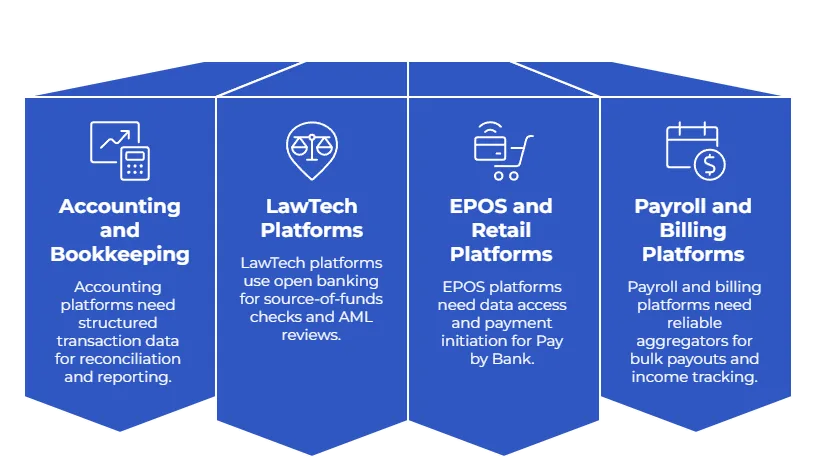
Accounting and Bookkeeping Platforms
Accounting platforms need open banking aggregators that deliver structured, categorised transaction data with consistent bank feed reliability. Finexer’s FCA-authorised AIS provides 99% UK bank coverage with real-time webhooks and categorised output – supporting reconciliation, MTD reporting, and client bank data workflows.
LawTech Platforms
LawTech platforms use open banking aggregators to access verified client bank transaction data for source-of-funds checks and AML reviews. Finexer’s AIS provides bank-authenticated transaction history with full consent logs and access timestamps that meet regulatory documentation requirements.
EPOS and Retail Platforms
EPOS platforms need an api aggregator covering both data access and payment initiation. Finexer’s FCA-authorised AIS and PIS enables Pay by Bank at checkout alongside structured transaction data for daily reconciliation.
Payroll and Billing Platforms
Payroll and billing platforms need reliable open banking aggregators for bulk payouts and income tracking. Finexer’s PIS supports bulk payout initiation alongside AIS for income verification – covering both payment and data workflows through a single integration.
Which bank aggregator is best for UK platforms?
The best api aggregator for a UK platform depends on the use case. For platforms building accounting, LawTech, EPOS, or billing workflows, key criteria are UK bank coverage, data quality, FCA authorisation, and AIS and PIS capability. Finexer is built specifically for these operational UK platform use cases.
What is the difference between open banking aggregators and direct bank integrations?
Open banking aggregators provide a single API connection to multiple UK banks – removing the need to build and maintain direct integrations with each bank individually. Direct integrations require separate technical agreements, development work, and ongoing maintenance per bank.
How do I verify if an open banking aggregator is FCA-authorised?
FCA authorisation can be verified on the FCA Financial Services Register. Platforms should confirm that their api aggregator holds AISP authorisation for data access and PISP authorisation for payment initiation before integration.
Build UK financial workflows on reliable open banking infrastructure.
About the Author

Ravi Ranjan
Ravi Ranjan is Co founder & CEO of Finexer