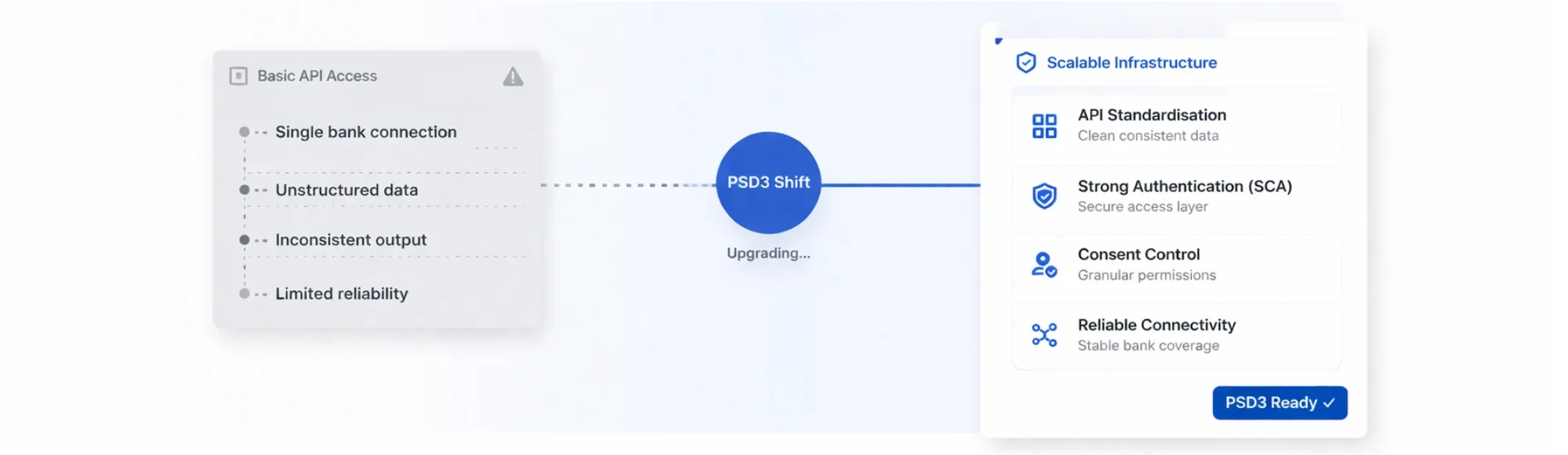
PSD3 is raising the infrastructure bar for platforms.
See how Finexer provides Open Banking infrastructure built for PSD3-ready financial data and payment workflows.
PSD3 open banking represents the next phase of financial regulation across Europe – and its implications for platforms extend well beyond compliance documentation. Where PSD2 established the legal framework for Open Banking access, PSD3 raises the standard for what compliant, reliable, and standardised financial infrastructure must deliver in practice.
For fintech founders, product teams, and compliance leads, the central question is not whether PSD3 applies. It is whether the infrastructure underpinning the platform is positioned to meet the direction PSD3 establishes – on API standardisation, data access reliability, strong customer authentication, and payment initiation controls.
Platforms currently operating on basic API integrations – single-purpose connections that were adequate under PSD2 – face a structural gap as regulatory and infrastructure standards converge on a higher baseline. PSD3 is expected to accelerate that gap into material future compliance and operational risk
This blog sets out what is PSD3, what it changes for platforms building on Open Banking infrastructure, and what the transition to production-grade financial systems requires in practice.
⚠️ Note: PSD3 has not yet entered into force. It remains in the EU legislative process following political agreement on the PSD3/PSR package in November 2025. This article focuses on the direction of travel and what platforms should consider now to prepare their Open Banking infrastructure.
TL;DR
PSD3 open banking raises the regulatory and technical standard for financial platforms across Europe. What is PSD3 in operational terms? It is the next generation of payments regulation mandating stronger API standardisation, enhanced consumer data protections, improved strong customer authentication, and more reliable payment infrastructure. For platforms, PSD3 signals the end of basic API access as a sufficient foundation – and the beginning of a compliance-driven shift toward scalable, production-grade Open Banking infrastructure.
Key Takeaways
What is PSD3 and how does it differ from PSD2?
PSD3 is the proposed third Payment Services Directive, building on PSD2 by mandating stronger API standardisation, improved strong customer authentication, enhanced consumer data rights, and more reliable Open Banking infrastructure across Europe. It raises the technical and compliance standard that financial platforms must meet.
How does PSD3 open banking affect platform infrastructure decisions?
PSD3 open banking shifts the standard for what compliant financial infrastructure must deliver – moving platforms away from basic API access toward production-grade data and payment systems with stronger reliability, security, and consent management requirements.
Does PSD3 apply to UK platforms post-Brexit?
The UK is not directly bound by PSD3 as EU legislation. However, the UK Payment Services Regulations review is progressing in parallel, and platforms operating across UK and European markets must monitor both regulatory directions simultaneously.
What infrastructure capabilities is PSD3 expected to introduce for platforms?
PSD3 open banking is expected to signal that platforms should operate on infrastructure supporting standardised API connectivity, robust strong customer authentication, reliable consent management, and documented data access controls – beyond what basic Open Banking API integrations typically provide.
Why is PSD3 an infrastructure decision and not solely a compliance exercise?
Because the requirements PSD3 is designed to introduce apply at the data access and payment initiation layer – the infrastructure layer. Platforms cannot satisfy future PSD3-aligned standards through compliance documentation alone if the underlying infrastructure does not support them operationally.
What Is PSD3 and What Does It Change?
The Regulatory Context
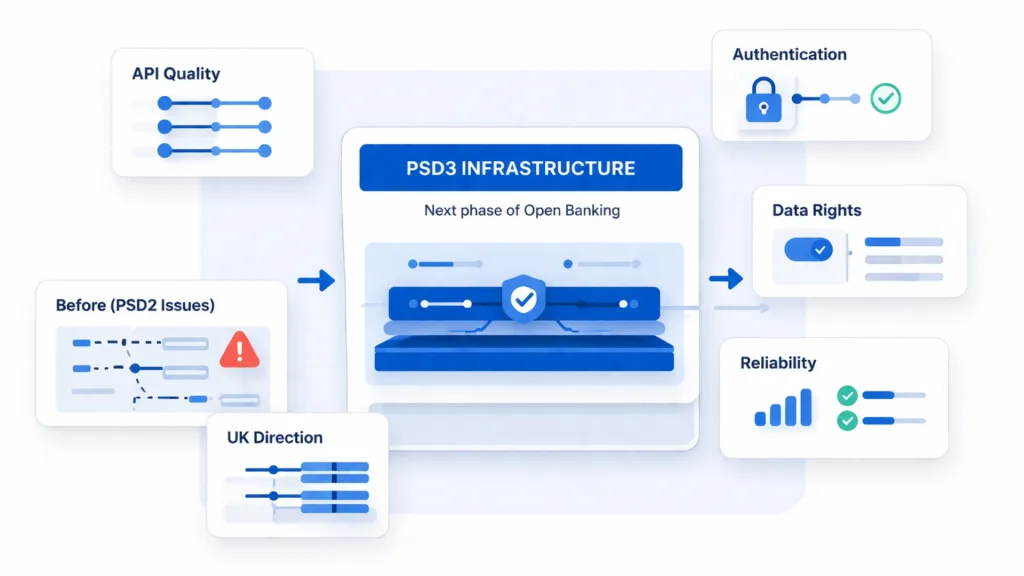
What is PSD3? PSD3 is the European Commission’s proposed revision of the Payment Services Directive, building on the Open Banking framework established under PSD2. While PSD2 mandated that banks open APIs to authorised third-party providers, PSD3 addresses the structural gaps that emerged in practice – inconsistent API quality, unreliable bank connectivity, authentication friction, and insufficient consumer data protections.
PSD3 and what platforms need to know covers the regulatory timeline in detail. The structural shift PSD3 represents is the relevant consideration for platform infrastructure decisions.
PSD3 is designed to introduce or strengthen requirements across four areas that are expected to directly affect how platforms build on Open Banking infrastructure:
- API standardisation – banks must provide dedicated, high-quality API interfaces meeting defined performance standards, addressing the inconsistency that fragmented Open Banking adoption under PSD2 created
- Strong customer authentication – enhanced SCA requirements with clearer exemption frameworks, reducing friction while maintaining security across payment and data access flows
- Consumer data rights – stronger consent frameworks, clearer data portability obligations, and enhanced protections governing how financial data is accessed, stored, and shared
- Payment infrastructure reliability – defined uptime and performance obligations for bank APIs, addressing connectivity gaps that have undermined Open Banking reliability in practice
“PSD3 is the point at which regulatory direction and infrastructure quality are converging. Platforms operating on basic API access should expect the compliance bar and the infrastructure bar to move in the same direction as PSD3 progresses.” – Clare, Finexer
What Is PSD3 in the UK Context
The UK departed the EU before PSD3 was finalised, meaning PSD3 does not apply directly as UK law. The UK Payment Services Regulations review is progressing in parallel, however – and the direction mirrors PSD3’s core principles on API quality, consumer protection, and payment infrastructure standards.
For platforms operating across UK and European markets, this requires monitoring two regulatory directions simultaneously. For UK-only platforms, the domestic regulatory trajectory is converging on equivalent standards regardless of the PSD3 designation.
How Does PSD3 Open Banking Raise the Infrastructure Bar?
From Basic API Access to Production-Grade Infrastructure
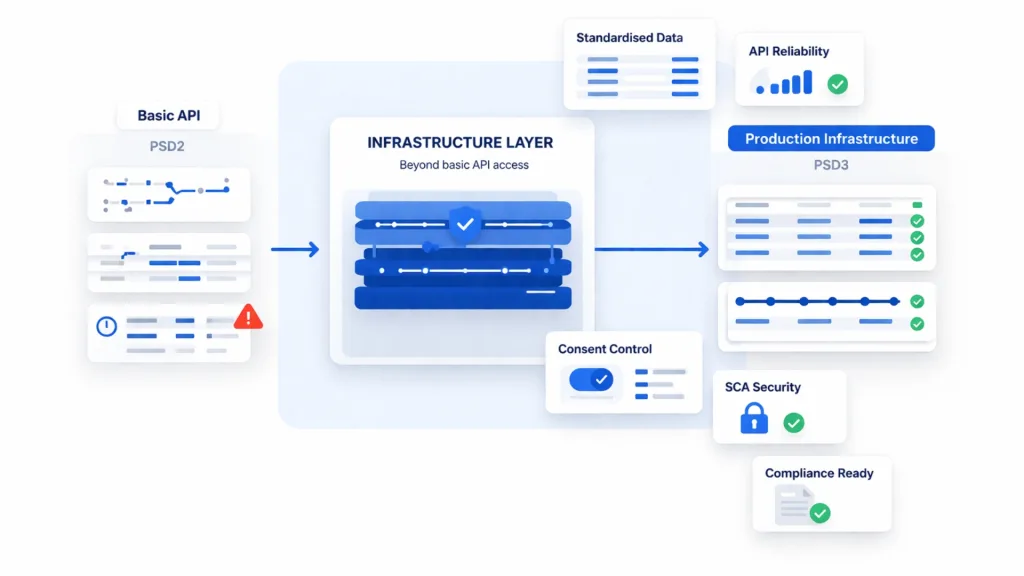
PSD2 established the legal right for platforms to access bank data and initiate payments through Open Banking APIs. What it did not guarantee was the quality, reliability, or standardisation of that access. The result was significant variation in API performance, authentication friction, and data consistency across institutions.
PSD3 open banking addresses this directly. The direction is from permitting Open Banking access toward requiring that access meets defined quality and reliability standards. For platforms, this distinction has material operational implications.
Basic API access was sufficient to operate under PSD2. As PSD3 develops, platforms should prepare for infrastructure standards that are expected to deliver:
- Consistent, standardised data output across all connected institutions
- Reliable API uptime and performance within defined benchmarks
- Robust consent management with granular permissions and revocation capability
- Strong customer authentication flows meeting enhanced SCA requirements
- Documented data access controls satisfying both GDPR and payment regulation obligations
Open Banking trends and infrastructure developments covers the broader market direction that PSD3 is accelerating for UK and European platforms.
Why This Is an Infrastructure Decision, Not a Documentation Exercise
The requirements PSD3 open banking is designed to introduce cannot be addressed at the policy layer. A platform cannot satisfy PSD3-aligned API standardisation requirements by updating its privacy policy. It cannot meet enhanced SCA obligations through compliance documentation if the underlying authentication architecture does not support them.
PSD3 requirements operate at the infrastructure layer – which means the compliance question is inseparable from the infrastructure question. Platforms operating on fragmented, basic API integrations face a structural gap, not a documentation gap.
How Should Platforms Evaluate Their Infrastructure Against PSD3?
The Evaluation Framework
| PSD3 Requirement Area | What It Means for Platforms | What to Look For in Infrastructure |
|---|---|---|
| API Standardisation | Bank APIs must meet defined quality and performance standards – platforms need consistent data output across all connected institutions | Standardised transaction data output, 99%+ UK bank coverage, normalised data formats across institutions |
| Strong Customer Authentication | Enhanced SCA requirements with clearer exemption frameworks – authentication flows must meet updated technical standards | FCA-authorised consent flows, granular permission scopes, compliant authentication architecture |
| Consumer Data Rights | Stronger consent frameworks and data portability obligations – platforms must document and control how financial data is accessed and shared | Time-limited consent, instant revocation capability, full consent logs and access timestamps |
| Payment Infrastructure Reliability | Expected stronger obligations around API uptime, availability, and performance for payment initiation – unreliable connectivity may present future compliance risk as PSD3 develops | Real-time webhooks, defined latency benchmarks, stable bank connectivity with failure handling |
| Data Access Controls | Documented controls over third-party financial data access – platforms remain responsible for their infrastructure layer | FCA-authorised AISP and PISP status verifiable on FCA register, data processing documentation |
How Does Finexer Support PSD3-Aligned Infrastructure?
Finexer is an FCA-authorised Open Banking infrastructure provider operating under PSD2 and UK Open Banking standards. For platforms assessing their infrastructure against the direction PSD3 is expected to establish, Finexer provides a PSD2-compliant foundation built on the same principles PSD3 is designed to strengthen – standardisation, reliability, consent management, and data access controls.
What Finexer’s Infrastructure Provides
- FCA-authorised AIS and PIS – verifiable on the FCA register
- 99% UK bank coverage with standardised, normalised data output across institutions
- Granular consent flows with time-limited permissions and instant revocation capability
- Full consent logs and access timestamps per data retrieval
- Real-time webhooks for transaction events and payment confirmations
- White-label consent architecture compliant with SCA requirements
- Usage-based pricing with 3-5 weeks onboarding support
“The platforms that navigate PSD3 most effectively will be those whose infrastructure already meets the standardisation and reliability requirements PSD3 mandates. Compliance documentation follows infrastructure quality – not the other way around.” – Clare, Finexer
What I Feel
PSD3 open banking is the clearest regulatory signal the market has received that basic API access is not the destination – it is the minimum starting point.
Platforms that approached Open Banking as a feature integration rather than an infrastructure investment are now facing a regulatory trajectory that validates exactly that distinction. What is PSD3 ultimately establishing? A standard that rewards platforms built on reliable, standardised infrastructure and creates material compliance exposure for those that are not.
The platforms best positioned for PSD3 are not necessarily those with the most detailed compliance frameworks. They are the ones that moved beyond fragmented API integrations before the regulatory pressure arrived.
Common Use Cases

Fintech SaaS Platforms
Fintech SaaS platforms building financial data and payment features require infrastructure that meets PSD3-aligned standards on API consistency, consent management, and data access documentation. Finexer’s FCA-authorised AIS and PIS provide the standardised foundation aligned with PSD3 open banking requirements – supporting compliant product development without fragmented bank integrations.
Accounting and ERP Platforms
Accounting platforms managing client financial data require Open Banking infrastructure that delivers consistent, standardised transaction data across all connected UK banks. Finexer’s AIS provides normalised data output with consent logs and access controls that align with PSD3’s enhanced data rights framework.
LawTech and Compliance Platforms
LawTech platforms operating under FCA and AML obligations require infrastructure supporting documented data access controls and consent audit trails. Finexer’s AIS provides bank-authenticated transaction data with full consent logs – meeting the data access documentation requirements that PSD3 open banking mandates.
Insurtech Platforms
Insurtech platforms accessing client financial data for underwriting require infrastructure with granular consent management and instant revocation capability. Finexer’s FCA-authorised AIS aligns consent architecture with PSD3’s enhanced consumer data rights framework – providing a compliant foundation for financial data workflows.
What is PSD3 and when does it take effect?
PSD3 is the European Commission’s proposed third Payment Services Directive, building on PSD2 to mandate stronger API standardisation, enhanced strong customer authentication, and improved consumer data protections across Open Banking. Final implementation timelines are subject to the EU legislative process. UK platforms should monitor both PSD3 and the UK Payment Services Regulations review in parallel.
How does PSD3 open banking affect platforms already operating under PSD2?
PSD3 open banking raises the quality and reliability standard beyond PSD2 requirements. Platforms operating on basic API integrations that satisfy PSD2 may find those integrations insufficient against PSD3-aligned standards on API standardisation, consent management, and payment infrastructure reliability.
Does a UK platform need to comply with PSD3?
PSD3 is EU legislation and does not apply directly to UK-only platforms post-Brexit. However, the UK Payment Services Regulations review is moving in an equivalent direction. Platforms operating across UK and European markets must monitor both frameworks, and UK-only platforms should treat PSD3’s direction as an indicator of where domestic regulation is heading.
Build on Open Banking infrastructure positioned for where regulation is heading.
About the Author

Clare Pearson
Clare Pearson is a senior payments professional with extensive experience across the global financial services and payments industry. She specialises in Open Banking, payment infrastructure, and financial technology transformation, with expertise spanning product delivery, operational strategy, regulatory compliance, and large-scale payments programmes. Clare currently serves as a Non-Executive Director at Finexer and a panel member for the Payment Systems Regulator (PSR), advising on the development of payment systems policy and innovation