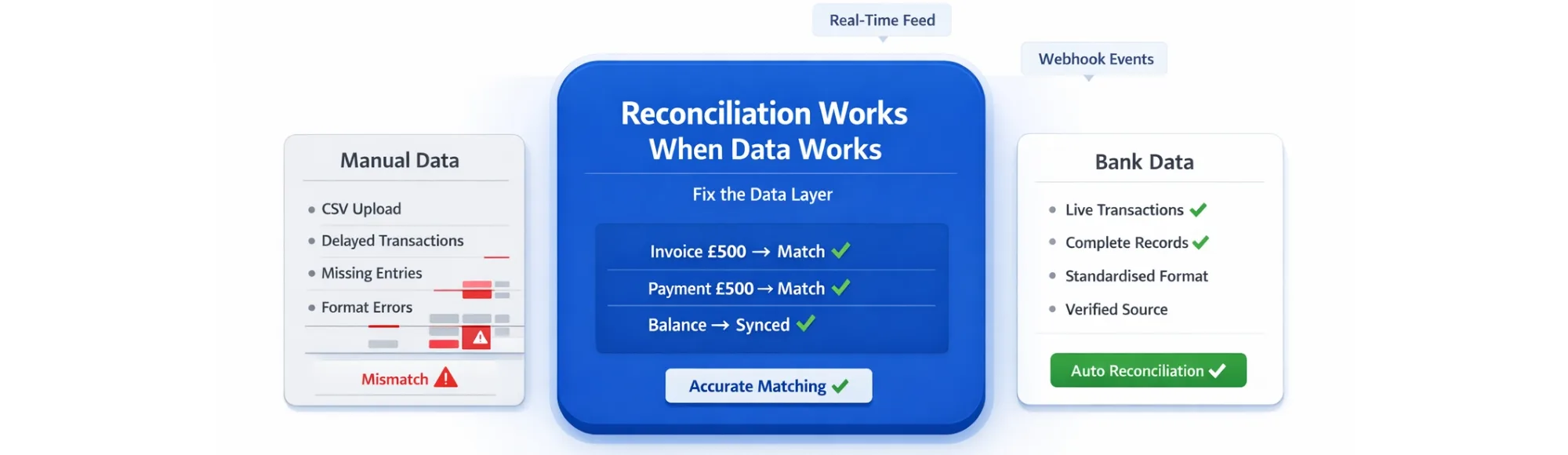
Reconciliation breaking at month-end because your data layer is unreliable?
Finexer provides real-time bank transaction data for accounting integration that actually works.
Accounting integration is not a software configuration problem. It is a data quality problem.
At Finexer, I work with accounting SaaS and ERP platforms that have built solid matching logic, well-designed workflows, and compliant reporting pipelines – and still face reconciliation failures every month. The issue is never the reconciliation engine. It is what feeds it.
When transaction data arrives late, in inconsistent formats, or from sources that cannot be verified, reconciliation of payments fails regardless of how well the matching logic is built. This blog covers where accounting integration breaks down at the data layer, what reliable reconciliation actually requires, and how real-time bank data infrastructure closes the gap.
TL;DR
Accounting integration fails at the data layer, not the reconciliation engine. CSV exports are delayed, inconsistently formatted, and unverifiable at source. Reliable reconciliation of payments requires real-time, bank-verified transaction data via FCA-authorised AIS – structured, continuous, and consistent across every UK bank. Finexer provides that data layer for UK accounting SaaS and ERP platforms.
Key Takeaways
Why does accounting integration fail at the data layer?
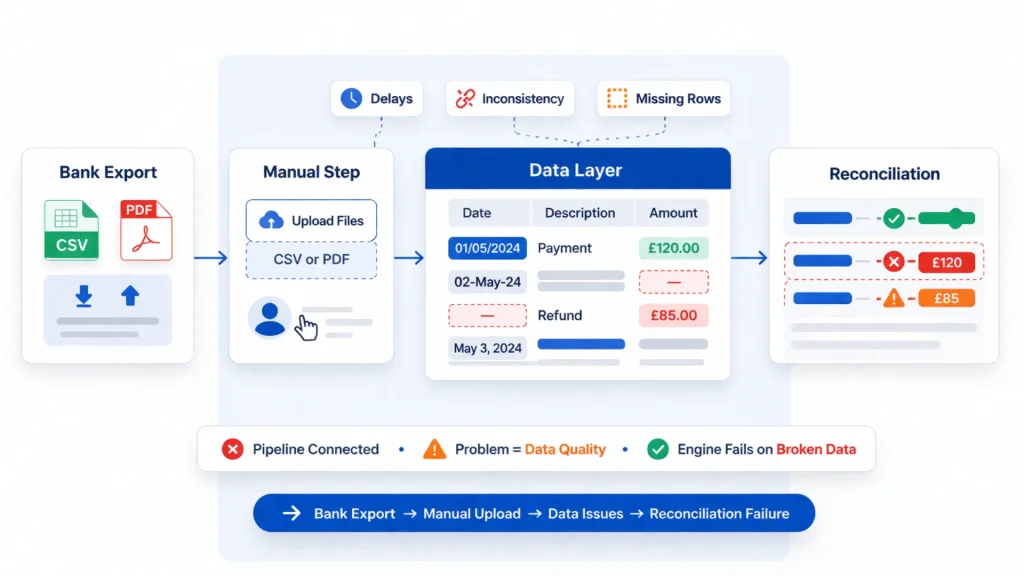
Most accounting integration pipelines depend on a manual step – a CSV export, a PDF upload, or a scheduled batch pull. That manual step introduces latency, format inconsistencies, and silent failures that make reconciliation of payments unreliable before matching logic even runs.
What does reliable reconciliation of payments require from data infrastructure?
Reconciliation requires transaction data that is current, complete, consistently structured, and verifiable at source. A bank statement PDF or CSV export meets none of these requirements reliably at scale.
How does real-time bank data change the reconciliation workflow?
Real-time AIS data eliminates the gap between when a transaction settles and when the accounting platform sees it. Reconciliation runs on current data – not yesterday’s export or last week’s upload.
What is the difference between accounting integration and data synchronisation?
Integration means the accounting system is connected to a reliable data source. Synchronisation means data flows continuously without manual steps. Most platforms have integration without synchronisation – which is why reconciliation of payments breaks.
Why Does Accounting Integration Break at the Data Layer?
Why Does Every Accounting Pipeline Have a Manual Step?
Every accounting SaaS platform I work with has at least one manual step in its data pipeline.
A user exports a CSV from their bank. Upload it to the platform. The platform parses it, maps the columns, and imports the transactions. The reconciliation engine runs.
That pipeline works. Until the user forgets to export. Until the bank changes its CSV format. Until the export covers the wrong date range. Until two transactions arrive in one file and one arrives in another.
The reconciliation of payments is not failing because the matching logic is wrong. It is failing because the data that reaches the matching logic is incomplete, delayed, or inconsistent.
“At Finexer, I see this pattern constantly. The platform has invested heavily in reconciliation logic but is running it against data that is days old and formatted differently by every bank. The data layer is the problem – not the engine.” – Ravi, Finexer
Why Do CSV and PDF Imports Fail at Scale?
CSV exports from UK banks are not standardised. Every institution formats its export differently – column headers, date formats, transaction reference structures, and amount representations all vary.
An accounting integration built on CSV imports requires bank-specific parsing logic for every supported institution. That logic breaks when banks update their export templates – which they do, without notice.
PDF bank statements are worse. Extracting structured transaction data from a PDF requires optical character recognition or manual entry. Neither is reliable at volume.
Why financial reconciliation fails without verified bank data covers the data quality failures that downstream reconciliation workflows cannot compensate for.
How Does Data Latency Break Reconciliation of Payments?
A CSV exported today contains transactions up to yesterday. A PDF statement covers the last 30 days. Neither gives the accounting platform visibility of what happened this morning.
For platforms running reconciliation of payments in near-real time – invoice matching, cash position monitoring, payment confirmation – latency in the data layer is a structural limitation. It cannot be solved at the reconciliation layer. It must be solved at the data source.
How Open Banking works for accounting and ERP systems covers how platforms move from batch-based data pipelines to real-time bank connectivity.
What Does Reliable Reconciliation of Payments Actually Require?
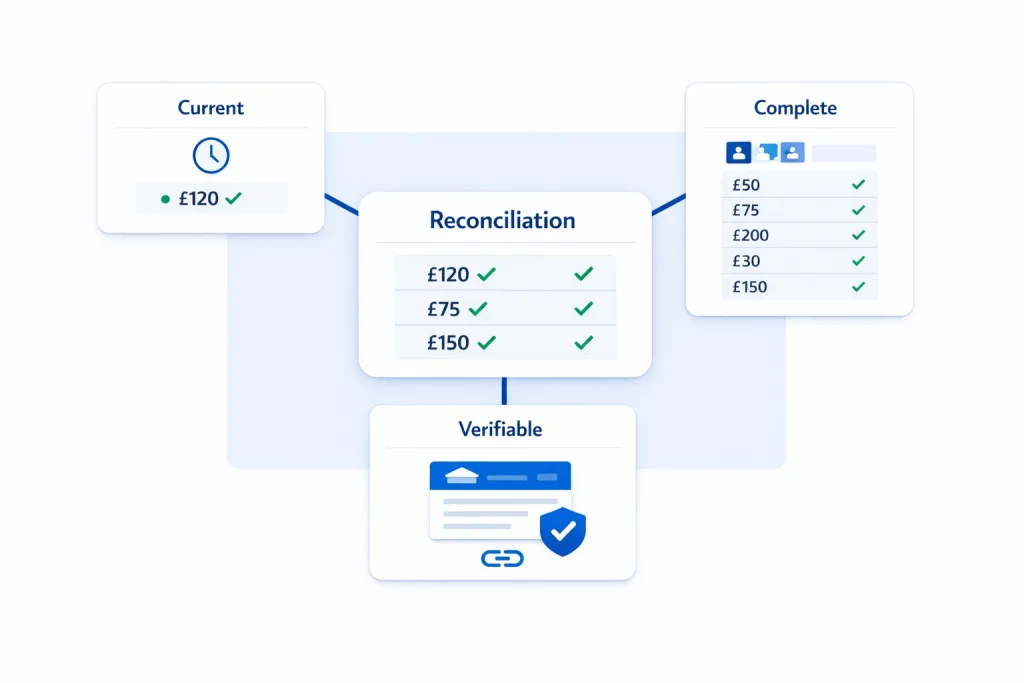
What Data Properties Does Reliable Reconciliation Require?
Reliable accounting integration requires three data properties that manual imports cannot guarantee:
- Current – transactions arrive as they settle, not in the next export cycle. A payment that cleared at 9am is visible to the reconciliation engine at 9am.
- Complete – all transactions across consented accounts are retrieved automatically. No dependency on a user selecting the correct date range during an export.
- Verifiable – data comes directly from the bank via FCA-authorised AIS. Bank-authenticated at source. No intermediate document that could be incomplete or misformatted.
Automated payment reconciliation for UK platforms covers how platforms implement reconciliation automation once the data layer is resolved.
Why Does Schema Consistency Matter Across UK Banks?
Accounting SaaS and ERP platforms connect users across the full range of UK banking institutions – high street banks, challengers, and business banking providers.
Reconciliation logic requires a consistent transaction schema. Merchant name, amount, date, counterparty reference, category code. That schema must be identical whether the transaction came from Barclays, Monzo, or Lloyds.
FCA-authorised AIS delivers a standardised JSON output regardless of source bank. The accounting integration receives the same structure every time. Matching logic is written once and applied across all connected institutions.
| Data Source | Latency | Format Consistency | Verifiable at Source | Suitable for Reconciliation? |
|---|---|---|---|---|
| CSV bank export | Manual – hours to days | Varies by bank and export version | No – user-generated document | No – latency and format gaps |
| PDF bank statement | Manual – days to weeks | No standard structure | No – document authenticity unverifiable | No – requires OCR or manual entry |
| Third-party aggregator (screen scraping) | Batch – typically daily | Inconsistent – breaks on bank UI changes | No – not FCA-authorised data access | Partial – reliability and compliance risk |
| FCA-authorised AIS (Open Banking) | Real-time via webhooks | Standardised JSON across all UK banks | Yes – bank-authenticated at source | Yes – current, complete, verifiable |
How Does Finexer Support Accounting Integration for UK Platforms?
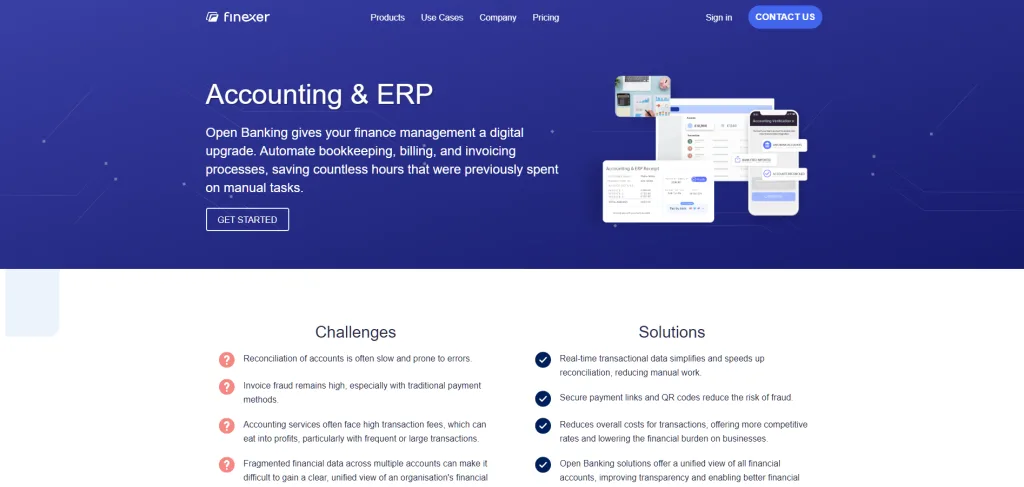
For accounting SaaS and ERP platforms that have tried CSV-based reconciliation at scale and hit the ceiling – Finexer’s FCA-authorised AIS is the data layer replacement. Structured, real-time bank transaction data that accounting integration workflows can depend on.
How Finexer supports accounting and ERP platforms covers the full use case mapping for platforms building on Finexer’s AIS infrastructure.
What Does Finexer’s Infrastructure Provide?
- FCA-authorised AIS – verifiable on the FCA register, read-only bank data access
- Real-time webhooks delivering transaction events as they settle
- Standardised JSON output – consistent schema across all connected UK banks
- 99% UK bank coverage across retail, business, and challenger banks
- Up to 7 years of transaction history for historical reconciliation and onboarding
- Merchant identifiers and category codes per transaction
- Multi-account connectivity from a single consent-based API connection
- Consent logs and timestamps per data retrieval for audit trail support
- White-label consent flows under the platform’s own brand
- Usage-based pricing – scales with client volume
- 3-5 weeks onboarding support to reach production deployment
“The accounting platforms that stop having reconciliation problems are the ones that resolve the data layer first. Real-time, bank-verified transaction data is not a feature upgrade. It is the foundation that makes reliable reconciliation of payments possible.” – Ravi, Finexer
What I Feel
I have seen platforms rebuild their reconciliation engine three times without fixing their reconciliation failure rate. The engine was never the problem.
The data layer was. Stale exports. Inconsistent formats. Missing transactions. Accounts the user forgot to include in the last CSV upload.
Financial data integration for UK accounting platforms covers the architectural shift from manual imports to continuous bank data connectivity in detail.
Accounting integration built on manual data inputs will always produce unreliable reconciliation of payments. Not occasionally. Structurally. The only fix is removing the manual step entirely – and that requires direct bank data access via FCA-authorised AIS.
Common Use Cases
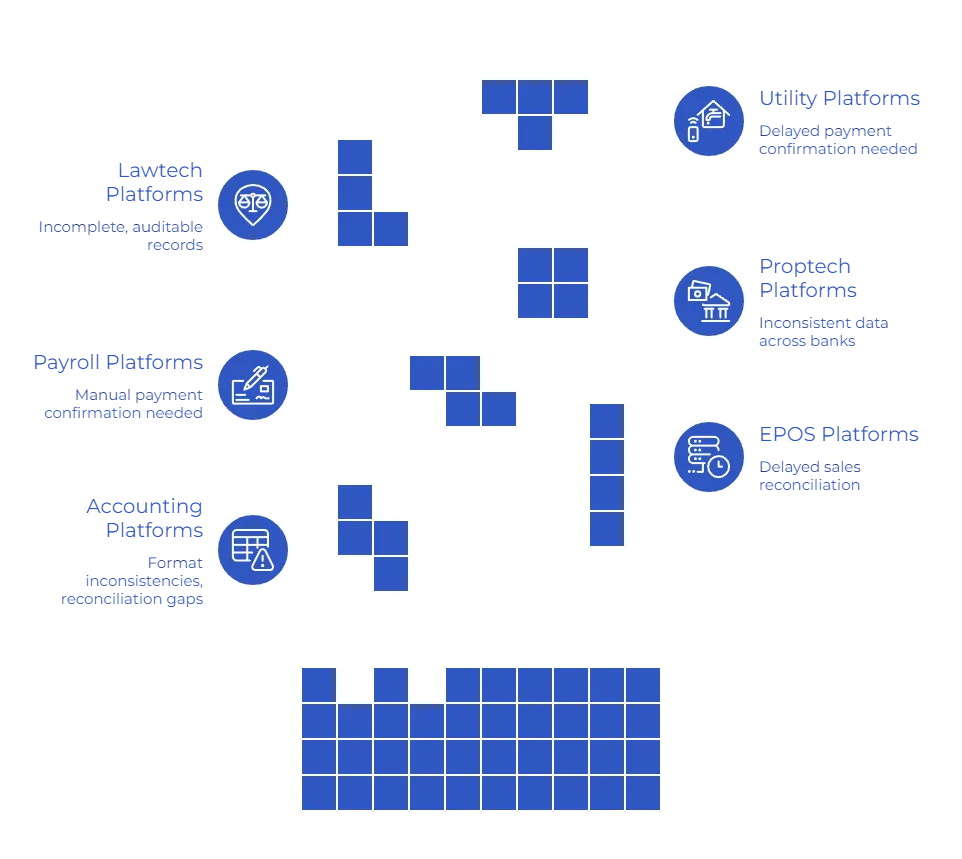
Accounting & ERP Platforms
CSV imports create format inconsistencies and reconciliation gaps at scale. Finexer’s AIS delivers real-time, standardised transaction feeds from client bank accounts – enabling accounting integration that reconciles current bank-verified data automatically.
EPOS Platforms
Daily sales reconciliation against bank receipts is delayed by batch settlement files. Finexer’s AIS provides real-time transaction data per payment event – matching against till records without end-of-day delays.
Payroll & Invoicing Platforms
Confirming outbound payment clearance requires real-time bank visibility. Finexer’s AIS delivers webhook-based transaction events as disbursements settle – enabling automated corporate bulk payment reconciliation without manual checks.
Proptech & Real Estate Platforms
Multi-bank rental income reconciliation requires consistent transaction data across institutions. Finexer’s AIS provides a single structured data feed across all consented accounts – removing the format inconsistency problem entirely.
Lawtech Platforms
SRA client account reconciliation requires complete, auditable records. Finexer’s AIS provides timestamped, consent-logged transaction data per account – supporting reconciliation of payments with a full audit trail.
Utility Billing Platforms
Matching incoming payments against billing records needs real-time receipt confirmation. Finexer’s AIS delivers payment confirmation per transaction – enabling billing cycle reconciliation without delayed settlement reports.
Why does reconciliation of payments fail in accounting platforms?
Reconciliation fails when the data feeding it is delayed, incomplete, or inconsistently formatted. CSV exports and PDF statements introduce all three problems. Real-time AIS data removes them.
What is the difference between accounting integration and bank feed connectivity?
Accounting integration connects the platform to a data source. Bank feed connectivity via FCA-authorised AIS is the most reliable form – structured, real-time, and bank-verified rather than dependent on user-initiated exports.
How does Open Banking AIS improve reconciliation accuracy for accounting platforms?
AIS delivers bank-verified transaction data in a standardised format across all UK banks – eliminating the format inconsistencies and latency gaps that CSV-based accounting integration creates in reconciliation workflows.
Resolve reconciliation failures at the data layer with FCA-authorised bank transaction infrastructure.
About the Author

Ravi Ranjan
Ravi Ranjan is Co founder & CEO of Finexer