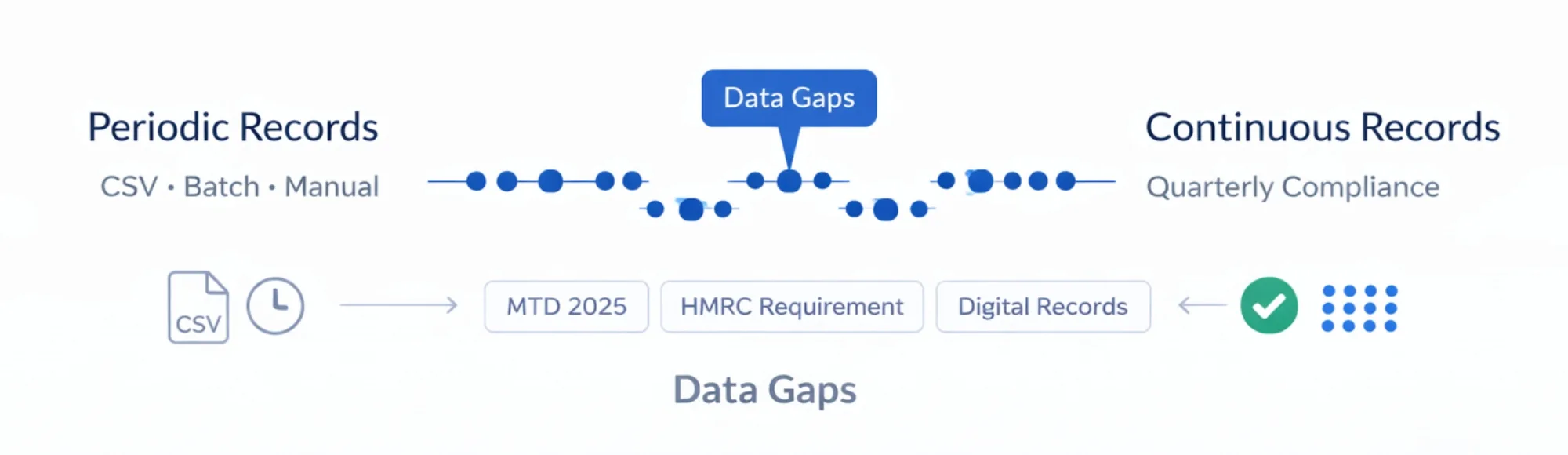
MTD infrastructure gap starts now.
Bank-verified transaction data for MTD income tax 2026 compliance.
MTD income tax 2026 is not a new filing form. It is a fundamentally different way of maintaining financial records.
From 6 April 2026, self-employed individuals and landlords with combined gross income over £50,000 must keep digital records continuously and submit quarterly updates to HMRC. Annual self-assessment is replaced. The data requirement is permanent and ongoing.
Most accounting SaaS and tax platforms have prepared for the submission layer. Very few have prepared for the data layer underneath it.
In my work with accounting platforms at Finexer, the MTD readiness gap is almost always in the data infrastructure – not the filing mechanism.
TL;DR
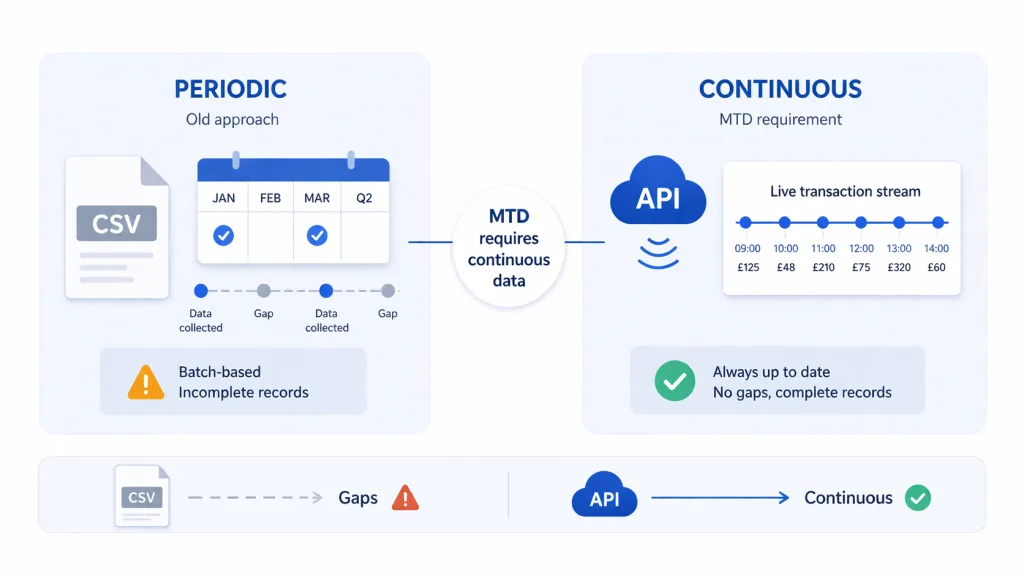
MTD income tax 2026 requires continuous digital records and four quarterly submissions per year from 6 April 2026 for those with income over £50,000 – dropping to £30,000 from April 2027. The HMRC MTD income tax changes 2026 are not a compliance checkbox. They require a shift from periodic data collection to continuous bank-verified record keeping. Platforms built on CSV imports and scheduled feeds cannot meet this standard reliably.
Key Takeaways
What are the MTD income tax 2026 requirements?
From 6 April 2026, affected taxpayers must:
- Keep digital records of all income and expenses with date, amount, and category
- Submit four quarterly updates to HMRC each year
- File an End of Period Statement (EOPS) annually
- Use HMRC-compatible software with digital links throughout
The threshold applies to self-employed individuals and landlords with combined gross income over £50,000.
Why is MTD income tax 2026 an infrastructure problem, not a compliance feature?
HMRC MTD income tax changes 2026 require continuous digital records – not records assembled at quarter-end. A platform that collects data periodically and reconstructs it before submission does not meet the standard. The record must reflect actual financial activity throughout the period, not a retrospective approximation.
What breaks in current systems under MTD income tax 2026?
- CSV imports miss transactions between export windows, leaving gaps in the digital record
- Delayed bank feeds deliver data hours or days after occurrence – not genuinely continuous
- Manual entry introduces errors that accumulate across the period and carry into quarterly submissions
What Do the HMRC MTD Income Tax Changes 2026 Actually Require?
What Is the MTD Timeline and Threshold?
MTD income tax 2026 applies in two phases:
| Date | Who Is Affected | Income Threshold | Requirement |
|---|---|---|---|
| 6 April 2026 | Self-employed and landlords | Combined gross income over £50,000 | Digital records, 4 quarterly updates, EOPS |
| April 2027 | Self-employed and landlords | Combined gross income over £30,000 | Same requirements, wider population |
According to HMRC’s guidance on MTD for Income Tax eligibility, the first quarterly submission for the 2026/27 tax year is due approximately 7 August 2026.
Making Tax Digital for Income Tax – platform preparation guide covers the full MTD ITSA timeline, submission requirements, and what HMRC-compatible software must deliver.
“The HMRC MTD income tax changes 2026 are clear on the submission requirements. What is less discussed is the data quality standard underneath them. A quarterly update submitted from incomplete records is not compliant – even if the submission itself processes correctly.” – Clare, Finexer
Why Are Most Systems Not Ready for MTD Income Tax 2026?
Where Do Current Platforms Break Under MTD Requirements?
The MTD income tax 2026 problem is not submission. It is continuity.
Most platforms currently collect client financial data through methods that create gaps:
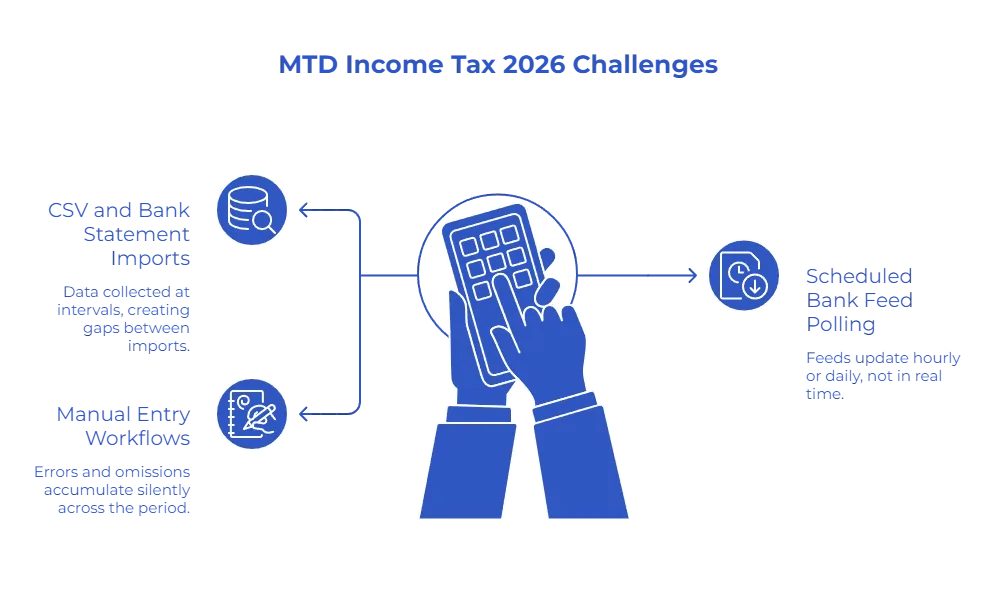
CSV and bank statement imports:
- Data collected at intervals – weekly, monthly, or at quarter-end
- Transactions between imports are missing until the next collection cycle
- The digital record is a series of snapshots, not a continuous record
Scheduled bank feed polling:
- Feeds update hourly or daily, not in real time
- A transaction that cleared at 9am may not appear until midnight
- Technically automated, but not genuinely continuous
Manual entry workflows:
- Errors and omissions accumulate silently across the period
- Incorrect categorisation propagates into every quarterly update
- No verification against the actual bank record
All three methods create records that look complete but contain gaps HMRC’s standard does not accept.
Making Tax Digital for Income Tax software requirements and compatibility covers what HMRC-compatible software must deliver and where current integrations fall short.
MTD for ITSA – what accountants and platforms need to know covers the specific digital record standards HMRC applies and the difference between compliant and non-compliant data collection.
How Does Finexer Support MTD Income Tax 2026 Readiness?
What Does Finexer’s AIS Provide for MTD Compliance?
MTD income tax 2026 readiness requires one thing above all: continuous bank-verified transaction data. Finexer’s FCA-authorised AIS provides exactly this for accounting SaaS and tax platforms:
- Real-time webhooks – each transaction delivered at occurrence, no polling gaps in the digital record
- Merchant IDs and category codes – correct expense classification from source, not inferred from descriptions
- Up to 7 years of transaction history – complete historical data for EOPS and HMRC review
- Consent logs and access timestamps – per-retrieval audit trail supporting HMRC compliance
- Structured JSON – consistent schema across almost all major UK banks
- Multi-account access in one consent flow – full financial picture per client
MTD exemption criteria and who qualifies covers the limited circumstances where platforms may apply for digital exclusion on behalf of clients.
“MTD income tax 2026 is a data infrastructure standard dressed as a filing requirement. The platforms that understand this early – and build continuous bank-verified records into their data layer now – will serve clients reliably through both the 2026 and 2027 thresholds.” – Clare, Finexer
What I Feel
MTD income tax 2026 is arriving in a market where most platforms are prepared for the submission but not the record.
The submission is the easy part. HMRC-compatible software handles it. What HMRC actually requires is a continuous, verified digital record behind every submission.
Periodic import workflows cannot produce this. A different data source is required – one that delivers transactions as they occur, with the structure and categorisation already applied.
The platforms that solve this before April 2026 will not just be compliant. They will be architecturally ready for the 2027 threshold expansion too.
What is MTD income tax 2026 and who does it affect?
MTD income tax 2026 applies from 6 April 2026 to self-employed individuals and landlords with combined gross income over £50,000. They must keep continuous digital records, submit four quarterly updates to HMRC each year, and file an annual End of Period Statement using HMRC-compatible software.
Why do current accounting systems fail MTD income tax 2026 requirements?
Current systems fail because they collect data periodically rather than continuously. HMRC MTD income tax changes 2026 require digital records that reflect actual financial activity throughout the period – not records assembled at quarter-end from CSV imports, scheduled feeds, or manual entry.
How does continuous bank data improve MTD income tax 2026 compliance?
FCA-authorised AIS delivers each bank transaction via webhook at the moment it occurs – with merchant IDs and category codes already applied. This gives accounting and tax platforms a genuinely continuous bank-verified digital record that meets MTD’s ongoing record-keeping standard without periodic data collection.
Build MTD income tax 2026 readiness on continuous bank transaction data.
About the Author

Clare Pearson
Clare Pearson is a senior payments professional with extensive experience across the global financial services and payments industry. She specialises in Open Banking, payment infrastructure, and financial technology transformation, with expertise spanning product delivery, operational strategy, regulatory compliance, and large-scale payments programmes. Clare currently serves as a Non-Executive Director at Finexer and a panel member for the Payment Systems Regulator (PSR), advising on the development of payment systems policy and innovation