Fewer intermediaries. Faster settlement. Real-time confirmation.
Open Banking payment infrastructure for billing, payment, and ERP platforms.
Delay payments are a persistent operational problem for billing platforms, payment SaaS, and ERP systems – and the cause is almost never the bank.
It is the infrastructure sitting between the payer and the recipient. Understanding payment service provider vs payment processor is the starting point for understanding why.
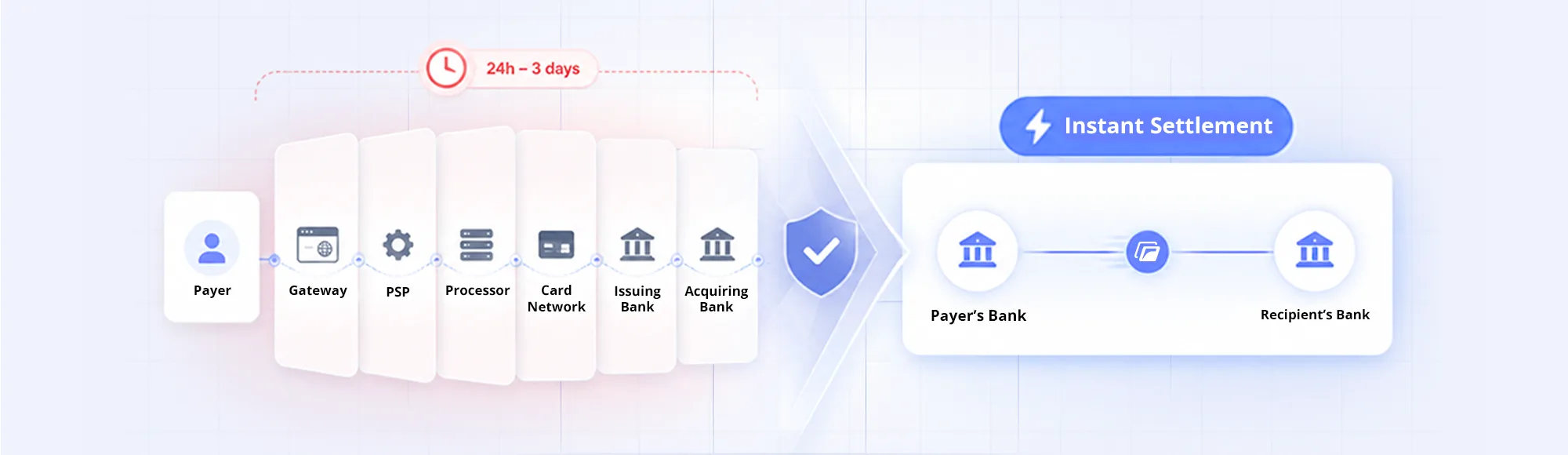
Most payment flows pass through multiple layers before funds settle: a payment gateway, a payment service provider, a payment processor, card networks, the issuing bank, and the acquiring bank. Each layer adds latency. Each handoff creates a potential failure point. And each intermediary charges for the privilege.
UK Open Banking payments reached 37.46 million in March 2026 – up 14.1% month on month – as platforms increasingly move towards direct bank-based payment flows that reduce this layering.
TL;DR
Delay payments occur when transactions pass through multiple intermediaries – gateway, PSP, processor, card networks, issuing bank, acquiring bank – before settling. Understanding payment service provider vs payment processor is key: a PSP bundles gateway and processing into one solution, while a payment processor handles the technical movement of funds between banks. Card-based flows through these layers take 24 hours to 3 days to settle. Account-to-account payments via Open Banking bypass card network intermediaries and settle via Faster Payments – reducing the layers where delays accumulate.
Key Takeaways
What causes delay payments in platform payment flows?
Delay payments accumulate at three points in the standard card payment chain:
- Between gateway and processor – the gateway batches transactions before passing them to the processor. Batch processing introduces latency between authorisation and settlement instruction.
- Through card networks – Visa and Mastercard route transactions between issuing and acquiring banks. Each routing step adds processing time and a potential failure point.
- Bank settlement window – card payments settle T+1 to T+3 depending on acquirer. The funds are authorised but not yet available. Platforms are reconciling against a position that has not cleared.
What is the difference between payment service provider vs payment processor?
A payment service provider (PSP) is a company that gives a platform everything needed to accept payments – the payment gateway, access to card network processing, fraud checks, and a merchant account – in a single integrated solution. Examples: Stripe, PayPal, Square.
A payment processor is the backend infrastructure that routes transaction data between the merchant’s acquiring bank and the customer’s issuing bank through card networks. It handles authorisation and settlement mechanics. PSPs typically sit on top of payment processors – the PSP manages the relationship, the processor moves the funds.
How do infrastructure choices affect payment delay?
More intermediaries = more delay payments. A payment going from payer to recipient via gateway → PSP → processor → card network → issuing bank → acquiring bank passes through six layers. Each layer adds latency and a potential hold. Account-to-account payments via Open Banking PIS go directly from payer’s bank to recipient’s bank – two layers, instant settlement via Faster Payments.
Why Do Payments Delay Even With Modern Systems?
What Creates Settlement Delays in Standard Payment Infrastructure?
The card payment system was not built for speed. It was built for scale and interoperability across thousands of banks and institutions globally.
That architecture creates structural latency at every layer.
Card settlement timelines (verified):
- Credit and debit card payments: 24 hours to 3 working days to settle into the merchant account
- BACS Direct Debit: 3 working days
- CHAPS: same-day but with cut-off times and high per-transaction cost
- Faster Payments (bank-to-bank): typically minutes
The gap between authorisation and settlement is where delay payments live. A card payment is authorised in seconds – the customer sees a confirmation. But the funds do not reach the merchant account for up to 3 days. In the intervening period, the platform’s cash position is uncertain.
For billing platforms and payment SaaS processing high volumes, this settlement lag compounds. The reconciliation step depends on data that is still in transit.
| Payment Method | Intermediaries | Settlement Time | Confirmation |
|---|---|---|---|
| Card (via PSP) | Gateway → PSP → Processor → Card Network → Banks | T+1 to T+3 | Authorisation instant, settlement delayed |
| BACS Direct Debit | Bacs clearing system → Banks | 3 working days | Batch notification |
| CHAPS | Bank of England RTGS → Banks | Same day (cut-off applies) | Same day, high cost |
| Pay by Bank (Open Banking) | Payer bank → Faster Payments → Recipient bank | Instant | Real-time webhook per payment |
“Delay payments are almost never caused by slow banks. They are caused by the number of systems the payment passes through before reaching the bank. Each layer is a delay. Each intermediary is a fee. Reducing the layers reduces both.” – Ravi, Finexer
Payment gateway vs PSP vs payment processor explained covers the structural differences between payment gateways, PSPs, and processors and how each affects settlement timelines.
What Is the Operational Impact of Delay Payments on Platforms?
How Do Settlement Delays Affect Billing and Payment Platforms?
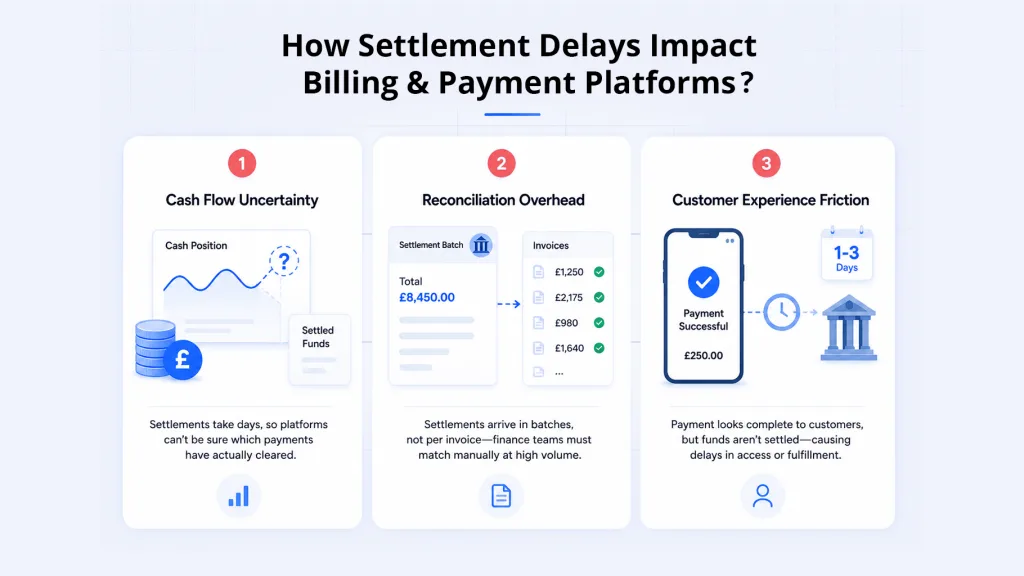
For platforms processing payments on behalf of clients, delay payments create three operational problems.
- Cash flow uncertainty: A billing platform collecting on behalf of 500 clients, each with 3-day card settlement, cannot confirm which payments have cleared at any given point. Cash flow reporting is based on authorised amounts, not settled funds. Decisions made on unsettled data carry inherent risk.
- Reconciliation overhead: Card payments settle in batches – not per-invoice. The settlement amount arriving in the merchant account does not map directly to individual invoices. Finance teams match settlement batches to original transactions manually. At volume, this is the single largest source of reconciliation cost.
- Customer experience friction: From the payer’s perspective, the card payment is completed immediately. From the platform’s perspective, it has not settled. If the platform gates access or fulfilment on settled funds, the gap between authorisation and settlement creates a friction window that customers experience as delay.
How to fix bank payment delays for payment platforms covers how payment infrastructure choices affect settlement speed and what platforms can do to reduce delay payments operationally.
How Does Open Banking Reduce Delay Payments?
Why Does Account-to-Account Payment Reduce Settlement Delay?
Account-to-account (A2A) payment via Open Banking PIS removes the card network intermediaries from the payment flow entirely.
The payment goes from the payer’s bank account directly to the recipient’s bank account via Faster Payments. No card network. No PSP processing layer. No T+1 to T+3 settlement window.
What changes:
- Settlement is instant via Faster Payments
- Confirmation arrives via webhook at the moment of settlement – not at the end of a batch cycle
- The payment reference is embedded at initiation – invoice matching is automatic
- No card processing fees on the transaction
What does not change:
Open Banking payment initiation works alongside existing PSP and card infrastructure – it does not replace it. Card payments remain appropriate for consumer-facing transactions where card acceptance is a customer expectation.
Open Banking PIS is most effective for B2B invoice payments, recurring collections, and high-value transactions where settlement speed and cost matter more than card acceptance breadth.
“The PSP vs payment processor question matters less than the intermediary count question. How many systems does this payment pass through before it settles? Every additional layer is a potential delay and a certain fee. Open Banking cuts that count to two – payer bank and recipient bank.” – Ravi, Finexer
Enterprise payment terms and settlement for B2B platforms covers how payment terms and settlement cycles affect cash flow for billing and enterprise payment platforms.
How Does Finexer Support Faster Payment Flows?
What Does Finexer Provide to Reduce Delay Payments?
Finexer’s FCA-authorised PIS provides account-to-account payment initiation that connects directly to UK bank infrastructure via Open Banking – reducing the intermediary layers where delay payments accumulate.
Payment initiation (PIS) – reducing settlement delay:
- Pay by Bank – direct A2A payment via Faster Payments, instant settlement
- Payment Links – shareable link initiating bank-authenticated payment, reference embedded at initiation
- Webhook confirmation per payment – settlement status returned to platform immediately, not in a batch cycle
- Zero chargebacks on initiated payments
- No PCI DSS requirements on Open Banking payment flows
Bank transaction data (AIS) – real-time confirmation:
- Real-time transaction data per payment – no waiting for bank statement
- Structured payment references for automated invoice matching
- Cash position reflects confirmed cleared transactions, not pending authorisations
Usage-based pricing, no setup fees. 3-5 weeks of hands on onboarding support.
What are payment service providers – explained for platforms covers how PSP infrastructure works and where Open Banking PIS fits alongside traditional payment service providers.
Delayed bank transfer payment confirmation covers how real-time bank transaction data reduces the confirmation lag that creates reconciliation delays for payment platforms.
What I Feel
Most platforms treat delay payments as a problem to manage.
Better retry logic. Better batch monitoring. Better reconciliation tools.
These help at the edges. They do not address the structural issue.
The delay is built into the card payment architecture. It is not a bug – it is the settlement model. Reducing it means reducing the intermediaries, not optimising around them.
Open Banking A2A does not solve every payment use case. But for B2B invoices, high-value transactions, and recurring collections – the cases where settlement speed matters most – removing the card network layer removes the delay.
Common Use Cases
Billing Platforms
Pay by Bank via Payment Links reduces delay payments – collections settle instantly with webhook confirmation per payment. No waiting for card batch settlement. No manual matching against batched settlement files.
Payment SaaS
Real-time AIS transaction data prevents delay payments by confirming each payment individually at settlement.Cash position is always based on cleared transactions – not on authorised amounts still in the settlement window.
ERP and Accounting Platforms
High-value B2B supplier payments via Open Banking PIS reduce delay payments – instant settlement via Faster Payments. Confirmation returns to the ERP via webhook – period-end cash position reflects actual cleared transactions.
How long does it take for a payment to settle in the UK?
Settlement time depends on the payment method. Card payments via PSP take T+1 to T+3 days to settle into the merchant account. BACS Direct Debit takes 3 working days. CHAPS settles the same-day but has cut-off times. Faster Payments (bank-to-bank, including Open Banking Pay by Bank) settles instantly. The method determines the delay – not the bank alone.
Why do payments still delay even when the card payment is authorised instantly?
Card authorisation confirms the payer has funds available – it happens in seconds. Card settlement is a separate process that takes T+1 to T+3 days as the transaction clears through card networks, the acquiring bank, and the PSP settlement cycle. Authorisation and settlement are different events. The delay payments problem lives in the settlement window, not the authorisation step.
How does Pay by Bank reduce payment delays compared to card payments?
Pay by Bank via Open Banking initiates a direct account-to-account transfer via Faster Payments, bypassing card networks and PSP settlement cycles. Settlement is instant. A webhook confirms cleared funds to the platform immediately – not at the end of a batch cycle. For B2B invoices and high-value transactions, this removes the primary intermediary layers where delay payments accumulate.
Stop managing delay payments. Reduce the layers that create them.
About the Author

Ravi Ranjan
Ravi Ranjan is Co founder & CEO of Finexer