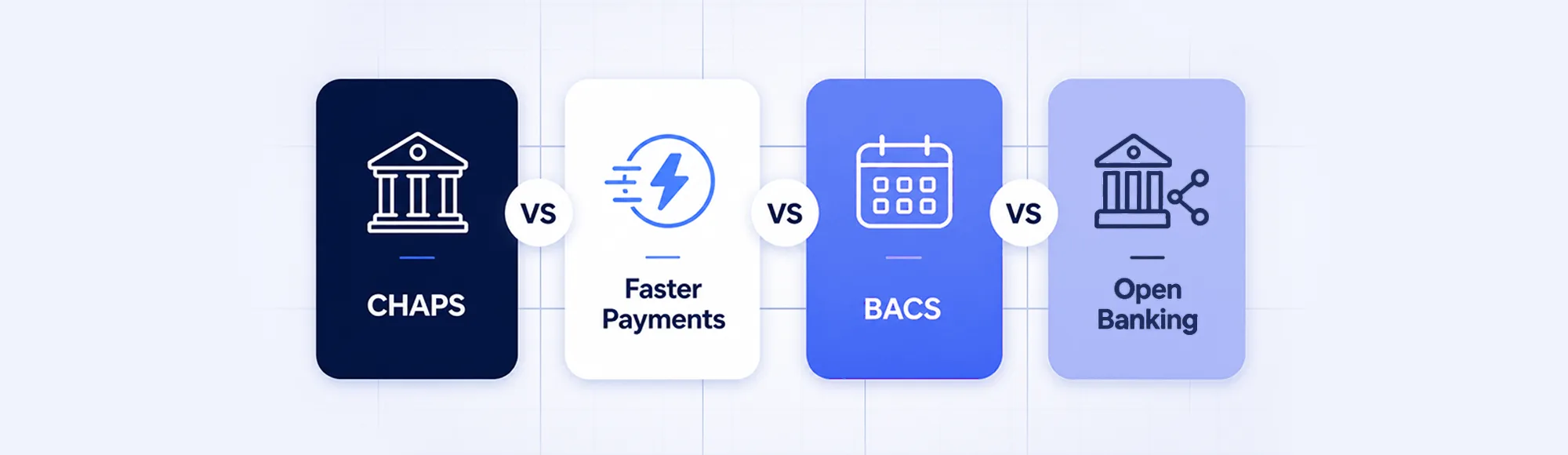
Same-day settlement. Sterling-only. The Bank of England operated.
CHAPS payment infrastructure explained for finance teams, treasury, and accounting platforms.
A CHAPS payment is the UK’s same-day high-value bank transfer system. Operated by the Bank of England via its Real-Time Gross Settlement (RTGS) infrastructure, each CHAPS payment settles individually and is irrevocable once sent.
In 2024, 52.7 million CHAPS payments were processed with a total value of £87.5 trillion – reflecting how embedded CHAPS is in UK property, treasury, and corporate payment infrastructure.
The question finance teams increasingly ask is not “what is a CHAPS payment?” It is “when is CHAPS actually the right choice?”
TL;DR
A CHAPS payment is a UK same-day, sterling-only bank transfer operated by the Bank of England. It is irrevocable once processed. Fees are £20-£35 per transaction at most UK banks (HSBC free from November 2025). CHAPS is essential for property completions, large time-critical transfers, and payments exceeding Faster Payments limits. For operational, recurring, and invoice-based payments, Open Banking PIS via Faster Payments is instant, cheaper, and API-driven.
Key Takeaways
What is a CHAPS payment?
CHAPS (Clearing House Automated Payment System) is a UK same-day payment system for high-value sterling transfers. Operated by the Bank of England since 2017, it settles payments in real time via RTGS – meaning funds move individually and with finality. CHAPS is sterling-only and UK domestic. It cannot be used for international transfers.
When is a CHAPS payment required?
Three specific scenarios justify CHAPS:
- Property completions – funds must clear by a contractual deadline; Faster Payments limits at some banks would not cover a typical purchase
- Payments exceeding Faster Payments limits – most UK banks cap Faster Payments at £250,000-£1,000,000; CHAPS has no upper limit
- Time-critical corporate transfers – treasury, tax payments, corporate settlements where same-day certainty is contractually required
What are the costs and cut-off times for CHAPS payments?
Most UK banks charge £20-£35 per outgoing CHAPS payment. HSBC removed its fee from 4 November 2025. Barclays charges £15 online for Business Banking (£25 by phone). Santander charges £25, with a 1pm telephone cut-off and 4:30pm branch cut-off.
CHAPS operates 6am-6pm Monday to Friday. Customer cut-off is 5:40pm. Payments after the cut-off process the next working day.
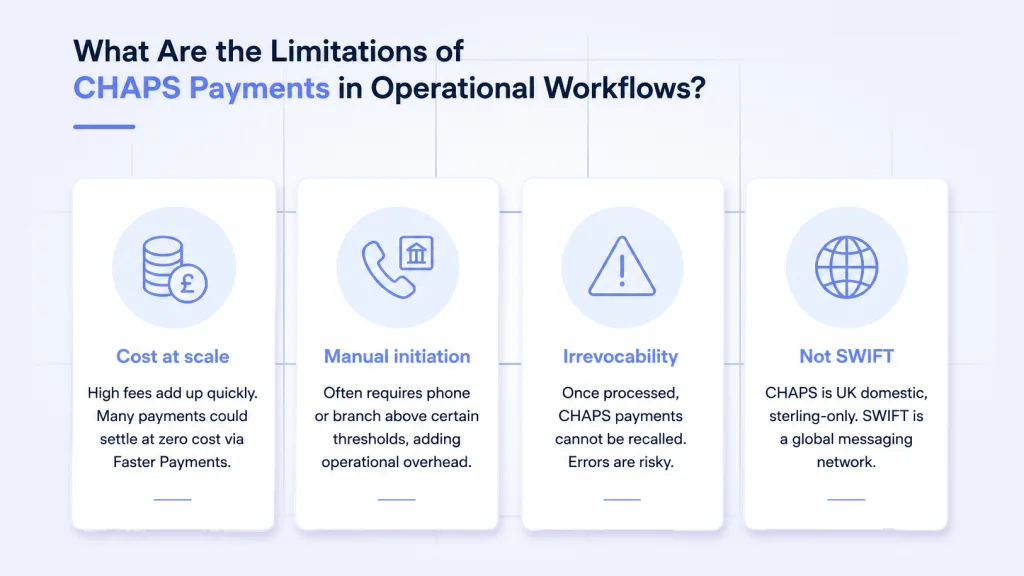
What Are the Limitations of CHAPS Payments in Operational Workflows?
Where Does a CHAPS Payment Create Problems in Practice?
CHAPS works exactly as designed for high-value, time-critical transfers. The problem is when it becomes the default for payments that do not require it.
Cost at scale: A finance team processing 200 supplier payments per month at £25 per CHAPS payment spends £5,000 per month in transfer fees. Most of those payments could settle via Faster Payments at zero cost.
Manual initiation: Many banks require CHAPS by phone or in branch above certain thresholds – adding operational overhead for recurring payment workflows.
Irrevocability: CHAPS payments cannot be recalled once processed. An error in account details has no guaranteed remedy.
Not SWIFT: CHAPS is UK domestic, sterling-only. SWIFT is a global messaging network for international transfers. Different systems, different purposes.
| Method | Settlement | Cost | Limit | Best For |
|---|---|---|---|---|
| CHAPS | Same-day (Mon-Fri) | £20-£35 per payment | No upper limit | Property, large corporate, time-critical |
| Faster Payments | Instant (24/7) | Free or low cost | Up to £1M (varies by bank) | Operational, recurring, invoice payments |
| BACS | 3 working days | Low / batch | No upper limit | Payroll, bulk direct debits |
| Open Banking PIS | Instant via Faster Payments | Usage-based API cost | Bank-dependent | Invoice payments, platform payouts, API-driven flows |
“CHAPS is the right tool for high-value, time-critical transfers where same-day certainty matters more than cost. For everything else – supplier invoices, platform payouts, recurring B2B payments – the question should be whether CHAPS is genuinely required or just the default.” – Ravi, Finexer
CHAPS, BACS, SWIFT and Faster Payments: UK transfer modes explained covers how the four main UK payment systems compare on speed, cost, and appropriate use cases.
When Is Open Banking a Better Alternative to a CHAPS Payment?
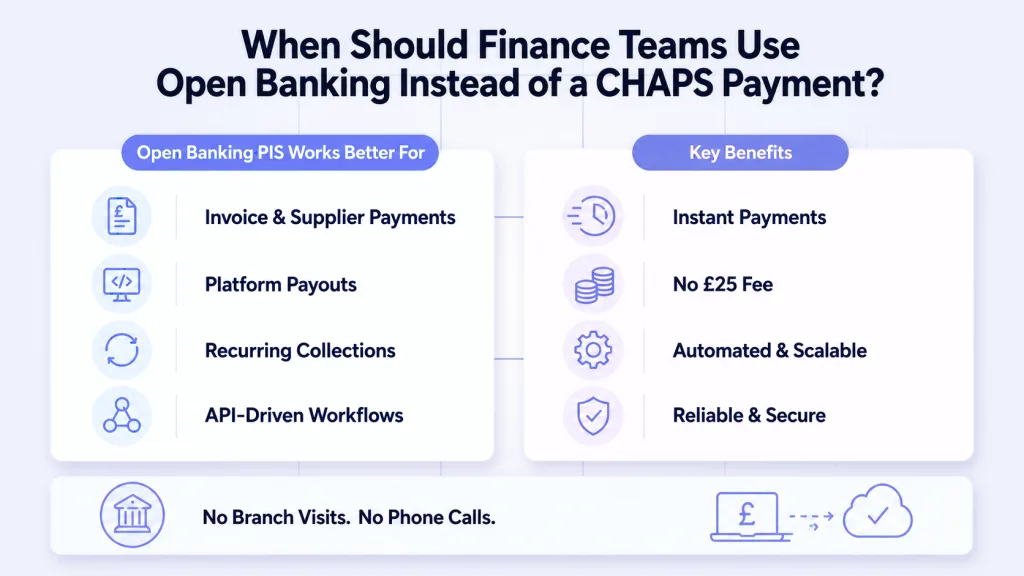
When Should Finance Teams Use Open Banking Instead of a CHAPS Payment?
Open Banking PIS operates via Faster Payments – not CHAPS. It is not a CHAPS replacement. It covers a different category of payments.
Where Open Banking PIS works better:
- Invoice and supplier payments under Faster Payments limits – instant, no £25 fee, reference embedded at initiation
- Platform payouts – bulk payments via single API call, each with structured reference
- Recurring collections – VRP replacing repeated manual CHAPS initiations
- API-driven workflows – webhook confirmation, reconciliation triggered at settlement
No branch visits. No phone calls. Payment integrates directly into billing or accounting platforms.
“For property completions and large corporate transfers, a CHAPS payment is the right tool. For operational payments – invoices, payouts, recurring collections – Open Banking PIS via Faster Payments covers the same need at a fraction of the cost.” – Ravi, Finexer
Third-party providers for payment initiation in the UK covers how Open Banking payment initiation providers compare for operational payment workflows.
Automated corporate bulk payment reconciliation covers how Open Banking payment data improves reconciliation for high-volume corporate payment workflows.
What I Feel
CHAPS payment is not the problem. It is excellent for what it was built for.
The problem is using a CHAPS payment as a default. Finance teams that audit CHAPS usage often find a significant proportion of payments that did not need same-day RTGS settlement – paying £25 per transaction for convenience, not necessity.
What is the purpose of a CHAPS payment?
CHAPS exists for transfers where same-day settlement certainty is a contractual or operational requirement – primarily property completions, corporate treasury, tax payments, and transfers exceeding Faster Payments bank limits. Its irrevocability and real-time RTGS settlement make it the only reliable option for time-critical, high-value transfers where a missed deadline carries material consequences.
Is CHAPS the same as SWIFT?
No. CHAPS is a UK domestic payment system for same-day sterling transfers. SWIFT is a global messaging network used for international payments between banks across different countries. They serve different purposes. If you need to send money internationally, SWIFT is the relevant system – not CHAPS.
Do all UK banks allow CHAPS payments?
Most major UK banks offer CHAPS, but access methods and fees differ. Barclays charges £15-£25. Santander charges £25. HSBC removed its CHAPS fee from November 2025. Some banks require CHAPS to be initiated by phone or in branches above certain thresholds. Faster Payments is available through virtually every UK bank and is free for most personal and business accounts.
Use Faster Payments for operational payments. Reserve CHAPS for when same-day certainty matters.
About the Author

Ravi Ranjan
Ravi Ranjan is Co founder & CEO of Finexer