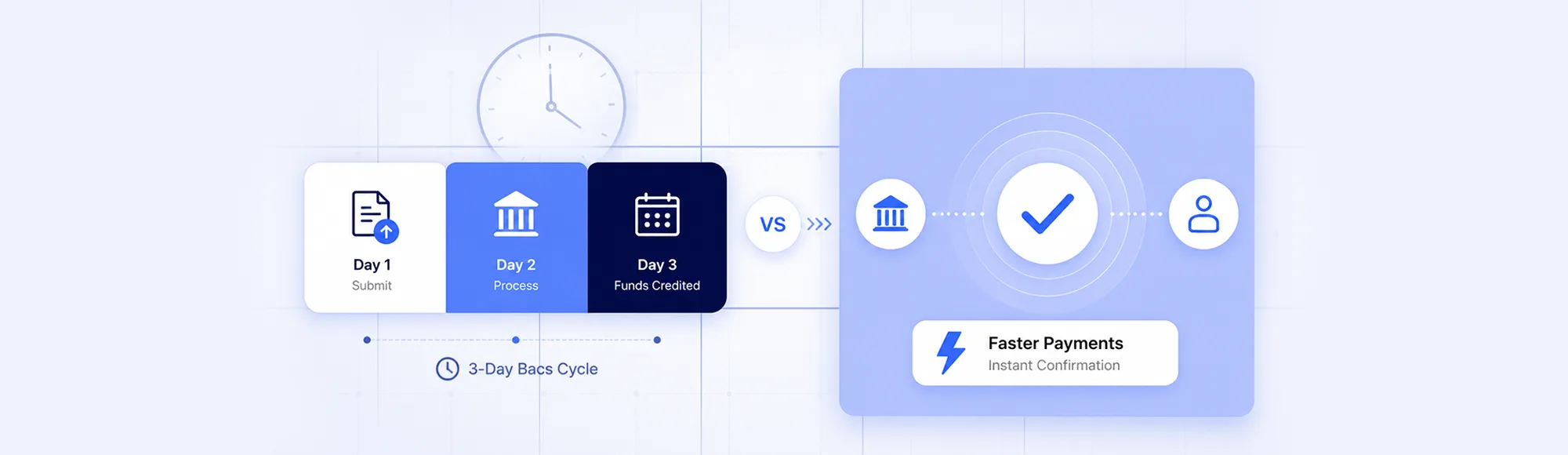
Reliable for payroll. Too slow for real-time platform workflows.
Bacs payment infrastructure explained for payroll platforms, billing SaaS, and finance teams.
A Bacs payment is the UK’s electronic system for direct bank-to-bank transfers – covering payroll, supplier payments, and Direct Debit collections. If you are searching “what is a Bacs transfer UK” – here is the short answer: it is a batch payment system settling in 3 working days, operated by Pay.UK, processing billions of transactions annually and paying 8 in 10 UK employees their wages (Bacs, bacs.co.uk).
The system works. For the payments it was designed for, it works extremely well.
The problem is when platforms use Bacs as a default for payments that need real-time confirmation, instant settlement, or API-driven reconciliation. A 3-day settlement cycle was built for predictable bulk transfers. It was not built for invoice payment confirmation, real-time cash flow visibility, or dynamic platform payment flows.
UK Open Banking processed 37.46 million payments in March 2026 – up 14.1% month on month. The platforms driving that growth are the ones that identified which of their payments actually need Bacs – and which ones need something faster.
TL;DR
A Bacs payment follows a 3-day cycle: Day 1 = submit, Day 2 = process, Day 3 = funds credited. What is a Bacs transfer in the UK? It covers two types – Bacs Direct Credit (payroll, supplier payments) and Direct Debit (recurring collections). A Bacs payment is low-cost and reliable for predictable, bulk transfers. It is not suitable for invoice payment confirmation, real-time reconciliation, or platform workflows that depend on instant settlement. For those workflows, Faster Payments or Open Banking PIS provides instant bank-to-bank settlement without the 3-day lag.
Key Takeaways
What is a Bacs payment?
A Bacs payment is a UK electronic bank-to-bank transfer operating on a 3-working-day settlement cycle. For anyone asking “what is a Bacs transfer UK” – Day 1: the paying organisation submits the payment file (between 07:00-22:30). Day 2: Bacs processes and validates each payment. Day 3: funds are simultaneously credited to recipients and debited from the sender. Files can be submitted up to 30 days in advance. Bacs covers two schemes: Direct Credit (outgoing payments – payroll, supplier invoices) and Direct Debit (incoming collections).
What is a Bacs transfer used for in the UK?
Bacs Direct Credit is used for:
- Payroll – 8 in 10 UK employees are paid via Bacs. The 3-day cycle allows payroll teams to plan ahead with confidence.
- Bulk supplier payments – businesses paying multiple suppliers on predictable schedules use Bacs files to batch payments efficiently
- Pension contributions – regular, predictable outgoing payments where settlement date is planned in advance
Bacs Direct Debit is used for:
- Subscription and utility collections – recurring customer payments on fixed or variable amounts
- Loan repayments and insurance premiums – regular scheduled collections
When does a Bacs payment become a problem?
When the platform needs real-time confirmation. Bacs does not return a per-payment webhook. It does not confirm individual transactions at settlement. It settles in batch. For payroll platforms running a scheduled monthly pay run, this is fine. For billing SaaS confirming individual invoice payments, this creates a reconciliation gap – funds arrive in batch without the per-invoice reference and timing precision that real-time payment confirmation provides.
What Is the Bacs Payment 3-Day Cycle in Practice?
How Does the Bacs Payment Settlement Process Work?
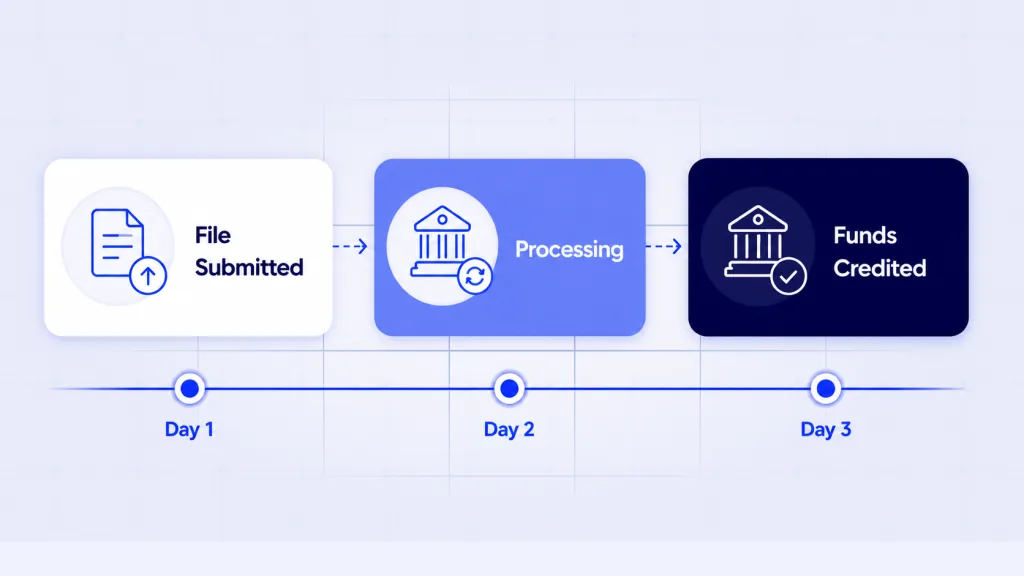
The 3-day cycle is straightforward – and it is also the source of most Bacs workflow problems for modern platforms.
Day 1 – Input: The organisation submits a payment file to Bacs containing all payment instructions. Files must be transmitted between 07:00 and 22:30. If the file misses this window, settlement shifts to the next available processing day.
Day 2 – Processing: Bacs validates the file and distributes payment instructions to each recipient’s bank. No funds move on Day 2. The payment is committed but not yet settled.
Day 3 – Entry: Funds are simultaneously credited to recipient accounts and debited from the sender. This is the settlement moment – but Bacs does not notify the sender individually per payment. Confirmation depends on bank statement reconciliation after the fact.
The operational gap:
Between Day 1 (submission) and Day 3 (settlement), the platform has no real-time confirmation. If a payment fails – wrong sort code, closed account, insufficient funds – the failure notification typically arrives via a ARUDD (Automated Return of Unpaid Direct Debits) or AROPS (Automated Return of Paid Direct Credits) report after the settlement cycle, not in real time.
“Bacs is excellent infrastructure for what it was designed for – bulk, predictable, pre-planned payments. The workflow breaks when platforms try to use it for payment types that require immediate confirmation. That is not a Bacs failure. It is a workflow mismatch.” – Ravi, Finexer
UK bank transfer modes: CHAPS, Bacs, SWIFT and Faster Payments explained covers how Bacs compares to CHAPS, Faster Payments, and SWIFT on speed, cost, and appropriate use cases.
Where Does a Bacs Payment Work and Where Does It Break?
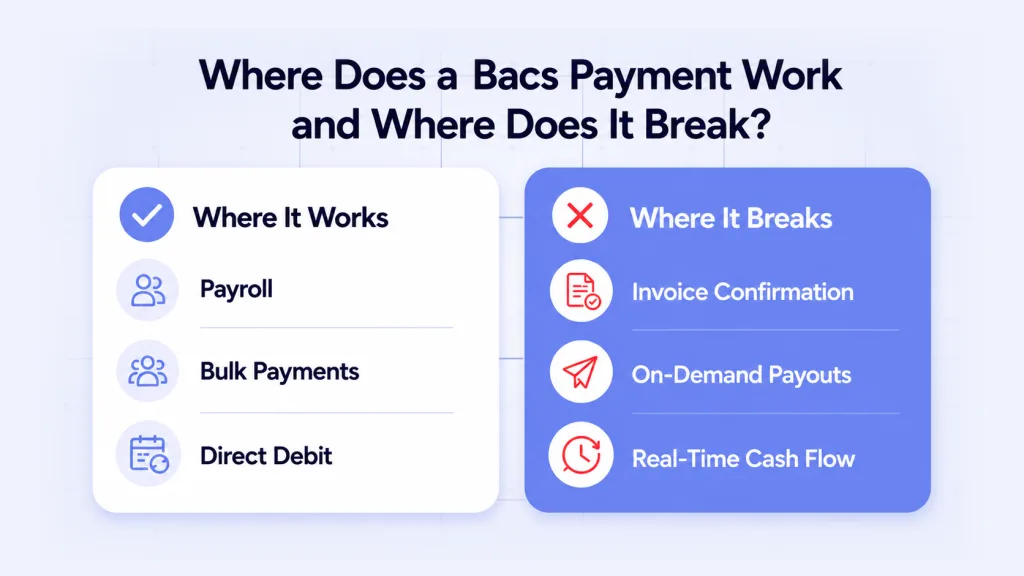
When Should Platforms Use Bacs and When Should They Use Faster Alternatives?
| Payment Scenario | Use Bacs? | Why / Why Not |
|---|---|---|
| Monthly payroll run | Yes | Predictable date, bulk volume, 3-day cycle planned in advance |
| Recurring Direct Debit collection | Yes | Fixed schedule, low cost, established mandate framework |
| Bulk supplier payments (fixed schedule) | Yes | Pre-planned batch – cost efficient at volume |
| Invoice payment confirmation | No | No per-payment real-time confirmation – reconciliation depends on batch statement |
| Platform payout to users (on-demand) | No | 3-day delay unacceptable for on-demand disbursements |
| Real-time cash flow tracking | No | Batch settlement means cash position is always 1-3 days behind reality |
What Modern Platforms Need That a Bacs Payment Cannot Provide
Why Does the 3-Day Bacs Payment Cycle Break Real-Time Financial Workflows?
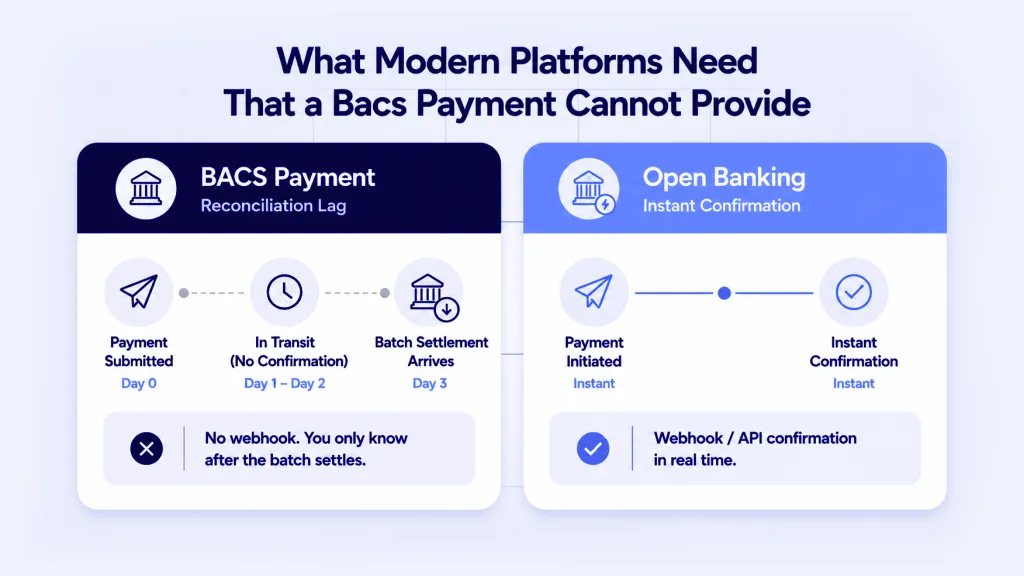
Modern billing SaaS, ERP systems, and payroll platforms increasingly need financial data that reflects what is happening now – not what happened three days ago.
Cash flow visibility gap: A platform processing 500 supplier payments via Bacs has no confirmed cash position for 3 working days after submission. Finance teams work from projected positions, not confirmed settlements. At month end, this gap compounds.
Reconciliation lag: Bacs payments arrive in batch. Individual payment references are present in the file – but matching them back to invoices requires a reconciliation step that cannot begin until Day 3 settlement, and often runs the day after. For platforms closing monthly accounts, this delay pushes period-end close further back.
No webhook confirmation: Bacs has no API-native payment confirmation mechanism. There is no webhook returning a per-payment status at settlement. The platform discovers payment status via bank statement data – end-of-day or manual export. This is a structural limitation, not a configuration issue.
Dynamic payment flows: Platform disbursements, on-demand payouts, and real-time settlement requirements cannot be scheduled 3 days in advance. A billing platform that needs to release funds on invoice approval cannot use Bacs – the payment cycle and the business event are structurally misaligned.
Instant transfers and faster payment infrastructure covers how instant payment infrastructure replaces batch settlement for platform payment workflows requiring real-time confirmation.
How Does Open Banking PIS Compare to Bacs?
What Does Faster Payments and Open Banking Add to Platform Payment Workflows?
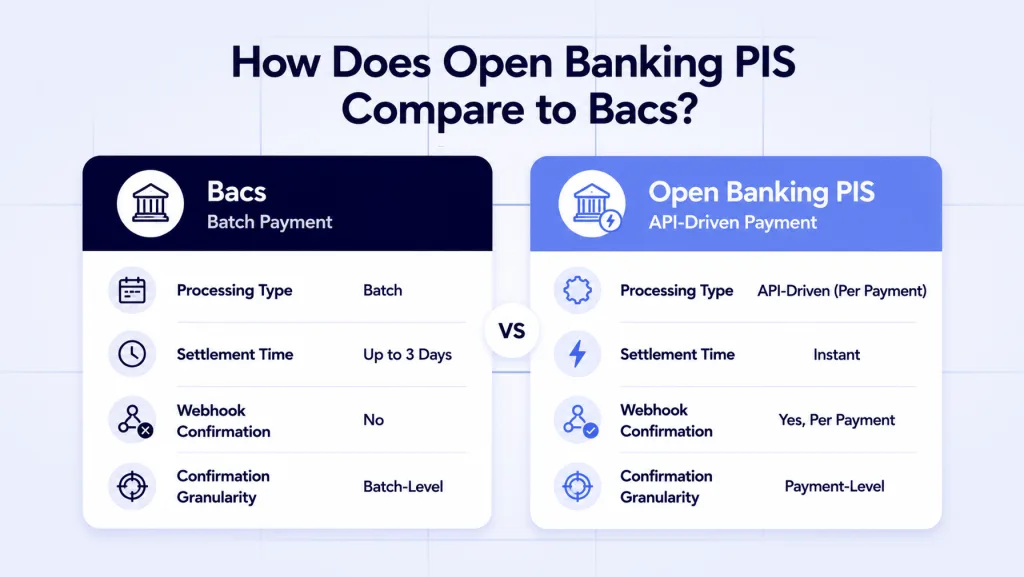
Understanding what is a Bacs transfer in the UK makes the comparison clearer. Faster Payments settles in seconds – same bank-to-bank infrastructure, without the 3-day cycle. Open Banking PIS initiates Faster Payments programmatically via API, adding per-payment references, webhook confirmation, and direct integration into the platform workflow.
What changes with Open Banking PIS:
- Payment initiated via API call – no manual file upload
- Settlement instant via Faster Payments
- Per-payment webhook confirmation returned to platform at settlement
- Invoice reference embedded at payment initiation – automated matching
- VRP (Variable Recurring Payments) for pre-authorised recurring payments without per-cycle manual action
What Bacs still does better:
- Bulk payroll at low cost per transaction
- Established Direct Debit mandate framework for consumer collections
- 30-day advance scheduling for cash flow planning
- Cannot be recalled once in the processing cycle – useful for commitment certainty
These are not competing systems. They are different tools for different payment types. The workflow problem is using Bacs for payment scenarios that require Faster Payments – and vice versa.
“The question is not whether to use Bacs or Faster Payments. It is whether the payment you are making is predictable and bulk – in which case Bacs works well – or dynamic and time-sensitive – in which case Bacs works against you.” – Ravi, Finexer
Open Banking payroll disbursement API for payroll platforms covers how Open Banking payment initiation works alongside Bacs for payroll platforms managing both bulk payroll and on-demand disbursement workflows.
How Does Finexer Support Platform Payment Workflows?
What Does Finexer Provide Alongside Bacs Infrastructure?
Finexer does not replace Bacs. Finexer provides Open Banking payment initiation (PIS) and bank transaction data (AIS) for the payment scenarios where Bacs is the wrong tool.
Payment initiation (PIS) – for real-time workflows:
- Pay by Bank – instant A2A payment via Faster Payments with webhook confirmation per payment
- Payment Links – shareable link initiating bank-authenticated payment, reference embedded at initiation
- Bulk Payout – high-volume outbound payments via single API call, per-payment references, instant settlement
- VRP – pre-authorised recurring payments without per-cycle manual initiation
Bank transaction data (AIS) – for real-time visibility:
- Real-time transaction data per payment via webhook – no batch delay
- Structured JSON with payment references – automated invoice matching
- Cash position reflects confirmed cleared transactions, not projected settlements
- Up to 7 years of transaction history for reconciliation and audit
Usage-based pricing, no setup fees. 3-5 weeks to production. Covers almost all major UK banks in a single integration.
Finexer payments product covers the full PIS capability set including Pay by Bank, Payment Links, Bulk Payout, and VRP for platform integration.
What I Feel
A Bacs payment gets blamed for problems it did not create.
The 3-day cycle is not a flaw. It is the design. A Bacs payment was built for scheduled, bulk, predictable transfers – and for those payments, it is the right infrastructure.
The problem is workflow mismatch. A platform that needs real-time invoice confirmation, on-demand disbursement, or instant cash position tracking is asking Bacs to do something it was not designed for.
The fix is not to complain about Bacs. It is to route the right payments through the right infrastructure.
Common Use Cases
Payroll Platforms
Monthly pay runs via Bacs payment Direct Credit – bulk file, pre-scheduled, low cost per employee. On-demand contractor disbursements via Open Banking PIS – instant confirmation, webhook per payment, reference embedded.
Billing and Subscription Platforms
Recurring collection via Direct Debit (Bacs) for predictable scheduled amounts. Invoice payment confirmation via Payment Links (Open Banking PIS) – instant settlement, per-invoice reference, reconciliation triggered at the moment of payment.
Accounting SaaS
Real-time AIS bank transaction data replacing end-of-day Bacs statement reconciliation. Cash position reflects confirmed settled transactions, not projected Bacs settlements pending Day 3 entry.
ERP Systems
Bulk supplier payments via Bacs for fixed-schedule payment runs. High-priority supplier payments and on-demand disbursements via Open Banking Bulk Payout – instant settlement, structured reference per payment, automated reconciliation.
What is a Bacs transfer UK and how long does it take to clear?
A Bacs payment follows a fixed 3-working-day cycle. Day 1 = file submission (07:00-22:30). Day 2 = processing and validation. Day 3 = funds credited and debited simultaneously. Bank holidays extend this timeline – they are not counted as Bacs processing days. Files can be submitted up to 30 days in advance to plan around holidays and payroll schedules.
What is the difference between Bacs and Faster Payments?
Bacs settles over 3 working days via batch processing – low cost, suitable for payroll and scheduled bulk transfers. Faster Payments settles in seconds, 24/7, with individual transaction processing and webhook confirmation. Bacs suits predictable, pre-scheduled payments. Faster Payments suits invoice confirmation, on-demand disbursements, and any B2B payment where real-time settlement matters.
Can a Bacs payment be cancelled?
A Bacs payment cannot be cancelled once it has entered the processing cycle. Instructions are grouped and committed on Day 1. To stop a payment, the bank must be notified before a specific cut-off time on submission day. After that, the payment proceeds to Day 3 settlement. Plan submissions carefully – especially around bank holidays and payroll deadlines.
Combine Bacs for bulk payroll with real-time Open Banking payments for everything else.
About the Author

Ravi Ranjan
Ravi Ranjan is Co founder & CEO of Finexer