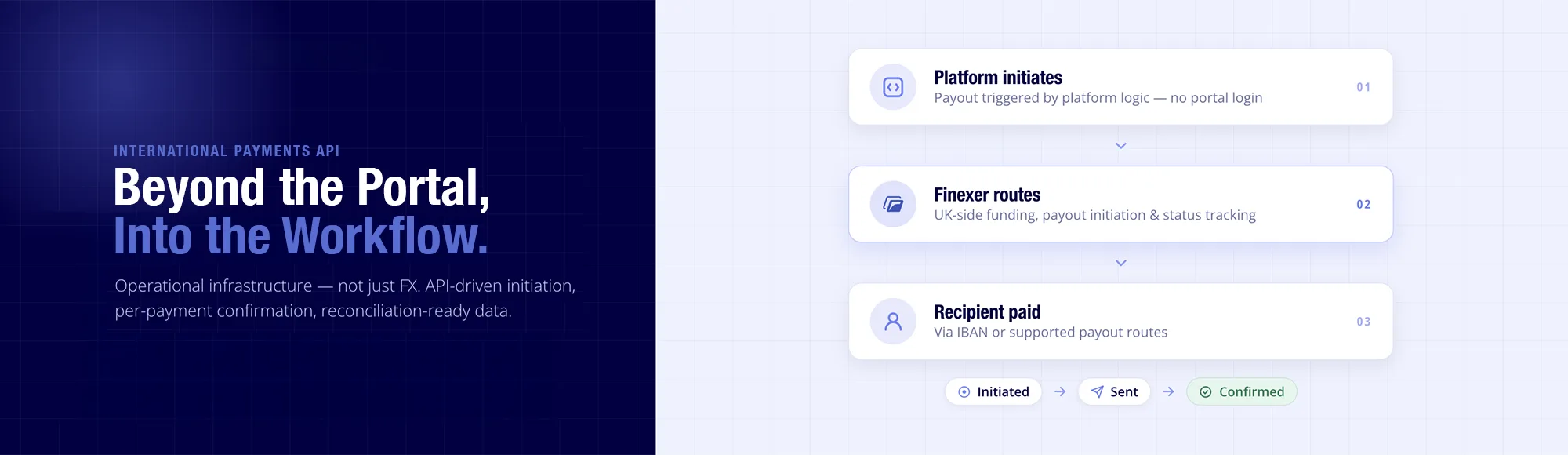
Every finance team I speak to follows the same international payment workflow: log into the bank portal, send the payment, wait for confirmation, then export statements and reconcile manually. At Finexer, I work with fintech platforms, ERP teams, and B2B payment providers that know this process is inefficient but haven’t found a scalable alternative.
An international payments API replaces that manual workflow with infrastructure that automates payment initiation, tracks confirmation in real time, and delivers reconciliation-ready data. It isn’t simply another banking interface or an FX tool-it removes manual operational work from the cross-border payment process.
Demand for reliable international payments APIs is rising as the G20 targets faster, cheaper, and more transparent cross-border payments by 2027. While the Financial Stability Board says most roadmap actions are complete and Project Nexus begins implementation across five countries in 2026, many businesses still rely on manual workflows. The gap is no longer policy-it’s implementation.
TL;DR: International payments APIs are helping B2B platforms reduce reliance on manual cross-border workflows at scale. The shift is not about FX rates – it is about payment automation, near real-time payment status confirmation, and structured transaction data that reduces reconciliation overhead. A cross border payments API that delivers payment tracking, consistent references, and reconciliation-ready outputs removes the overhead that those manual workflows create.
Key Takeaways
What does an international payments API actually do?
It initiates cross-border payments programmatically, provides payment status confirmation per transaction via webhook, and delivers structured data to the platform’s reconciliation layer. Unlike manual payment workflows, the API embeds references at initiation, provides status confirmation via webhook at settlement, and is designed to reduce the manual steps between payment execution and ledger update.
Why do cross-border payment workflows still fail operationally?
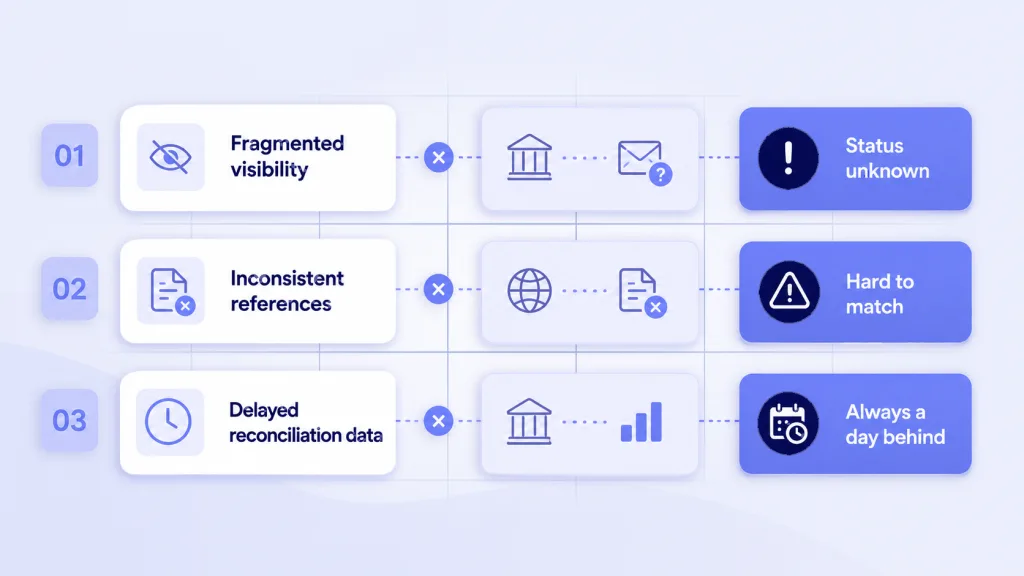
Three reasons: fragmented visibility (payment initiated but no real-time confirmation), manual reference management (SWIFT codes entered inconsistently across transactions), and delayed reconciliation data (bank statements arrive the next day with no per-payment breakdown). These are infrastructure problems, not process problems.
What should a cross border payments api deliver?
Payment initiation with embedded references, confirmation per transaction, structured data in a consistent format, and historical records for audit. The API should remove the human steps between payment initiation and ledger update – not just swap the interface.
How are businesses automating international payments in 2026?
By connecting payment initiation, tracking, and reconciliation into a single API workflow. Payment goes out via API with an embedded reference. Webhook fires at settlement. The platform can match outgoing to incoming based on the shared reference. Less portal login, less spreadsheet work, less manual confirmation chasing.
Why Do International Payment Workflows Still Break?
The global cross-border payments market moves trillions annually. EU instant payments alone are projected to grow from 3 billion to 30 billion transactions by 2028. Yet most B2B businesses still process international payments through a combination of bank portals, manual spreadsheets, and confirmation emails.
The problem is not that international payments are slow. It is that the operational layer between initiating a payment and confirming it landed is entirely manual.
Three failure modes drive most cross-border payment operational problems:
- Fragmented visibility. A payment leaves the company account. The treasury team does not know it is confirmed until the beneficiary emails to say they received it – or did not. There is no real-time status. The payment is either “sent” or “unknown.”
- Inconsistent references. Cross-border payments require a reference. That reference is filled in manually, inconsistently, or left blank. The payment clears. The bank statement shows a debit with a reference that matches nothing in the accounts payable system. Someone manually investigates.
- Delayed reconciliation data. Bank statements arrive at the end of day or the following morning. The reconciliation team matches international payments on T+1 data. Cash position is always a day behind. For treasury decisions, that lag compounds.
“International payment workflows fail because the payment and the operational data are separated. The payment goes through one system. The confirmation comes through another. The reconciliation happens in a third. An international payments API connects all three – and that is what makes it operational infrastructure, not just a payment tool.” – Ravi, Finexer
For B2B platforms comparing how API-driven payments change cross-border workflows versus traditional manual approaches, the B2B payments Open Banking APIs guide covers how real-time payment reduces the operational gap in supplier and partner payment operations.
What Does a Cross Border Payments API Need to Provide?
| Operational Requirement | Manual Bank Portal | International Payments API |
|---|---|---|
| Payment initiation | Manual entry per transaction, login to banking portal required | Programmatic – triggered by platform logic, no human step |
| Payment reference | Entered manually, inconsistent across transactions | Embedded at initiation, consistent end to end |
| Settlement confirmation | Email from beneficiary or next-day bank statement | Payment status confirmation per transaction via webhook |
| Transaction data | Bank statement export, requires formatting | Structured JSON – consistent format, no manual reformatting |
| Reconciliation | Manual matching on T+1 or T+2 data | Enables automated matching – reference flows from initiation to confirmation |
| Audit trail | Spreadsheet + email chain | Individual log per payment with timestamp, reference, and status |
The difference is not speed. It is operational control.
A cross border payments API that delivers per-payment webhooks, embedded references, and structured transaction data significantly reduces the manual steps between payment execution and reconciliation. The platform initiates. The API confirms. The data feeds the ledger automatically.
ISO 20022 migration is accelerating this shift. With 90% of high-value payment value projected to flow through ISO 20022 messaging upon full adoption, the amount of structured data travelling with each cross-border payment is increasing dramatically. International payments apis built on this infrastructure deliver richer transaction data with every payment – making the reconciliation step increasingly automatable.
For fintech platforms and ERP systems building payment API integrations, the payment integration via API guide covers how Open Banking payment infrastructure compares to card gateway integrations on settlement speed, data richness, and operational overhead.
Where Do Cross-Border Payment Workflows Break Most Visibly?
The breakdown is not dramatic. It is incremental.
A global payroll platform processes 200 cross-border payments per month. Each one goes through the bank portal. Each reference is manually entered. Each confirmation is tracked in a shared spreadsheet. At 200 payments through an international payments api, this is manageable – minimal ops work per cycle.
At 2,000 payments per month, it is a full-time job. At 10,000, it is a department.
Scale does not change the workflow. It just makes the cost visible – and that is when the case for an international payments api becomes undeniable.
Three areas where this becomes visible fastest:
- Supplier and partner payouts. A fintech platform paying international suppliers needs payment confirmation before releasing the next order. Manual confirmation takes 24-48 hours via bank transfer. An international payments API delivers webhook confirmation within minutes of settlement. The supplier relationship improves. The accounts payable backlog disappears.
- Invoice payment tracking. B2B billing platforms need per-invoice payment status to close the AR cycle. Manual bank statements show a credit with a reference that may or may not match an open invoice. A cross border payments api with embedded invoice references significantly simplifies this loop – the credit arrives with the ID of the invoice it settles, making matching much more straightforward.
- Global payroll disbursements. Payroll platforms making international payments to employees or contractors need both payment confirmation and reconciliation data. Missing one creates a compliance gap. An international payments API provides both payment status confirmation and reconciliation-ready data per transaction – reducing the compliance documentation burden significantly.
“The platforms that solve international payment workflows at scale do one thing consistently – they stop treating the API as a replacement for the bank portal and start treating it as the core of the payment workflow. Once it is infrastructure, the overhead disappears.” – Ravi, Finexer
For B2B platforms and billing systems processing international disbursements at scale, the Open Banking API integration guide covers how unified payment and data infrastructure connects payment initiation to operational visibility without multiple integration layers.
How Finexer Supports International Payment Workflows
Finexer is not a bank. It does not provide treasury management, multi-currency accounts, or FX conversions.
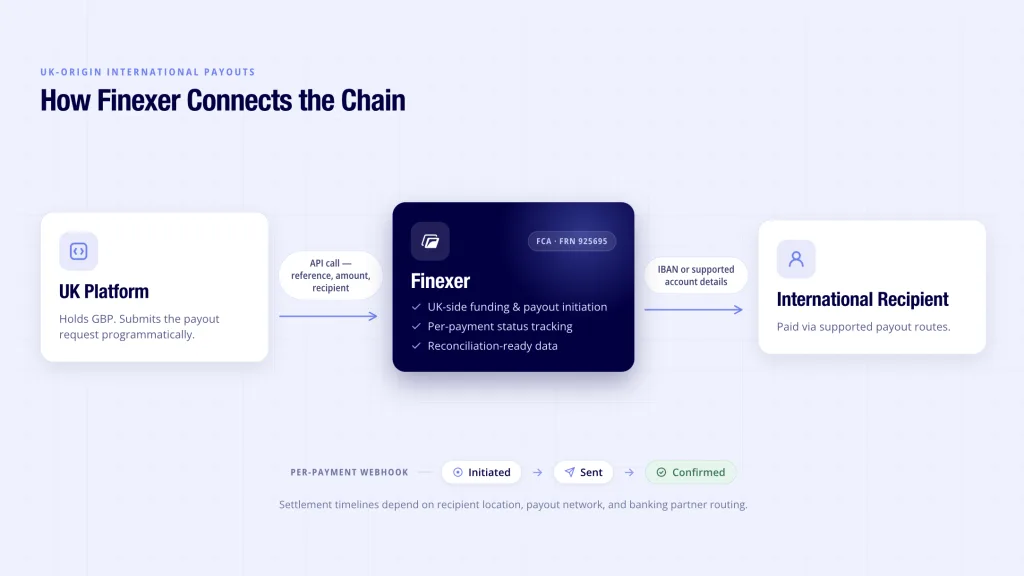
Finexer provides API infrastructure for UK-origin international payouts – covering UK-side funding, payout initiation, status tracking and reconciliation. International recipients are paid via IBAN or supported account details through supported payout routes.
Settlement timelines and coverage depend on recipient location, payout network, and banking partner routing. Per-payment status tracking and reconciliation-ready data are provided at the initiation layer.
What Finexer’s international payments infrastructure covers:
- UK-side funding and payout initiation – international disbursements to supported recipients via IBAN or supported payout routes, with payment reference embedded at initiation
- Bulk Payout – multiple international recipients in a single API call, each with an individual payment reference and confirmation
- Per-payment webhook – payment status updates delivered per transaction via webhook, not in end-of-day batches
- Reconciliation file auto-generated – every payout batch produces a reconciliation file exportable to accounting software, traceable by unique reference ID
- Pre-payment validation – sort codes, account numbers, and payment details validated before funds move
- Usage-based pricing, no setup fees, deployment timelines measured in weeks
- FCA-authorised AISP and PISP (FRN925695)
The payment reference flows from initiation through to payment status confirmation. This supports automated matching at the platform level – reducing the need for manual login, reference chasing, and manual reconciliation steps.
For platforms processing bulk international disbursements looking at how payment-level tracking changes the workflow, the Finexer bulk payment services guide covers how the payout infrastructure handles real-time verification, individual payment status, and reconciliation file generation at scale.
The Real Question
Most platforms I speak to have evaluated international payments APIs on two criteria: FX rates and global reach.
Those matter. But for most B2B platforms evaluating an international payments api, they are not where the operational problem lives.
The operational problem is the 40 minutes of manual work per payment cycle that nobody counts because it happens across three different people and two different spreadsheets. It does not show up on a P&L.
It shows up in headcount, in errors, and in the accounts payable manager reconciling SWIFT statements on Friday afternoon.
A good international payments API does not just replace the portal. It reduces the manual layer between initiation and reconciliation – and that is where the operational value is. That is what separates infrastructure-grade deployments from portal replacements.
Common Use Cases
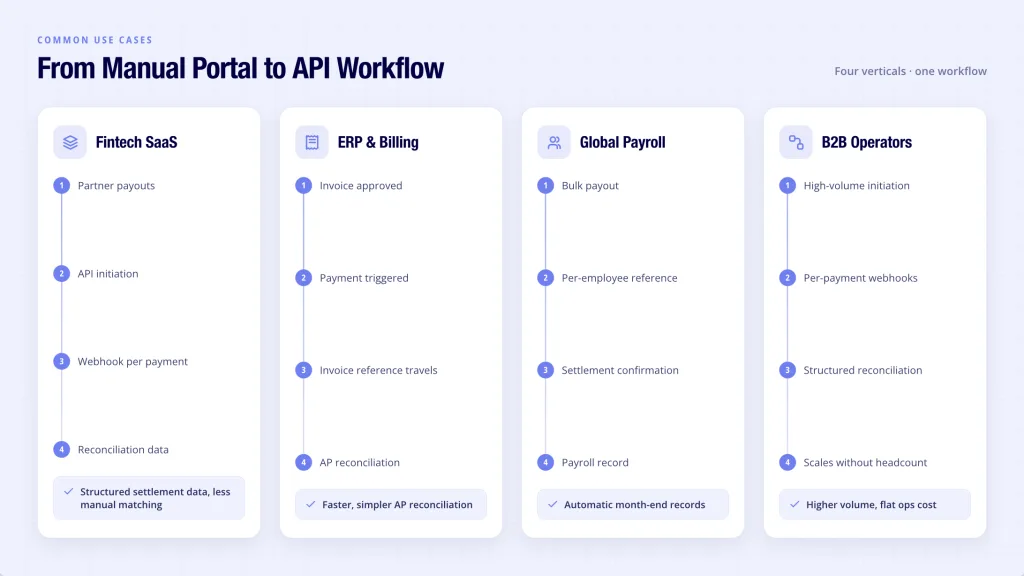
Fintech SaaS Platforms
- Automates partner and affiliate payouts through API.
- Embedded references and per-payment webhooks provide structured settlement data, reducing manual reconciliation.
ERP and Billing Systems
- Triggers supplier payments automatically after invoice approval.
- Invoice references travel with the payment, making AP reconciliation simpler and faster.
Global Payroll Platforms
- Executes bulk payroll with per-employee references.
- Settlement confirmations create reconciliation records automatically, reducing month-end effort.
B2B Payment Operators
Supports higher payment volumes without proportional headcount growth.
Replaces manual payment cycles with API initiation, webhooks, and structured reconciliation data.
What is a cross border payments API?
A cross-border payments API initiates international payments programmatically, provides per-transaction status updates via webhook, and delivers reconciliation-ready payment data. It replaces manual banking workflows with automated payment initiation and tracking.
How do international payments APIs work?
The platform submits a payment request with recipient details and a payment reference. The API processes the payment and returns webhook updates containing the reference, amount, and timestamp, enabling automatic reconciliation.
How do businesses automate international payments?
By replacing manual bank portal workflows with API-driven payment initiation, webhook confirmations, and structured payment data. The payment reference is preserved from initiation through settlement, enabling automated matching.
What are the benefits of a cross-border payments API over SWIFT?
Real-time webhook status instead of waiting for bank statements. Programmatically embedded payment references. Structured reconciliation data instead of raw exports. Workflows that scale with payment volume without increasing manual effort.
Fix the international payment workflow at the infrastructure layer and the overhead scales away.
Explore with AI
About the Author

Ravi Ranjan
Ravi Ranjan is Co founder & CEO of Finexer