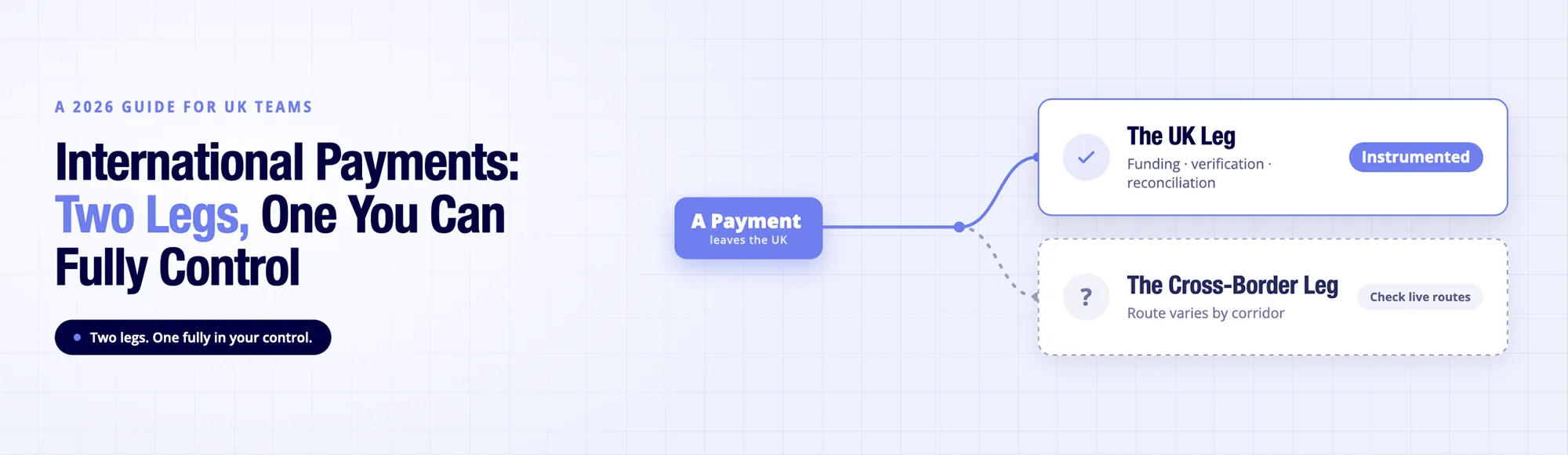
Brief: International payments are funds moving between a UK business and parties abroad. Every payment has two legs: a fast, instrumented UK leg and a cross-border leg that runs on rails such as SWIFT or a provider’s local network. Costs come from four places, and Open Banking improves the UK-side leg (funding, verification, reconciliation) but does not move money across borders.
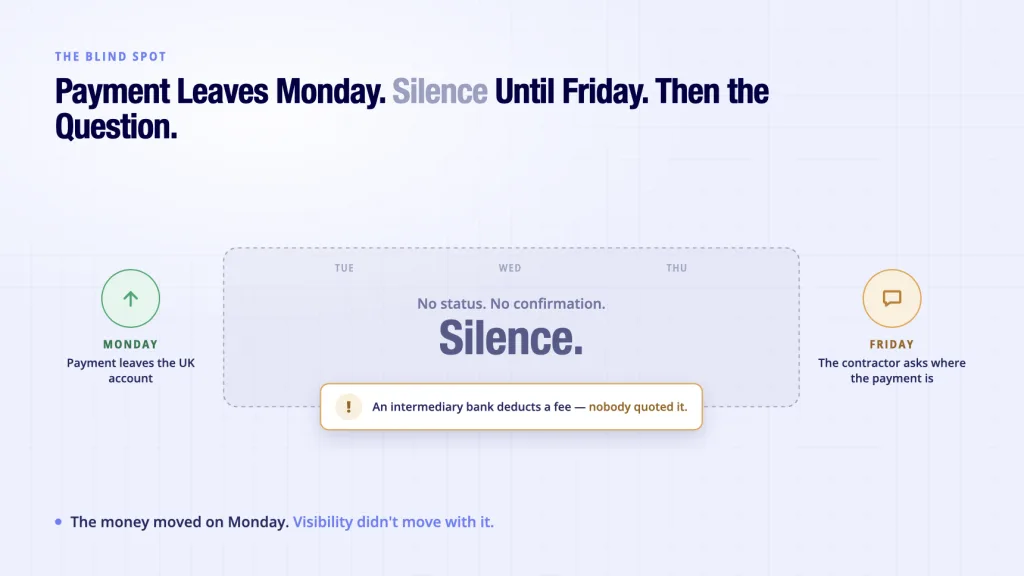
A UK platform’s user pays an overseas contractor on Monday. The money leaves the account the same day. Then silence: no status, no confirmation, until the contractor asks on Friday where the payment is, and an intermediary bank has taken a fee nobody quoted.
That five-day blind spot is why international payments have a reputation problem, and why platform teams keep being asked to fix something that happens mostly outside their systems. This guide explains where the journey actually breaks, what it really costs, and which half of the problem you can now control.
What Are International Payments?
International payments, in a business context, are transfers of funds between a company in one country and a person or business in another. For a UK business, this implies two things at once: paying overseas suppliers, contractors, and sellers, and collecting from international customers.
The same flows are often called cross-border payments, and they are growing fast. The Bank of England expects cross-border payment values to exceed $250 trillion by 2027, while noting that these payments remain slower, more expensive, and less transparent than domestic ones. Closing that gap is the point of everything that follows.
How Do International Payments Work From the UK?
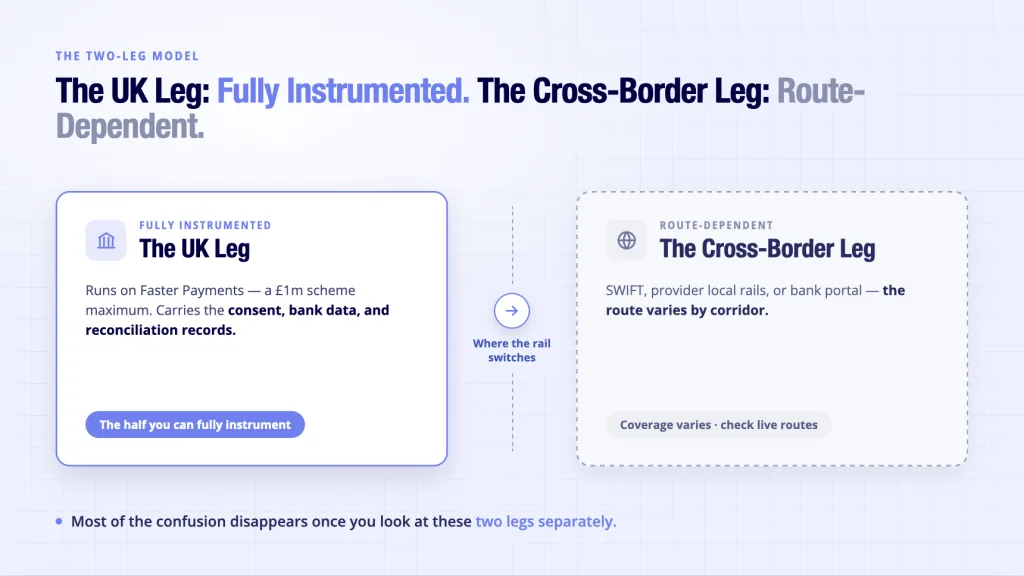
Each of these international payments is a combination of two things, and most of the confusion disappears once you look at them separately.
The UK leg: funding, data, and control
Funds leave a UK business account first. Within the UK, payments between UK accounts run on Faster Payments, a 24/7 rail with a £1 million scheme maximum per payment and provider-set limits below that. This leg also carries the consent, the bank transaction data, and the reconciliation records, which is why it is the halfway point of the journey that a platform can fully instrument.
The cross-border leg: routes and rails
In the case of international payout services, the payment switches rails. The three common routes:
| Route | How It Moves | Typical Speed | Cost Pattern | Watch Out For |
|---|---|---|---|---|
| SWIFT / correspondent banking | Bank to bank through intermediaries | 1-5 working days, corridor-dependent | Sending fee, possible mid-route deductions, FX margin | Fees taken in transit that nobody quoted |
| Provider local rails | Provider holds accounts in destination countries and pays out locally | Often same or next day, when supported | Lower per payment, FX margin applies | Coverage varies by corridor; check live routes |
| Bank portal transfers | One-by-one international transfers via business banking | Days | Flat fee plus FX margin each time | No API, no per-payment status |
The local-rails model is the most trusted for international payout services, which is why “coverage” in this market always refers to specific corridors, not everywhere. It is also why the same cross border money transfer can arrive in hours on one route and days on another.
What Do International Payments Really Cost?
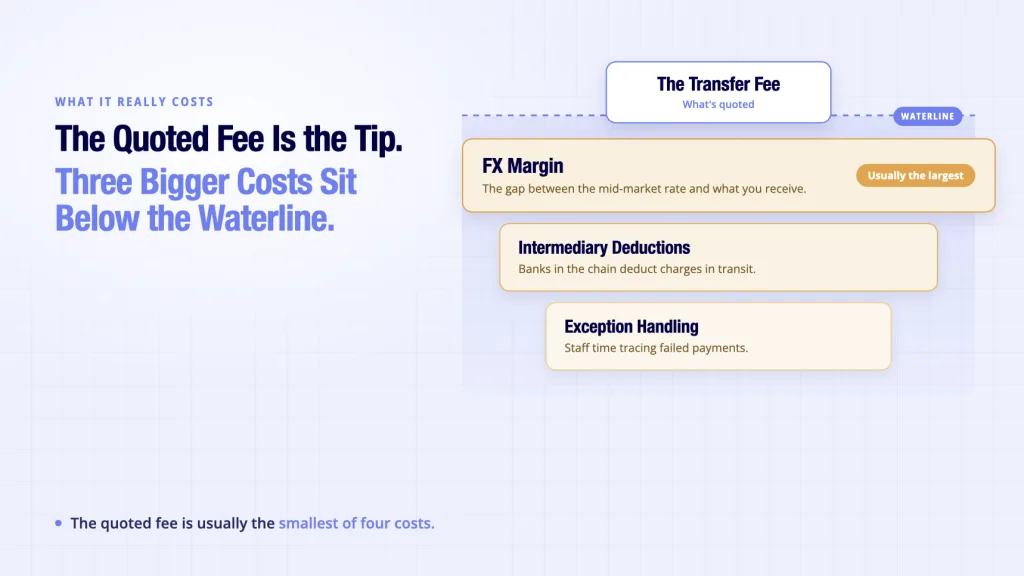
The quoted transfer fee is usually the smallest of four costs:
- The transfer fee: The visible, per-payment charge.
- The FX margin: The gap between the mid-market rate and the rate you receive. This is where most of the real cost sits, and it is rarely shown as a fee.
- Intermediary deductions: On correspondent routes in international payout services, banks in the chain can deduct charges in transit, so recipients receive less than what was sent.
- Exception handling: Failed and investigated payments consume staff time. UK government-backed research found businesses affected by late payments spend an average of 86 hours of staff time a year chasing them, and cross-border exceptions are the slowest to trace because no single party sees the whole chain.
Comparing international payout services on the transfer fee alone almost always misleads. Instead, evaluate all four cost components using your actual payment volumes, including your busiest, average, and slowest quarters, to understand the true cost of each provider.
The G20 cross-border payments programme has set public targets for cheaper, faster, and more transparent payments by 2027, but progress is corridor by corridor, so quoted delivery times remain estimates.
Can Open Banking Send Money Internationally?
No. Open Banking initiates payments and reads account data between UK accounts only, and it is worth stating plainly because it is the most common misunderstanding in this market. What Open Banking does change in international payments is the UK-side leg:
- Funding: The domestic payment that funds a payout can run account to account, instant via Faster Payments, instead of by card or manual transfer.
- Verification: Account details can be checked against bank records before money moves, cutting recipient-detail failures.
- Reconciliation: UK account transaction data arrives structured and in real time, so finance teams see what’s left, when, and against which payout run.
The cross-border leg is unchanged: once funds leave the UK, they travel on whichever route the provider supports. The UK-side layer, meanwhile, is now mainstream infrastructure, with Open Banking Limited’s live performance data showing 17.94 million active UK connections and 37.46 million payments processed in March 2026.
What Should You Look For in International Payout Services?
For platform teams, four checks separate international payout services quickly:
- Live corridor coverage: Which countries, currencies, and routes are supported today, confirmed in documentation rather than a coverage map.
- Per-payment status: A webhook per payout beats a portal to check. If your users send many payouts at once, the same logic applies at the batch level, covered in our bulk payouts multiple payments guide.
- Speed where it matters. The UK-side leg can be instant; the cross-border leg is an estimated delivery time by corridor. Platforms with payout-heavy models can read our guide to real-time withdrawals for payout-heavy platforms for how the domestic half is handled.
- Regulatory status. Verify FCA authorisation on the FCA Register, not the website badge, for the UK-regulated part of the service.
Where Does Finexer Fit in the International Payout Services?
For UK platforms, the solvable half of international payments is the UK side, and that is the layer Finexer provides. Finexer provides API infrastructure for UK-origin international payouts: covering UK-side funding, payout initiation, status tracking, and reconciliation. International recipients are paid via IBAN or supported account details through supported payout routes.
In practice, that gives a platform team:
- Payout initiation and status tracking through one API, from creation to completion
- Structured AIS transaction data for reconciliation, with no manual bank statement review
- FCA-authorised (FRN925695) as both AISP and PISP
- 99% UK bank coverage
- Usage-based pricing and white-label deployment
The cross-border movement runs over supported payout routes, with delivery times estimated per corridor rather than guaranteed.
Conclusion
International payments stop feeling unpredictable once you read them as two legs: a UK side you can now fully instrument, and a cross-border side that improves corridor by corridor. Evaluate any provider through that split, across all four cost components, and the shortlist builds itself.
How long do international payments take from the UK?
It depends on the route and corridor. Correspondent banking typically takes one to five working days, while provider local rails can deliver the same or next day, where supported. Treat every quoted time as an estimated delivery time, since checks on either leg can add days.
Are cross border payments regulated in the UK?
The UK side is regulated: providers operating in the UK must be FCA-authorised, and you can verify any provider on the FCA Register. Beyond the border, the institutions involved answer to their own jurisdictions, which is one reason transparency drops mid-route.
How do businesses automate reconciliation for international payouts?
Through structured bank data on the UK side. The Transaction and Invoice Tracker via Open Banking AIS provides structured bank transaction data per payment, enabling reconciliation without manual bank statement review. The platform matches that data to its own payout records, so exceptions surface as events rather than month-end surprises.
If you are mapping which of your payout problems live on the UK leg and which live beyond it, Finexer’s team is happy to walk through how the UK-side infrastructure works against your use case.
Explore with AI
About the Author

Ravi Ranjan
Ravi Ranjan is Co founder & CEO of Finexer