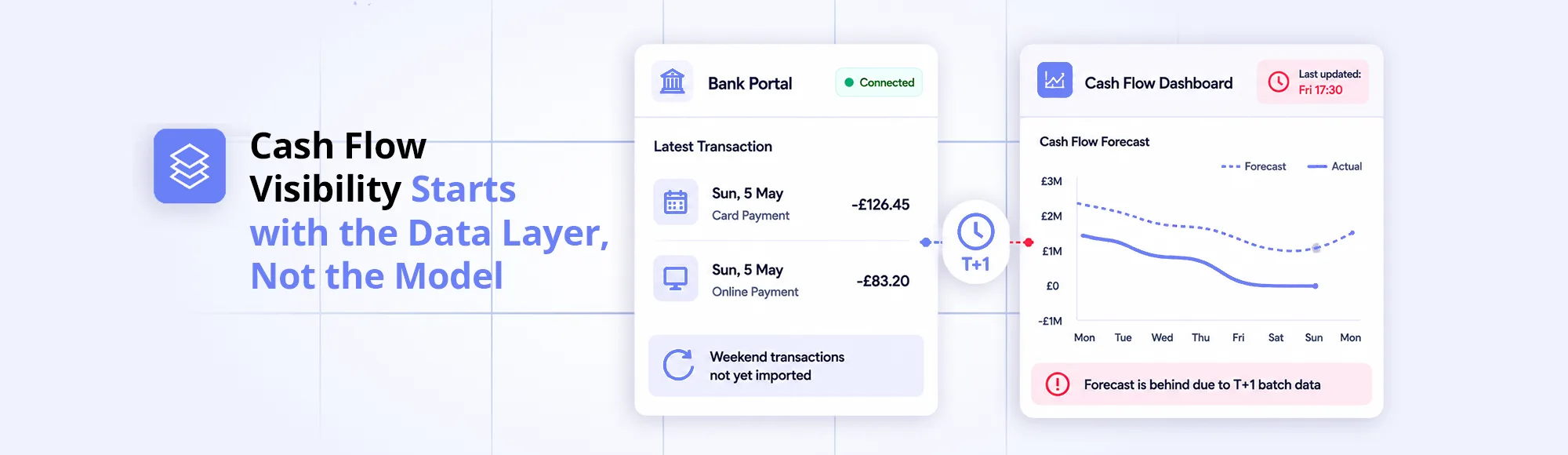
Connected bank data. Real-time transaction visibility. Forecast-ready infrastructure.
Open Banking AIS for platforms and finance teams that need to improve cash flow visibility.
To improve cash flow visibility, start with the data. The forecast said £180,000. The actual balance on Monday morning was £134,000.
The difference was not a business problem. It was a data timing problem. Three payments had settled over the weekend. The forecast had not seen them. The finance team built their week on a number that was already wrong before Monday began.
Most attempts to improve cash flow visibility start with the forecasting model. That is the wrong starting point. These are not forecasting failures. They are data infrastructure failures. The forecast model is usually sound. The bank transaction data feeding it is delayed, fragmented, or manually imported once a week.
Improving cash flow visibility doesn’t start with a better forecasting model. It starts with the data layer. That’s the only way to improve cash flow visibility in a way that holds at scale.
“The finance teams I work with that struggle most with cash flow visibility are not bad at forecasting. They are working with data that is 24-48 hours behind the actual cash position. You can’t forecast accurately from stale inputs, regardless of how sophisticated your model is.” – Ravi, Finexer
TL;DR
To improve cash flow visibility, bank transaction data must arrive near settlement – not in T+1 overnight batches. Most UK finance teams are forecasting from yesterday’s position. Open Banking AIS fixes this: per-transaction data near settlement, consolidated balance across connected accounts, no manual imports. Better data timing means more accurate forecasts.
Key Takeaways
Why is cash flow forecast important for a business?
Every significant financial decision runs on a cash position assumption. Payroll, supplier payments, credit decisions – all depend on accuracy. When the forecast is wrong because bank data is delayed, those decisions are wrong too. The cost isn’t inaccuracy alone. It’s decisions made on confidence the data didn’t support.
What causes cash flow visibility gaps in finance operations?
Three problems: T+1 bank statement batches rather than per-transaction data, multi-bank positions needing separate downloads per institution, and payment tracking disconnected from the bank data layer. Each creates a gap between actual cash position and what the finance team sees. Together, they make real-time visibility structurally impossible.
How does Open Banking improve cash flow visibility?
Open Banking AIS delivers per-transaction bank data near settlement rather than overnight batches. Balanced data across connected accounts arrives via a single integration. PIS adds per-payment webhook confirmation. Together they give finance teams the data layer to move from T+1 batch forecasting to continuous cash position visibility.
Why Do Finance Teams Still Struggle to Improve Cash Flow Visibility
What Are the Structural Causes of Cash Flow Blind Spots?
The tools exist to improve cash flow visibility. The forecasting models are built. The spreadsheets are maintained.
The data feeding them is stale.
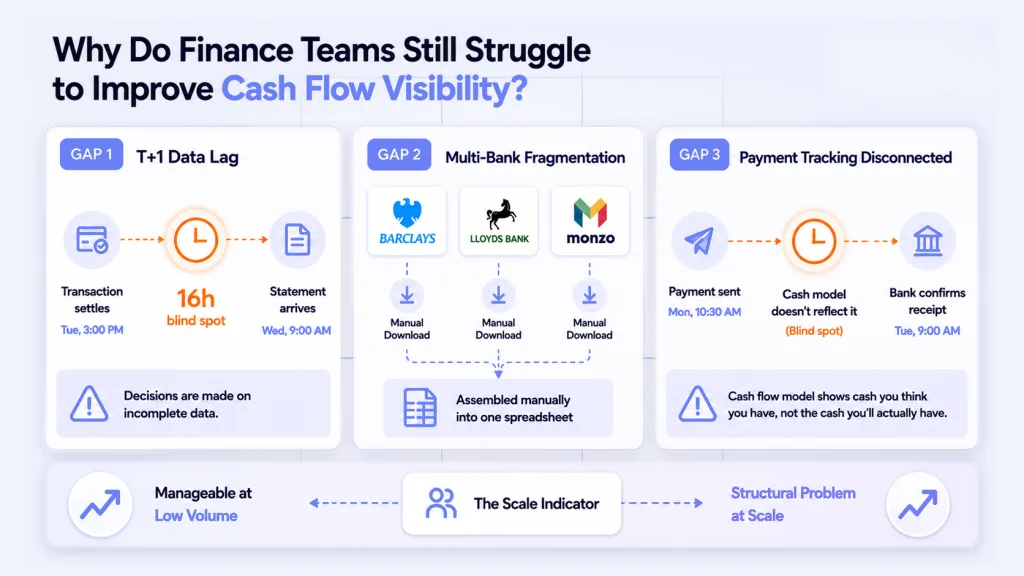
Three structural gaps create cash flow blind spots in most UK finance operations, regardless of what forecasting software is running on top:
T+1 bank statement data. Bank statements for most UK business accounts arrive in overnight batches. A payment that settled at 3pm on Tuesday appears in Wednesday morning’s import. For a finance team trying to understand their cash position at the end of day, that 16-hour gap is the forecast error.
At low transaction volumes this is manageable. At 200 transactions a week across multiple accounts, the cumulative data lag compounds into a forecast that is structurally behind the actual cash position.
Multi-bank fragmentation. A business running a current account at Barclays, a savings account at Lloyds, and a payroll account at Monzo has three separate portals, three separate statement exports, and three separate reconciliation processes. Nobody sees a consolidated cash position unless someone manually assembles it.
That manual assembly takes time. By the time it exists, some inputs are already a day old. The result is not cash flow visibility – it is cash flow reconstruction. For platforms building connected workflows that include both transaction data and expense visibility, expense management via Open Banking connects both flows in a single financial data layer.
Payment tracking disconnected from bank data. A payment goes out via bank transfer. The payment platform shows “sent.” The bank confirmation arrives in the next morning’s statement. The 16-hour gap between payment initiation and bank-confirmed settlement is invisible to the cash flow model.
It is not invisible to the cash position. The money has already moved.
For finance operations teams evaluating how to improve cash flow visibility – and what bank data infrastructure actually changes in the workflow, the real-time transaction monitoring guide covers how webhook-based transaction events differ from batch-based imports in production finance workflows.
Why Is Cash Flow Forecast Important – and Why Does Data Quality Determine Its Value
What Happens When Cash Flow Forecasts Run on Delayed Data?
Why is cash flow forecast important for a business? The direct answer: because liquidity decisions run on it.
A business does not fail because it is unprofitable. It fails because it runs out of cash at a specific moment. The forecast exists to prevent that moment – to give decision-makers enough lead time to act before the problem becomes irreversible.
That lead time only exists if the forecast reflects the current cash position accurately.
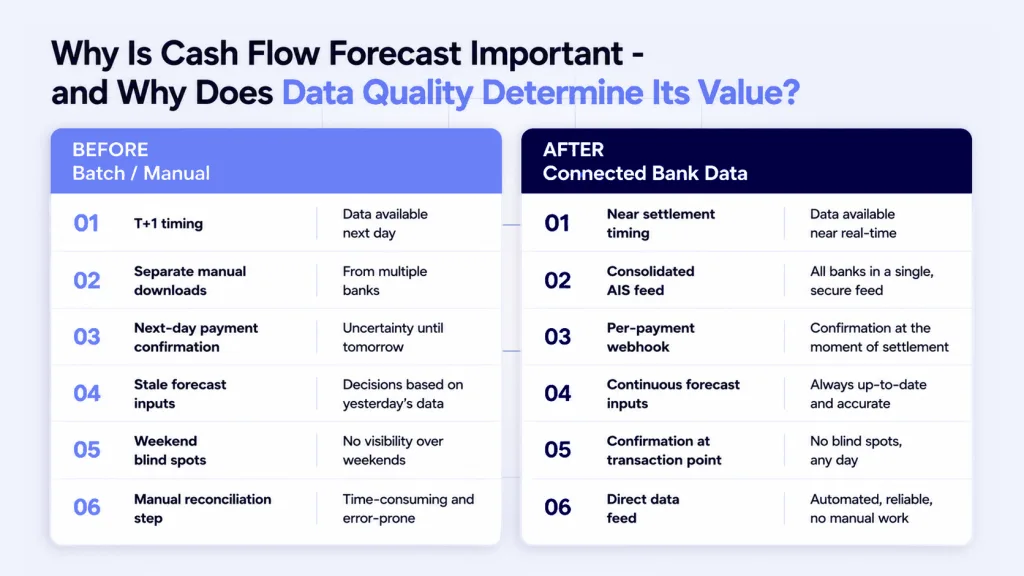
| Cash Flow Visibility Requirement | Batch / Manual Data Approach | Connected Bank Data Approach |
|---|---|---|
| Bank transaction data timing | T+1 overnight batch – data reflects yesterday’s position | Near settlement – per-transaction data at point of confirmation |
| Multi-bank cash position | Separate manual downloads per institution – assembled manually | Consolidated balance across connected accounts via single AIS feed |
| Payment confirmation | Visible in next-day statement – gap between send and confirmation | Per-payment webhook at bank confirmation – status near-immediately |
| Forecast data freshness | Forecast built on data that may be 16-24 hours old | Forecast inputs updated continuously as transactions confirm |
| Cash flow blind spots | Weekend settlements, same-day transfers invisible until Monday batch | Transactions visible at confirmation regardless of timing |
| Reconciliation connection | Manual step between bank data and forecasting tool | Structured bank data feeds forecast model directly |
The difference between columns is not forecast model sophistication. It’s data timing. The right column is what genuine cash flow visibility looks like in practice.
A finance team using the right-hand column does not have a better forecasting model. It has better inputs. And forecasting, like any analytical process, produces outputs only as accurate as its inputs allow.
For accounting and ERP platforms building cash flow visibility into their product, the payment API integration guide covers how PIS and AIS connect at the infrastructure level to provide both outgoing payment data and incoming bank transaction confirmation.
How Does Finexer Support Cash Flow Visibility Workflows
What Does Finexer Provide for Connected Financial Visibility?
Finexer is not a cash flow forecasting software. It doesn’t build financial models, provide treasury services, or act as a cash flow tool.
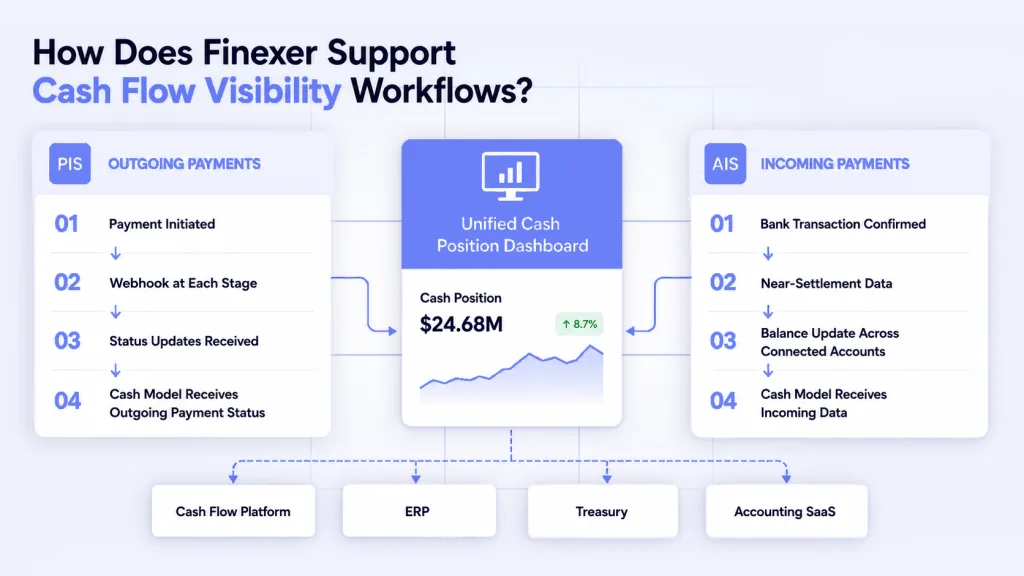
Finexer provides FCA-authorised Open Banking AIS and PIS – the bank data and payment infrastructure layer that cash flow management platforms, ERP systems, and finance operations teams use to improve the data quality feeding their visibility and forecasting workflows.
The challenge to improve cash flow visibility has two sides. The data that arrives from the bank. And the data that leaves via payments. Finexer addresses both.
AIS – Transaction and Invoice Tracker:
- Per-transaction bank data near settlement – not T+1 overnight batch
- Balance data across connected accounts in consistent JSON format
- Merchant IDs and category codes at source – no manual categorisation required
- Single integration across almost all major UK banks – no separate portal per institution
- Up to 7 years of transaction history for trend analysis and retrospective cash flow modelling
The cash flow model receives current bank data rather than yesterday’s batch. The multi-bank visibility problem resolves. The manual assembly step disappears.
PIS – for outgoing payment confirmation:
- Per-payment webhook at each lifecycle stage – initiated, confirmed, failed
- Failure notification near-immediately with reason code
This closes the outgoing side of the cash flow picture. When a payment leaves, the cash model knows. It does not wait for the next morning’s bank statement to find out.
- Usage-based pricing, no setup fees, deployment measured in weeks
- FCA-authorised (FRN 925695)
For finance teams and platforms evaluating how bank reconciliation connects to cash flow visibility, the bank reconciliation guide covers how real-time bank data changes the reconciliation workflow that cash flow models depend on.
What I Feel
The cash flow forecast problem is described as a forecasting problem. It is not.
Most finance teams I work with are capable of building accurate cash flow models. The model logic is sound. The assumptions are reasonable. The outputs are wrong because the inputs are stale.
A forecast built on yesterday’s bank data isn’t a forecast. It is a reconstruction of a cash position that no longer exists. By the time the finance team acts on it, the actual cash position may have changed significantly.
The fix isn’t a better model. It is connecting the model to data that arrives near settlement rather than in a batch file the following morning.
That’s an infrastructure decision. Not a forecasting one.
“Every finance team I’ve worked with that solved this made one change: they stopped importing bank statements and started receiving bank data. The forecast improvement follows from that single decision.” – Ravi, Finexer
Common Use Cases
Cash Flow Management Platforms
Platforms building tools to improve cash flow visibility for SMEs and finance teams need bank transaction data that arrives at the point of confirmation, not in overnight batches. AIS near-settlement data via Open Banking gives forecasting models current inputs – reducing the structural lag that makes most cash flow forecasts inaccurate by design rather than by error.
ERP and Finance Operations Systems
ERP systems consolidating cash positions across multi-bank setups benefit from AIS delivering consistent JSON transaction data across almost all major UK banks via a single integration. Finance teams see a consolidated cash position without manual downloads from multiple bank portals.
Treasury and Finance Operations Teams
Treasury teams managing payment timing and liquidity decisions need per-payment confirmation data that connects outgoing payment status to the cash flow model. PIS webhooks at each payment lifecycle stage give treasury visibility into what has left the account – not what is pending in a payment platform.
Accounting SaaS Platforms
Accounting platforms building cash flow modules for clients need bank transaction data that feeds the module continuously rather than requiring daily manual bank statement imports. When expense data connects to the same Open Banking layer as transaction data, the cash flow picture includes both incoming and outgoing flows without a separate manual import step.
What is the most common cause of cash flow forecast errors?
Delayed bank data. A forecast built on T+1 overnight batches reflects yesterday’s cash position. Weekend settlements and same-day transfers are invisible to the model until the next batch import. The forecast isn’t wrong because the logic is poor – it’s wrong because the inputs are stale. Near-settlement bank data removes the structural lag that drives most forecast errors.
How can a business improve cash flow visibility?
By connecting bank transaction data directly to the cash flow model rather than importing via batch statements. Open Banking AIS delivers per-transaction data near settlement across connected accounts in consistent format – reducing the T+1 lag that creates blind spots between the actual cash position and what the finance team sees.
What is a common purpose of a cash flow forecast?
To give decision-makers lead time before a projected cash shortfall becomes irreversible. The forecast doesn’t prevent cash flow issues – it surfaces them early enough that options remain. A forecast connected to near-settlement bank data surfaces issues earlier than one based on overnight batch imports, providing more time to act.
Improve cash flow visibility with connected bank data and real-time payment tracking.
About the Author

Ravi Ranjan
Ravi Ranjan is Co founder & CEO of Finexer