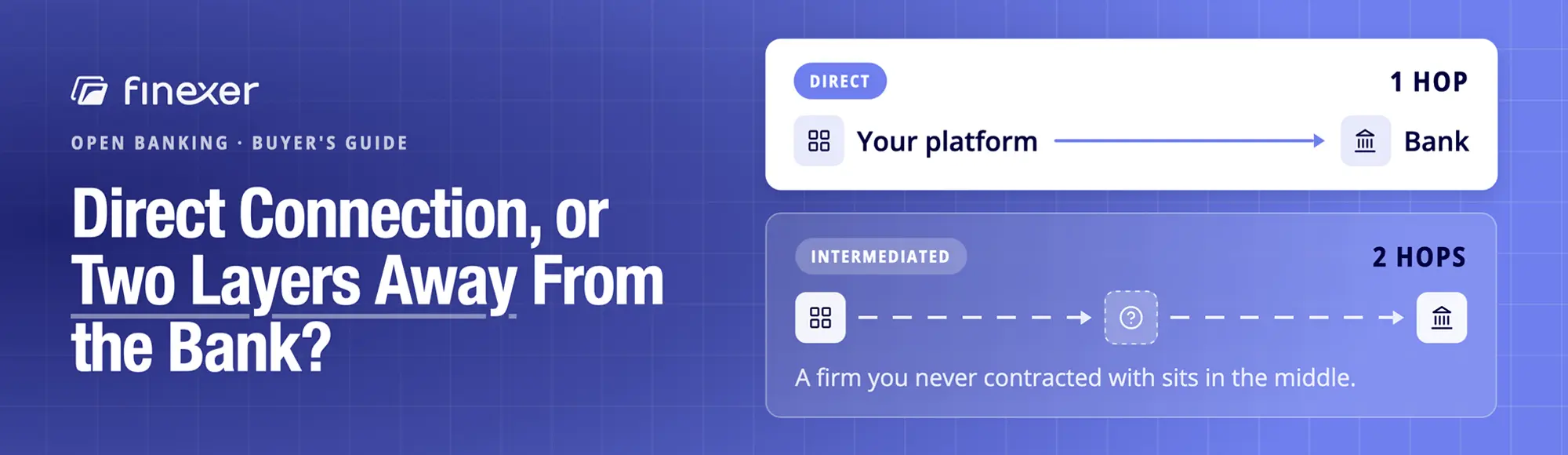
Some UK Open Banking providers hold their own direct connection to each bank’s AIS and PIS interfaces. Others route your data and payments through a third party’s connection, which puts you two layers away from the bank without necessarily telling you so.
What is an open banking direct bank connection?
An open banking direct bank connection means the provider has built and maintains its own integration with a bank’s AIS (account information) and PIS (payment initiation) interfaces, under its own FCA permissions. When something changes on the bank’s side, that provider sees it first and fixes it directly.
Intermediated access: reselling or white-labelling another provider’s connection
Intermediated access is when a provider resells or white-labels another firm’s bank connections. Your data and payment flows run through a company you have no direct contract with, no visibility into, and no ability to escalate to.
Direct connection vs. intermediated access
| Point of Distinction | Direct Connection | Intermediated Access |
|---|---|---|
| Who controls uptime | The provider you contract with | A third party you don’t contract with |
| Diagnosing a bank-side fault | Fixed directly by your provider | Depends on an upstream firm’s response time |
| Regulatory relationship with the bank | Held by your provider | Held by a firm you can’t identify from the outside |
| How a failure surfaces to you | Reported with context | Often appears as an unexplained outage |
Why does this distinction matter commercially?
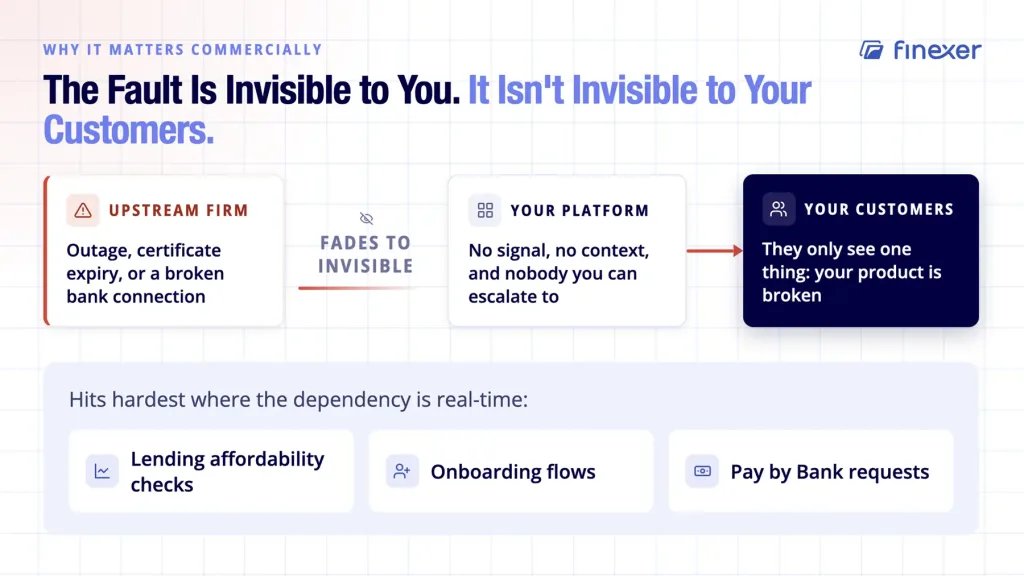
If the upstream provider in an intermediated setup has an outage, a certificate expiry, or a broken connection, it’s invisible to you. You can’t escalate it because you have no relationship with the firm actually holding the connection. Your customers still experience the failure as your product breaking, regardless of where the fault sits.
This matters most for platforms with real-time dependencies on banking data: lending affordability checks, onboarding flows, or Pay by Bank payment requests. An open banking direct bank connection removes one layer of failure you can’t see or control.
How to check whether a provider holds a direct connection?
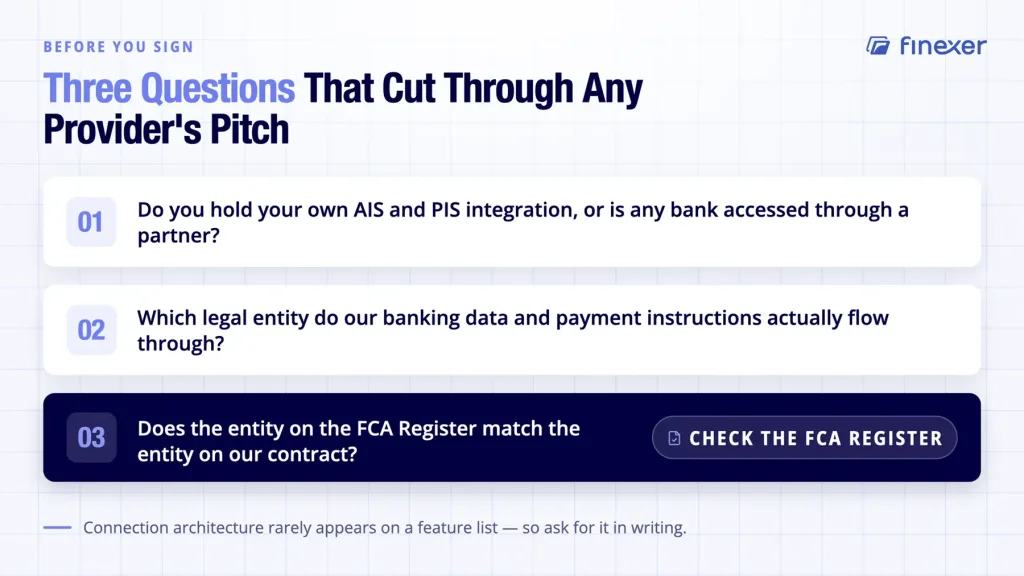
- Ask the provider directly whether they hold their own AIS and PIS integration with each bank in their coverage list, or whether any banks are accessed through a partner.
- Ask which legal entity your banking data and payment instructions actually flow through.
- Check the FCA Register to confirm which entity holds AISP and PISP permissions, and whether that matches the entity you’re signing a contract with.
Provider content and general comparisons of open banking providers rarely raise this point, because connection architecture is harder to market than a feature list. It’s still one of the most consequential questions in a technical evaluation.
How does Finexer’s direct connectivity fits this?
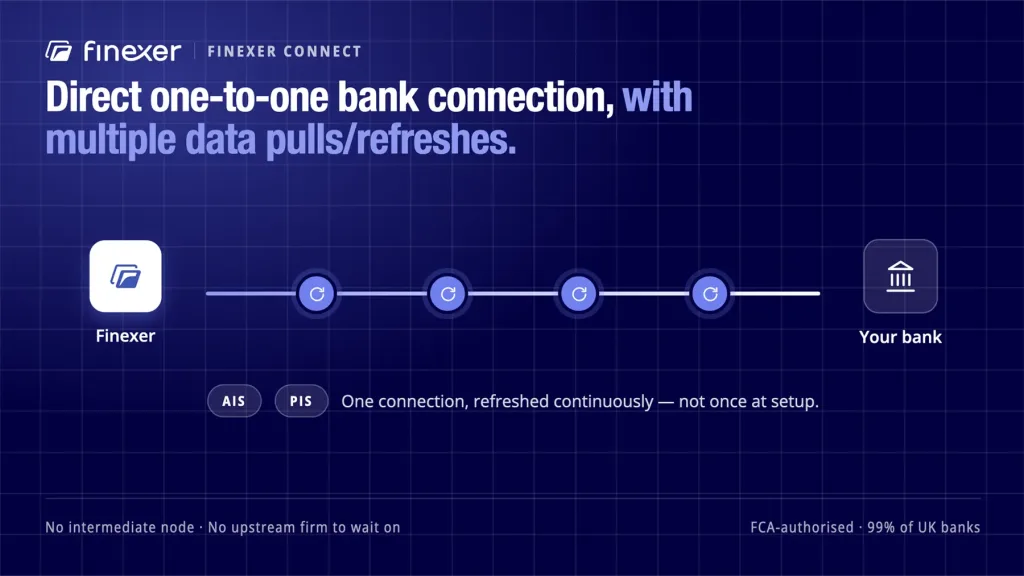
Finexer holds a direct one-to-one bank connection, with multiple data pulls/refreshes with each bank in its coverage list, across both AIS and PIS, rather than reselling access through another firm. For a growing FinTech or embedded finance platform, that means outages and bank-side changes are diagnosed and resolved directly, without waiting on a partner you have no contract with.
This connectivity sits underneath every Finexer product through Finexer Connect, the regulated bank-connectivity and consent layer used for account data access and payment initiation.
If you’re weighing providers as part of a broader evaluation, our guide to open banking solution providers covers the wider selection criteria. And if pricing transparency is part of your comparison, our breakdown of TrueLayer pricing may be a useful reference point.
Bottom line
Not every Open Banking provider connects directly to a bank. Before signing, ask plainly whether your provider holds its own AIS and PIS integration or is passing your data through a firm you’ve never heard of. An open banking direct bank connection is easy to verify and directly affects how quickly faults get fixed.
See how Finexer’s direct bank connectivity supports your platform.
Explore with AI
About the Author

Ravi Ranjan
Ravi Ranjan is Co founder & CEO of Finexer