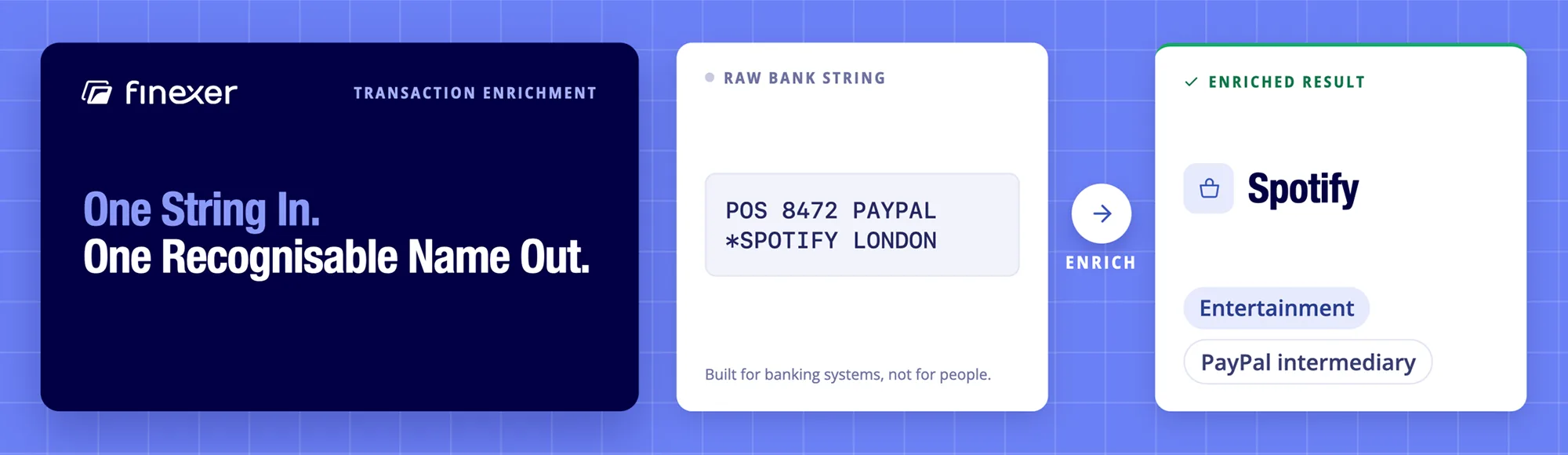
Bank transaction descriptions are short, inconsistent strings created for banking and payment systems, not end users. Merchant name enrichment matches those strings against merchant intelligence and returns a recognisable name, often with a category and related fields.
Start here: Compare one transaction before and after enrichment.
Before: POS 8472 PAYPAL *SPOTIFY LONDON
After: Spotify | Entertainment | PayPal intermediary
Why do bank transaction strings look so messy?
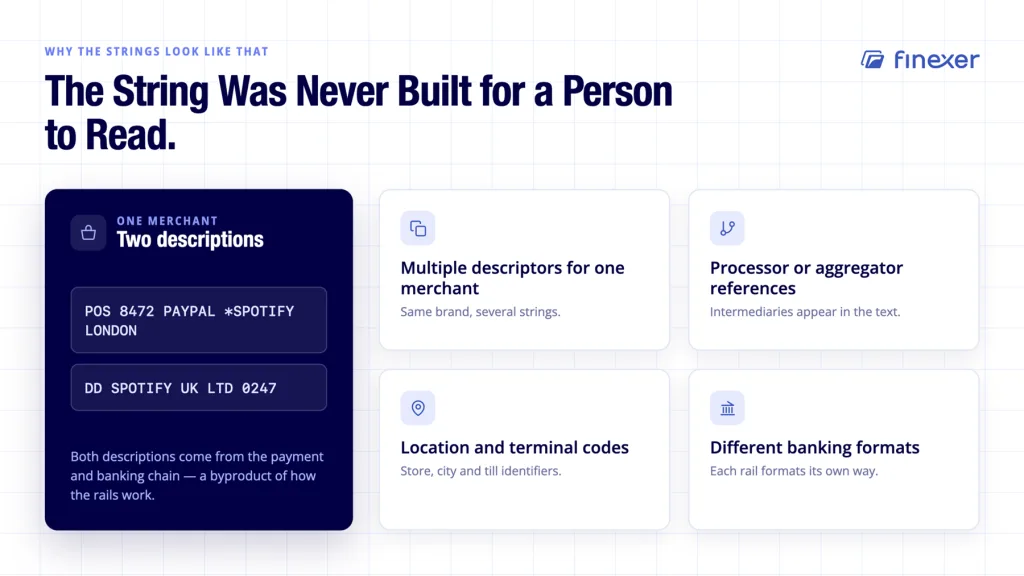
They come from the payment and banking chain rather than a clean brand-name field built for your application. A string may contain processor references, location codes, shortened names or terminal identifiers.
A merchant can appear under several descriptions. Cards can route through intermediaries, while direct debits and transfers can follow different patterns.
Common sources of variation include:
- Multiple descriptors for one merchant
- Processor or aggregator references
- Location and terminal codes
- Different banking formats
Basic text matching can miss related descriptions. Merchant name enrichment must connect them without misleading matches.
How does merchant name enrichment work?
It combines transaction information with merchant intelligence, identifies the likely merchant and returns structured information. Categorisation can then assign a spending group.
| Input | Enriched Result |
|---|---|
| Inconsistent description | Recognisable merchant name |
| Processor reference | Merchant or legal entity |
| Unclear description | Spending category |
| Limited context | Confidence score and related fields |
Readable merchant names can support clearer transaction displays, search, filtering and financial analysis.
Which providers offer transaction enrichment?
Several Open Banking providers offer enrichment, but their approaches and market emphases differ.
| Provider | Publicly Described Enrichment | Market Emphasis |
|---|---|---|
| TrueLayer | Merchant names and classification | UK, Ireland and France |
| Tink | Merchant information and categorisation | European and multi-market |
| Yapily | Merchant names, categories and recurrence | UK and Europe |
| Plaid | Merchant names, categories and recurring spending | Strong US presence, UK services comparatively thinner than the US |
The lesson is clear: Enrichment is a distinct data layer and not a replacement for Open Banking connectivity. It interprets what a transaction already says.
Look at merchant coverage, fields returned, latency, and geography and confidence information.
For more on transaction data, see Finexer’s transaction data guide.
What does Finexer provide?
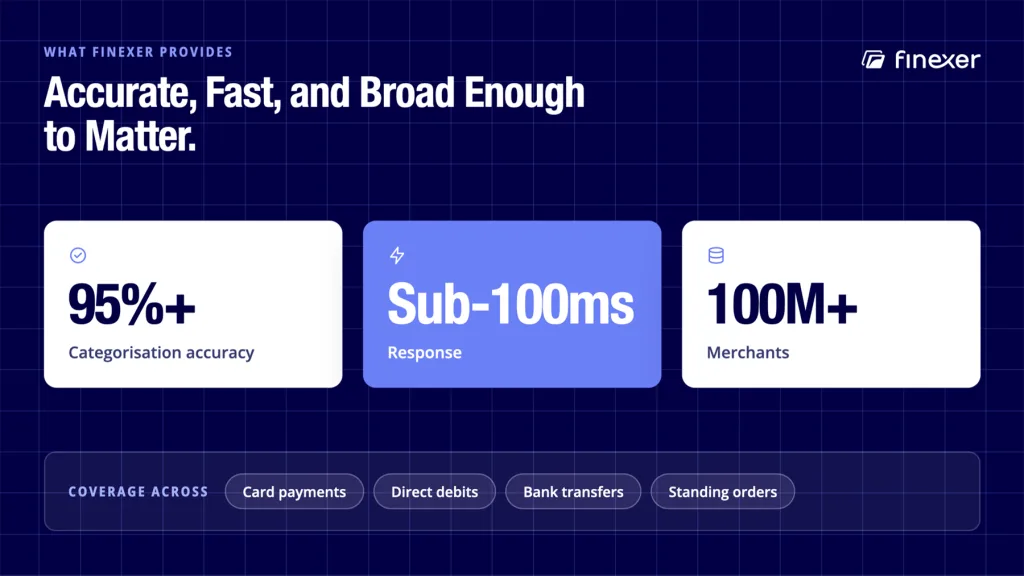
Finexer’s Transaction Enrichment API adds merchant identification and transaction categorisation to standard Open Banking data. It can return merchant name, legal entity, spending category, billing pattern, location, transaction type and confidence score.
Finexer states:
- 95%+ categorisation accuracy
- Sub-100ms response
- 100M+ merchants
- Card payments, direct debits, bank transfers and standing orders
For teams considering merchant data enrichment, ask whether the resulting information is accurate, timely and useful within the product.
Finexer is FCA-authorised as an Authorised Payment Institution, FRN 925695. Its Data product provides consent-based access to account, balance and transaction data, while enrichment adds merchant intelligence.
Where does merchant name enrichment fit in an app?
It sits between receiving transaction information and presenting useful financial context.
A typical flow is as follows:
- The customer consents to Open Banking access.
- The application receives transaction data.
- Enrichment identifies the merchant and adds context.
- The application presents the result in its interface.
For third-party banking apps, this can make transaction feeds easier to understand across connected accounts.
What should teams look for?
Before selecting an enrichment service, ask the following questions:
- How many merchants can it recognise?
- Which transaction types does it support?
- What fields does it return?
- How quickly does it respond?
- How is confidence represented?
- Which banks and countries does it cover?
- Can the data fit the application’s workflow?
Merchant recognition is useful when the resulting data works for the product.
For platforms that also need consent-based banking connectivity, Finexer’s bank data API provides the Data infrastructure.
Is merchant name enrichment the same as categorisation?
No. Merchant identification answers the question “Who received the money?”. Categorisation answers the question “what type of spending or income the transaction represents?”. They often work together.
Can one merchant have several transaction descriptions?
Yes. Processors, locations, payment methods and banking providers can produce different descriptions for the same merchant.
Does enrichment replace the original transaction data?
Not necessarily. Enrichment adds structured intelligence to transaction information. The original banking record can remain part of the application’s underlying data.
Why does merchant recognition matter?
It turns difficult-to-read descriptions into information that users and software can interpret, search and organise.
Concluding remarks
Cryptic transaction strings reflect information created for banking and payment systems. Merchant name enrichment adds context an application needs for recognisable financial information.
If unreadable transaction strings are limiting your product experience, Finexer’s Transaction Enrichment API can add merchant identification and categorisation to standard Open Banking data.
Explore with AI
About the Author

Yuri
Yuriy Yakushko is a fintech founder and software engineer with over 20 years of experience building financial technology. He’s passionate about creating scalable, secure infrastructure that helps businesses modernise how they access financial data and manage payments.