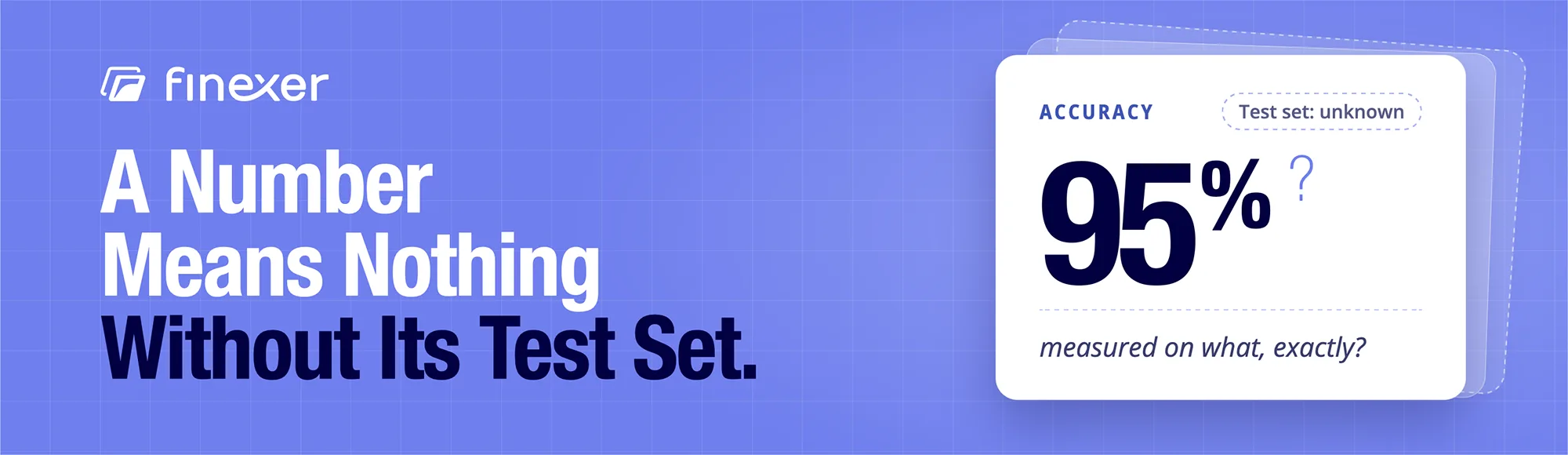
Automated transaction categorisation can be accurate, but no headline percentage tells you enough on its own. Transaction categorisation accuracy depends on the test set, merchant coverage, transaction types and how the system handles unfamiliar descriptions. Before accepting a vendor’s number, test transactions that resemble your own.
What determines transaction categorisation accuracy?
Transaction categorisation accuracy depends on merchant knowledge, descriptor variation and the long tail of transactions that do not fit established patterns.
A bank description can be accurate yet difficult for software to interpret. It may contain an abbreviated merchant name, processor or reference rather than a recognisable name.
This is why transaction enrichment adds context to standard Open Banking data. Finexer’s transaction data provides the underlying context, while categorisation adds spending categories and merchant intelligence.
Why do merchant databases matter?
A larger merchant database gives a model more known patterns from which to work.
But database size is not the same as accuracy. Coverage should be tested against the merchants, sectors and transaction types that matter to your product.
Why do descriptions create difficult cases?
Descriptors vary by bank, payment method and merchant. The same business can appear differently across card payments, direct debits, bank transfers and standing orders.
Difficult cases include unfamiliar merchants, transfers and descriptions containing several clues.
How can you test a provider’s accuracy?
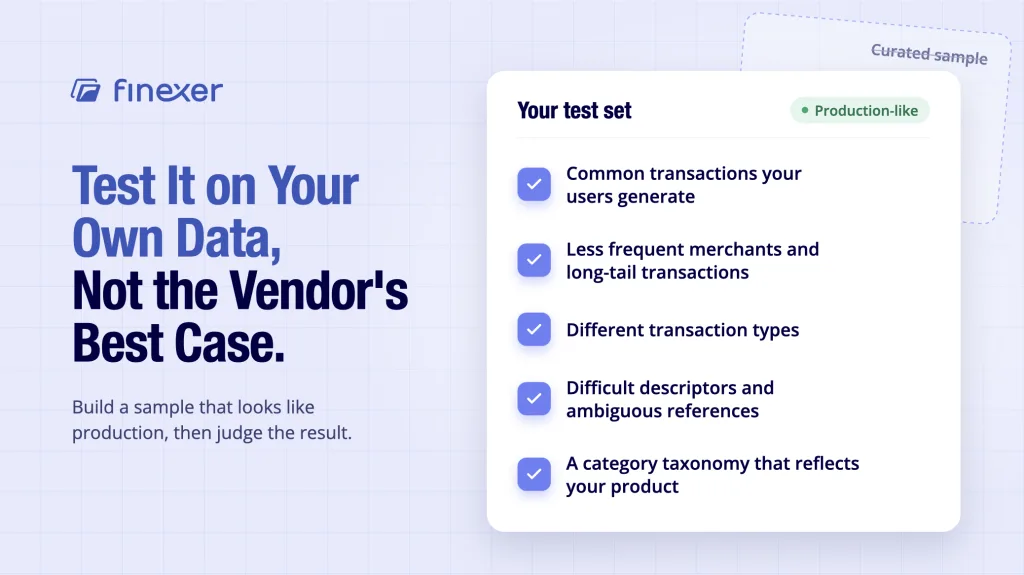
Use a representative transaction sample rather than accepting a vendor’s headline figure.
A practical test should include the following:
- Common transactions your users generate.
- Less frequent merchants and long-tail transactions.
- Different transaction types.
- Difficult descriptors and ambiguous references.
- A category taxonomy that reflects your product.
Before choosing a provider, test its output against your own transaction data rather than relying only on published accuracy claims. You can also review Finexer’s bank data API to understand the underlying banking data available for enrichment.
Measure more than the percentage. Check category-level accuracy, merchant recognition, confidence scores and the share of transactions needing human review.
A provider can perform differently on a curated sample and a production-like sample.
What does “good enough” accuracy look like?
The answer depends on the job that categorisation performs.
| Use Case | What Matters Most |
|---|---|
| Customer spending view | Recognisable merchants and useful categories |
| Budgeting | Consistent category assignment |
| Internal reporting | Repeatable classifications across periods |
| Reconciliation | Correct transaction type and matching context |
For a customer-facing feature, an occasional correction may be acceptable if the overall experience remains useful. For internal financial workflows, repeated misclassification can create review work and distort reporting.
A 95% result does not mean that the remaining 5% carries equal business impact.
How do leading providers differ?
The market combines classification, merchant identification and enrichment across different markets.
| Provider | Enrichment or Categorisation Focus | Positioning |
|---|---|---|
| TrueLayer | Transaction classification and merchant naming | UK and European Open Banking |
| Yapily | Categorisation, enrichment and merchant recognition | European B2B Open Banking |
| Tink | Categorisation, merchant information and recurring transactions | European financial data |
| Plaid | Merchant, category and location enrichment | Strong US presence, with UK products |
| Salt Edge | Categorisation and merchant identification | Broad international coverage |
| Finexer | Categorisation and merchant identification | UK-focused infrastructure |
The comparison is regarding which provider’s coverage, taxonomy and output fit your data and product. TrueLayer, Yapily, Tink, Plaid and Salt Edge, among others, are identified as distinct competitors with different geographic and product positions.
What does Finexer report for transaction categorisation?
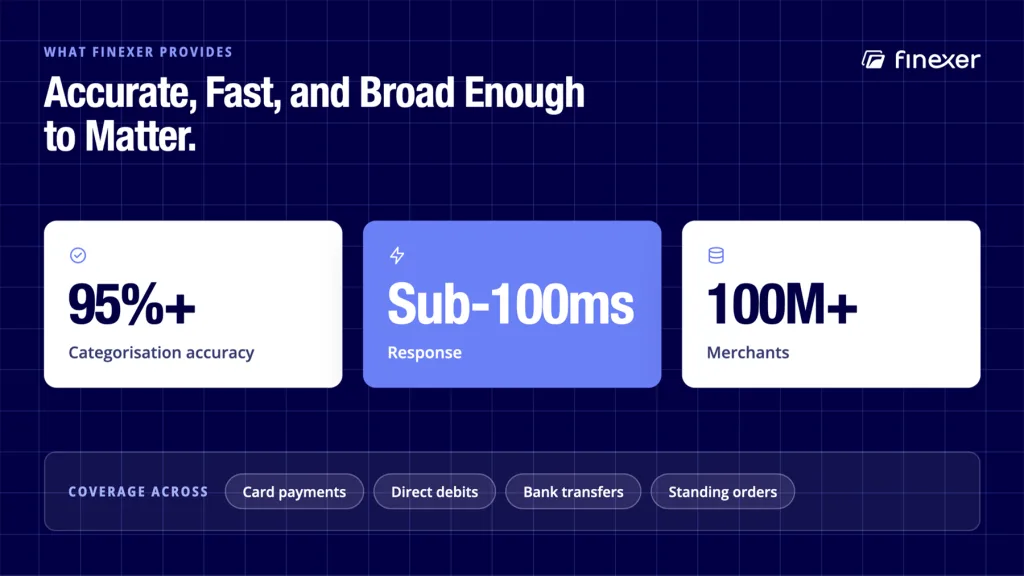
Finexer reports 95%+ accuracy for its Transaction Enrichment API, with sub-100ms response times and a database covering 100 million+ merchants.
The product adds merchant identification and categorisation to standard Open Banking data. Outputs include merchant name, legal entity, spending category and confidence score.
For platforms assessing transaction categorisation, these outputs provide more context than a category alone. The API covers card payments, direct debits, bank transfers and standing orders.
Finexer is an infrastructure provider rather than software that end users log into. Its enrichment capability is intended for platforms building transaction experiences into their own products.
What should buyers ask before choosing a provider?
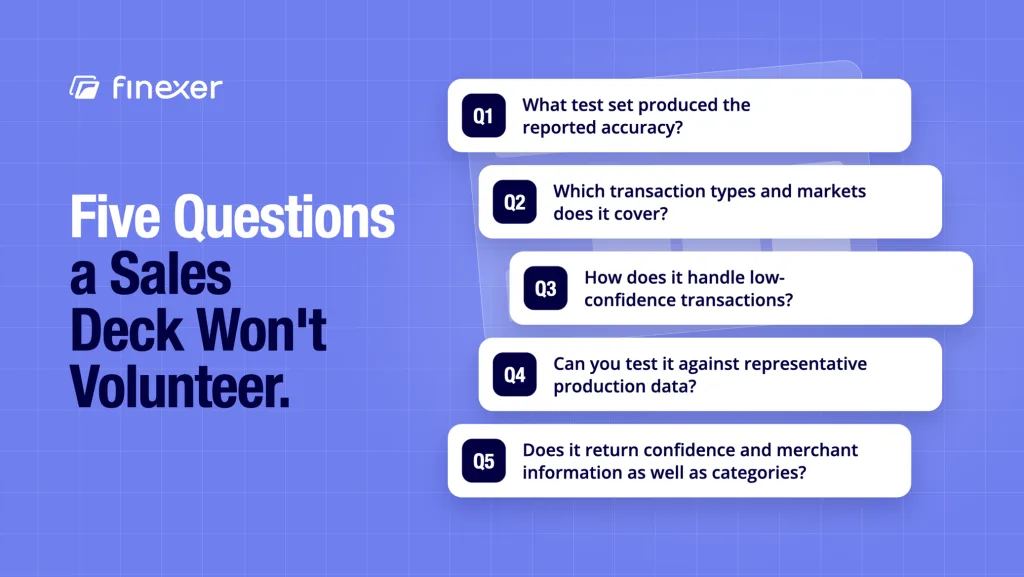
Ask these five questions:
- What test set produced the reported accuracy?
- Which transaction types and markets does it cover?
- How does it handle low-confidence transactions?
- Can you test it against representative production data?
- Does it return confidence and merchant information as well as categories?
If you are comparing financial data providers UK, treat categorisation as one evaluation factor. Underlying banking data, enrichment outputs and the integration model all affect user experience.
Is 95% transaction categorisation accuracy good?
It can be, but the number needs context. A representative test set and category-level results are more informative than a headline percentage.
Why are some transactions hard to categorise?
Unfamiliar merchants, varied descriptors, transfers and ambiguous references create cases where transaction text does not clearly indicate a category.
Can users correct incorrect categories?
Some providers support feedback or custom categorisation. Ask whether corrections can inform future transactions.
Does better categorisation mean better banking data?
Not necessarily. Banking data can be accurate while still being difficult for business software to interpret. Categorisation adds an interpretation layer.
Get transaction categorisation you can test against real data
When inconsistent transaction descriptions undermine transaction categorisation accuracy, Finexer’s Transaction Enrichment API adds merchant and category context for clearer transaction experiences.
Explore with AI
About the Author

Ravi Ranjan
Ravi Ranjan is Co founder & CEO of Finexer