Pay Overseas Staff on Time.
GBP payouts with per-payment status you can act on.
reach the account and arrive in the amount the recipient expects. The route can determine whether payday feels routine or becomes a finance problem.
TL;DR: International payroll payments depend on the route behind the payment, not just the payroll calculation. Bank wires, specialist FX providers, global payroll platforms and GBP payouts to supported accounts differ in fees, FX treatment, timing and visibility. Choice starts with what the recipient must receive, when they must receive it and how quickly the payer needs to spot exceptions.
Why this matters
A payroll system can calculate pay correctly and still leave finance teams guessing whether a payment arrives late or short.
That matters for UK businesses paying overseas employees or contractors and even payroll or invoicing platforms handling payroll payments internationally.
If you are choosing a provider to run overseas payroll itself, that is a different question. Our guide to overseas payroll services covers that service-selection decision. This article focuses on the payment after payroll has been calculated.
What makes international payroll payments different?
International payroll payments add more variables than a domestic salary payment. A payment can be marked as sent while the recipient is still waiting.
The main issues are route, currency, timing, recipient details and payment visibility. Each can affect what reaches the recipient and when it arrives.
A UK team may be familiar with sort codes and account numbers. Overseas payments can require IBANs or other supported account details, creating another point where errors can enter the workflow.
Which payment routes can a UK business use?
There is no single route for every overseas payment. The choice depends on the destination, currency, timing and payment volume, and the visibility the business needs.
| Route | Cost Structure | Timing | Recipient Experience |
|---|---|---|---|
| Bank wire | Transfer fee, possible FX margin and intermediary deductions | Cut-offs and correspondent banking can add delay | May receive less than expected |
| Specialist FX provider | Transfer pricing plus conversion cost or FX margin | Built around international transfer workflows | Often receives local currency |
| Global payroll platform | Payroll or platform charges, plus possible payment or FX costs | Depends on payroll and payout workflow | Payment sits within a wider payroll service |
| GBP payout to supported account | Provider pricing plus applicable conversion or receiving costs | Depends on destination, route and banking partner | Receives the amount delivered through the route |
See our guide to cross border payments for payment structures.
International payments processing can therefore involve several stages between approval and receipt.
Where does the real cost come from?
The transfer fee is visible but is not necessarily the biggest cost.
For international payroll payments, separate these questions:
- What fee does the provider charge?
- What FX margin applies if currency conversion happens?
- Can another bank deduct money before the recipient receives it?
A low transfer fee can hide an FX margin. Intermediary deductions can also change the amount received.
International payments processing is therefore a total-cost question.
Record the amount sent and, where available, the amount received. This gives finance teams a better basis for comparing routes.
Our business international payments guide looks more broadly at international payment costs.
Why can a payment miss payday?
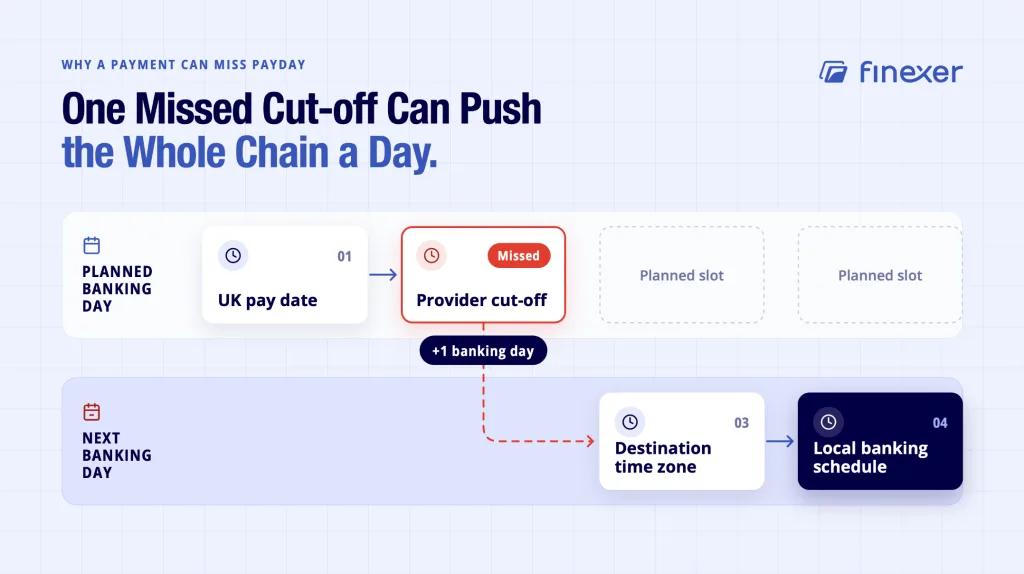
A payroll team may work to a UK pay date while a recipient’s bank operates in another time zone. Provider cut-offs, weekends and local banking schedules can shrink the processing window.
For payroll payments international, ask:
- When must the payment be submitted?
- What is the provider’s cut-off?
- Which time zone controls it?
- What happens after the cut-off?
- Does the destination bank add another processing stage?
- When will the payer learn that the payment failed or returned?
Several stages can sit in sequence. A missed cut-off can push one stage into the next banking day and affect the expected pay date.
What can go wrong?
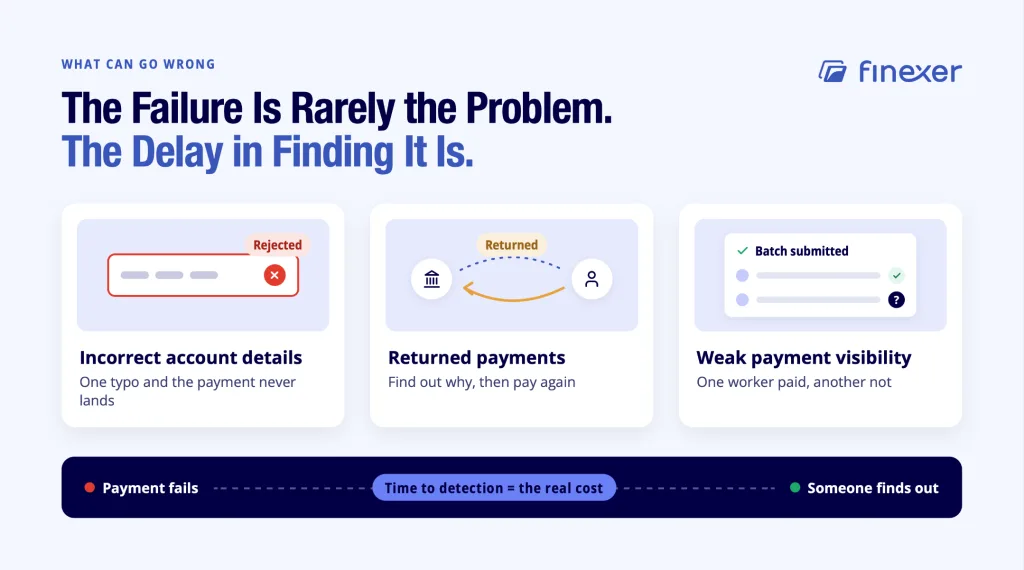
International payroll payments can fail for mundane reasons. The bigger issue is often the delay before anyone discovers the mistake.
Incorrect account details
International account formats vary. A team accustomed to UK sort codes and account numbers may need IBANs or other supported account details for overseas recipients.
A typo can produce a rejected or returned payment. An unfamiliar format can slow checks before submission.
Returned payments
A returned payment creates two jobs: finding out why it returned and deciding how to pay the recipient again.
If the payroll system only shows that a batch was submitted, finance may not know which individual payment needs attention.
Weak payment visibility
Batch processing can hide individual outcomes. That becomes uncomfortable when one worker has been paid and another has not.
At scale, exceptions become harder to manage. Our article on global mass payouts looks at this problem in larger payout workflows.
What should a business check before choosing a route?
An assessment can fit on one page.
| Area | Questions to Ask |
|---|---|
| Cost | Transfer fee, FX margin, intermediary or receiving deductions? |
| Timing | Cut-off, destination processing, weekends and holidays? |
| Payment data | Which account details, formats and currencies are required? |
| Visibility | Can finance see individual status, returns and reconciliation data? |
A route can look attractive on paper yet create operational work if individual outcomes stay hidden.
How do competitors approach the wider payment problem?
Providers focus on different parts of the payment stack, so geographic coverage alone does not show whether a provider fits a payroll workflow.
TrueLayer, Yapily and Tink combine data and payment capabilities. GoCardless focuses strongly on recurring payments and collection. Crezco focuses on B2B invoice payments. Plaid has broad international coverage and a strong US presence, while Salt Edge focuses on financial data aggregation.
For a UK payroll or contractor platform, compare providers by workflow:
| Need | What to Examine |
|---|---|
| UK-origin funding | How the UK side of the payment is initiated |
| Overseas payout | Which recipient details and routes are supported |
| Payment status | Whether each payment has an individual status |
| Cost control | Whether fees and FX treatment are visible |
| Platform integration | API model and payment-event handling |
| Compliance position | Who provides the regulated payment service |
A broader geographic footprint may matter for one use case, while a UK-focused infrastructure layer may fit another.
What does compliance involve at a basic level?
International payroll payments still require payment controls. Businesses should verify recipient information and keep records of payment instructions and outcomes.
Responsibilities depend on the business model and jurisdictions. Payment infrastructure does not replace local tax, employment-law or payroll-compliance obligations.
How does Finexer handle international payouts?
A UK-origin payroll payment needs a supported route to reach an overseas recipient, with enough status information to act when something goes wrong.
Finexer supports international GBP payouts to recipients using IBAN or supported account details through supported payout routes. Settlement time varies by destination, route and banking partner, so international payouts should not be presented as having guaranteed instant settlement.
For platforms building this into their product, Finexer Payments provides the relevant payment infrastructure.
Relevant capabilities include the following:
- International GBP payouts to recipients using IBAN or supported account details.
- Per-payment status for individual payment outcomes.
- UK-origin payout capability through supported payout routes.
- FCA-authorised payment infrastructure, with FRN 925695.
- A direct one-to-one bank connection, with multiple data pulls/refreshes.
Finexer is infrastructure and not software that employees or contractors log into. The platform remains responsible for its payroll workflow.
Which businesses can benefit from this approach?
Payroll platforms
A payroll SaaS product can calculate pay while keeping payment initiation and status within its workflow.
Contractor platforms
Contractor management platforms often pay people in multiple countries. Individual status helps operations teams identify exceptions.
Invoicing platforms
Some invoicing products also pay suppliers or contractors. The same principles apply: recipient details, route, cost, timing and status.
Should the payer send GBP or convert before payment?
There is no universal answer. The choice depends on the recipient’s required currency, selected route and conversion-attached costs. Compare the total amount the recipient should receive, not just the transfer fee.
Who should absorb currency-conversion costs?
That depends on the commercial arrangement with contractors. State the payment currency and treatment of conversion costs before the pay date so that the recipient knows what to expect.
Can a payroll platform separate payroll calculation from payment infrastructure?
Yes. A platform can calculate payroll within its own workflow and use a separate payment infrastructure provider for payouts. The key is to define responsibilities for payment initiation, status, reconciliation and compliance.
What should finance teams compare after a pay run?
Compare the amount sent, recipient outcome where available, fees, conversion treatment, returned payments and processing time. Reviewing these together gives a clearer picture than looking at the transfer fee alone.
Closing thought
Payroll software decides what someone is owed. Payment infrastructure determines how that money gets there.
For UK businesses paying people abroad, cost, timing, recipient details and status matter.
See how Finexer handles international GBP payouts to IBAN or supported account details, with per-payment status so a returned salary payment is caught the same day.
Explore with AI
About the Author

Ravi Ranjan
Ravi Ranjan is Co founder & CEO of Finexer