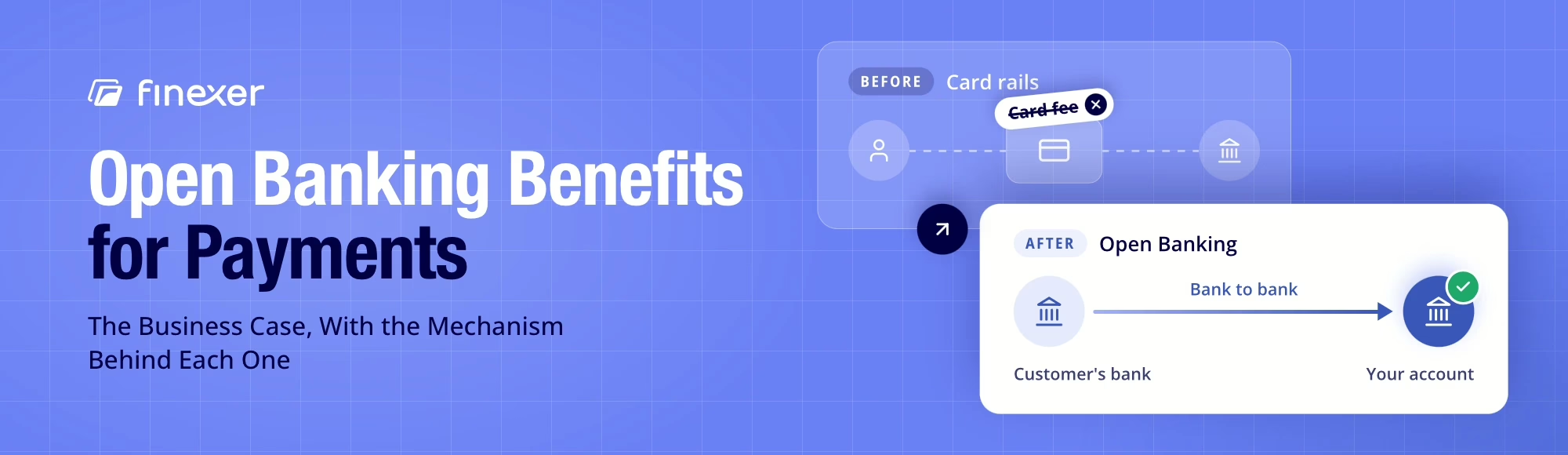
The open banking benefits for payments go beyond lower transaction costs. But what makes them a compelling business case for UK platforms?
If you’re building the case to switch, the pitch is simple: platforms that move to open banking payment methods cut transaction costs, settle faster than card rails, and get reconciliation data that doesn’t need manual checking.
This isn’t a definition piece. It’s the mechanism behind each open banking benefits for payments claim, so you can actually defend it in front of a decision-maker.
The scale behind this is real, not theoretical: in September 2026, UK Open Banking infrastructure recorded 169.13 million successful payment initiation (PIS) API calls, as part of 2.92 billion successful API calls overall, with 99.79% weighted API availability.
Every benefit below reflects an established and growing ecosystem, not a pilot.
Key takeaways
- Open banking benefits for payments come from removing card interchange from the flow, not from a vague efficiency story.
- Settlement runs over Faster Payments rather than a multi-day card cycle, and payment references carry through to reconciliation automatically.
- The honest trade-offs (customer familiarity, different refund mechanics) matter more for credibility than the upside alone.
What Are the Benefits of Open Banking for Payments?
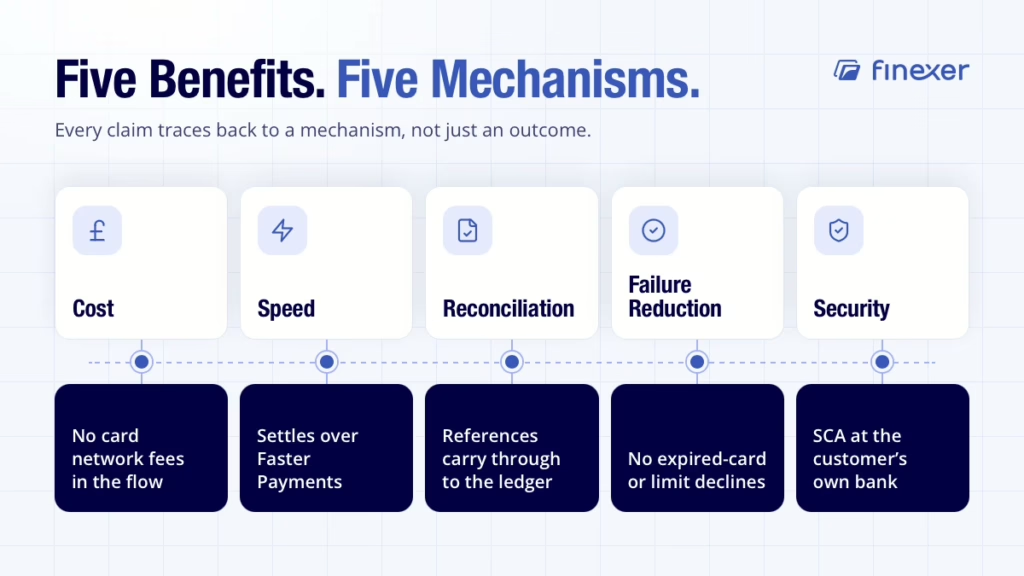
Each open banking benefits for payments claim below has a mechanism behind it, not just an outcome.
Cost
There’s no card network fees in the flow, since the payment moves directly between bank accounts rather than through a card network.
Finexer’s approved positioning is that this saves up to 90% on transactional costs compared with card processing, though the actual saving depends on your current card mix and volume. This is the single biggest line item behind most open banking benefits for payments business cases.
Speed
Settlement runs over Faster Payments rather than a multi-day card settlement cycle, so funds land without the batch delays card rails introduce.
Reconciliation
Payment references and real-time banking data carry through to your ledger, so matching a payment to an invoice doesn’t need manual checking. This is what automated reconciliation looks like in practice, rather than something added to a dashboard later.
Failure reduction
There’s no expired card or credit-limit decline in the flow, since the payment draws directly from an account rather than against a card’s available balance.
Security
Strong Customer Authentication happens at the customer’s own bank on every payment, and no card details are stored anywhere in the flow, which removes a category of fraud risk entirely rather than just monitoring for it.
Where the Benefit Is Biggest by Business Type
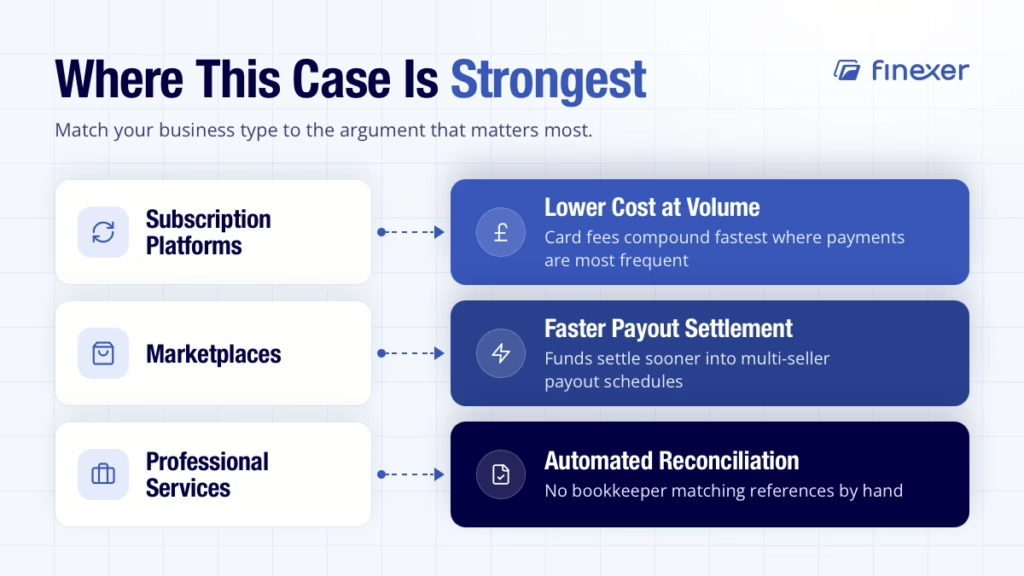
Subscription platforms gain most from lower per-transaction cost at volume, since card network fees compound fastest where payment frequency is highest. Marketplaces paying out multiple sellers benefit from faster settlement into payout schedules.
Professional services with recurring invoicing gain the most from automated reconciliation that doesn’t need a bookkeeper to match references by hand. For a broader look at how these open banking benefits apply beyond payments specifically, see our guide to open banking for businesses.
The same logic applies on the merchant side of open banking for payments: the fewer intermediaries between the customer’s bank and your ledger, the fewer places a payment can fail or a fee can be added.
What Are the Downsides of Open Banking Payments?
Two practical considerations are worth keeping in mind:
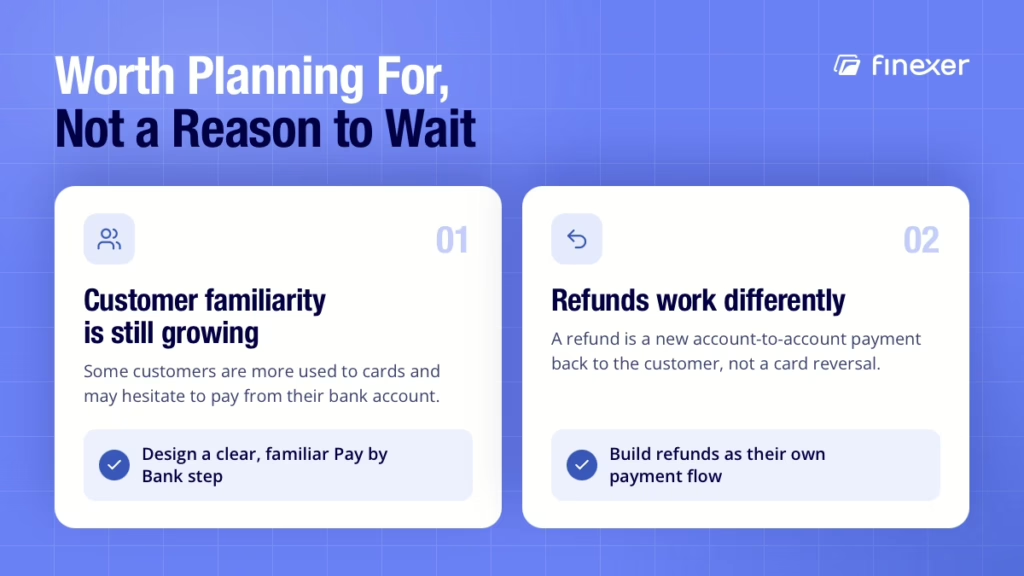
- Customer familiarity is still growing: Some customers may hesitate to pay directly from their bank account, especially if they are more familiar with card payments.
- Refunds work differently: Unlike card refunds, which are reversed through the card network, an open banking refund requires a new account-to-account payment back to the customer. Your refund process needs to account for this.
These trade-offs don’t outweigh the open banking benefits for payments, but they do need to be considered when planning the payment experience.
Where Does Finexer Fit in Open Banking Payments?
Finexer provides open banking payment initiation with instant settlement and per-payment webhook status, so your platform knows a payment has landed without polling for it.
Strong Customer Authentication is handled at the customer’s bank on every transaction, and pricing is transparent, with no hidden charges.
Finexer’s payments API is built around the same mechanisms behind the open banking benefits for payments above: no card network fees in the flow, payment authorised directly at the customer’s own bank, and automated reconciliation data that carries through without manual matching.
Bottom Line
The case for open banking benefits for payments holds up because each claim traces to a specific mechanism, not a marketing line: no card network fees, no card network delay, no manual reference matching, and Strong Customer Authentication in place of stored card details.
The honest trade-offs, customer familiarity, and different refund mechanics are real, but they’re operational planning questions, not reasons to shelve the open banking benefits case.
What are the benefits of Open Banking for payments?
Lower cost from removing card network fees, faster settlement than card rails, automated reconciliation from payment references and real-time banking data, fewer failed payments, and Strong Customer Authentication on every transaction. Each of these open banking benefits for payments comes from a specific mechanism, not a general efficiency claim.
What are the downsides of Open Banking payments?
Customer familiarity is still building compared with cards, so some customers may hesitate at first. Refunds also work differently: they’re a new payment back to the customer rather than a card-network reversal, which changes how your refund process needs to be built.
Does Open Banking really save money on payments?
Removing card network fees from the flow is where the open banking benefits case is strongest on cost. Finexer’s payment infrastructure helps businesses reduce transaction costs compared with card processing, although the actual savings depend on the existing payment mix and transaction volume.
How is a refund different with Open Banking?
A card refund reverses through the card network using the original transaction. An open banking refund is a new account-to-account payment sent back to the customer, so it needs to be built as its own payment flow rather than assumed to work the same way.
Instant settlement, per-payment webhook status, and pricing with no hidden charges, built around the same mechanisms behind the benefits above.
Explore with AI
About the Author

Ravi Ranjan
Ravi Ranjan is Co founder & CEO of Finexer