
Open banking for payments moves money directly from one bank account to another via Faster Payments, without card networks in between. For UK merchants, this matters because 98% of card transactions run through Visa and Mastercard -and every one of them carries interchange fees that come off your margin.
In 2026, this is no longer niche. Amazon and eBay both launched Pay by Bank UK in early 2026, enabling millions of customers to pay without a card. Open Banking UK processed 37.46 million payments in March 2026 alone. The question for merchants is no longer whether open banking for payments works -it’s whether it works for your specific use case.
This guide gives you the cost, settlement, and checkout trade-offs so you can make that call. For a broad overview of open banking payment methods, see open banking payment methods.
Key Takeaways
- Open banking for payments initiates account-to-account payments via Faster Payments -no card rails, no interchange fees, instant settlement
- There were 2.06 billion UK Card transactions in April 2026; Pay by Bank sits alongside cards, not instead of them
- The open banking payment flow includes built-in SCA via bank authentication -stronger than card entry, no separate implementation needed
- Open banking payments for e-commerce merchants suit high-value, low-return basket types best; cards still outperform on impulse and low-value purchases
How Does Open Banking for Payments Work?
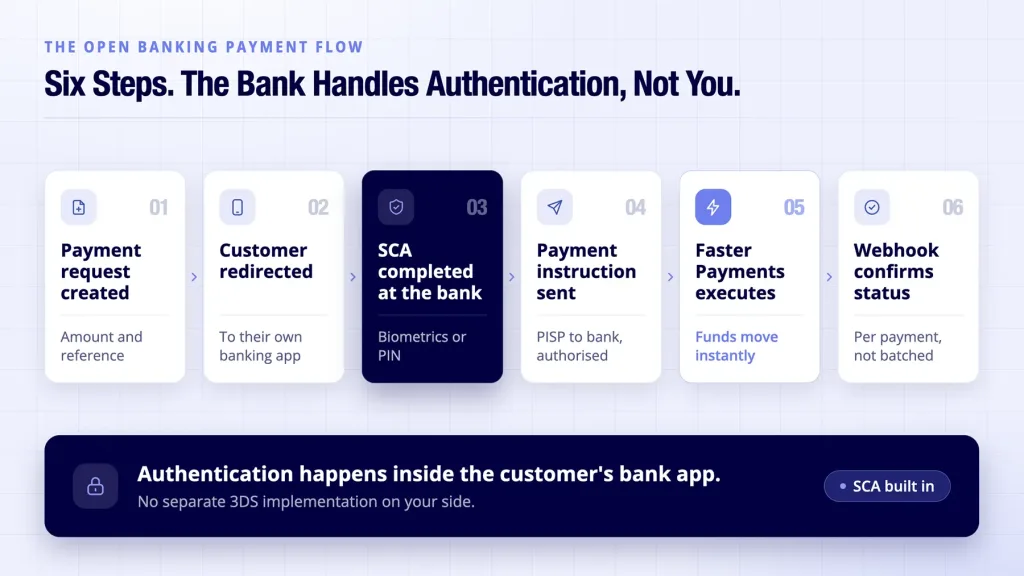
Open banking for payments is regulated under PSD2 through a Payment Initiation Service Provider (PISP). The PISP creates a payment request, routes the customer to their bank for authorisation, and the bank executes the payment via Faster Payments.
The Open Banking Implementation Entity (now Open Banking Limited) oversees the technical standards that make this interoperable across UK banks. Without the Open Banking Implementation Entity’s common API framework, each bank would have a different integration -which is why Open Banking UK developed centralised standards from the start.
The step-by-step payment flow
- Payment request created -Your platform sends a payment instruction to the PISP with amount, reference, and recipient account
- Customer redirected -Customer is taken to their own banking app for customer authorisation
- SCA completed at the bank -Customer authenticates with biometrics or PIN -this IS the SCA step, handled natively by the bank
- Payment instruction sent -The PISP sends the authorised payment instruction to the bank
- Faster Payments executes -Funds move instantly via Faster Payments to your account
- Webhook confirms status -Your platform receives a per-payment webhook confirming the outcome
For a deeper technical breakdown, see open banking payment initiation.
What does customer authorisation look like in practice?
Unlike card payments where the customer enters card details into your checkout, open banking payments redirect the customer to their own bank. This is the same environment they use for all their banking. Familiarity improves over time, and with Pay by Bank merchants like Amazon and eBay now offering this flow, customer recognition is building fast.
How Does Open Banking Compare to Cards for Merchants?
The core evaluation for merchants is cost versus familiarity. Open banking for payments wins on cost, settlement speed, and fraud exposure. Cards win on customer comfort and coverage for low-value transactions.
| Factor | Cards | Open Banking / A2A |
|---|---|---|
| Transaction cost | Interchange fees + acquirer margin | Lower per-transaction; no card network |
| Settlement timing | 1-3 business days | Instant via Faster Payments |
| SCA | Separately implemented | Bank-native, built in |
| Chargeback exposure | Moderate to high | Very low (payment is irrevocable) |
| Failed payment causes | Insufficient funds, expired card, block | Insufficient funds, bank-side timeout |
| Best basket type | Low-value, impulse, recurring | High-value, one-off, invoice |
Interchange fees compound at scale. A merchant processing significant card volume pays those fees on every transaction -open banking account-to-account payments remove this overhead entirely.
To compare current Pay by Bank providers on these criteria, see pay by bank providers.
What Does Open Banking for Payments Mean for E-Commerce Merchants?
Open banking payments for e-commerce merchants are growing fastest in higher-value checkout scenarios. Only 6% of UK e-commerce transactions used A2A payments in 2025 (Worldpay Global Payments Report 2026), but with Amazon and eBay offering Pay by Bank UK in 2026, consumer familiarity is accelerating.
The Role of Open Banking UK in the Checkout Process
Open banking payments for e-commerce merchants do not replace cards in every scenario. They sit alongside them. Here is where the fit is strongest:
- High-value purchases (electronics, furniture, travel): Interchange fees are most painful here; instant settlement improves working capital significantly
- Invoice payment flows: Payment reference carries through automatically -no reconciliation guesswork
- Returning customer flows: Once a customer has authorised once, repeat purchases have a familiar flow
For a broader view of where open banking fits among online payment systems, see online payment systems.
Checkout conversion considerations
Open banking payments for e-commerce merchants involve a redirect to the bank app. This adds a step compared to a stored card. For some merchant categories and customer types, this creates friction. The honest position: conversion rates depend on customer familiarity, basket size, and device type. Mobile conversion is strong where banking apps are already in daily use. Desktop conversion requires a clear UX prompt.
Refund handling
Refunds under open banking work differently to card refunds. There is no chargeback mechanism. Refunds are initiated by the merchant via the PISP, returning funds via Faster Payments. This typically settles faster than card refunds (which run through card network timelines).
The trade-off: the customer cannot initiate a dispute through their card issuer. Merchants need a clear refund policy that customers understand at checkout.
What Are the Honest Limitations of Open Banking for Payments?
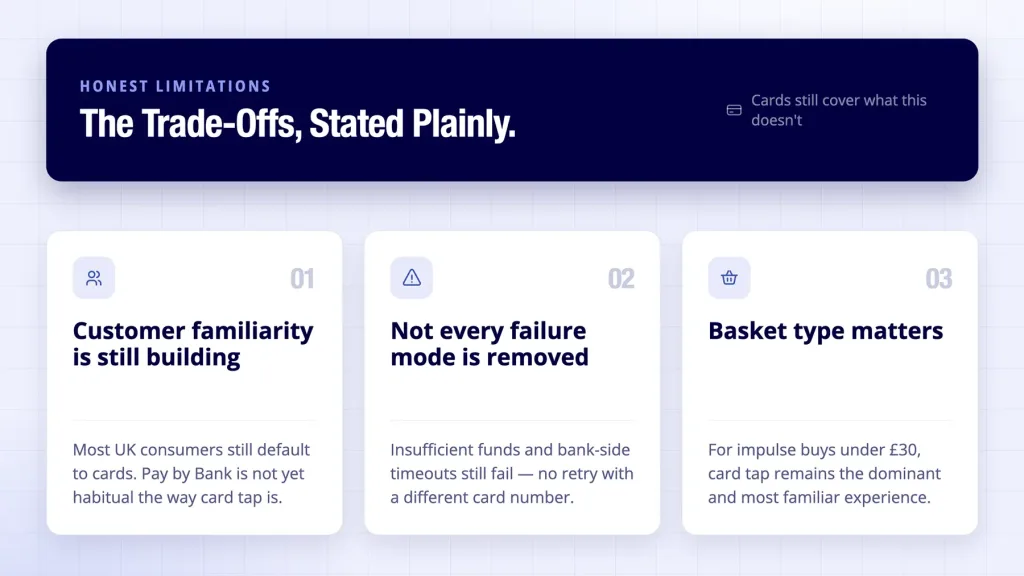
Every open banking for payments evaluation should address these:
Customer familiarity is still building
Despite growth, most UK consumers still default to cards. Pay by Bank UK is not yet habitual in the way that card tap is. Merchants need to present the option clearly and reduce friction at the bank redirect step.
Not every failure mode is removed
Open banking payment failures happen -most commonly due to insufficient funds or a bank-side timeout during the authorisation step. Unlike cards, there is no retry with a different card number. Your checkout flow needs a fallback to card or a clear retry mechanism.
Basket type matters
Open banking payments for e-commerce merchants perform best in high-value, considered purchases. For impulse buys under £30, card tap remains the dominant and most familiar experience.
Which Sectors Benefit Most From Open Banking for Payments?
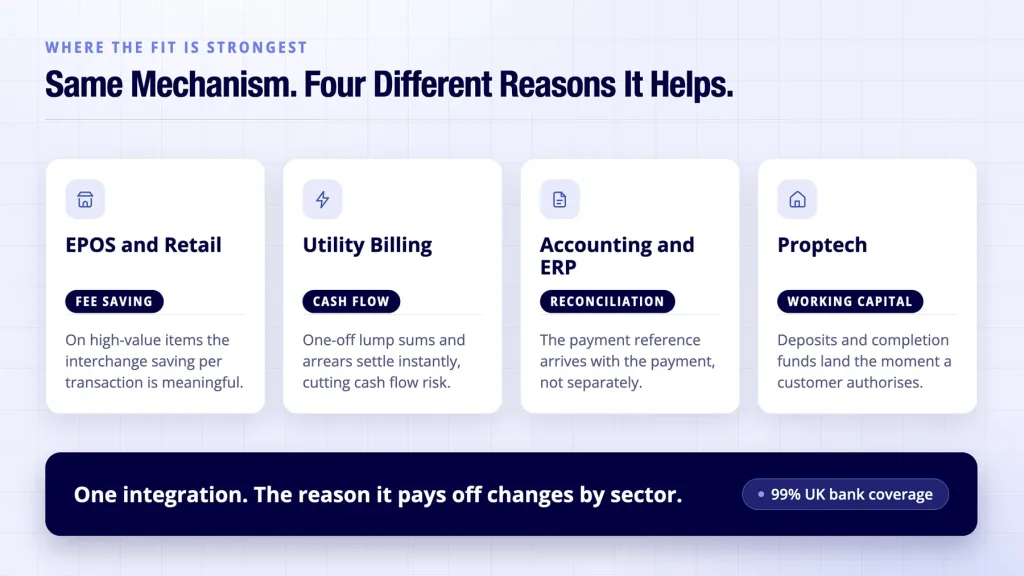
Open banking payment examples vary by sector. Here is where the fit is strongest for UK merchants in 2026:
EPOS and Retail
Pay by Bank merchants in physical retail are growing, led by major platforms. For high-value items, the interchange fee saving per transaction is meaningful. The open banking API UK integration connects your till to the bank redirect flow without additional card hardware.
Utility Billing
Open Banking UK is well-suited to one-off lump sum and arrears payments for utilities. Instant settlement reduces cash flow risk. Payment references carry through cleanly to billing systems, reducing reconciliation overhead.
Accounting and ERP Platforms
Invoice settlement via open banking for payments means reference data arrives with the payment -not separately. The open banking API UK connects invoice tracking to payment status via webhooks.
Proptech
High-value, time-sensitive payments (deposits, completion funds) benefit most from instant settlement. Working capital improves when funds arrive the moment a customer authorises, not 1-3 days later.
How Does Finexer Deliver Open Banking for Payments?
Finexer is an FCA-authorised PISP (FRN 925695) operating under the Payment Services Regulations 2017. Finexer initiates open banking payments that settle via Faster Payments -it is the authorised initiation layer, not the rail owner.
What Finexer’s Payments product delivers for merchants:
- Payment requests created via a single API call, per the open banking API UK standard
- Customer authorisation handled through bank redirect with SCA built in -no additional 3DS implementation
- Settlement instant via Faster Payments, directly into your account
- Per-payment webhooks on every transaction -not batched, not delayed
- Almost all UK bank coverage including business and challenger accounts
- Irrevocable payment (no card-style chargebacks) with a clear refund initiation route
- PCI DSS-Secure by design, with banking data handled securely to support account information and reconciliation workflows
- Usage-based pricing -Pay based on your actual transaction usage, with flexible pricing that scales with your needs
- 3-5 weeks onboarding assistance for mid-market SaaS and fintech platforms
See Finexer Payments to explore how the integration works for your merchant or platform use case.
Bottom Line
Open banking for payments gives UK merchants a lower-cost, instantly settling alternative to card rails. The trade-offs are real -customer familiarity is still building, and the checkout flow requires a bank redirect that adds a step.
But for high-value transactions, invoice settlement, and sectors like proptech, utility billing, and B2B platforms, the working capital and cost advantages are material. Open Banking UK processed 37.46 million payments in March 2026 -the infrastructure is proven and growing. The open banking payment question in 2026 is not whether it works but which part of your checkout it should cover.
What is open banking for payments and how does it differ from cards?
Open banking for payments initiates an account-to-account payment directly from the customer’s bank, settling instant via Faster Payments. Cards process through Visa or Mastercard, carrying interchange fees and 1-3 day settlement. The key differences for merchants are cost (no interchange fees), settlement speed, and chargeback exposure (very low for open banking payments vs high for cards).
What are some open banking examples for UK merchants?
Open banking examples in the UK include Amazon Pay by Bank UK (launched February 2026), eBay Pay by Bank UK (launched shortly after), utility bill payments, and invoice settlement for B2B platforms. Open banking payment examples span retail, proptech, accounting, and EPOS sectors -anywhere that instant settlement and low per-transaction cost outweigh card familiarity.
How does Open Banking UK handle failed payments?
Open banking payment failures typically occur from insufficient funds or a bank-side timeout during customer authorisation. Unlike cards, there is no retry with a different card number. Merchants should build a fallback to card payment in their checkout flow and display clear error messaging at the bank redirect step.
Who governs the open banking API UK standard?
The open banking API UK standard was developed by the Open Banking Implementation Entity (now operating as Open Banking Limited). The Open Banking Implementation Entity sets the common technical standards that ensure open banking payments work interoperably across all UK banks, so a single integration connects to nearly all UK current accounts.
Is Pay by Bank suitable for all Pay by Bank merchants?
Pay by Bank UK is best suited for Pay by Bank merchants handling high-value, one-off, or invoice-based transactions. It is less suited to impulse or low-value purchases where card tap remains faster and more familiar. Most Pay by Bank merchants offer it alongside card payments rather than as a replacement.
Connect to real-time banking data and payments through one FCA-authorised integration.
Explore with AI
About the Author

Ravi Ranjan
Ravi Ranjan is Co founder & CEO of Finexer