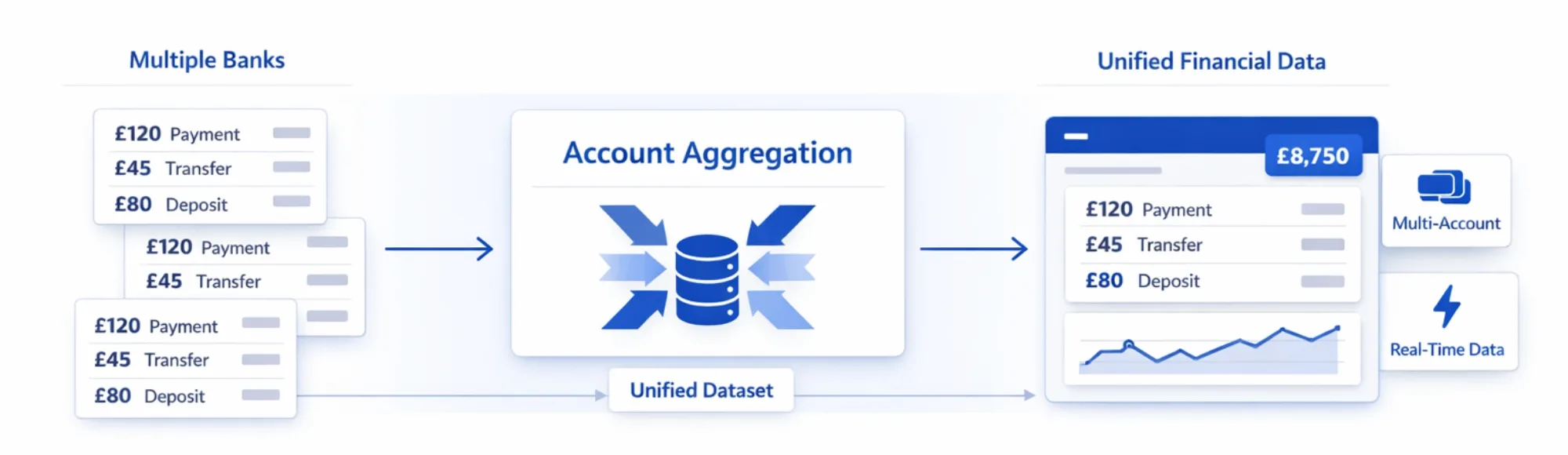
Need multi-bank financial data for your platform?
Finexer gives UK platforms FCA-authorised AIS access – structured, real-time, aggregated across 99% of UK banks.
The platforms I work with rarely have a single-bank problem. Their clients hold current accounts with one bank, savings with another, and business accounts with a third. Their merchants operate across multiple banking relationships. Their users’ financial activity is spread across institutions in ways that no single bank statement can capture.
This is where account aggregation services become essential – not as a convenience feature, but as the data foundation that makes financial workflows accurate.
Without aggregation, platforms piece together fragmented financial pictures from manually uploaded statements, incomplete exports, and single-institution data that misses significant portions of a user’s financial activity. The analysis built on top of that data is only as complete as the least connected account.
This blog explains how account aggregation services work, why multi-bank visibility matters for platform workflows, and how Open Banking AIS infrastructure enables reliable data aggregation across UK banks.
TL;DR
Account aggregation services allow platforms to collect financial data from multiple bank accounts into a single, unified dataset. Data aggregation services built on Open Banking AIS retrieve transaction history, account balances, and financial activity across banks with user consent. Finexer provides FCA-authorised AIS infrastructure covering 99% of UK banks – enabling platforms to build account aggregation services with structured, real-time multi-bank data.
Key Takeaways
What are account aggregation services?
Account aggregation services collect financial data from multiple bank accounts and consolidate it into a single dataset. Platforms use these services to retrieve transaction history, account balances, and financial activity across different banks – giving a complete financial picture rather than a single-institution view.
How do data aggregation services retrieve multi-bank financial data?
Data aggregation services use Open Banking AIS APIs to retrieve financial data from each connected bank account with user consent. Data is standardised into consistent formats across all institutions – so platforms receive the same structured output regardless of which UK bank the account is held with.
Why do platforms need account aggregation services rather than single-bank connections?
Most users and businesses hold accounts across multiple banks. Single-bank connections produce incomplete financial datasets. Account aggregation services retrieve data across all connected accounts – giving platforms the complete transaction history and balance data that financial analysis and verification workflows require.
What financial workflows depend on multi-bank data aggregation?
Affordability assessment, source-of-funds verification, financial reporting, reconciliation, subscription monitoring, and income verification all require complete financial data. Incomplete single-bank data produces inaccurate outputs in every one of these workflows.
What does Finexer provide for account aggregation services?
Finexer provides FCA-authorised AIS infrastructure delivering structured transaction data, account balances, and financial history across 99% of UK banks – with real-time webhooks, merchant identification, and up to 7 years of transaction history for multi-bank aggregation workflows.
What Are Account Aggregation Services?
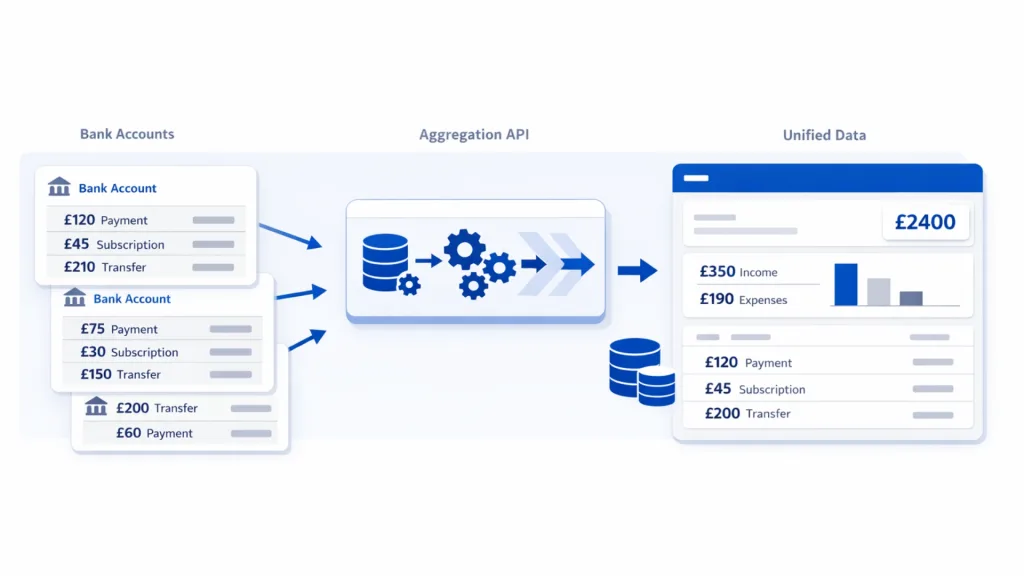
Account aggregation services are the infrastructure layer that collects financial data from multiple bank accounts and standardises it into a single, usable dataset for platform workflows.
In an Open Banking context, account aggregation services work through AIS APIs. The user connects their bank accounts via a consent-based flow. The AIS infrastructure retrieves transaction data and balances from each connected institution. The platform receives a unified financial dataset – regardless of how many banks the user holds accounts with or how different their underlying data formats are.
What account aggregation services retrieve per connected account:
- Transaction history – amounts, timestamps, merchant identifiers, category codes
- Account balances – current, available, and running balance data
- Account details – sort code, account number, IBAN, BIC
- Income and expense patterns across the full account set
“The platforms that get the most value from account aggregation services are the ones that treat multi-bank visibility as a baseline requirement – not a premium feature. Incomplete financial data produces incomplete analysis.” – Yuri, Finexer
Why Single-Bank Data Is Not Enough
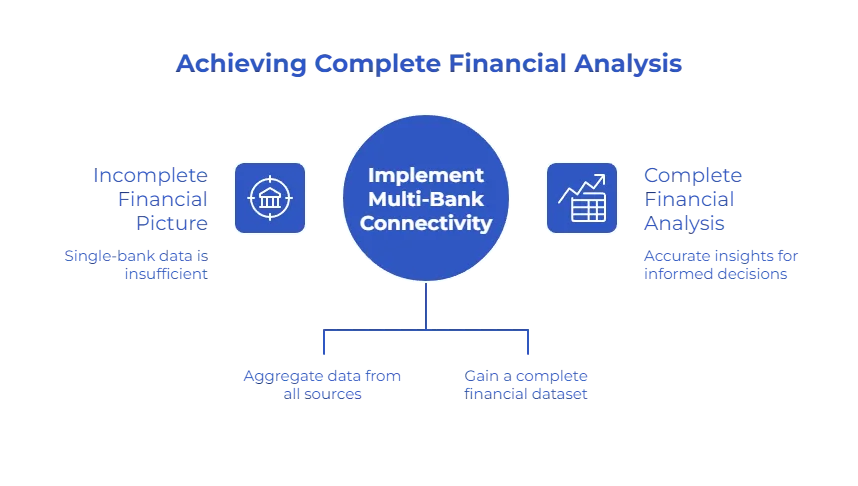
I see this consistently. A platform connects to a user’s primary current account and builds financial analysis on that data. The analysis looks complete. It is not.
The user’s salary arrives into a secondary account at a different bank. Their standing orders go out from a joint account. Their savings buffer sits in a challenger bank that the platform never connected to. The financial picture the platform has built is structurally incomplete – and the workflows built on top of it reflect that incompleteness.
The Multi-Bank Reality for UK Platform Users
UK consumers and businesses routinely hold accounts across multiple institutions. Current accounts, savings accounts, business accounts, and payment accounts often sit with different providers. Financial activity that matters for analysis – income, recurring commitments, spending patterns – is distributed across this account set.
Data aggregation services that only connect to one account miss everything else. Account aggregation services that connect across all accounts give platforms the complete financial dataset their workflows actually need.
Bank account aggregation API for UK platforms covers the API integration layer for platforms building multi-bank connectivity.
How Do Data Aggregation Services Work in Open Banking?
Open Banking AIS is the regulatory and technical infrastructure that makes account aggregation services work reliably at scale across UK banks.
The aggregation workflow:
- Platform initiates bank connection request via AIS API
- User authenticates with each bank via Strong Customer Authentication
- User grants consent for specific data access per account
- AIS retrieves structured financial data from each connected bank
- Platform receives standardised JSON outputs across all accounts
- Aggregated dataset feeds into platform workflows
The key word is standardised. Every UK bank returns different raw data formats. Account aggregation services built on Open Banking AIS convert these into consistent structured outputs – so platforms receive the same data schema whether the account is with Barclays, Monzo, or any of the 99% of UK banks Finexer covers.
Open banking data aggregation for accounting platforms covers how aggregated data powers accounting-specific workflows.
How Should Platforms Evaluate Account Aggregation Services?
| Criteria | Why It Matters | What to Look For |
|---|---|---|
| UK Bank Coverage | Aggregation gaps produce incomplete financial datasets – missing accounts break analysis | 99% UK bank coverage; CMA9 and challenger banks; consistent across institutions |
| Data Standardisation | Multi-bank data arrives in different formats – aggregation services must normalise it | Structured JSON; consistent schema across banks; merchant IDs; category codes |
| Transaction History Depth | Financial analysis and verification need historical data beyond 90 days | Up to 7 years transaction history; configurable lookback periods per account |
| Real-Time Updates | Live financial workflows need current transaction data – not weekly aggregation batches | Real-time webhooks; live balance data; event-driven transaction feeds |
| Multi-Account Consent | Users must be able to connect multiple accounts across different banks in one flow | Multi-account consent flow; cross-bank connection in single user journey |
| FCA Authorisation | UK platforms must use regulated AIS providers for compliant bank data access | FCA-authorised AIS; GDPR-compliant; consent-based with instant revocation |
How Does Finexer Enable Account Aggregation Services?
Finexer is an FCA-authorised Open Banking provider delivering AIS infrastructure for UK platforms building account aggregation services and data aggregation services across multiple banks.
What Finexer’s AIS provides for account aggregation:
- Structured bank transaction data from 99% of UK bank accounts
- Multi-account connectivity from a single consent-based API connection
- Account details including sort code, IBAN, and BIC per connected account
- Transaction history up to 7 years with merchant identification and category codes
- Real-time webhooks delivering transaction events across all connected accounts
- Balance data – current and available – across the full account set
- FCA-compliant consent flows with granular permissions and instant revocation
- White-label capability for branded bank connection journeys
- Usage-based pricing
Best financial data aggregators for UK platforms covers how Finexer compares to alternative aggregation infrastructure providers.
What I Feel
The account aggregation services question I get from product teams is usually framed as a coverage question – which banks does it support? That is the right starting point but not the whole picture.
Coverage gets a platform connected. Data quality determines whether the aggregated dataset is actually usable. Consistent merchant identification, structured category codes, and standardised schemas across every connected bank – that is what separates account aggregation services that power real workflows from those that just collect data.
Multi-bank visibility is only valuable if the data arriving from bank twelve looks the same as the data arriving from bank one.
Common Use Cases
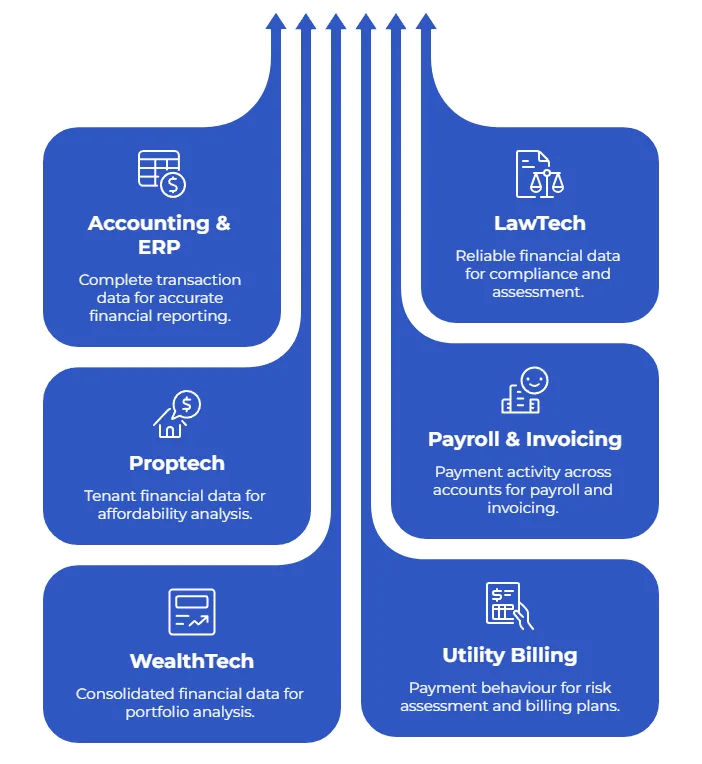
Accounting & ERP Platforms
Accounting platforms use Finexer’s account aggregation services to retrieve client transaction data across all connected bank accounts – not just primary current accounts. Reconciliation workflows run against a complete financial dataset rather than a single-bank view that misses transactions held elsewhere. Client financial reporting reflects actual financial activity, not a partial subset of it.
LawTech Platforms
LawTech platforms – including insolvency practices – use multi-bank data aggregation services to access client financial activity across all accounts during source-of-funds verification and financial assessment. A complete cross-account transaction history is substantially more reliable for compliance purposes than a single-account statement that excludes significant financial activity.
Proptech & Real Estate Platforms
PropTech platforms use account aggregation services to retrieve tenant financial data across all connected accounts for affordability assessment. Income arriving into secondary accounts, recurring commitments going out from joint accounts, and savings buffers held elsewhere are all visible – giving affordability analysis a complete financial picture rather than a single-account approximation.
Payroll & Invoicing Platforms
Payroll platforms use data aggregation services to monitor payment activity across multiple business bank accounts – confirming salary disbursements, tracking invoice settlements, and identifying payment patterns across the full account set that contractors and clients operate with.
WealthTech Platforms
WealthTech platforms use Finexer’s account aggregation services to consolidate client financial data across current accounts, savings accounts, and business accounts into a single financial profile. Aggregated transaction history and balance data across the full account set supports portfolio analysis and financial planning without requiring clients to manually report account activity.
Utility Billing Platforms
Utility platforms use data aggregation services to assess customer payment behaviour across connected accounts during onboarding – identifying payment patterns, income consistency, and existing financial commitments that inform billing risk assessment and payment plan structures.
What are account aggregation services in Open Banking?
Account aggregation services collect financial data from multiple bank accounts into a single dataset using Open Banking AIS APIs. Platforms use these services to retrieve transaction history, account balances, and financial activity across different banks with user consent – enabling complete financial analysis rather than single-institution views.
How do data aggregation services work for platforms with multi-bank users?
Data aggregation services use AIS APIs to connect to each of a user’s bank accounts with consent. Financial data from every connected account is retrieved and standardised into consistent structured outputs – so platforms receive the same data schema regardless of which UK bank the account is held with.
Is Finexer suitable for platforms building account aggregation services?
Yes. Finexer is FCA-authorised and provides AIS infrastructure covering 99% of UK banks – delivering structured transaction data, account balances, and up to 7 years of financial history across multiple connected accounts. Platforms integrate once to access multi-bank account aggregation services with real-time webhooks and consistent data outputs.
Build complete financial visibility with multi-bank account aggregation services.
About the Author

Yuri
Yuriy Yakushko is the Founder of Finexer, an FCA-authorised Open Banking platform that enables businesses to access real-time bank data and Pay-by-Bank payments through secure API infrastructure. With more than 20 years of experience in fintech and software engineering, he focuses on building scalable financial technology that helps businesses modernise payments and financial data workflows.