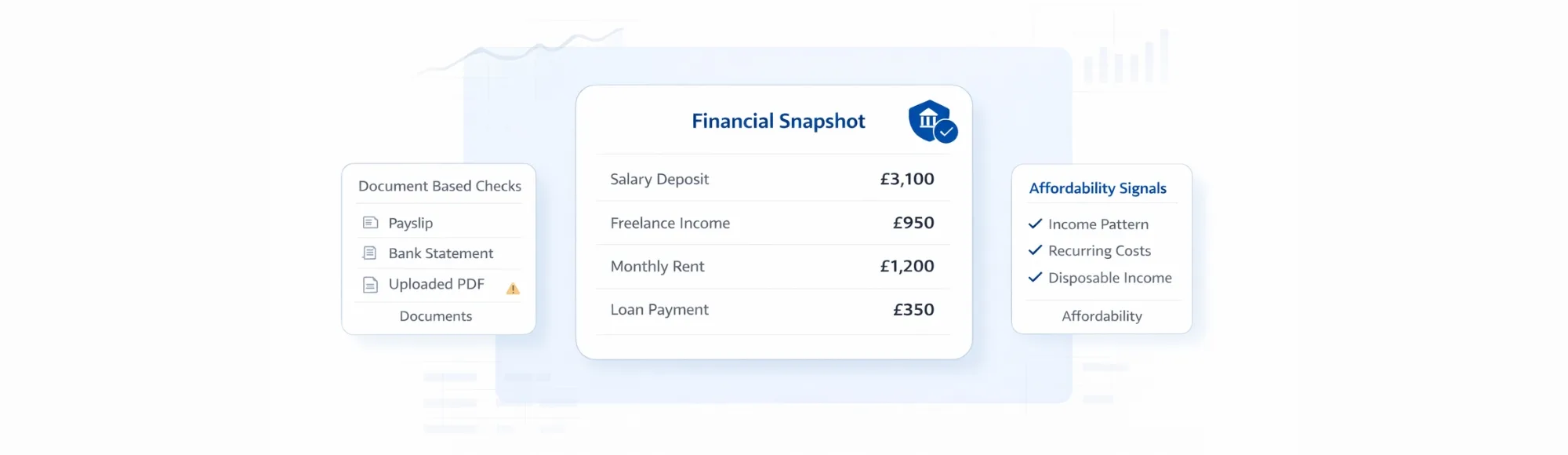
Still running affordability checks on payslips and PDFs?
Finexer gives platforms verified bank data for accurate financial assessment.
A payslip shows what someone earns. It does not show what they spend, what they owe, or whether their income is consistent month to month.
For PropTech platforms, rental verification tools, and financial assessment infrastructure, document-only affordability assessments create a structural accuracy gap. The data submitted does not reflect actual financial behaviour – it reflects what an applicant chose to submit.
At Finexer, we work directly with UK PropTech platforms and financial verification teams that have moved beyond single-document checks. Verified bank transaction data adds a layer of financial visibility that payslips and statements alone cannot provide – showing income patterns, recurring commitments, and spending behaviour from the source.
This blog is written for Product Managers, Compliance teams, and Engineering leads building affordability assessment workflows into PropTech, rental, or financial verification platforms. It focuses on why document-only checks create operational risk and how bank transaction data improves assessment accuracy without replacing existing document processes.
TL;DR
Affordability assessments built on documents alone miss income patterns, spending behaviour, and recurring financial commitments. Finexer provides FCA-authorised Open Banking AIS infrastructure that gives PropTech and rental platforms verified bank transaction data – enabling accurate, automated affordability assessments directly within onboarding workflows.
Key Takeaways
Why do document-only affordability assessments fall short for platforms?
Payslips and bank statements are static snapshots. They do not show ongoing spending patterns, hidden financial commitments, or income consistency – all of which are critical to accurate affordability assessment.
What does verified bank transaction data add to affordability assessments?
It provides income deposit patterns, recurring expense identification, discretionary spending signals, and financial commitment visibility – drawn directly from the applicant’s live bank account rather than submitted documents.
Which platforms need automated affordability assessment infrastructure?
PropTech platforms, rental verification tools, shared ownership platforms, and any financial verification system that needs to assess a user’s real financial capacity during onboarding.
How does Open Banking AIS support affordability assessments?
AIS connectivity retrieves verified bank transaction history with user consent. Platforms receive structured financial data covering income, outgoings, and spending behaviour for use in affordability modelling.
What does Finexer provide for affordability assessment workflows?
Finexer provides FCA-authorised AIS infrastructure delivering verified bank transaction data – covering 99% of UK banks – with up to 7 years of transaction history for income pattern analysis and financial behaviour assessment.
Why Are Affordability Assessments Difficult With Document-Only Workflows?
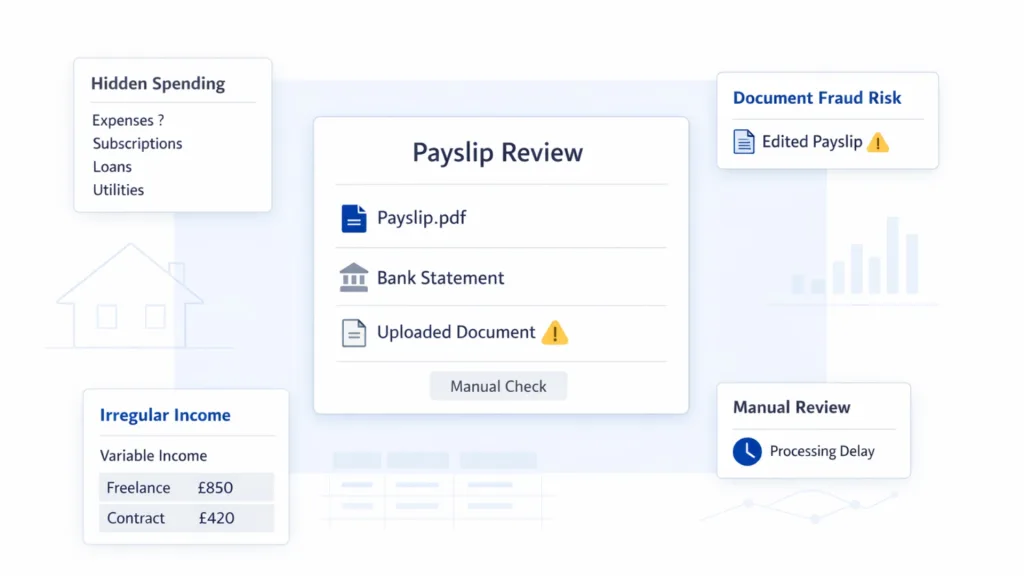
Most platforms begin affordability checks the same way. Applicants submit payslips. Bank statements are requested. Income figures are reviewed manually against spending estimates.
This works at low volumes. At scale, it creates four compounding problems.
Documents are incomplete by design. A payslip confirms gross salary but gives no visibility into what an applicant actually spends each month. Recurring debt payments, subscription commitments, and irregular outgoings are all invisible from payslip data alone.
Document submission is easy to manipulate. Payslips and bank statements can be altered before submission. Without a verification layer that connects to the source bank account, platforms have no mechanism to confirm the figures submitted are accurate.
Self-reported income misrepresents irregular earners. Self-employed applicants, contractors, and those with multiple income streams cannot accurately represent their financial position through a single payslip. Document-based affordability assessments consistently underserve these applicants.
Manual review cannot scale. Every document submitted requires human review time. For platforms processing high volumes of affordability assessments, manual verification creates onboarding delays that affect conversion and operational cost.
“Document submission tells platforms what applicants want them to see. Bank transaction data shows what is actually there.” – Finexer, working with UK PropTech and financial verification platforms
How Open Banking enables tenant affordability checks for PropTech platforms covers the tenant verification layer in detail.
What Does Bank Transaction Data Add to Affordability Assessments?
Verified bank transaction data does not replace document checks. It adds a financial behaviour layer that documents cannot provide.
- Income Pattern Identification
Regular salary deposits, freelance income, benefit payments, and secondary income sources are all identifiable from transaction history. Platforms can assess income consistency across months – not just at the point of a single payslip submission.
This is particularly valuable for self-employed applicants and those with variable income, where a single document submission fails to represent actual earning capacity.
- Recurring Commitment Visibility
Monthly outgoings – rent, loan repayments, subscription services, and regular transfers – are visible from transaction data. Platforms can calculate real disposable income rather than relying on applicant-declared expenses.
For affordability assessments, disposable income calculated from actual transaction behaviour is significantly more accurate than self-reported figures on an application form.
- Spending Behaviour Analysis
Transaction categorisation reveals discretionary spending patterns alongside committed outgoings. Platforms can assess financial behaviour over time – identifying applicants whose stated income-to-expense ratio does not match actual spending patterns.
How bank-verified income supports rent affordability checks explains how this data applies specifically to rental verification workflows.
How Should Platforms Evaluate Affordability Assessment Infrastructure?
| Criteria | Why It Matters | What to Look For |
|---|---|---|
| Bank Data Coverage | Gaps in bank coverage create incomplete affordability pictures for applicants using smaller institutions | 99% UK bank coverage; CMA9 and challenger banks; consistent data formats |
| Transaction History Depth | Affordability assessments require sufficient history to identify income consistency and spending patterns | Up to 7 years of transaction history; configurable lookback periods |
| Income Signal Detection | Raw transaction data needs structured income identification to be useful for affordability modelling | Salary deposit detection; recurring income identification; multi-source income support |
| Spending Categorisation | Disposable income calculation requires categorised outgoing transaction data | Transaction categorisation; committed vs discretionary spend separation; recurring commitment flags |
| Consent Management | UK regulatory requirements mandate explicit, granular consent for financial data access | FCA-compliant consent flows; granular permissions; revocable access |
| API Integration Speed | Faster deployment reduces time-to-value for product teams building verification workflows | 2-3x faster integration vs alternatives; 3-5 weeks onboarding support |
How Does Finexer Enable Affordability Assessments for UK Platforms?
Finexer provides FCA-authorised Open Banking AIS infrastructure that gives PropTech platforms, rental verification tools, and financial assessment systems direct access to verified bank transaction data for affordability workflows.
What Finexer Provides for Affordability Assessment
- Verified bank transaction data from 99% of UK bank accounts via AIS connectivity
- Up to 7 years of transaction history for income pattern analysis and spending behaviour assessment
- Structured transaction outputs covering income deposits, recurring commitments, and categorised outgoings
- Real-time data access via webhooks for live affordability checks during onboarding
- FCA-compliant consent flows with granular permissions and instant revocation
- White-label capability for branded applicant-facing verification journeys
- 2-3x faster integration versus alternative providers with 3-5 weeks onboarding support
Platforms integrate Finexer’s AIS data directly into their affordability assessment logic. Income detection, spending categorisation, and disposable income calculations are all built by the platform – Finexer provides the verified financial data layer that makes those calculations accurate.
Finexer does not provide affordability scoring engines, decision tools, or credit assessment software. Platforms build those workflows on top of Finexer’s verified bank transaction infrastructure.
What We See in Practice
PropTech platforms integrating bank transaction data into affordability assessments follow a consistent pattern. Initial deployment adds Open Banking data as a supplementary layer alongside existing document checks – giving reviewers a verified financial picture to cross-reference against submitted payslips.
Within two to three months, most platforms extend the same data feed to automate parts of the assessment workflow. Income pattern detection and recurring commitment identification reduce manual review time significantly for straightforward applications.
A pattern we observe consistently: a UK rental platform moves from manual payslip review to Open Banking-connected affordability assessment. Self-employed applicants – previously declined due to insufficient payslip evidence – are now assessable from three to six months of verified transaction history. Approval rates for this segment improve without any change to the platform’s underlying affordability criteria.
“Bank transaction data does not change what platforms assess. It changes the accuracy of what they can see.” – Finexer, working with UK PropTech and rental verification platforms
Platforms adding Finexer’s AIS data to affordability assessment workflows report:
- More accurate disposable income calculations from verified transaction data
- Better coverage for self-employed and variable-income applicants
- Reduced manual review workload for standard application profiles
- Faster onboarding for applicants with clear transaction histories
Common Use Cases
PropTech & Real Estate Platforms
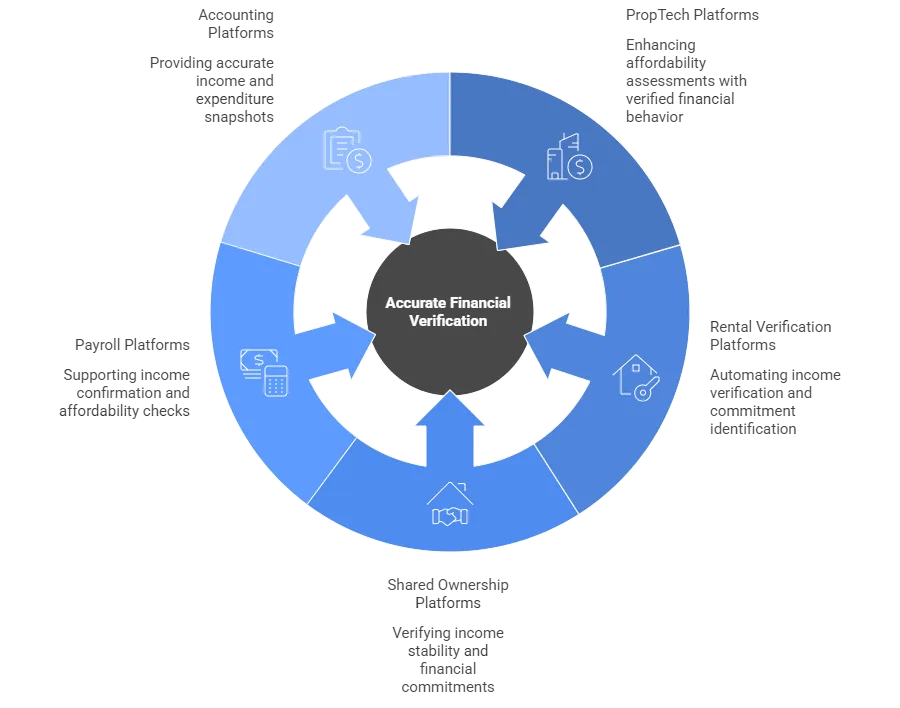
PropTech platforms use Finexer’s AIS data to add verified financial behaviour to affordability assessments – covering income consistency, monthly outgoings, and spending patterns that payslip checks alone cannot provide. This supports more accurate decisions for both standard and complex applicant profiles.
Rental Verification Platforms
Rental platforms integrate bank transaction data to automate income verification and recurring commitment identification within affordability workflows. Verified transaction history replaces time-consuming manual statement review for applicants who can share bank data via Open Banking consent.
Shared Ownership & Housing Association Platforms
Shared ownership platforms performing affordability assessments for housing association applications use bank transaction data to verify income stability and financial commitments across the required assessment periods – supporting compliance with scheme-specific affordability criteria.
Payroll & Invoicing Platforms
Payroll platforms offering embedded financial verification for their business clients use Finexer’s AIS data to support income confirmation and affordability checks – enabling faster contractor onboarding and financial capacity verification within existing payroll workflows.
Accounting & ERP Platforms
Accounting platforms supporting client financial verification use verified bank transaction data to provide accurate income and expenditure snapshots for affordability reporting – replacing manual bank statement collection with structured, consent-based financial data.
What is an affordability assessment for housing platforms?
An affordability assessment verifies whether an applicant has the financial capacity to meet a financial commitment – such as rent or shared ownership payments. It typically involves income verification, recurring expense identification, and disposable income calculation. Bank transaction data provides a more complete picture than payslips alone.
How does Open Banking improve affordability assessments for PropTech platforms?
Open Banking AIS connectivity provides verified bank transaction history directly from the applicant’s bank account. Platforms can identify income patterns, recurring commitments, and spending behaviour – enabling more accurate affordability assessments than document-only workflows.
Is Finexer suitable for PropTech platforms performing affordability assessments?
Yes. Finexer is FCA-authorised and provides AIS infrastructure covering 99% of UK banks. PropTech platforms integrate Finexer’s verified bank transaction data directly into their affordability assessment workflows – with up to 7 years of transaction history and white-label consent flows for branded applicant journeys.
Accurate affordability assessment starts with verified bank data.
About the Author

Finexer
The Finexer Team is a collective of fintech engineers, payments specialists, and Open Banking experts working on financial infrastructure for UK businesses. Finexer builds API-driven solutions that allow companies to access real-time bank data, initiate Pay by Bank payments, and integrate financial services directly into their products.