
Verified Income, Faster Lets.
Consented income data and rent collection with status.
A tenant’s payslip looks fine. Three weeks later, the first rent payment bounces. The gap between what a document says and what actually lands in an account is where most letting agents get caught out, and it’s exactly what a properly run affordability check rent process is meant to close.
TL;DR: Affordability checks confirm that a tenant’s income supports the rent, using evidence stronger than a self-declared figure. Getting an affordability check rent decision right is only half the job. Collecting rent reliably once the tenancy starts and choosing rent collection services that actually reduce admin is the other half most guides skip.
This guide draws on Finexer’s work as an FCA-authorised Open Banking infrastructure provider (AISP and PISP, FRN 925695), supporting UK proptech platforms and letting agents across the full tenancy lifecycle, from application to ongoing collection.
Agents ask us for two different things that they think are one thing. In confirming someone can afford the rent and actually collecting it every month once they’ve moved in, getting the first one right doesn’t help if the second one keeps failing.
What an Affordability Check Rent Process Actually Confirms
An affordability check rent process confirms that a prospective tenant’s income realistically supports the rent being asked, based on evidence rather than a number they’ve written on a form.
It’s worth being precise about what this isn’t. It isn’t a credit check, and it isn’t tenant referencing. It’s narrower: does the income exist, and is it enough, based on what can actually be verified.
The Rules of Thumb Agents Actually Use
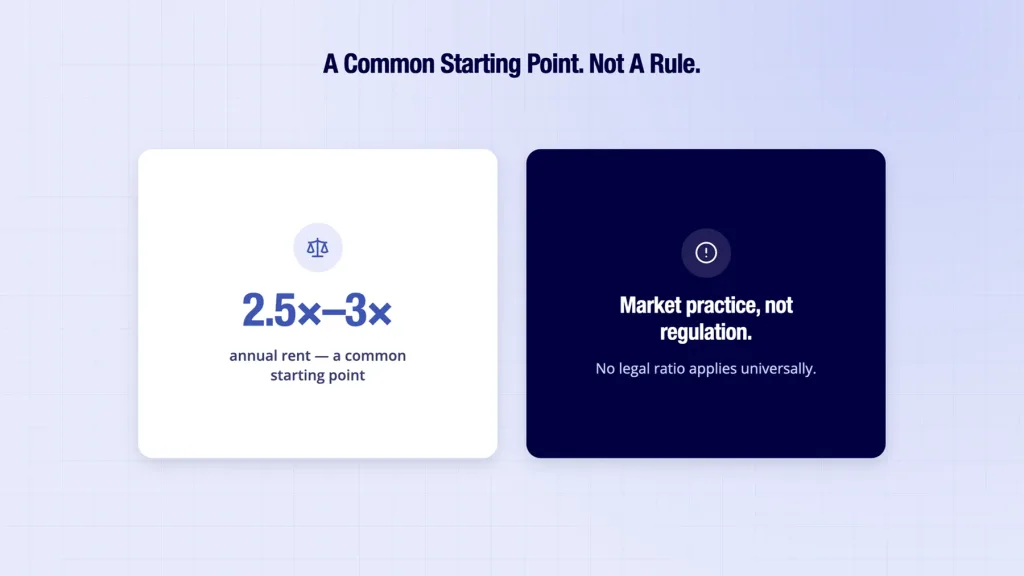
UK letting agents commonly work from income multiples as a rough guide, not as a regulated standard. A tenant’s annual income being roughly two-and-a-half to three times the annual rent is a common starting point many agents use informally.
This is market practice, not regulation. There’s no legal ratio that applies universally, and agents vary in how strictly they apply any multiple, particularly for tenants with guarantors, joint applications or non-salaried income.
With average UK private rent having risen 3.5% to £1,381 a month in the year to April 2026 (Office for National Statistics), the gap between a rough rule of thumb and an actual verified figure matters more than it used to.
Evidence Types Compared
| Evidence type | Time to obtain | Forgery risk | Accuracy |
|---|---|---|---|
| Payslip | Fast, tenant usually has one | Moderate, editable as an image or PDF | Reflects gross pay, not what actually lands |
| Employer reference | Slow, depends on employer response time | Low, but can be generic or delayed | Confirms employment, not exact income details |
| Bank statement | Fast to moderate | Moderate, can be cropped or edited | Shows what landed, if unedited |
| Consented bank data | Fast, minutes | Low, pulled directly from the bank | Reflects actual income landing in the account |
Each has a real place. The question is which one an agent is actually relying on when a decision gets made under time pressure and whether that evidence would actually hold up if an affordability check rent decision were ever challenged later.
The Verification Gap
Submitted documents can be edited. A payslip or bank statement is a file, and files can be altered before they’re ever seen.
Manual review doesn’t close this gap either. It’s slow, and even a careful reviewer is checking whether a document looks right, not confirming the underlying figures against the bank itself.
This is the specific gap covered in more depth on Finexer’s rent affordability check page, which looks at how bank-verified income closes it directly: consented data shows income actually landing in the account, rather than a document claiming it does.
Collecting Rent: The Part That Happens After the Decision
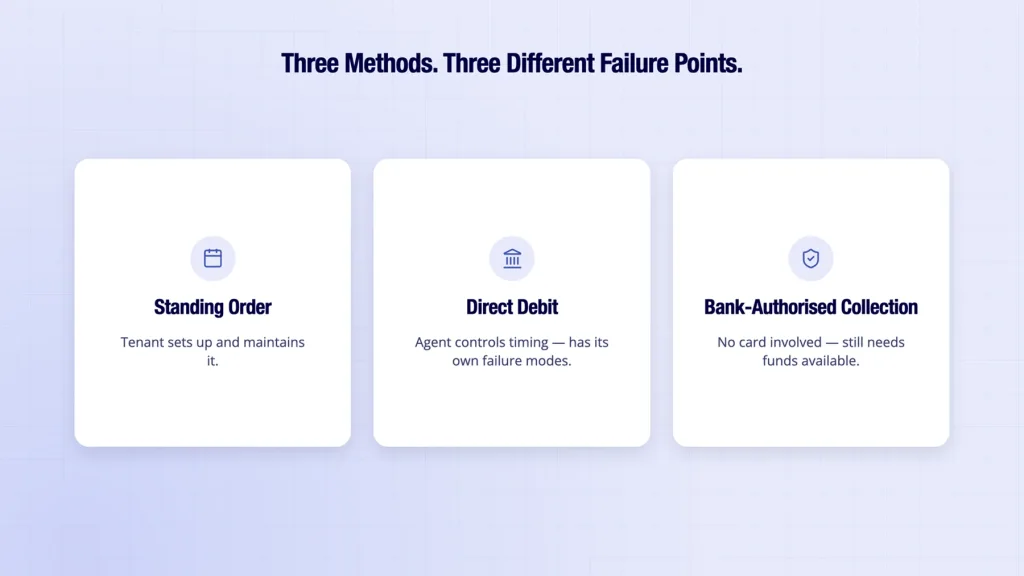
Confirming affordability once doesn’t guarantee reliable payment every month afterward. Collecting rent is a separate, ongoing problem with its own set of methods.
A standing order puts the tenant in control of setting up and maintaining the payment, which means it’s also the tenant’s responsibility if it lapses or the amount needs to change.
Direct Debit gives the landlord or agent more control over timing and amount, at the cost of Direct Debit’s own failure modes: cancelled mandates and insufficient funds among them.
Bank-authorised recurring collection removes the card-expiry failure category entirely as there’s no card involved although it still depends on the tenant’s account having sufficient funds on the collection date.
Visibility matters as much as the method itself. Knowing a payment failed the day it happens, rather than discovering it during monthly rent reconciliation, is what turns a missed payment into a quick follow-up instead of a month-long chase.
Rent Collection Services: What Gets Outsourced, and What Doesn’t
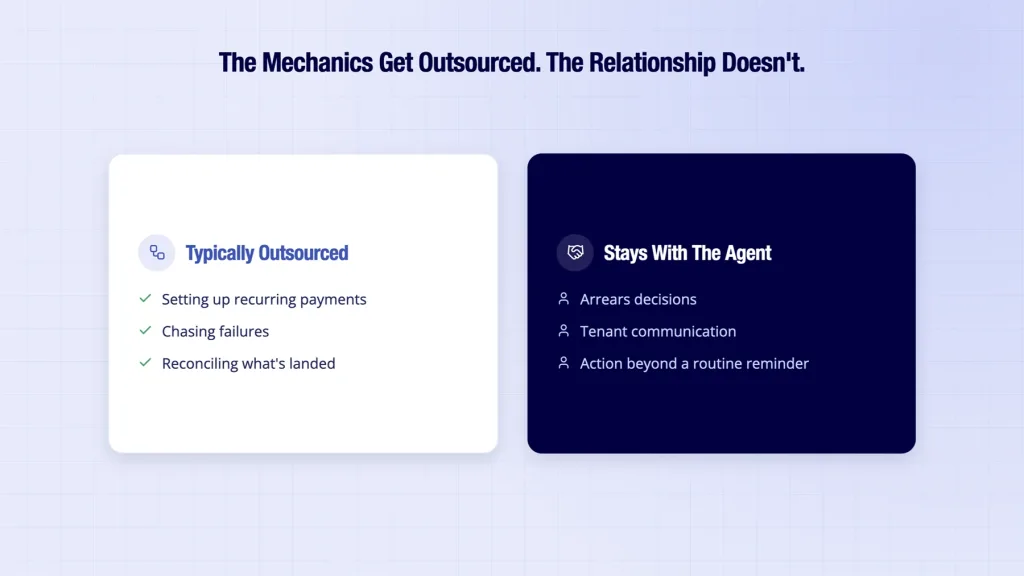
Agents typically outsource the mechanics of collection: setting up recurring payments, chasing failures and reconciling what’s landed against what’s owed.
What usually stays with the landlord or agent directly is the relationship itself: decisions about arrears, communication with the tenant and any action beyond a routine payment reminder.
Rent collection services vary in where exactly that line sits, and platforms offering broader property management, including rental property accounting software, often bundle collection with reconciliation and reporting rather than treating it as a standalone service.
Finexer’s Role in This Process
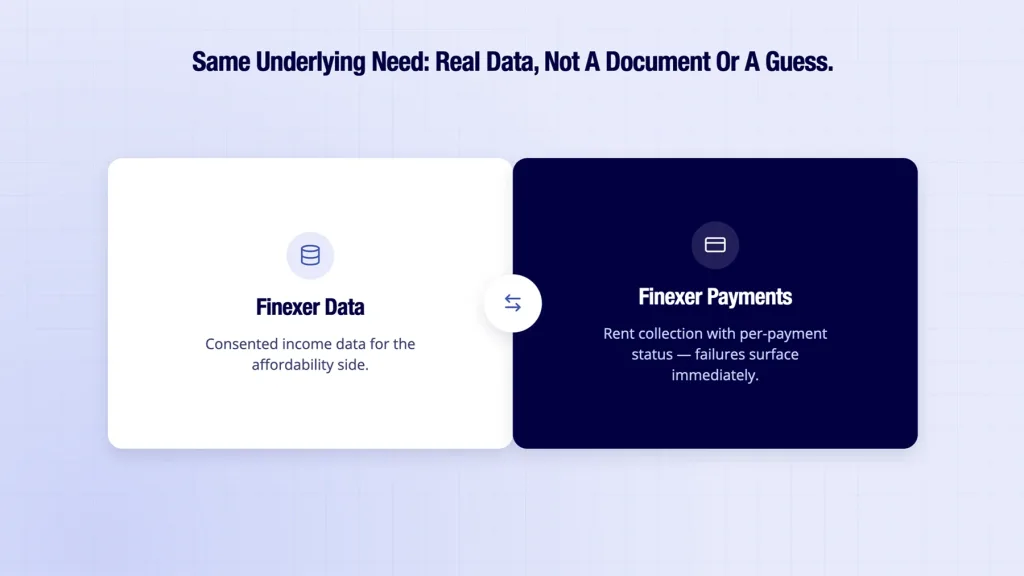
Agents assessing affordability and collecting rent are solving two connected problems with the same underlying need: real data, not a submitted document or a hopeful assumption.
Finexer Data supplies consented income data for the affordability side, while Finexer’s Payments product supports rent collection with per-payment status, so a failed payment surfaces immediately rather than at the end of the month.
Where This Fits
Proptech platforms build affordability checks and rent collection directly into their tenant onboarding and ongoing management flows, so the same system that assesses a tenant at application also handles their payments once they’ve moved in.
Letting agents use both pieces separately from proptech platforms in many cases, verifying income at application through one process and managing collection through whichever payment method their landlords prefer, which is often where visibility gaps between the two stages start to show up.
Does an affordability check replace tenant referencing?
No. It’s one input into a wider referencing process that typically also includes identity checks, previous landlord references, and other checks a referencing service carries out separately.
What happens if a tenant’s income is genuinely irregular, such as self-employment?
Consented banking data can still show income patterns over time, which tends to work better for irregular income than a single payslip that only captures one month would.
Is bank-authorised rent collection more expensive than a standing order?
Cost structures vary by provider, but the difference usually comes down to visibility and reliability rather than a fundamentally different price point for the tenant.
Can a landlord manage collecting rent without any outsourced service at all?
Yes, many do, particularly with a small number of properties, though visibility into failures tends to be the first thing that suffers without a dedicated system in place.
See how Finexer gives letting platforms consented income data for affordability decisions and rent collection with per-payment status.
Explore with AI
About the Author

Ravi Ranjan
Ravi Ranjan is Co founder & CEO of Finexer