
Arrears Visible in Days.
Referenced collection and real-time banking data that matches.
A payment lands in the client account. The name on it doesn’t match any tenant on file, there’s no reference and now someone has to work out whether it’s this month’s rent, last month’s rent or the wrong property entirely. That’s rent reconciliation on a bad day, and it happens more often than most agents admit.
TL;DR: Rent reconciliation matches money actually received against rent due per tenancy. Done well, arrears surface within days. Done by hand, they surface at month end, once chasing a payment has already gotten harder.
This guide draws on Finexer’s work as an FCA-authorised Open Banking infrastructure provider (AISP and PISP, FRN 925695), supporting UK proptech platforms and letting agents in managing rent collection and matching across property portfolios.
“Most agents don’t have a rent reconciliation problem because they’re careless,” says Ravi, who works with UK platforms across payroll, lawtech and accounting. “They have one because the data they’re working from wasn’t built to match cleanly in the first place.”
What Rent Reconciliation Actually Does
Rent reconciliation matches money received in a client or landlord account against rent due per tenancy, tenant by tenant and payment by payment.
Done properly, it answers one question immediately: is this tenancy up to date or not. Done badly, that question doesn’t get answered until someone sits down at month end to work it out from scratch.
Why Rent Reconciliation Is Harder Than It Looks
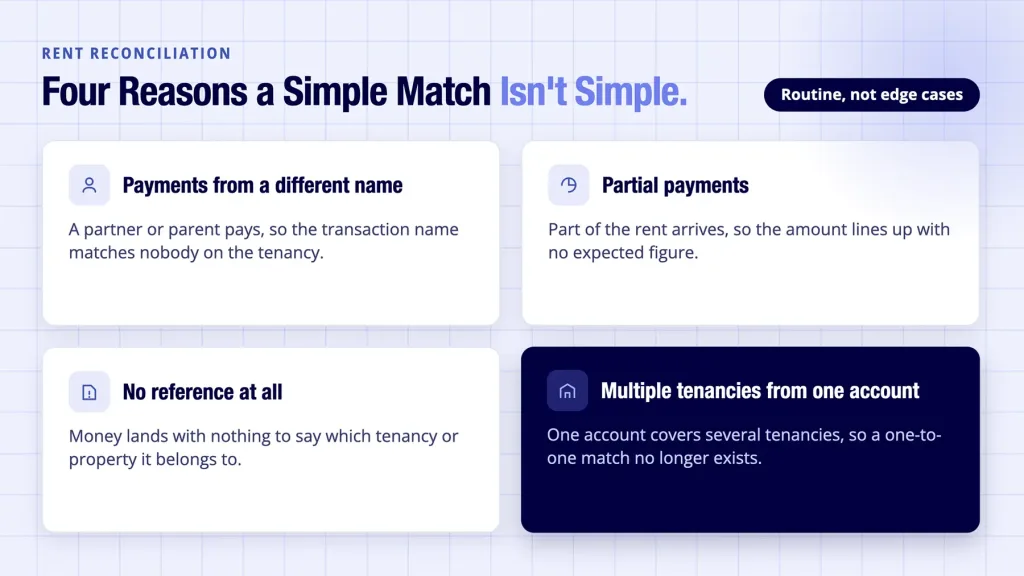
On paper, matching a payment to a tenancy sounds straightforward. In practice, several things break the match before it ever happens.
- Payments from a different name: A tenant pays from a partner’s or parent’s account, and the name on the transaction doesn’t match anyone on the tenancy.
- Partial payments: A tenant pays part of what’s due, which still needs matching even though the amount doesn’t align with any expected figure.
- No reference at all: A payment lands with nothing identifying which tenancy or property it belongs to.
- Multiple tenancies from one account: One person managing payments for several tenancies or a joint tenancy paid from a single account muddies what should be a one-to-one match.
Any one of these turns a match that should take seconds into something that needs a human to work out by elimination.
The Manual Process and Where It Breaks
The manual version of rent reconciliation looks the same at most agencies: Download a bank statement, open the tenancy schedule and match line by line, by eye.
This works slowly when every payment carries a clean reference and lands on time. It stops working the moment a payment doesn’t match cleanly, because now someone has to chase it, and chasing takes time that a missed payment doesn’t wait around for.
This manual bottleneck is exactly what pushes many agencies toward rental property accounting software in the first place, not because the software is exciting but because eyeballing statements against a spreadsheet stops scaling past a handful of properties.
What Makes Rent Reconciliation Actually Solvable
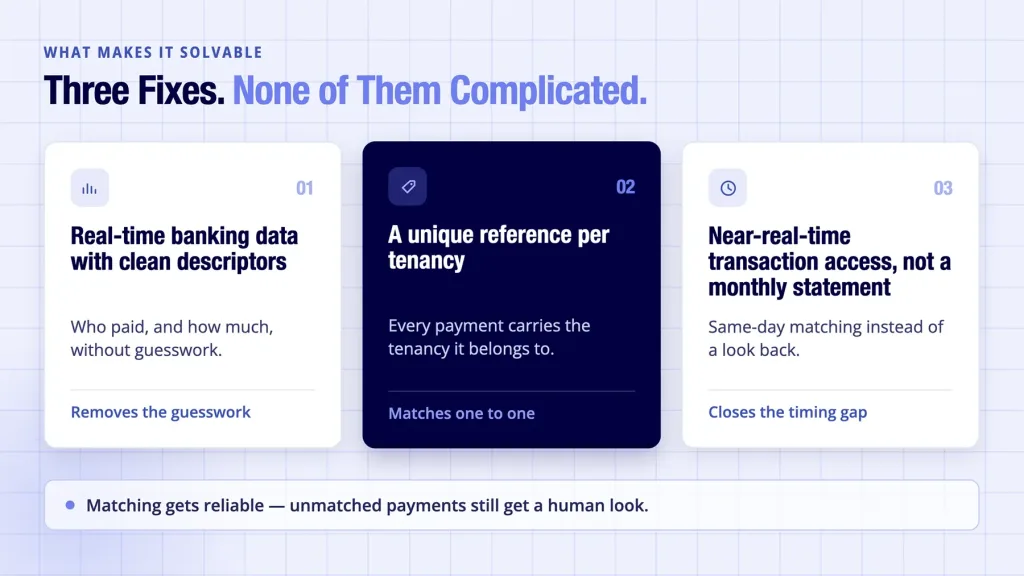
Three things turn rent reconciliation from a manual chase into something closer to automatic: real-time banking data with clean descriptors, a unique reference per tenancy and near-real-time access to transactions rather than waiting for a monthly statement.
Real-time banking data matters because a descriptor that clearly shows who paid and how much removes most of the guesswork a manual match relies on. This overlaps with the broader principles covered on Finexer’s reconciliation of payments page, applied here specifically to the tenancy-by-tenancy structure that makes lettings different from general payment matching.
Real-time banking data is what closes the timing gap. A payment that can be seen the same day it lands, rather than at the next monthly statement, is what actually makes same-day matching possible instead of a retrospective exercise.
Arrears Visibility as the Commercial Outcome
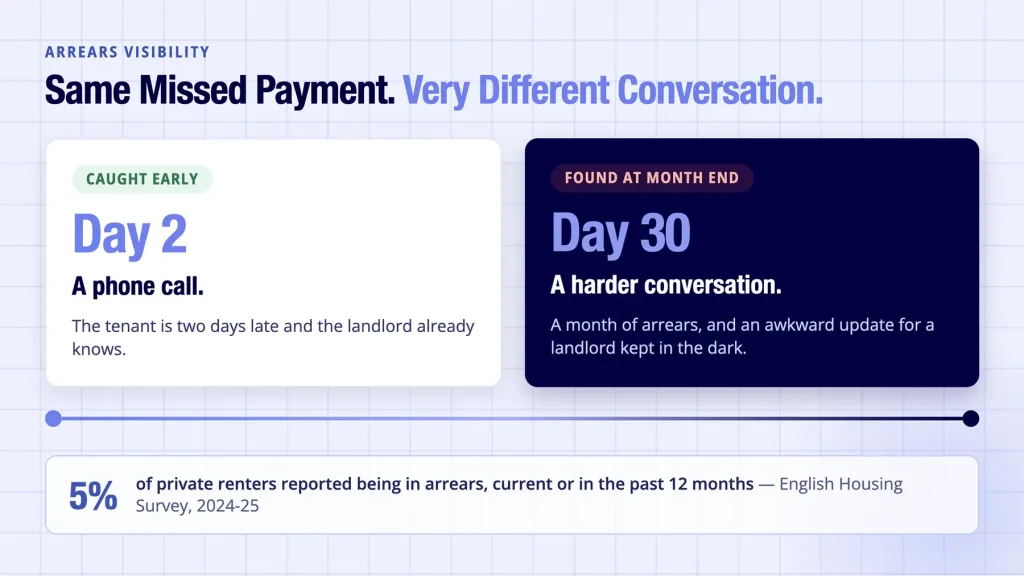
The real value in solving rent reconciliation isn’t the matching itself. It’s what catching a mismatch early actually lets an agent do.
A missed payment spotted on day two is a phone call. The same missed payment discovered on day thirty, at the end of a reconciliation cycle, is a harder conversation with a tenant who’s now a month behind and an awkward update to a landlord who’s been kept in the dark the whole time.
English Housing Survey data shows that 5% of private renters in England reported being in rent arrears, current or within the past 12 months (English Housing Survey, 2024–2025). Catching that early, rather than discovering it a month late, changes what an agent can realistically do about it.
Rental Checks and Referencing: A Different Question Entirely
Rent reconciliation and tenant referencing get conflated constantly, and they shouldn’t be. They answer completely different questions at completely different points in the tenancy.
Rental checks and a rental reference check happen before a tenancy starts, assessing whether a prospective tenant is likely to be a reliable one, by way of checking their employment history, previous landlord references and often an affordability check rent process confirming that their income supports the rent being asked.
Rent reconciliation happens after the tenancy has already started, matching what’s actually being paid against what’s actually due.
One is a decision made once, at the start. The other runs every single month for as long as the tenancy continues.
Finexer doesn’t perform tenant referencing or rental checks. The rental reference check and referencing process itself sits with dedicated referencing services; Finexer’s role is entirely on the data side of collection and matching once a tenancy is live.
A Brief Note on Client Money
Rent collected on behalf of landlords is client money, and handling it correctly involves its own regulatory obligations that sit outside the scope of reconciliation itself. Agents should confirm their specific client money handling requirements with their own compliance advisor rather than relying on general guidance.
Finexer’s Role in Reconciliation
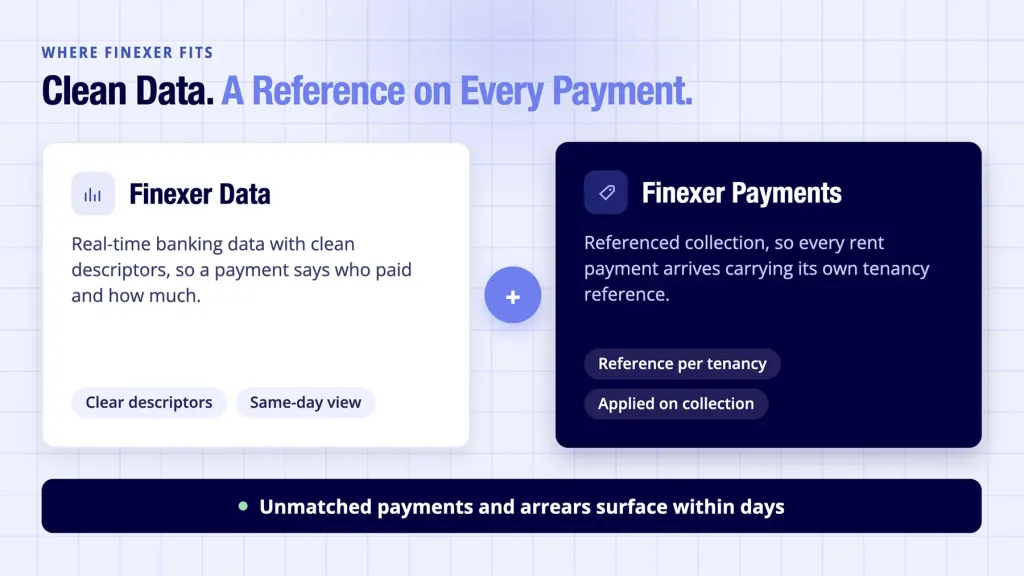
Agents matching rent against tenancies are working with two things that determine how reliable that match can ever be: how clean the underlying banking data is and how consistently each tenancy carries its own reference.
Finexer’s banking data API supplies real-time banking data with clean descriptors, and Finexer’s Payments product supports referenced collection, so each tenant’s payment carries a reference, which makes matching against the right tenancy far more reliable than an unreferenced bank transfer ever could.
Where This Fits
Proptech platforms build rent reconciliation directly into tenant and landlord dashboards, so a missed payment surfaces automatically inside the same system that manages the tenancy.
Letting agents managing this manually or through a general accounting tool typically feel this most difficult at portfolio scale, where the number of tenancies makes eyeballing statements impractical past a certain point.
Does rent reconciliation software replace a property management system entirely?
No. It typically works alongside or inside one, handling the specific matching problem rather than replacing tenancy management, maintenance tracking or communication with tenants and landlords.
What happens when a payment genuinely can’t be matched to any tenancy?
It stays flagged as unmatched until someone investigates it directly, usually by checking the payer name and amount against active tenancies manually as a last resort.
Is a unique reference per tenancy something agents have to ask tenants to use correctly?
Often yes, unless the collection method assigns and applies the reference automatically, which removes the risk of a tenant mistyping or omitting it.
How is a rental reference check different from a credit check?
A rental reference check typically covers employment, previous landlord references and income evidence. It’s broader than a credit check alone, and specific scope varies by referencing provider.
See how Finexer gives letting platforms referenced rent collection and real-time banking data, so unmatched payments and arrears surface within days.
Explore with AI
About the Author

Paul Lucraft
Paul Lucraft is a payments industry strategist and advisor with more than two decades of experience across banking, card networks, and financial services infrastructure. His expertise covers fraud prevention, payment risk management, financial strategy, and the operational development of card payment systems. He previously held senior roles at Mastercard Europe where he served as General Manager for the UK and Ireland, overseeing fraud risk, operational governance, and payment network strategy across the region. Earlier in his career, Paul worked at Lloyds TSB and TSB Bank leading fraud strategy, credit collections, and card business finance operations.