
Match Every Payment
Verified bank data. A unique reference. Near-real-time transaction access
A customer pays. Your system says received. Your bank statement disagrees by 40p, three days, or an entire missing reference. Multiply that by ten thousand transactions and reconciliation of payments stops being an afternoon task and starts eating a finance team’s month. Nobody budgets for that. Everybody ends up paying it anyway, usually in the last week before close.
TL;DR: Reconciliation of payments confirms that money recorded in a system genuinely moved through the bank. This guide covers what a bank reconciliation statement shows, why payment reconciliation breaks, what makes it solvable, how the main data providers compare on the inputs that matching actually needs, and where exceptions belong instead of blocking the close.
This guide draws on Finexer’s experience as an FCA-authorised (FRN 925695) Open Banking infrastructure provider supplying verified bank data and payment references that UK platforms and finance teams build reconciliation on.
“Reconciliation isn’t a data problem until the data forces it to be. Give a platform verified bank data and a reference that survives the whole payment journey, and matching stops being guesswork,” says Ravi Ranjan.
What Reconciliation of Payments Actually Confirms
Reconciliation of payments matches each expected payment, the one your invoice or ledger says should exist, against a real transaction that landed in the bank. Nothing counts as reconciled until both sides agree.
That sounds narrow, but it sits underneath almost everything a finance function relies on. Cash-flow reporting, supplier payment confirmation, and month-end close all assume the ledger reflects what actually happened in the bank. When reconciliation lags, every number built on top of it is provisional.
What a Bank Reconciliation Statement Shows
A bank reconciliation statement compares your internal cash records against the bank’s own record for the same period, then lists every difference: payments you’ve recorded that haven’t cleared, bank entries you haven’t logged yet, and fees or charges the bank deducted that never reached your books. It’s the output of reconciliation, not the process itself. Payment reconciliation is the ongoing matching work; the statement is the snapshot that proves the two sides agree.
Why Payment Reconciliation Breaks
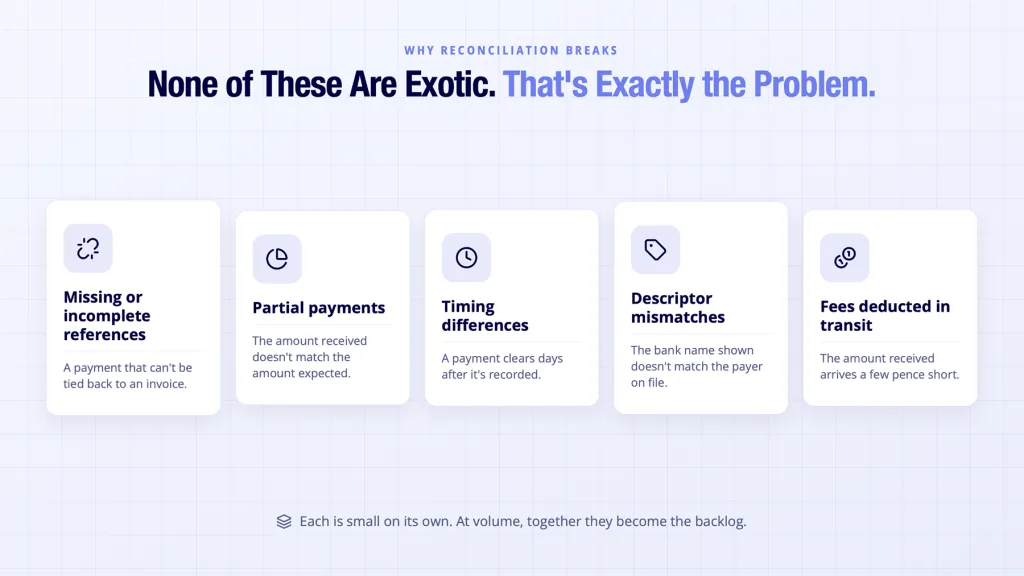
Reconciliation rarely fails for one reason. It usually fails for several, at once:
- Missing or incomplete references, so a payment can’t be tied back to an invoice
- Partial payments, where the amount received doesn’t match the amount expected
- Timing differences, where a payment clears in the bank days after it’s recorded
- Descriptor mismatches, where the bank name shown doesn’t match the payer on file
- Fees deducted in transit, so the amount received is a few pence short
Each of these is small individually. Across thousands of transactions, they become the manual reconciliation backlog most finance teams quietly live with.
None of them are exotic. A customer types their own reference instead of the invoice number. A payment splits across two installments. A bank settles on a Friday what your ledger recorded on a Wednesday. The failure mode is almost always this ordinary, which is exactly why it’s so easy to underestimate until the backlog is three weeks deep.
Manual Matching Against Automated Matching
| Manual matching | Automated matching | |
|---|---|---|
| Effort | Hours per cycle, every cycle | Minutes, mostly exception handling |
| Error rate | Rises with transaction volume | Stays flat with better inputs |
| Timeliness | Batched, often end of month | Near-continuous |
| Audit trail | Spreadsheet-dependent | System-logged automatically |
Neither approach fixes bad inputs. Automated bank reconciliation still needs clean references and verified bank data to match against; it just processes them faster than a person can.
Teams sometimes expect automation to absorb data the way a human reviewer would, reading intent into a garbled descriptor. It doesn’t work that way. An automated matcher applies rules consistently at scale; it doesn’t improvise. Feed it the same missing reference a person would have to chase manually, and it produces the same exception, just faster and with a cleaner audit trail attached.
What Makes Reconciliation Solvable
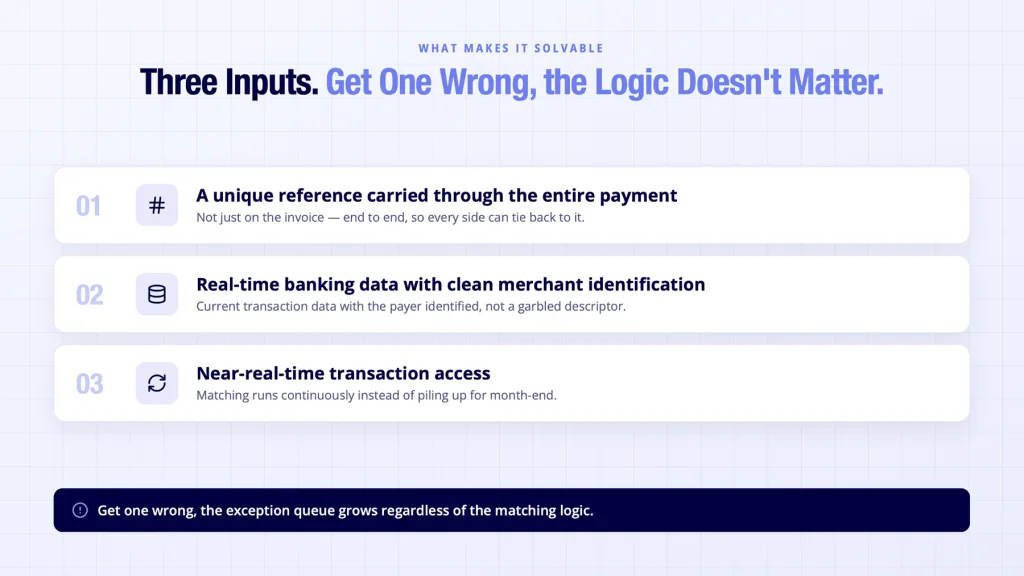
Three things turn payment reconciliation from a manual chore into something a platform can run reliably:
- A unique reference carried through the entire payment, not just the invoice
- Verified bank data with clean merchant identification
- Near-real-time transaction access, so matching happens continuously instead of at month-end
This is also the logic behind transaction matching software: the tool only performs as well as the reference and the data it’s given.
Get those three right and match rates climb without adding headcount. Get any one of them wrong and the exception queue grows regardless of how sophisticated the matching logic is behind it.
Handling Exceptions Without Blocking the Close
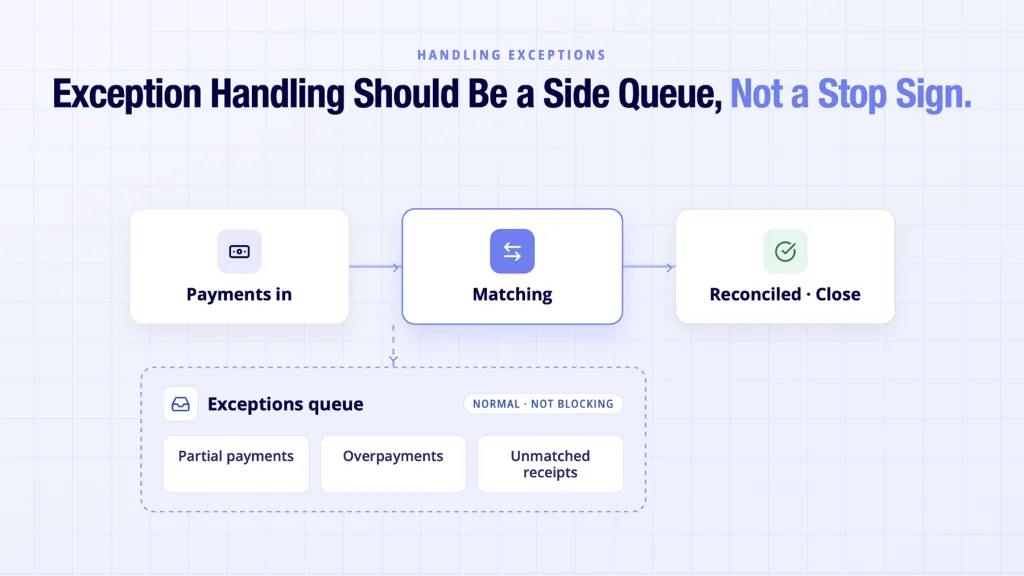
Not every payment matches cleanly, and a good process expects that. Partial payments, overpayments, and unmatched receipts should route to a queue for review, not stall the rest of the reconciliation run. This matters as much for invoices as for general ledger entries; see automated invoice reconciliation for how the same principle applies at invoice level.
A useful benchmark: if exceptions consistently make up more than a small fraction of monthly transaction volume, the problem usually sits upstream, in references or data quality, not in the exception process itself.
Choosing a Data Provider for Reconciliation
Reconciliation quality depends on what a provider hands the platform before matching even starts. Coverage and enrichment vary more than most comparisons show:
| Provider | UK/EU bank coverage | Enrichment for matching |
|---|---|---|
| TrueLayer | 69+ institutions | Predicted merchant name and transaction classification |
| Yapily | ~2,000 institutions across 19 European countries | Categorisation available through Yapily Data Plus |
| Plaid | Extensive global coverage with strongest support in North America | Categorised transactions and enriched merchant information |
| Finexer | UK-focused Open Banking platform offering data and payments through a unified API | Merchant identification and category applied |
Broad coverage solves connectivity. It doesn’t automatically solve reconciliation of payments, which depends on merchant identification accuracy and how the reference travels alongside the payment, not just how many banks a provider reaches.
Where Finexer Fits
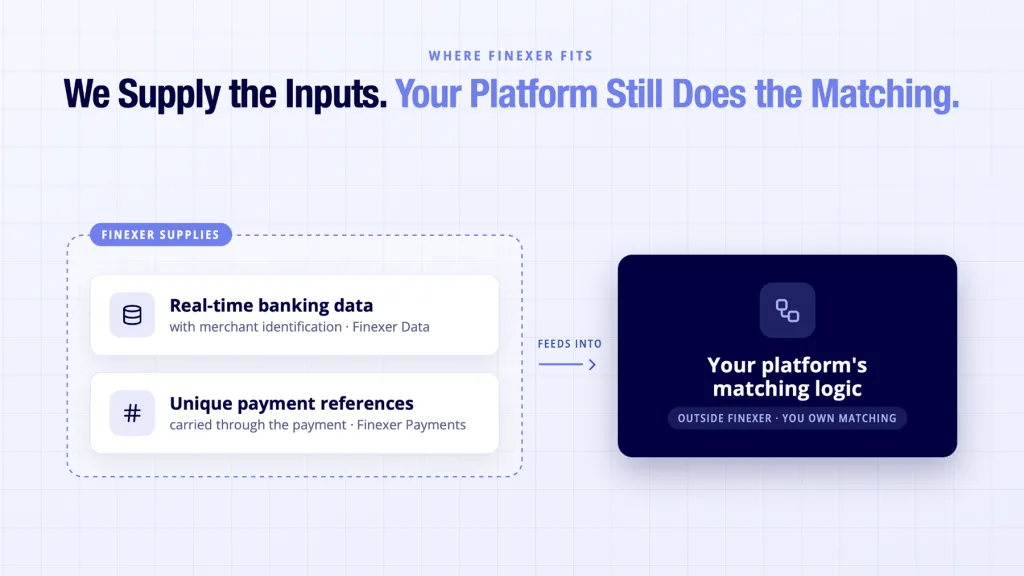
Finexer doesn’t automate the matching itself; the platform does that. What Finexer supplies is the input matching depends on: verified bank data with transaction data enrichment through Finexer Data, and unique payment references generated through Finexer Payments.
Together, those two products give a platform’s own matching logic something reliable to work against, through Finexer’s bank data API.
This matters most for Accounting & ERP platforms closing books monthly, where late-arriving descriptors delay the whole cycle rather than one account. Payroll and Invoicing platforms feel it at volume, matching supplier and contractor payments where one bad reference can hold up a batch run.
Proptech platforms carry a version of their own: reconciling rent and deposit payments against tenant ledgers, where a mismatched name on an otherwise correct payment still needs a human to resolve it manually.
What’s the difference between a bank reconciliation statement and payment reconciliation?
Payment reconciliation is the ongoing process of matching records to real transactions. The bank reconciliation statement is the document produced at the end of that process, showing any remaining differences.
Why does reconciliation still break even with automation in place?
Automation depends on its inputs. If the payment reference is missing or if the bank descriptor arrives without the enrichment we provide and doesn’t identify the payer clearly, no matching engine can close the gap on its own.
Should unmatched payments block the reconciliation close?
No. Routing partial payments and unmatched receipts into a separate exception queue keeps the rest of the close moving instead of stalling on a handful of edge cases.
Does more bank coverage mean better reconciliation?
Not by itself. Coverage determines which accounts a provider can reach; reconciliation quality depends on merchant identification and reference data, which vary independently of how many banks are supported.
Giving your platform what it needs to match payments reliably. See how Finexer supplies verified bank data with merchant identification and unique payment references.
Explore with AI
About the Author

Ravi Ranjan
Ravi Ranjan is Co founder & CEO of Finexer