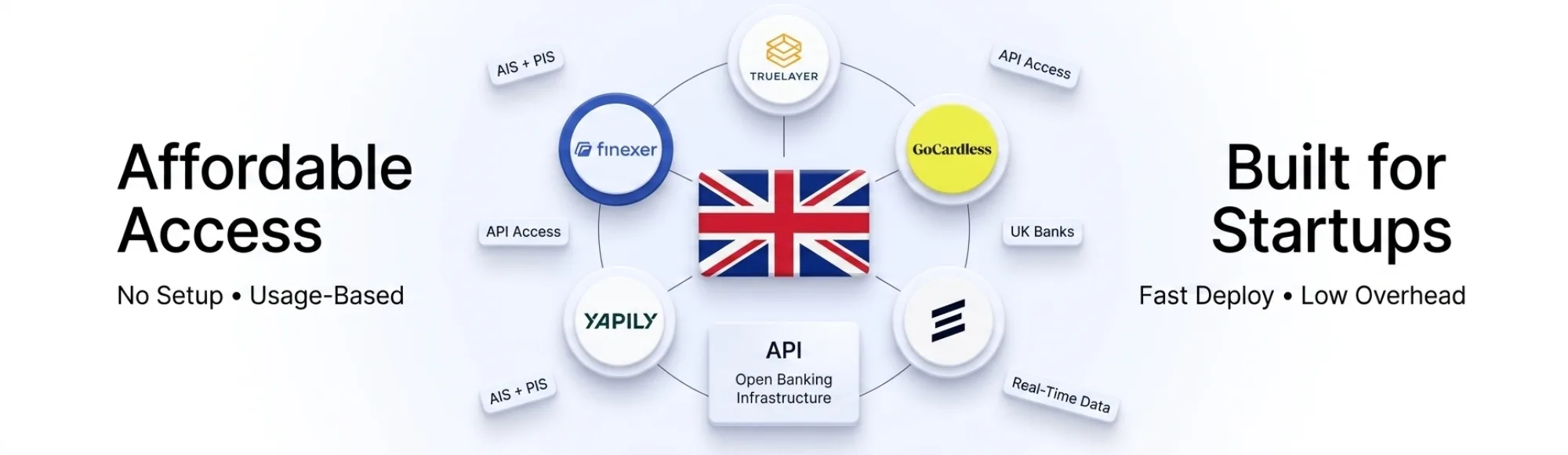
No setup fees. Usage-based pricing.
Affordable Open Banking infrastructure for UK startups, SMEs, and SaaS platforms.
Affordable Open Banking for startups and SMEs means more than the lowest headline price. It means the total cost of building, deploying, and operating financial features – integration cost, operational overhead, compliance burden, and data access – managed efficiently from day one.
UK Open Banking has grown to 17.51 million user connections as of December 2025, with an estimated £43 billion annual economic opportunity for the UK economy (Open Banking Limited, 2025). For startups and SMEs, that opportunity is only accessible when the infrastructure is priced and structured for how early-stage businesses actually work.
This blog compares the top five UK Open Banking providers on affordability and what actually determines open banking affordability for startups and SMEs building financial features.
“Open banking affordability is not about finding the cheapest API. It is about total cost – integration time, compliance overhead, and whether you need one provider or two. Those hidden costs dwarf the per-transaction fee.” – Ravi, Finexer
TL;DR
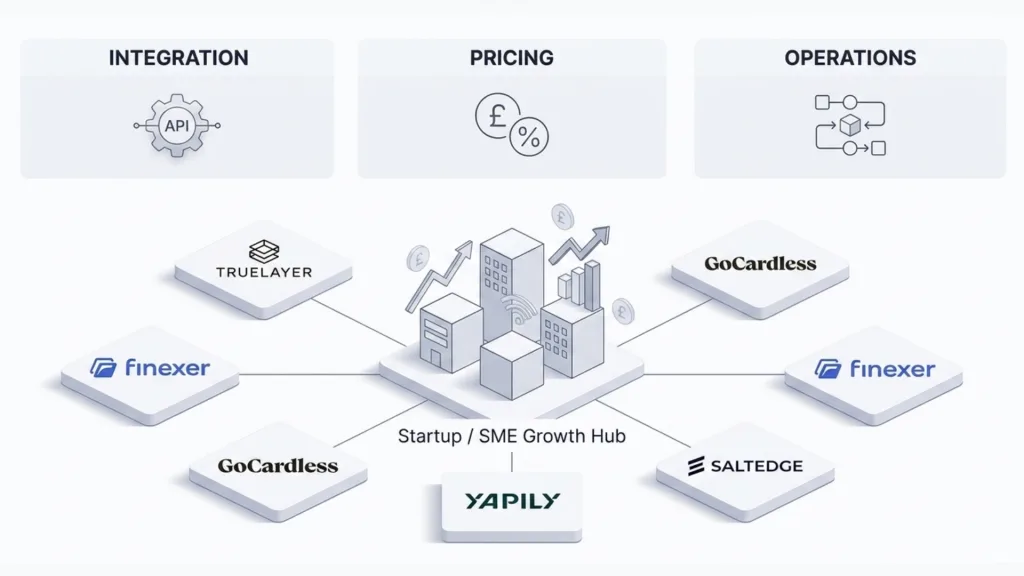
Affordable Open Banking for startups and SMEs depends on three cost drivers: integration complexity, pricing model, and operational overhead. Usage-based pricing with no setup fees is the most cost-efficient model for early-stage platforms. The top UK providers for affordable Open Banking in 2026 are TrueLayer, Finexer, GoCardless, Yapily, and Salt Edge – each with different affordability profiles depending on use case, geography, and scale.
Key Takeaways
What makes Open Banking affordable for startups?
Three factors determine open banking affordability – not just the API price:
- Integration cost – how long it takes to integrate and go live. A cheaper API that takes 6 months to integrate is not affordable
- Pricing model – usage-based pricing lets startups pay only for what they use at early volumes
- Operational overhead – compliance, data management, and support costs that sit outside the API price
Why does Open Banking affordability matter for SMEs?
SME late payments cost the UK £11 billion annually (Open Banking Expo, 2026). Open Banking addresses this directly through faster, bank-authenticated payment flows – but only if the infrastructure is accessible. High setup fees, or enterprise-only contracts price out the SMEs who would benefit most.
What should startups evaluate when comparing providers on affordability?
- Usage-based vs subscription pricing – does cost scale with actual transaction volume?
- Setup and cancellation fees – are there upfront costs before a single API call?
- Integration speed – does 2-3x faster deployment translate to lower development cost?
- Compliance built-in – does the provider’s FCA authorisation cover the platform’s requirements, or are there additional costs?
- AIS + PIS in one – does one integration cover both data and payments, or are separate contracts required?
Who Are the 5 Best Affordable Open Banking Providers for UK Startups and SMEs?
1. Finexer
Finexer is an FCA-authorised UK-only Open Banking infrastructure provider built specifically for startups, SMEs, and early-stage SaaS platforms. It provides AIS and PIS in a single integration with usage-based pricing, no setup fees.
Affordability profile:
- Usage-based pricing – pay only per API call.
- No setup fees, no cancellation fees
- Up to 90% savings on transaction costs versus card-based payment alternatives
- Deploys 2-3x faster than market alternatives – lower development cost per integration
- 3-5 weeks to production with active onboarding support
- FCA-authorised infrastructure – compliance built in, no additional regulatory overhead
- 99% UK bank coverage in a single integration – no need for multiple providers
Best for: UK startups and SMEs needing affordable AIS and PIS together, with no upfront cost and fast time to production.
“Finexer builds specifically for UK-first platforms. No EU complexity, no multi-currency overhead. That is what makes the pricing model work for startups – you pay for what you use, from the first API call.” – Ravi, Finexer
Affordable Open Banking providers for UK startups covers Finexer’s affordable open banking model in detail for early-stage UK platforms.
2. TrueLayer
TrueLayer is the UK’s largest Open Banking payment network, processing over 20 million users as of December 2025. It is primarily payments-first – Pay by Bank, VRP, and payouts – with data access available alongside.
Affordability profile:
- Strong UK and EU payment infrastructure
- Focused on payments volume – most cost-efficient for platforms with high payment transaction volumes
- Data access available but secondary to payment initiation
- Enterprise-oriented pricing – better suited to platforms at scale than early-stage builds
Best for: Platforms prioritising UK and EU payment initiation at volume.
How to choose an Open Banking provider for your platform covers how to evaluate providers on cost, coverage, and deployment speed.
3. GoCardless
GoCardless specialises in recurring payment collection – Direct Debit, bank debit, and variable recurring payments across the UK and internationally. It is primarily a payment collection tool with limited data access capability.
Affordability profile:
- Transparent per-transaction pricing for payment collection
- Strong fit for platforms collecting recurring invoices or subscription payments
- Limited AIS data access – not a bank data infrastructure provider
- Pricing scales well for high-volume recurring collection workflows
Best for: Platforms collecting recurring payments where Direct Debit or bank debit is the primary use case.
4. Yapily
Yapily is a pan-European Open Banking infrastructure provider offering AIS, PIS, and data enrichment across the UK and European markets. It covers consumer and business accounts with LLM-powered transaction categorisation.
Affordability profile:
- UK and EU coverage in a single integration
- Suitable for platforms expanding across European markets
- Pricing models vary by volume and product – better suited to platforms at moderate to high scale
- 140 business transaction categories for deep data enrichment
Best for: Platforms requiring UK and EU coverage or deep business account categorisation.
Budget-friendly Open Banking solutions for UK businesses covers how UK providers compare on pricing model and affordability for startups and SMEs.
5. Salt Edge
Salt Edge is a global Open Banking and compliance platform covering 5,000+ banks across 50+ countries. It offers AIS, PIS, and PSD2 compliance infrastructure for banks and financial platforms.
Affordability profile:
- Broad global coverage – most cost-efficient for platforms needing multi-geography data access
- PSD2 compliance tooling for banks – compliance infrastructure available as a product
- UK coverage available within global offering
- Better suited to platforms operating across multiple regions than UK-first startups
Best for: Cross-border platforms needing enrichment and bank connectivity across multiple markets.
Open Banking for UK SMEs – 2026 guide covers how UK SMEs can evaluate Open Banking providers for their specific scale and use case.
| Provider | Pricing Model | Setup Fees | AIS + PIS | UK Fit |
|---|---|---|---|---|
| Finexer | Usage-based | None | AIS + PIS together | UK-only, 99% coverage |
| TrueLayer | Volume-based | Enterprise terms | PIS-first | UK + EU (20 markets) |
| GoCardless | Per-transaction | Low | PIS-only (recurring) | UK + international |
| Yapily | Volume tiers | Varies by plan | AIS + PIS + enrichment | UK + EU (19 countries) |
| Salt Edge | Custom / volume | Varies | AIS + PIS + compliance | Global (50+ countries) |
What I Feel
Most startups evaluating affordable Open Banking ask the wrong first question.
“Which provider is cheapest?” is the wrong question.
The right questions are: How long does integration take? What is the total cost including compliance and operational overhead? Does one integration cover both data and payments, or do I need two providers?
Open banking affordability for startups is about removing the hidden costs – setup fees, multi-provider complexity, and compliance overhead – not just comparing API prices.
Common Use Cases
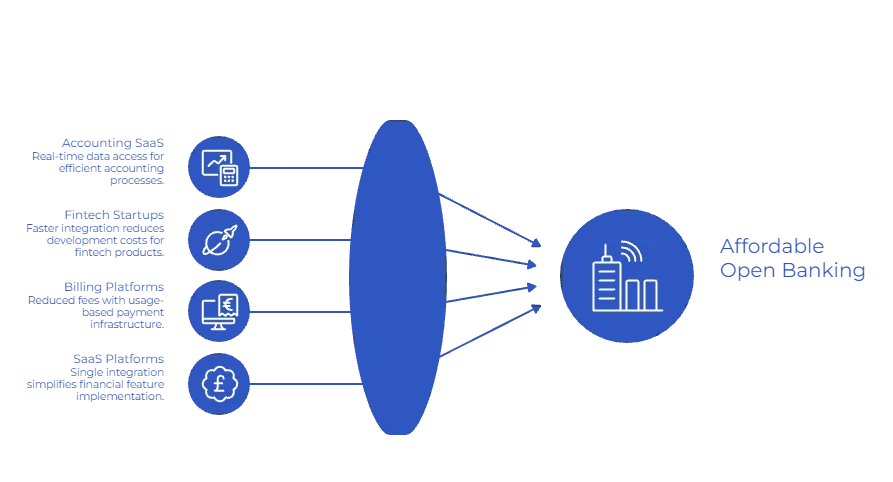
Accounting SaaS Startups
Affordable open banking enables real-time bank transaction data access for reconciliation without CSV imports. Finexer’s usage-based AIS delivers structured transaction data per API call – cost scales with client count, not from day one.
Fintech Startups Building Products
Integration cost dominates early-stage builds. Finexer’s 2-3x faster deployment reduces the development time that is the real cost of open banking affordability for product teams building on a limited runway.
Billing and Payments Platforms
Pay by Bank via Open Banking reduces card processing fees by up to 90%. For billing platforms at early volume, usage-based PIS pricing means payment infrastructure cost scales alongside revenue rather than preceding it.
SaaS Platforms Adding Financial Features
Adding Open Banking AIS + PIS as a feature requires a single integration that covers both data and payment workflows. Finexer’s combined AIS + PIS under one contract removes the dual-provider overhead that makes Open Banking expensive for SaaS builders at early stage.
What is affordable Open Banking for startups?
Affordable Open Banking for startups means usage-based pricing with no setup fees, fast deployment to reduce development cost, FCA-authorised infrastructure to avoid separate compliance overhead, and AIS plus PIS in a single integration to avoid managing multiple providers. Open banking affordability depends on total cost of ownership, not just API pricing.
Which UK Open Banking provider is best for SMEs?
For UK SMEs needing both bank data access and payment initiation, Finexer provides the most affordable open banking model – usage-based pricing, no setup fees, near-universal UK bank coverage, and 3-5 weeks to production. For recurring payment collection only, GoCardless is the established option. For EU expansion alongside the UK, Yapily provides broader geographic coverage.
How does Open Banking reduce costs for UK startups?
Open Banking reduces costs through three mechanisms: bank-authenticated payments eliminate card processing fees by up to 90%, direct bank data access removes the manual data collection overhead, and FCA-authorised infrastructure built into the provider removes the compliance cost of building and maintaining regulatory compliance independently.
Build affordable Open Banking infrastructure that scales with your platform.
About the Author

Ravi Ranjan
Ravi Ranjan is Co founder & CEO of Finexer