Need verified bank transaction data infrastructure?
Access AIS Open Banking connectivity for regulated platforms
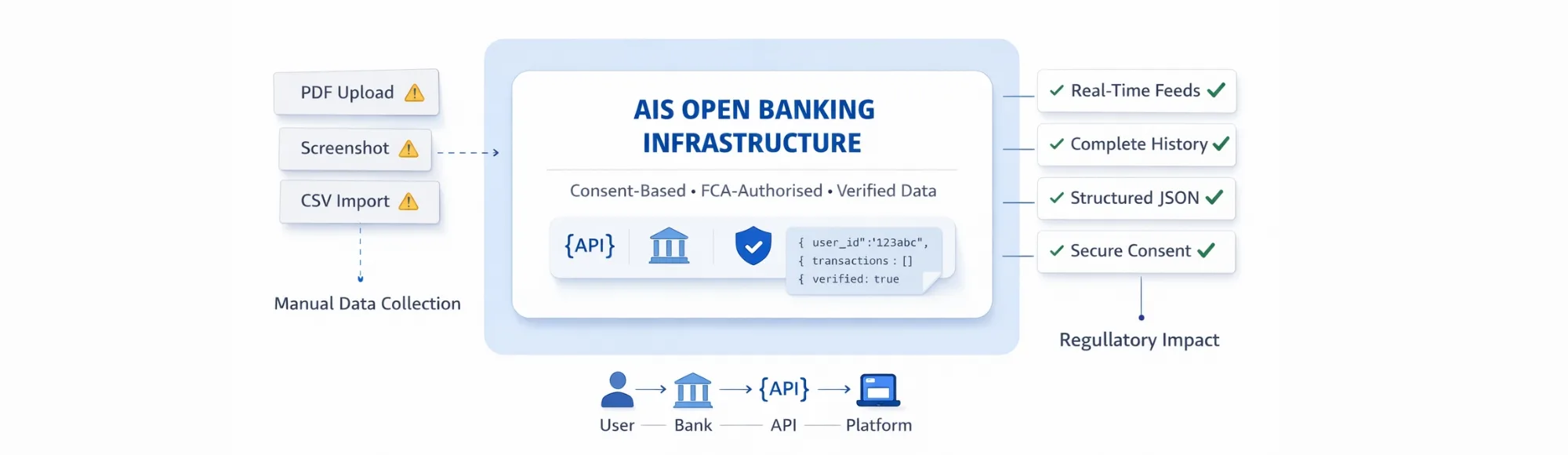
UK regulated platforms building financial features need AIS Open Banking infrastructure enabling secure, consent-based access to verified bank transaction data. Accounting SaaS, LawTech platforms, and compliance tools cannot scale operations when financial visibility depends on manual statement uploads.
Account Information Services (AIS) in the UK allow authorised third-party providers (AISPs) to securely access user financial data from banks via APIs with explicit consent. This enables fintech apps to provide consolidated account views, budgeting tools, and tailored financial product recommendations.
This explains how AIS Open Banking infrastructure enables UK platforms to access verified transaction data, what capabilities eliminate manual processes, and why FCA-authorised connectivity supports regulatory workflows.
Key Takeaways
How does AIS infrastructure benefit platforms?
AIS Open Banking enables platforms to access verified bank transaction data through FCA-authorised infrastructure, eliminating manual statement uploads and providing structured financial records for compliance workflows.
Why do regulated platforms need AIS connectivity?
Manual processes prevent scaling. Platforms need consent-based bank data access providing transaction-level visibility, audit-ready records, and automated workflows without operational overhead.
What breaks without proper infrastructure?
Manual uploads create verification gaps. Screenshot-based evidence lacks authentication. Transaction visibility remains incomplete. Compliance workflows fail at scale.
What should platforms evaluate?
FCA-authorised infrastructure, UK bank coverage, transaction data completeness, consent management, historical access depth, API reliability.
Where does Finexer enable AIS access?
Finexer provides Open Banking connectivity using FCA-authorised infrastructure. Platforms access verified bank transaction data through APIs. Platforms build financial features on top.
What is AIS in Open Banking?
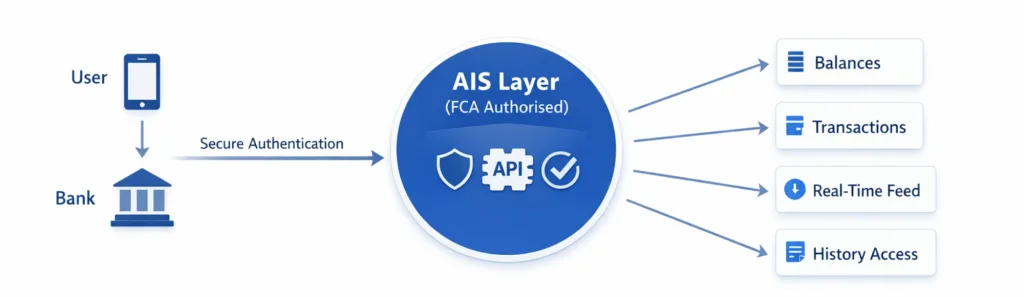
Account Information Services (AIS) enable regulated third parties to access bank account data with user consent. AIS providers must be authorised by the Financial Conduct Authority under UK Open Banking regulations.
Core AIS capabilities:
- Access to account balances and transaction history
- Real-time financial data retrieval
- Secure, consent-based connectivity
- Structured transaction records
- Historical data access (bank dependent)
Security and consent: Users must provide explicit, time-limited consent (often up to 90 days) for AISPs to access their data. No credentials are shared, as access is managed via secure, tokenised APIs.
AIS forms a core component of the UK Open Banking ecosystem regulated by the FCA, enabling platforms to build financial features using verified bank data.
Why AIS matters for regulated platforms
Accounting SaaS platforms need:
- Continuous bank feeds for client reconciliation
- Verified transaction logs eliminating manual uploads
- Structured financial data supporting MTD ITSA
- Audit-ready records for compliance
LawTech platforms require:
- Client account visibility for trust account monitoring
- Source-of-funds verification using complete transaction history
- Audit-ready records meeting SRA Account Rules
- Verified financial data for AML compliance
AIS Open Banking infrastructure transforms how UK platforms access financial data. Regulated platforms using AIS Open Banking connectivity move from manual collection to automated, verified bank data access.
The infrastructure gap without AIS
Manual processes breaking workflows:
Without AISP Open Banking infrastructure, platforms rely on manual bank statement uploads. AIS connectivity eliminates this operational bottleneck. Users provide PDFs or screenshots. Platforms cannot verify authenticity. Financial records remain incomplete.
Operational problems:
- Manual uploads delay workflows
- Screenshots lack institutional verification
- CSV imports require user intervention
- Historical access limited to uploaded periods
- Broken connectivity when users change banks
- Compliance exposure from unverified records
Platforms building financial features on manual uploads discover serious problems during regulatory reviews. Auditors require verified financial records. Manual processes cannot provide required authentication.
How AIS Open Banking infrastructure works
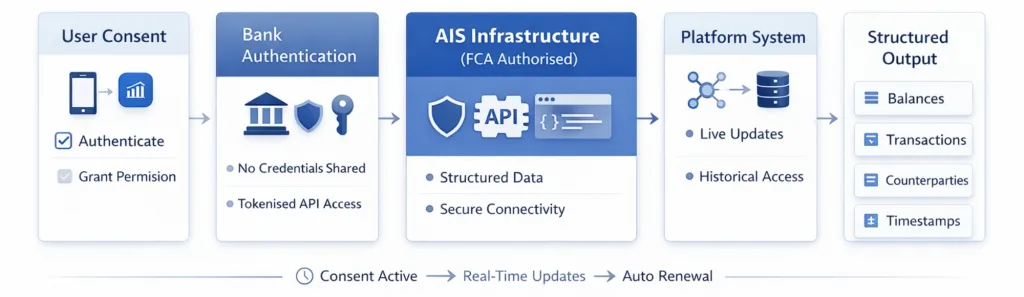
- User consent flow: Users authenticate through their banking app. Platforms request specific data access permissions. Users grant consent for defined periods. Banks provide secure API access.
- Secure authentication: No credentials shared with platforms. Banks handle user authentication. Tokenised API access maintains security. Consent tracked and managed automatically.
- Direct bank data retrieval: Platforms access transaction data through secure APIs. Banks provide structured financial records. Data arrives in consistent JSON format. Historical transactions retrieved automatically.
- Ongoing data access: Real-time transaction feeds continue during consent period. Webhooks notify platforms when new transactions occur. Consent renewal happens smoothly without disruption.
- Structured transaction records: Payment amounts, counterparties, timestamps, merchant details arrive consistently formatted. Transaction categorisation enabled through data enrichment. Complete audit trails maintained automatically.
AIS vs screen scraping
- Consent-based regulated access: AIS operates under FCA authorisation. Users provide explicit consent. Banks manage authentication securely. Regulatory framework ensures proper oversight.
- Reduced compliance risk: FCA-authorised infrastructure meets UK regulations. Consent management demonstrates proper authorisation. Verified data provenance supports audit requirements.
- Structured API data: Consistent JSON format across banks. Standardised transaction fields. Reliable data completeness. Automated error handling.
- Reliability improvements: Direct API connectivity prevents breaking changes. Bank authentication remains stable. Consent management automated. Historical access guaranteed.
Screen scraping lacks regulatory framework, breaks frequently, and cannot provide verified data required for compliance workflows.
How Finexer enables AIS infrastructure
Finexer provides Open Banking connectivity using FCA-authorised infrastructure enabling platforms to access verified bank transaction data.
Key capabilities:
- 99% UK bank coverage
- FCA-authorised infrastructure
- Real-time webhooks
- Up to 7 years historical data
- Usage-based pricing
- White-label ready
- 2-3x faster integration
- 3-5 weeks onboarding support
- Saves up to 90% on transaction costs
Platforms integrate AIS infrastructure through REST endpoints. Users authenticate accounts via secure Open Banking flows. Platforms receive verified transaction information automatically.
Real-time webhooks notify platforms when transactions occur. Financial data updates continuously. Transaction feeds continue automatically during consent periods.
Historical transaction access extends up to seven years depending on bank support. Platforms retrieve complete financial history without manual statement requests.
Critical positioning:
Finexer provides Open Banking connectivity using FCA-authorised infrastructure. Finexer is not a bank or regulatory consultant.
Platforms control financial features, compliance logic, and regulatory reporting. Finexer provides the verified bank transaction data layer.
For platforms requiring AISP infrastructure, Finexer enables secure connectivity.
Common use cases
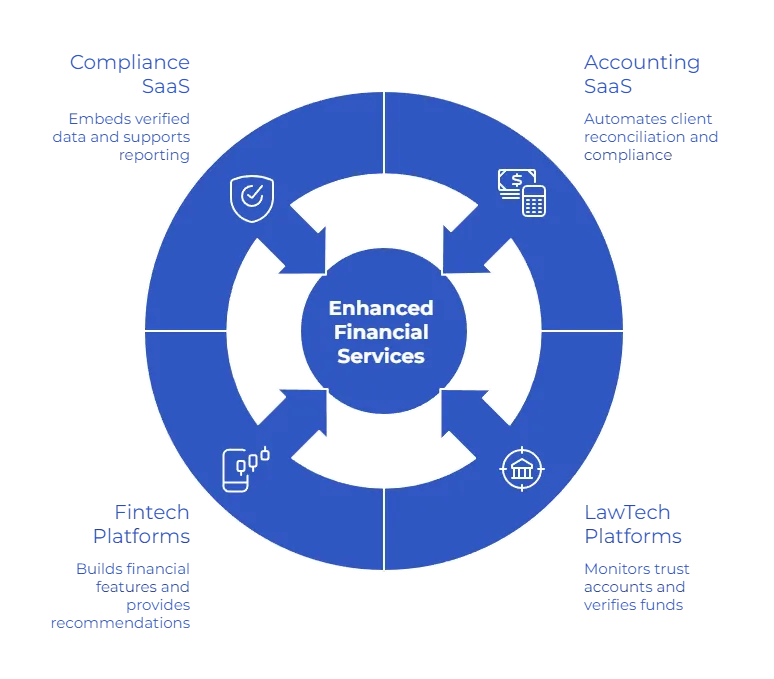
Platforms implementing AISP Open Banking capabilities enable these sector-specific use cases:
Accounting SaaS:
- Automate client reconciliation using continuous bank feeds
- Replace manual statement uploads with verified data
- Support MTD ITSA compliance with structured records
- Build audit-ready financial logs
LawTech platforms:
- Monitor client accounts for trust account oversight
- Verify source-of-funds using complete transaction history
- Maintain audit-ready records for SRA compliance
- Support AML screening with verified financial data
Fintech platforms:
- Build financial features using verified bank data
- Access real-time transaction feeds
- Provide consolidated account views
- Enable financial product recommendations
Compliance SaaS:
- Embed verified financial data layer
- Support audit trail requirements
- Enable AML screening workflows
- Provide regulatory reporting infrastructure
What I Feel About AIS Open Banking
Most platforms still treat Open Banking like optional infrastructure. They stick with manual PDF uploads because “it works for now.” Then hit scaling walls when verifying thousands of transactions manually becomes impossible.
The reality nobody talks about:
- Manual uploads don’t verify anything
- Screenshots can be edited in seconds
- CSV files lack institutional authentication
- Compliance teams can’t defend this in audits
I’ve watched platforms lose enterprise deals because they couldn’t demonstrate verified data provenance. Procurement asks “how do you verify financial records?” and the answer is “users upload PDFs” – deal dies instantly.
AIS solves this at the infrastructure level. Bank-authenticated data. Consent tracked automatically. Complete audit trails. FCA-authorised framework. Yet platforms avoid it because integration seems hard.
Here’s the truth:
- Integration takes 3-5 weeks
- Manual verification takes forever and scales terribly
- One FCA audit question about data authenticity justifies the entire migration
Platforms building for regulated markets can’t avoid this forever. LawTech needs it for SRA compliance. Lending needs it for underwriting. Accounting needs it for MTD ITSA.
The question isn’t whether to use AIS infrastructure. It’s whether to migrate now or wait until manual processes block growth.
What is AIS in Open Banking?
AIS (Account Information Services) in Open Banking enables authorised third parties to access bank account data with user consent. AISPs securely retrieve financial information via APIs, allowing platforms to provide consolidated views and financial services without handling credentials.
Which UK banks use Open Banking?
99% of UK banks support Open Banking including major banks (Barclays, HSBC, Lloyds, NatWest), challenger banks (Monzo, Starling, Revolut), and building societies. Platforms using AIS infrastructure access nearly all UK banking institutions through standardised APIs.
Is Open Banking legal in the UK?
Yes, Open Banking is regulated by the Financial Conduct Authority under UK regulations. AIS providers must be FCA-authorised. Users provide explicit consent. Banks manage secure authentication. Regulatory framework ensures consumer protection and data security.
Access AIS Open Banking infrastructure with verified bank transaction data and FCA-authorised connectivity.
About the Author

Ravi Ranjan
Finexer