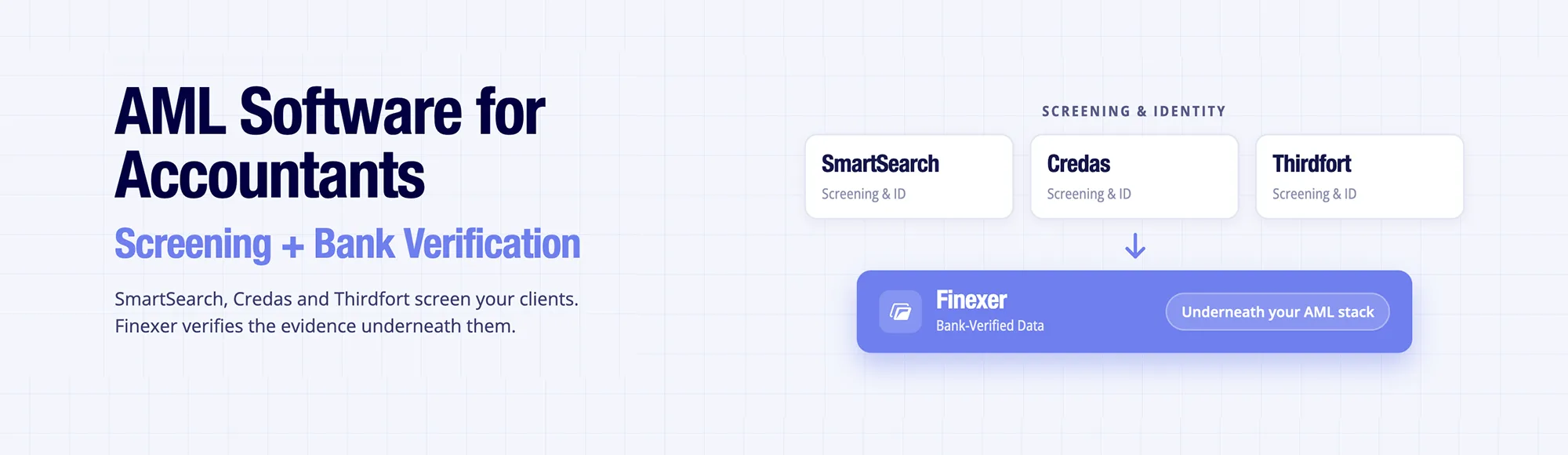
Verify clients, not documents:
See how Finexer’s Verification and AIS confirm identity and source of funds against real bank data, layered underneath the AML software you already run.
A client hands over a passport scan and a bank statement PDF, both of which can be edited in minutes, and most AML software for accountants never checks either against the source.
The strongest UK compliance stacks pair a screening tool like SmartSearch, Credas or Thirdfort with bank-verified data for identity and source-of-funds checks. At UK accounting firms, the recurring gap isn’t screening coverage; it’s that nobody is confirming that the bank statement itself is real.
By Paul, Compliance Lead at Finexer
“In my experience working with compliance teams, the biggest gap in Open Banking verification is the source of funds. Firms screen a client against sanctions and PEP lists, get a clean result, then accept a self-uploaded bank statement as proof of where the money came from. That statement was never checked against the bank.”
The Gap Between Screening Clients and Verifying Their Money
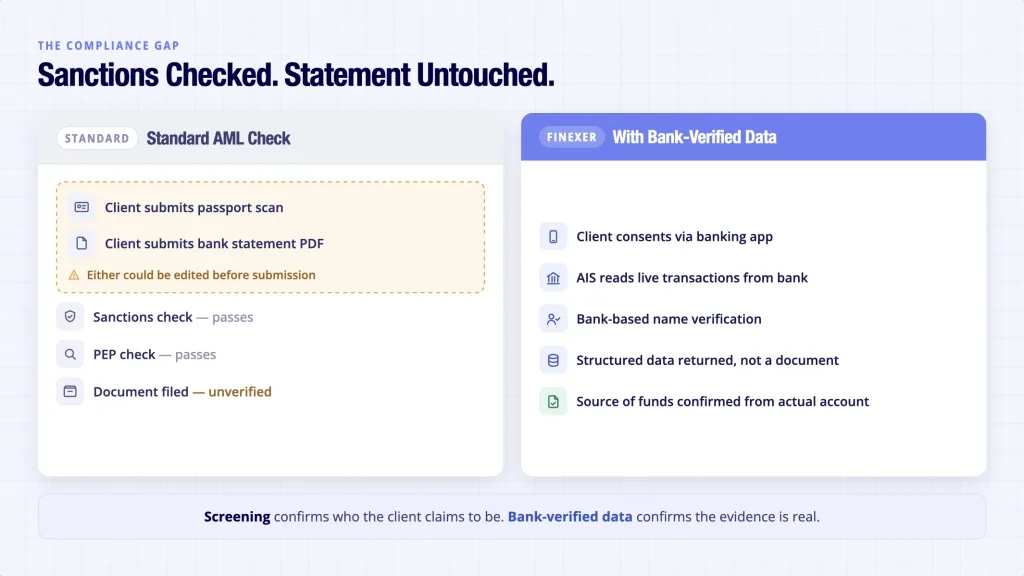
A bookkeeping firm onboards a new limited company client under Money Laundering Regulations 2017. The team runs a sanctions check, a PEP check, and files the passport copy the client emailed over. Every box is ticked.
What nobody checked: whether that passport image was edited, or whether the “source of funds” bank statement the client attached actually matches an account they control. AML software for accountants was built to solve screening. It was never built to confirm the underlying document is genuine.
That gap doesn’t show up in an audit until it’s too late. For firms handling company formations, high-value transactions, or clients outside standard PAYE income, the risk sits exactly where the screening tools stop looking.
What to Look for in AML Software for Accountants UK?
Five criteria separate a compliance stack that actually closes the risk from one that just produces a clean report.
- Sanctions, PEP and adverse media coverage – Does the tool screen against live UK and international lists, or a static database updated infrequently?
- Ongoing monitoring – Does the client get re-screened automatically after onboarding, or only at the point of engagement?
- Document authenticity checks – Can the tool detect an edited PDF or altered passport scan, not just read the text on it?
- Source-of-funds verification – Does the firm see real bank transaction data, or rely on a document the client chose to upload?
- Case management and audit trail – Can the firm produce evidence of every check for an SRA or ICAEW inspection, on demand?
Most AML tools for accountants are strong on the first two and thin on the last three.
Top AML Software for Accountants UK Options
SmartSearch
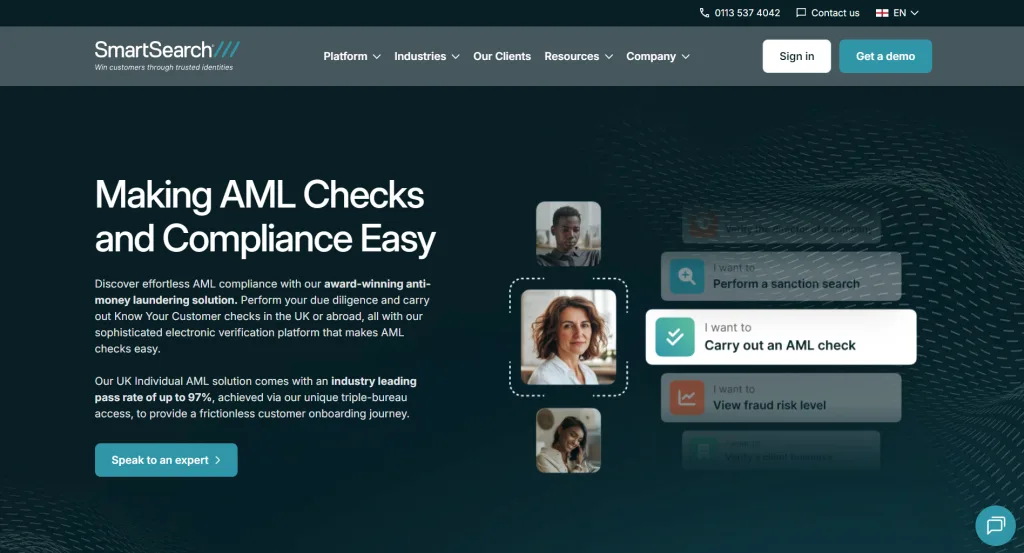
SmartSearch is one of the most widely used AML platforms among UK accounting practices, combining sanctions, PEP and adverse media screening with electronic ID verification and automated ongoing monitoring. It’s built specifically around UK regulated-sector compliance workflows, including MLR 2017 evidence requirements.
Good for: Practices that need a single, audit-ready screening record across every client type.
Credas
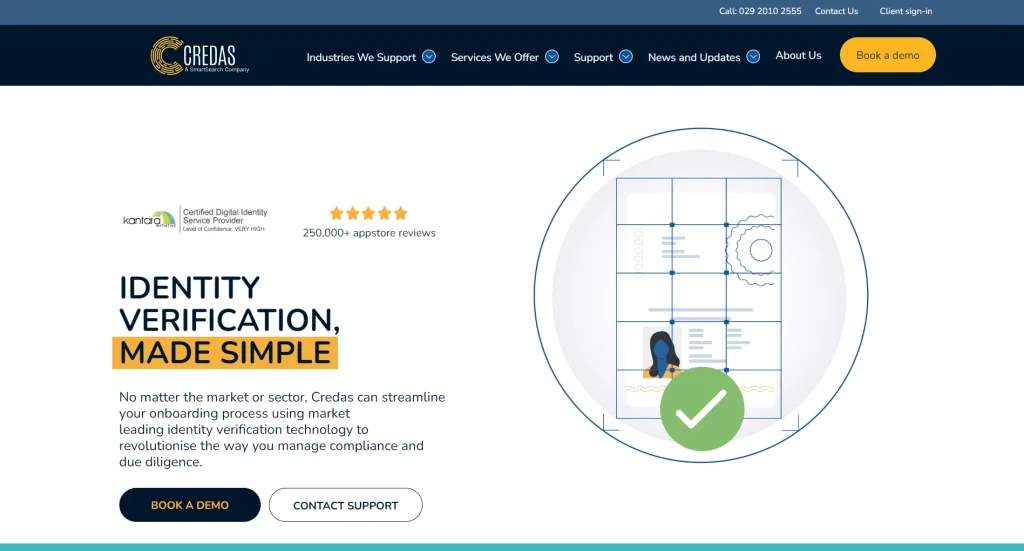
Credas focuses on digital identity verification with biometric facial matching, alongside AML screening and right-to-work checks. It’s used across accountancy, legal and property sectors where in-person ID checks are being replaced with remote onboarding.
Good for: Firms prioritising a fast, mobile-first identity capture step at onboarding.
Thirdfort
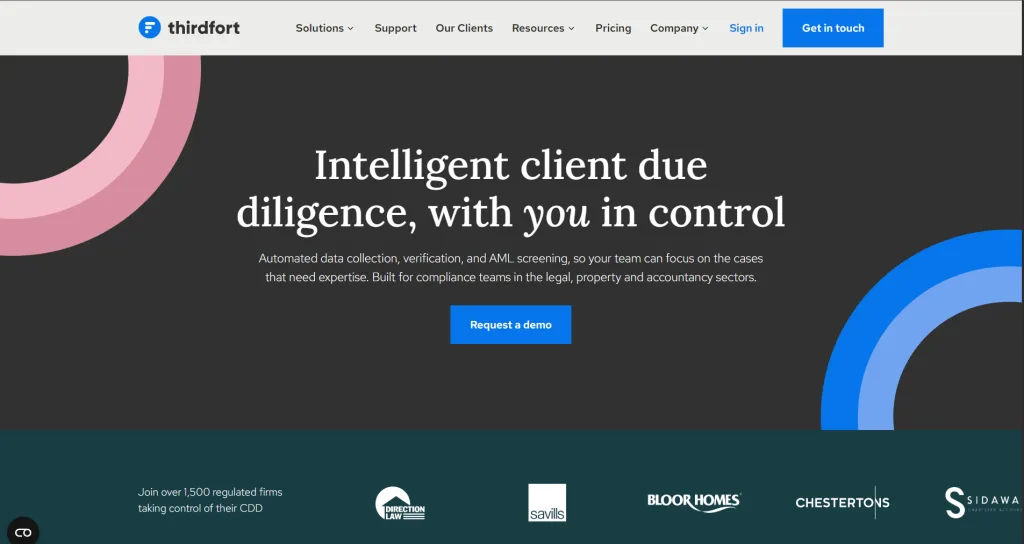
Thirdfort combines identity verification, AML screening and source-of-funds document review in one client-facing app, with a strong presence in legal and accountancy client onboarding. Its source-of-funds feature relies on the client uploading supporting documents through the app.
Good for: Firms wanting a single client-facing app that covers ID, AML and document collection together.
Comparison Table
| Tool | Sanctions & PEP Screening | Ongoing Monitoring | Document Authenticity | Bank-Verified Source of Funds | Best For |
|---|---|---|---|---|---|
| SmartSearch | Yes | Yes | Partial | No | Full-service AML screening and monitoring |
| Credas | Yes | Partial | Biometric ID only | No | Fast digital onboarding with biometric verification |
| Thirdfort | Yes | Yes | Partial | No | Single client-facing onboarding app |
Why Every Tool in This Table Shares the Same Blind Spot?
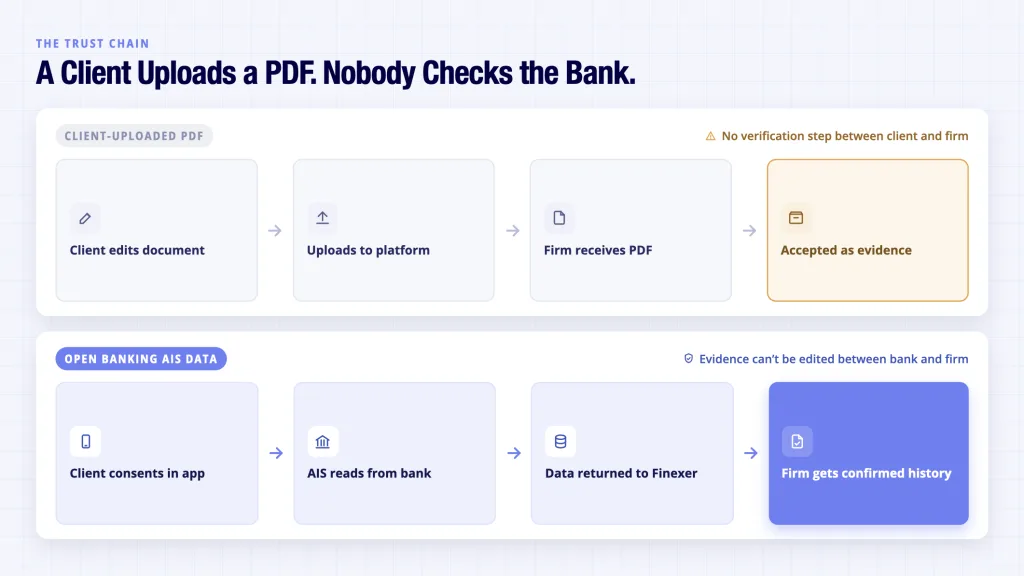
Every option above screens the client against lists and verifies who they claim to be. None of them confirm that the bank statement or source-of-funds document a client submits reflects an actual, current bank account. A firm accepts a screenshot showing a £40,000 deposit, and the screening tool has no way to check it against the bank that supposedly issued it.
Closing that gap requires a different kind of check: one that reads transaction data directly from the client’s bank, with their consent, rather than trusting a document they chose to send.
Finexer’s Verification and AIS: Closing the Source-of-Funds Gap
Accounting firms doing client due diligence need to confirm a client’s identity and where their money actually came from, not just that their name is clear on a sanctions list.
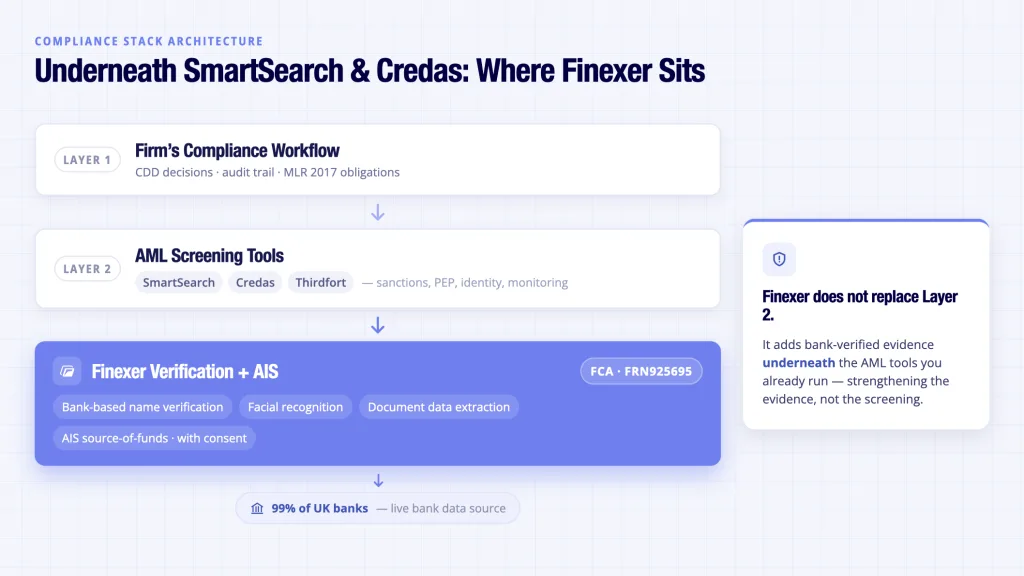
Finexer doesn’t replace SmartSearch, Credas or Thirdfort, and doesn’t screen sanctions, PEP or adverse media lists. It sits underneath a firm’s existing AML stack as the data layer:
Finexer’s Verification product confirms a client’s identity against real bank records and runs facial recognition against a passport or driving licence, while Finexer’s AIS reads live transaction data, with consent, so a source-of-funds figure can be checked against an actual account rather than a submitted PDF.
AIS transaction data for source-of-funds checks are also used for KYC onboarding for accountants. This is the same bank-verified data comparison approach Finexer already applies to audit data for accountancy firms.
- Bank-based name verification: real-time match against bank records, not a submitted form
- Facial recognition with similarity score: selfie checked against passport or driving licence
- Document data extraction: structured data pulled directly from the ID document
- AIS transaction data for source-of-funds checks, used for KYC onboarding for accountants
- 99% UK bank coverage
- FCA-authorised AISP and PISP (FRN925695)
- Usage-based pricing
Firms layering this underneath their screening tool are also cutting customer due diligence costs by reducing manual document review time per client file.
What Should AML Software for Accountants Include?
AML software for accountants uk should combine three things: sanctions and PEP screening, identity verification, and a way to confirm source of funds against real data. Most platforms deliver the first two well.
The third is where firms are most exposed, because a client-submitted bank statement can be edited before it ever reaches the compliance team. Layering bank-verified data through Open Banking AIS means the firm sees actual transaction history rather than a document.
This doesn’t replace the client due diligence obligations set out under MLR 2017, it strengthens the evidence behind them. Firms in the Accounting & ERP use case category are already applying this same bank-data layer to reconciliation, not just onboarding.
What is the best AML software for accountants uk?
There’s no single best option: SmartSearch suits practices wanting full screening and monitoring in one platform, Credas suits fast biometric onboarding, and Thirdfort suits firms wanting a single client-facing app. The right choice depends on whether screening breadth, onboarding speed, or client experience matters most.
Do accountants need AML software?
Yes, UK accountants and bookkeepers are a regulated sector under MLR 2017 and must carry out client due diligence, including sanctions and PEP screening, for every client relationship. Manual checks are permitted but rarely scale past a handful of clients per month.
How much does AML software cost per check?
Pricing varies by provider and typically runs on a per-check or subscription model, with cost depending on screening depth and monitoring frequency. Bank-verified data layers like Finexer’s Verification and AIS run on usage-based pricing.
Is bank-verified data covered under FCA regulation?
Yes, providers offering Account Information Services in the UK must be FCA-authorised. Finexer is authorised as both an AISP and PISP under FRN925695.
Screening tells you who the client is. Bank data helps confirm their money.
See how Finexer adds verified identity and source-of-funds checks to your AML workflow.
Explore with AI
About the Author

Paul Lucraft
Paul Lucraft is a payments industry strategist and advisor with more than two decades of experience across banking, card networks, and financial services infrastructure. His expertise covers fraud prevention, payment risk management, financial strategy, and the operational development of card payment systems. He previously held senior roles at Mastercard Europe where he served as General Manager for the UK and Ireland, overseeing fraud risk, operational governance, and payment network strategy across the region. Earlier in his career, Paul worked at Lloyds TSB and TSB Bank leading fraud strategy, credit collections, and card business finance operations.