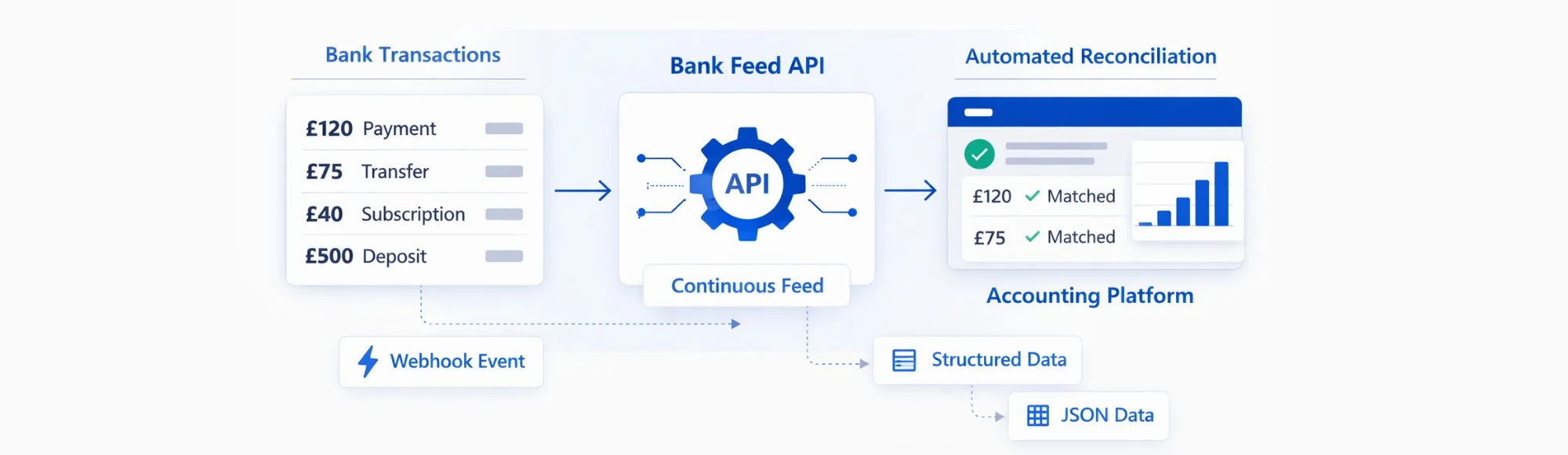
Need reliable bank feed infrastructure for your accounting platform?
Finexer API gives UK accounting platforms FCA-authorised AIS access – structured transaction feeds, real-time webhooks, API-ready.
When I work with accounting platforms evaluating bank feed infrastructure, the conversation usually starts with the same operational complaint. Reconciliation is accurate when it runs – but getting it to run automatically, consistently, and without a manual data collection step in the middle is where the architecture breaks down.
The root cause is almost always the same. The platform does not have a reliable api for bank feed that delivers structured transaction data continuously. It has a manual process – CSV imports, bank statement uploads, or scheduled batch feeds – that approximates continuous data but introduces latency and inconsistency at every cycle.
An api for bank feed changes this architecture. Transaction data flows directly from the bank into the accounting system. Reconciliation runs against live, structured data. The manual step disappears.
This blog explains why accounting platforms need a reliable api for bank feed, what the Finexer API provides, and how continuous bank transaction feeds change reconciliation workflows in practice.
TL;DR
An api for bank feed allows accounting platforms to retrieve bank transaction data continuously from source – replacing manual CSV uploads and batch imports with structured, real-time transaction feeds. Finexer API provides FCA-authorised AIS infrastructure covering 99% of UK banks, giving accounting and ERP platforms reliable bank feed data for automated reconciliation and financial reporting workflows.
Key Takeaways
What is an api for bank feed?
An api for bank feed is a programmatic interface that allows accounting platforms to retrieve bank transaction data directly from financial institutions – continuously and in structured format. Instead of manual bank statement collection, transaction data flows automatically into the accounting system via the API.
Why do accounting platforms need a dedicated api for bank feed?
Manual bank data collection – CSV imports and statement uploads – introduces data latency, formatting inconsistencies, and manual steps that break reconciliation automation. A dedicated api for bank feed delivers structured transaction data continuously, enabling reconciliation workflows to run without manual data collection steps.
What does Finexer API provide for bank feed automation?
Finexer API provides FCA-authorised AIS connectivity covering 99% of UK banks – delivering structured bank transaction data with merchant identifiers, category codes, and real-time webhooks for continuous bank feed automation in accounting and ERP platforms.
How does an api for bank feed improve reconciliation accuracy?
Bank feed APIs retrieve transaction data directly from the bank – the same source of truth the accounting records need to match against. Reconciliation built on direct bank data produces more accurate outputs than reconciliation built on manually collected statements that may be incomplete or out of date.
Which accounting platforms benefit most from Finexer API bank feed infrastructure?
Accounting SaaS platforms, bookkeeping tools, ERP systems, and financial operations software that currently collect bank data manually – or rely on scheduled batch imports – benefit most from replacing that process with a continuous api for bank feed.
What Is an API for Bank Feed?
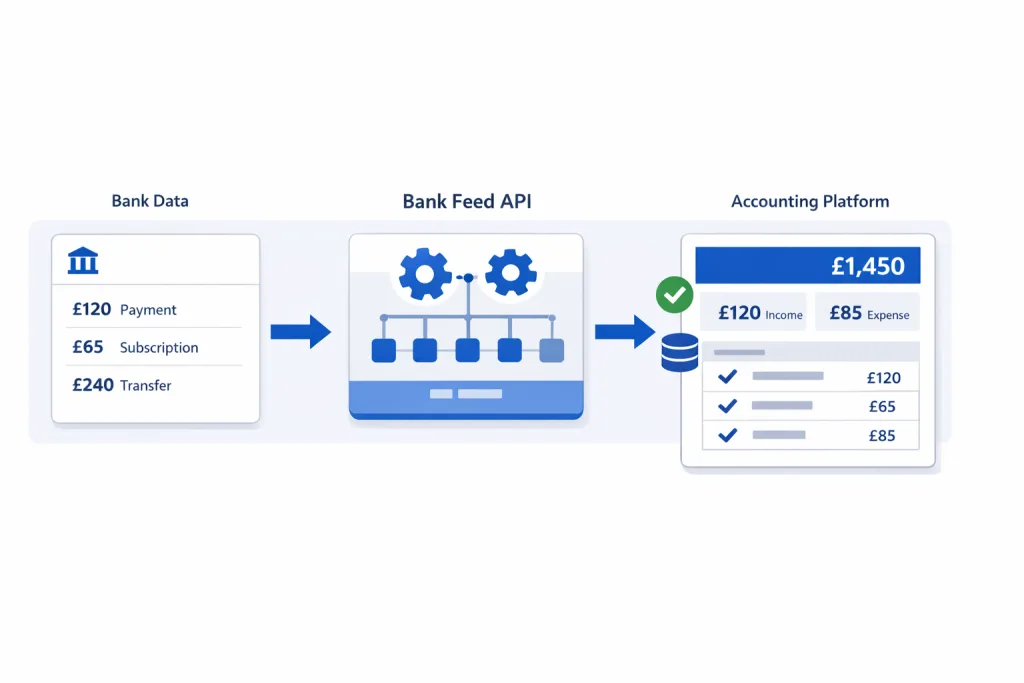
An api for bank feed is the infrastructure layer that connects an accounting platform directly to bank transaction data. Instead of waiting for a user to upload a bank statement or export a CSV, the platform retrieves structured transaction data automatically via API – at the point transactions occur, not hours or days later.
What a bank feed API delivers per connected account:
- Transaction history – amounts, timestamps, merchant identifiers, reference codes
- Account balances – current and available balance data
- Category codes – transaction type classification per entry
- Payment counterparty details – sort code, account number, payee name
The accounting system receives this data in structured JSON format – consistent across every UK bank the user holds accounts with. No reformatting. No manual field mapping. No import errors from inconsistent CSV exports.
“The api for bank feed question accounting platforms ask me is almost never about the API itself. It is about what changes when they stop collecting bank data manually. The answer is: reconciliation becomes a background process instead of a daily task.” – Yuri, Finexer
Why Manual Bank Data Collection Breaks Reconciliation at Scale

I see this consistently across accounting platforms. The reconciliation logic is solid. The matching rules are well-designed. But the process breaks at the data collection step – every single time.
CSV Imports Introduce Latency and Formatting Errors
Scheduled CSV imports collect transaction data in batches. A transaction that settles on Tuesday may not appear in the accounting system until Thursday’s import cycle. Reconciliation runs on data that is already 48 hours old – creating a gap between actual financial activity and recorded financial activity that widens with every missed import cycle.
Different banks export CSV files in different formats. Column headers vary. Date formats differ. Amount formatting is inconsistent. Every import cycle requires preprocessing before reconciliation logic can run – adding manual effort that scales linearly with client volume.
Manual Statement Uploads Are Not a Scalable Architecture
For accounting platforms managing dozens or hundreds of client accounts, manual bank statement collection is not a workflow – it is a bottleneck. Finance teams spend time collecting data that should arrive automatically. Errors in manually uploaded files produce reconciliation discrepancies that require manual investigation.
An api for bank feed removes both problems. Transaction data arrives automatically in structured format. The accounting system has current data at all times.
Bank feed API guide for UK accounting SaaS covers the technical build considerations for platforms integrating bank feed infrastructure.
How Does the Finexer API Enable Bank Feed Automation?
Finexer API is FCA-authorised AIS infrastructure that gives accounting platforms direct bank transaction feed access across 99% of UK banks.
The bank feed workflow with Finexer API:
- User connects their bank account via FCA-compliant consent flow
- Finexer API retrieves structured transaction data from the connected bank
- Real-time webhook delivers transaction events to the accounting platform as they occur
- Accounting system receives structured JSON output – merchant ID, amount, category, timestamp
- Reconciliation logic runs automatically against live bank data
- Financial records update without manual data collection step
The platform maintains one Finexer API integration. Finexer handles bank connectivity across all 99% of supported UK institutions – so engineering teams are not building or maintaining individual bank connections.
API to get bank transactions for UK platforms covers transaction retrieval specifics in detail.
How Should Accounting Platforms Evaluate Bank Feed API Infrastructure?
| Criteria | Why It Matters | What to Look For |
|---|---|---|
| Data Continuity | Reconciliation automation requires transaction data as it settles – not in weekly batches | Real-time webhooks; continuous transaction feeds; live balance data |
| Data Structure Consistency | Automated field mapping requires the same schema across all connected banks | Structured JSON; merchant IDs; category codes; standardised schema across UK banks |
| UK Bank Coverage | Accounting platforms serving diverse client bases need complete bank coverage | 99% UK bank coverage; CMA9 and challenger banks included |
| Transaction History Depth | Onboarding existing clients requires historical data beyond current period | Up to 7 years transaction history; configurable lookback periods |
| Multi-Account Support | Business clients operate across multiple bank accounts simultaneously | Multi-account connectivity; cross-bank aggregation; single consent flow |
| FCA Authorisation | UK accounting platforms must use regulated AIS providers for compliant bank data access | FCA-authorised AIS; GDPR-compliant; consent-based with instant revocation |
What Does Finexer API Provide for Accounting Platforms?
Finexer API is FCA-authorised AIS infrastructure delivering continuous bank transaction feeds for UK accounting and ERP platforms.
What Finexer API provides:
- Structured bank transaction data from 99% of UK bank accounts
- Real-time webhooks delivering transaction events as they occur
- Merchant identifiers and transaction category codes per transaction
- Account balance data – current and available per connected account
- Transaction history up to 7 years for historical onboarding and reporting
- Multi-account connectivity from a single consent-based API connection
- FCA-compliant consent flows with granular permissions and instant revocation
- White-label capability for branded bank connection journeys within platform products
- Usage-based pricing
Bank with API for UK platforms covers the broader bank connectivity architecture Finexer API operates within.
Supported UK banks via Finexer lists the full coverage of institutions accessible through Finexer API.
What I Feel
The api for bank feed question I get from accounting platform teams is usually framed as a reliability question – will it work consistently across all our clients’ banks?
That is the right question. Coverage is the baseline. But the issue I see most often after platforms go live is not coverage – it is data quality. Two platforms can both claim 99% UK bank coverage. The difference is whether the transaction data arriving from bank twelve is structured the same way as bank one.
Finexer API standardises output across all connected banks. For accounting reconciliation workflows, that consistency is what makes automation reliable – not just theoretically possible.
Common Use Cases
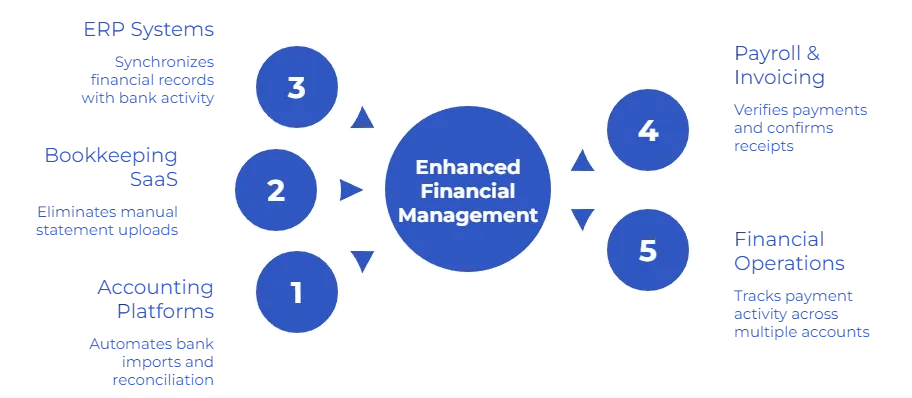
Accounting & ERP Platforms
Accounting platforms use Finexer API to replace manual CSV bank imports with continuous AIS transaction feeds. Reconciliation runs automatically against live bank data – matching client transactions to accounting entries as they settle rather than after a manual collection cycle. Month-end processing time reduces significantly for practices managing multiple client accounts.
Bookkeeping SaaS Platforms
Bookkeeping platforms integrate Finexer API to retrieve client bank transaction data continuously – replacing the manual statement upload request that currently sits between client and bookkeeper. Structured merchant identification and category codes reduce manual categorisation workload per client account, allowing bookkeepers to review exceptions rather than categorise every transaction manually.
ERP Systems
ERP platforms use Finexer API to synchronise financial records with bank activity automatically. Payment confirmations, supplier settlements, and payroll disbursements appear in the ERP system as transactions settle – keeping financial records current without manual bank data entry or scheduled import cycles.
Payroll & Invoicing Platforms
Payroll platforms use Finexer API bank feed data to verify salary payment settlements and contractor disbursements against bank transaction records. Invoice platforms use AIS transaction feeds to confirm client payment receipt automatically – triggering invoice status updates without manual payment checking.
Financial Operations Platforms
Financial operations tools use Finexer API to track payment activity across multiple business bank accounts simultaneously. Cash flow visibility, payment pattern monitoring, and financial reporting all run against continuous bank feed data rather than periodic manual exports.
What is an api for bank feed in accounting platforms?
An api for bank feed is a programmatic interface that retrieves bank transaction data continuously from financial institutions – replacing manual CSV uploads and statement collection with structured, real-time transaction feeds. Accounting platforms use bank feed APIs to automate reconciliation, update financial records, and maintain current transaction data without manual data collection steps.
How does Finexer API work as a bank feed infrastructure provider?
Finexer API is FCA-authorised AIS infrastructure covering 99% of UK banks. Accounting platforms integrate once through Finexer API and receive continuous structured bank transaction feeds – with real-time webhooks, merchant identifiers, category codes, and up to 7 years of transaction history – across all supported UK banking institutions.
Which accounting platforms should use Finexer API for bank feed automation?
Accounting SaaS platforms, bookkeeping tools, ERP systems, and financial operations software that currently collect bank data manually should use Finexer API for bank feed automation. Platforms managing multiple client accounts benefit most – replacing per-client manual data collection with a single API integration that delivers continuous transaction feeds across all connected accounts.
Automate reconciliation with a reliable api for bank feed.
About the Author

Yuri
Yuriy Yakushko is the Founder of Finexer, an FCA-authorised Open Banking platform that enables businesses to access real-time bank data and Pay-by-Bank payments through secure API infrastructure. With more than 20 years of experience in fintech and software engineering, he focuses on building scalable financial technology that helps businesses modernise payments and financial data workflows.