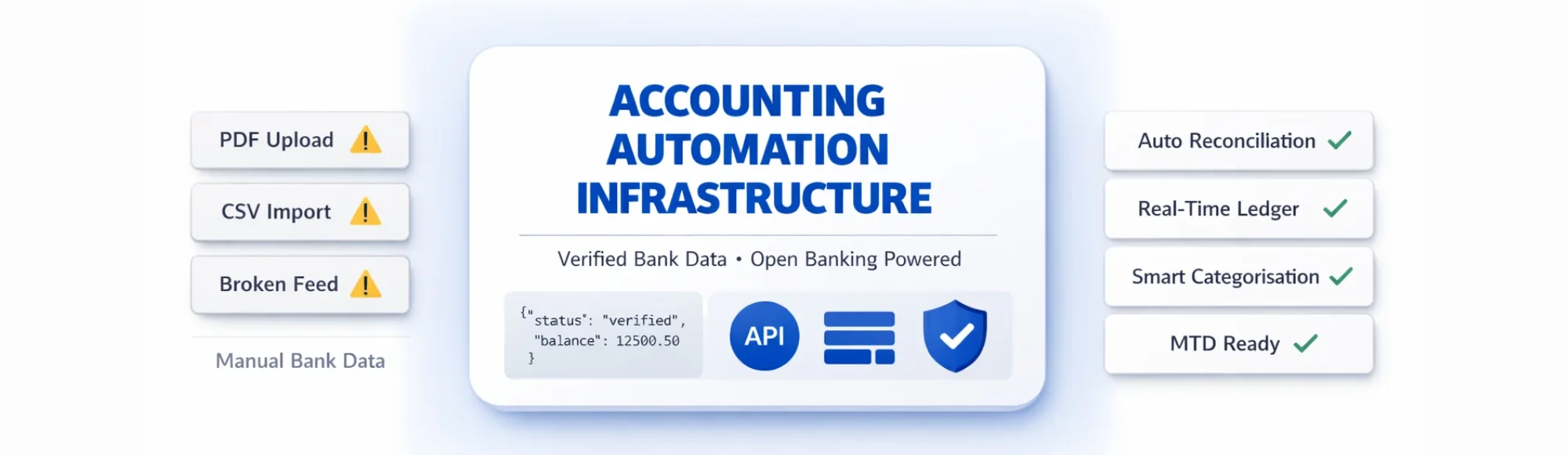
Manual bank feeds breaking accounting automation?
Access verified transaction data for automated workflows
UK accounting SaaS platforms cannot automate workflows when bank data access depends on manual statement uploads. Cloud-based software utilises accounting process automation to handle bank reconciliation, invoicing, and expense management, ensuring compliance with HMRC and Making Tax Digital requirements.
Accounting process automation in the UK utilises cloud-based software and AI to automate bank reconciliation, invoicing, and expense management. It reduces manual data entry, speeds up cash flow, and can save firms up to 2,000 hours annually.
This explains how accounting SaaS platforms enable accounting process automation using verified bank transaction data and why Open Banking infrastructure eliminates manual processes.
Key Takeaways
How does infrastructure enable automation?
Accounting process automation requires verified bank transaction data. Platforms using Open Banking infrastructure eliminate manual uploads, providing structured financial records enabling automated reconciliation and categorisation.
Why do accounting platforms need reliable bank feeds?
Manual uploads break automation workflows. Platforms need continuous, verified transaction access providing real-time financial visibility supporting automated ledger updates without operational overhead.
What breaks accounting automation workflows?
Manual statement uploads create delays. Inconsistent merchant descriptions prevent accurate categorisation. Broken bank feeds disrupt reconciliation. Compliance gaps emerge when records lack verification.
What should platforms prioritise?
Verified data sources, UK bank coverage, transaction completeness, real-time feeds, categorisation accuracy, FCA-authorised infrastructure, consent management.
Where does Finexer fit?
Finexer provides verified bank transaction infrastructure. Platforms access structured financial data through Open Banking APIs. Platforms build automation of accounting process features on top.
The hidden bottleneck in accounting automation
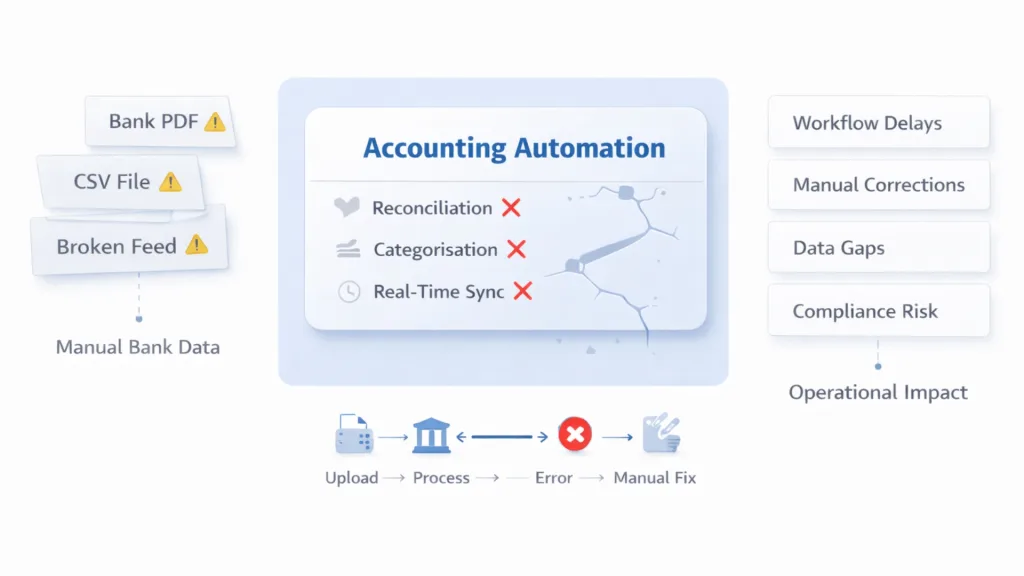
Accounting platforms building automation workflows discover serious infrastructure gaps when bank data access depends on manual processes.
Operational problems breaking automation:
- Manual bank statement uploads delay workflows
- CSV imports require user intervention
- Broken bank feeds disrupt reconciliation
- Delayed transaction updates prevent real-time visibility
- Inconsistent merchant descriptions prevent accurate categorisation
- Reconciliation errors require manual intervention
- Compliance exposure from unverified records
Without reliable bank data infrastructure, automation fails. Platforms cannot automate reconciliation when transaction visibility requires periodic manual uploads. Categorisation accuracy suffers when merchant descriptions lack structure.
Why structured bank feeds matter
Accounting process automation depends fundamentally on reliable, structured bank transaction data. Open Banking provides regulated access transforming how platforms receive financial information.
- Consent-based bank access: Users authenticate through banking apps. Platforms request specific data permissions. Banks provide secure API access. Transaction data flows continuously during consent periods.
- Direct-from-bank transaction records: Verified financial records with institutional authentication. Complete transaction history without manual collection. Structured data in consistent JSON format. Merchant details enabling accurate categorisation.
- Ongoing feed reliability: Real-time transaction updates via webhooks. Automated chronological logging. Continuous visibility eliminating manual refresh. Historical access up to 7 years (bank dependent).
This reinforces verified financial data APIs providing a compliance-grade data layer supporting accounting process automation infrastructure.
AIS vs traditional bank feeds
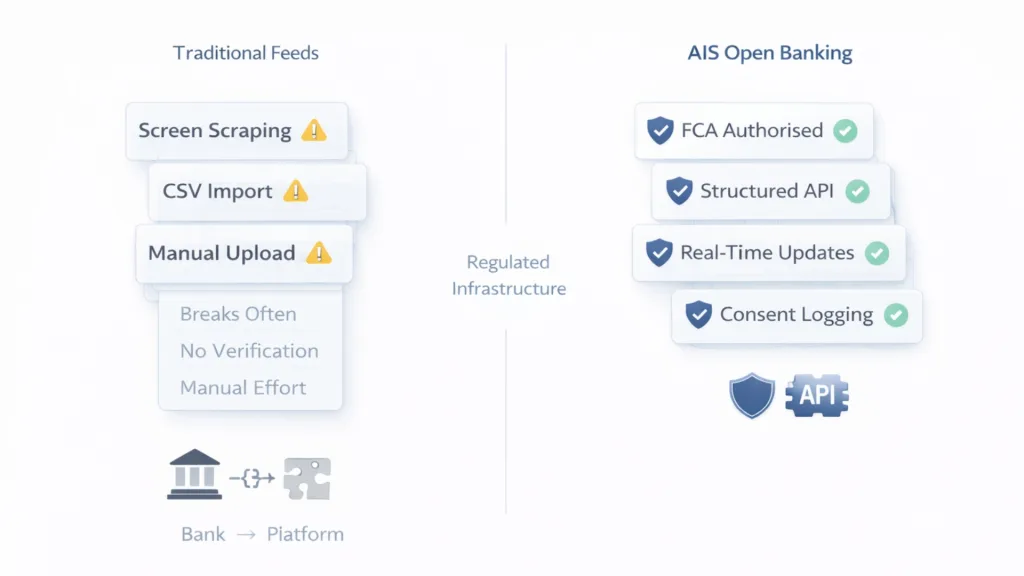
Legacy approaches breaking workflows:
Screen scraping lacks regulatory framework, breaks frequently when banks update interfaces, cannot provide verified data required for compliance.
Manual CSV imports require user intervention, create delays, lack real-time visibility, introduce errors during file processing.
Open Banking AIS infrastructure:
- Regulated FCA-authorised access
- Structured APIs providing consistent format
- Reliable updates without breaking changes
- Consent logging demonstrating proper authorisation
- Reduced compliance exposure
Platforms using automated bookkeeping infrastructure access verified transaction data eliminating manual processes.
How Finexer enables accounting process automation
Finexer provides Open Banking connectivity using FCA-authorised infrastructure enabling platforms to access verified bank transaction data.
Key capabilities:
- 99% UK bank coverage
- FCA-authorised infrastructure
- Real-time webhooks
- Up to 7 years historical data
- Usage-based pricing
- White-label ready
- 2-3x faster integration
- 3-5 weeks onboarding support
- Saves up to 90% on transaction costs
Platforms integrate bank feed APIs through REST endpoints. Users authenticate via secure Open Banking flows. Platforms receive structured transaction information enabling automation of accounting process workflows automatically.
Real-time webhooks notify platforms when transactions occur. Categorisation happens automatically using merchant enrichment. Reconciliation workflows trigger without manual intervention.
Transaction data includes structured fields enabling automated processing. Payment amounts, counterparties, timestamps, merchant details arrive consistently formatted supporting accurate categorisation.
Critical positioning:
Finexer does not provide accounting software, ledger logic, or tax calculations. Platforms control workflow rules, GL mapping, and reporting formats.
Finexer provides the structured, verified bank transaction data layer enabling accounting process automation.
For platforms requiring automation infrastructure, verified data access removes bottlenecks.
Common use cases
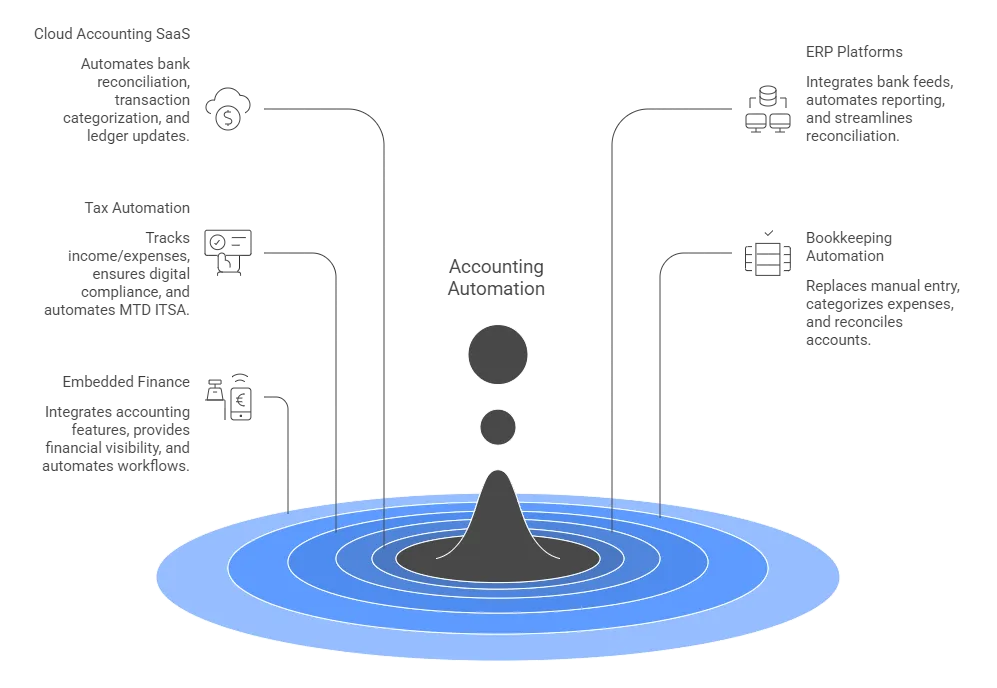
Platforms implementing accounting process automation enable these workflows:
Cloud accounting SaaS:
- Automate bank reconciliation using continuous feeds
- Categorise transactions automatically with merchant data
- Update ledgers in real-time without manual entry
- Support MTD ITSA compliance with structured records
- Maintain audit-ready financial logs
ERP platforms:
- Integrate bank feeds for cash flow visibility
- Automate financial reporting with verified data
- Enable exception-based reconciliation workflows
- Reduce manual bookkeeping overhead
Tax automation platforms:
- Track income and expenses automatically
- Support digital record compliance
- Enable MTD ITSA workflow automation
- Maintain structured records for HMRC
Bookkeeping automation:
- Replace manual data entry with automated feeds
- Categorise business expenses using merchant intelligence
- Reconcile accounts automatically
- Generate reports from verified transaction data
Embedded finance platforms:
- Embed accounting and ERP features
- Provide automated financial visibility
- Enable workflow automation for SME clients
- Support compliance requirements
What I Feel About Accounting Process Automation
Most platforms claim “full automation” but still require users to upload bank statements manually. That’s not automation. That’s spreadsheet work with extra steps.
The real issue? Platforms automate everything except the data collection part. They build smart categorisation engines. Beautiful dashboards. ML-powered reconciliation. Then make users manually download CSVs from their bank.
I’ve seen platforms spend six months building automated invoice matching. Then lose customers because bank feeds break every two weeks. Users don’t care about your AI if they have to babysit the data pipeline.
Here’s what nobody admits: most “automated accounting” platforms are just fancy wrappers around manual data entry. They’ve automated the processing but not the collection. That’s why adoption stays low.
The platforms that actually scale do three things:
- Reliable bank connectivity that never requires manual intervention
- Structured data that doesn’t need cleanup before processing
- Real-time feeds that eliminate batch upload delays
Open Banking infrastructure solves all three. Yet platforms still use screen scrapers because switching infrastructure is hard. So they keep patching sync failures instead of fixing the foundation.
Automation isn’t about what happens after data arrives. It’s about never needing humans to collect that data in the first place.
What is process automation in accounting?
Process automation in accounting uses technology to handle repetitive tasks automatically. Platforms automate bank reconciliation, transaction categorisation, invoice processing, and expense management using verified bank transaction data accessed through Open Banking APIs.
What are the 4 stages of process automation?
Process automation stages include: task identification (determining automatable processes), technology selection (choosing infrastructure), implementation (integrating systems), and optimisation (refining workflows). For accounting process automation, reliable bank data infrastructure is fundamental.
Which accounting software is widely used in the UK?
UK accounting platforms include Xero, QuickBooks, Sage, and FreeAgent. These platforms increasingly use Open Banking infrastructure for automated bank feeds, enabling accounting process automation replacing manual data entry with verified transaction access.
Enable accounting process automation with verified bank transaction data and automated workflows.
About the Author

Ravi Ranjan
Finexer