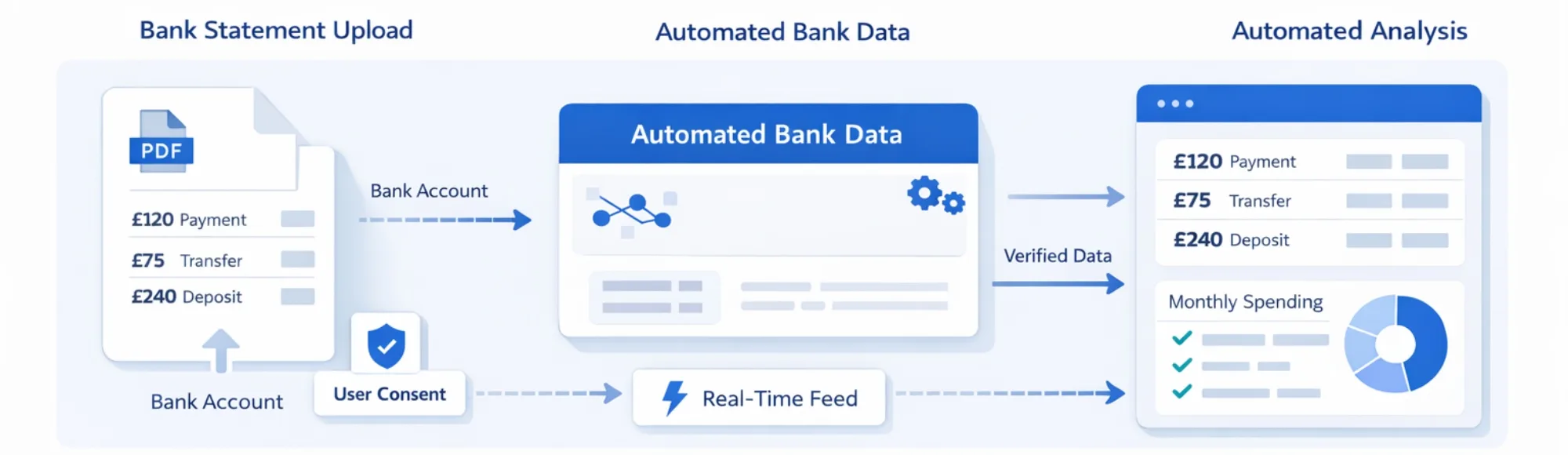
Replacing manual bank statement uploads in your platform?
Finexer gives UK platforms FCA-authorised AIS access – structured bank data, real-time, API-ready.
Every platform I work with that handles financial verification has the same process buried somewhere in its workflow. A user is asked to upload a bank statement. They download a PDF from their banking app, attach it to a form, and submit it. Someone on the platform side opens the file, extracts the relevant information manually, and enters it into the system.
This process works at low volume. At scale, it becomes the bottleneck that limits everything else.
The data extraction is manual. The format differs by bank. The statement may be three weeks old by the time it is processed. And none of the information can be verified at source – the platform has to trust that what was submitted accurately reflects what is in the account.
Automated bank statement analysis solves all of these problems simultaneously. Instead of asking users to submit documents, platforms retrieve structured financial data directly from the bank – verified, current, and in a format the system can process without human intervention.
At Finexer, I work with UK accounting platforms, LawTech tools, and ERP systems that have made this transition. The operational change is immediate – the manual step disappears, and the financial data quality improves at the same time.
TL;DR
Automated bank statement analysis replaces manual PDF and CSV uploads with structured bank transaction data retrieved directly from source via Open Banking AIS APIs. Automated bank statement retrieval gives platforms verified, current financial data without manual extraction or document submission. Finexer provides FCA-authorised AIS infrastructure covering 99% of UK banks for platforms replacing manual statement workflows with automated financial data feeds.
Key Takeaways
What is automated bank statement analysis?
Automated bank statement analysis is the process of analysing financial activity using structured bank transaction data retrieved directly from the bank – rather than manually uploaded PDF or CSV statements. Platforms use Open Banking AIS APIs to retrieve the same financial information a bank statement contains, in structured format, without manual document collection.
What is automated bank statement retrieval?
Automated bank statement retrieval allows platforms to retrieve bank transaction data directly from financial institutions through Open Banking APIs with user consent – replacing manual bank statement upload requests with secure, consent-based bank data access.
Why do manual bank statement uploads create operational problems at scale?
Manual uploads introduce data latency, format inconsistencies across banks, manual extraction workload, and unverifiable data quality. A PDF submitted by a user cannot be verified against the actual account – it reflects what was in the account at the time of export, not current financial activity.
How does automated bank statement analysis improve financial data quality?
Automated bank statement retrieval accesses data directly from the bank with user consent. The data is bank-verified – it reflects actual account activity, not a document the user exported and submitted. It is current, structured, and consistent across all connected banks.
What does Finexer provide for automated bank statement analysis?
Finexer provides FCA-authorised AIS infrastructure delivering structured bank transaction data – including merchant identifiers, category codes, and account balance data – covering 99% of UK banks with real-time webhooks for continuous automated bank statement retrieval.
What Is Automated Bank Statement Analysis?
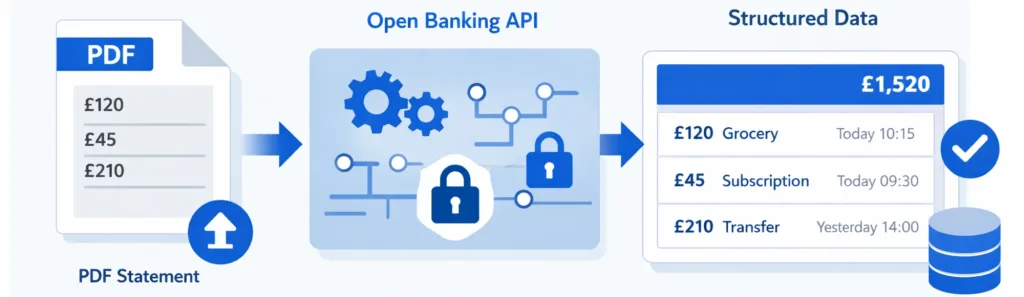
Automated bank statement analysis is the shift from document-based financial data collection to API-based bank data retrieval. Instead of a user downloading a PDF from their bank and uploading it to a platform, the platform retrieves the same financial information directly from the bank account via Open Banking AIS – with the user’s explicit consent.
What automated bank statement retrieval delivers instead of a PDF:
- Transaction history – structured per transaction with merchant identifiers, amounts, timestamps
- Account balance data – current and available balance
- Transaction category codes – classifying each entry automatically
- Counterparty details – sort code, account number, payee name per transaction
The platform receives this in structured JSON format. No parsing. No manual extraction. No reformatting required before the data enters the workflow.
“The manual bank statement process works until it does not. The point where it stops working is usually the point where a platform’s user volume outgrows the team’s ability to process uploads manually. Automated bank statement analysis removes the ceiling.” – Ravi, Finexer
Why Manual Bank Statement Workflows Break at Scale
Every Bank Produces a Different Format
PDF and CSV bank statements are not standardised across UK banks. Column headers differ. Date formats vary. Amount formatting is inconsistent between institutions. Every manual upload requires preprocessing before data can enter the platform workflow – and that preprocessing step does not get faster as volume increases.
Documents Cannot Be Verified at Source
A bank statement PDF reflects what was in the account at the point of export. It cannot be verified against current account activity. A user can submit a statement from six months ago. A statement can be edited before submission. The platform has no way to confirm that what was submitted matches what is actually in the account.
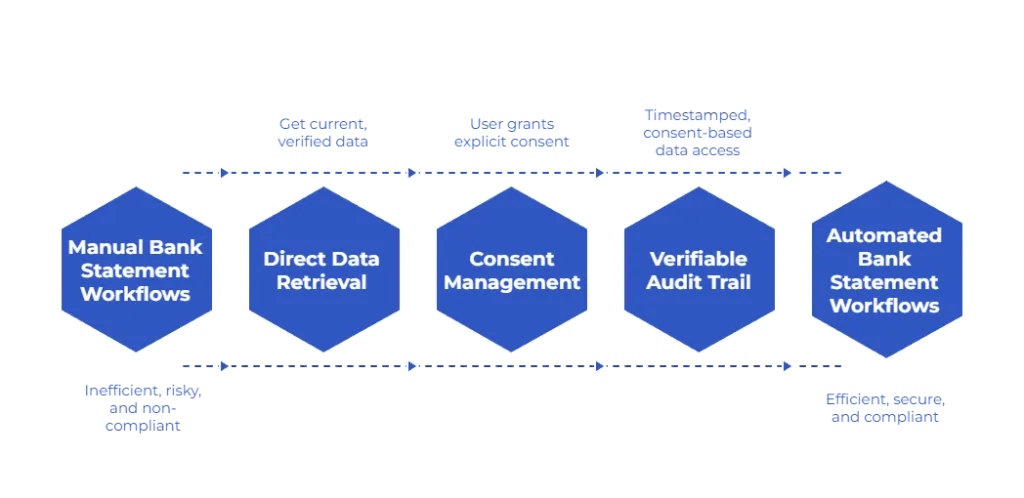
Automated bank statement retrieval removes this risk entirely. Data comes directly from the bank with consent – current, unmodified, and bank-verified.
Manual Extraction Creates Compliance Risk
For LawTech platforms conducting source-of-funds verification, manual statement review creates a compliance gap. The audit trail behind a manually submitted document is limited – when was it submitted, by whom, and does it accurately reflect the account? Automated bank statement analysis creates a verifiable data access record – consent granted, data retrieved, timestamp logged.
Bank statement automation for UK platforms covers the automation infrastructure in detail.
How Does Automated Bank Statement Retrieval Work?
Open Banking AIS infrastructure is what makes automated bank statement retrieval possible at scale across UK banks.
The automated retrieval workflow:
- Platform initiates bank connection request via AIS API
- User authenticates with their bank via Strong Customer Authentication
- User grants consent for specific data access – transactions, balances, or both
- AIS retrieves structured financial data directly from the bank
- Platform receives standardised JSON output – same schema regardless of which UK bank
- Financial data enters the platform workflow automatically – no manual extraction
The user completes one consent flow. The platform retrieves structured bank data directly. The manual document collection step is gone.
How Should Platforms Evaluate Automated Bank Statement Analysis Infrastructure?
| Criteria | Why It Matters | What to Look For |
|---|---|---|
| Data Verification | Automated retrieval must deliver bank-verified data – not document approximations | Direct AIS retrieval from source; no document intermediary; consent-based access |
| Format Standardisation | Automated analysis requires consistent data schema across all UK banks | Structured JSON; merchant IDs; category codes; consistent schema across institutions |
| UK Bank Coverage | Analysis gaps occur when user bank accounts fall outside coverage | 99% UK bank coverage; CMA9 and challenger banks included |
| Transaction History Depth | Financial analysis and compliance verification need historical data beyond 90 days | Up to 7 years transaction history; configurable lookback periods |
| Audit Trail | Compliance workflows require verifiable records of data access and consent | FCA-compliant consent flows; access logs; consent records; instant revocation |
| Real-Time Data Access | Current financial analysis requires live data – not historical document exports | Real-time webhooks; live balance data; continuous transaction feeds |
How Does Finexer Enable Automated Bank Statement Analysis?
Finexer is FCA-authorised to provide account information services – delivering structured bank transaction data for UK platforms replacing manual bank statement workflows with automated financial data feeds.
What Finexer’s AIS provides for automated bank statement analysis:
- Structured bank transaction data from 99% of UK bank accounts
- Real-time webhooks delivering transaction events as they occur
- Merchant identifiers and transaction category codes per transaction
- Account balance data – current and available per connected account
- Transaction history up to 7 years for historical analysis and compliance lookback
- Multi-account connectivity from a single consent-based API connection
- FCA-compliant consent flows with granular permissions and instant revocation
- White-label capability for branded bank connection journeys
- Usage-based pricing
Automation of accounting process using bank data covers how automated bank data feeds power accounting workflow automation beyond statement replacement.
What I Feel
The automated bank statement analysis shift I see most often is not driven by a technology decision – it is driven by a volume problem. Platforms that manage financial verification for tens of clients can absorb manual statement processing. Platforms managing hundreds cannot.
The inflection point is usually a hiring decision. A platform is about to hire someone specifically to process bank statement uploads. That is the moment automated bank statement retrieval becomes worth evaluating seriously – because the alternative is a headcount that scales with user volume indefinitely.
The platforms that make the shift earlier save that headcount and improve data quality at the same time.
Common Use Cases
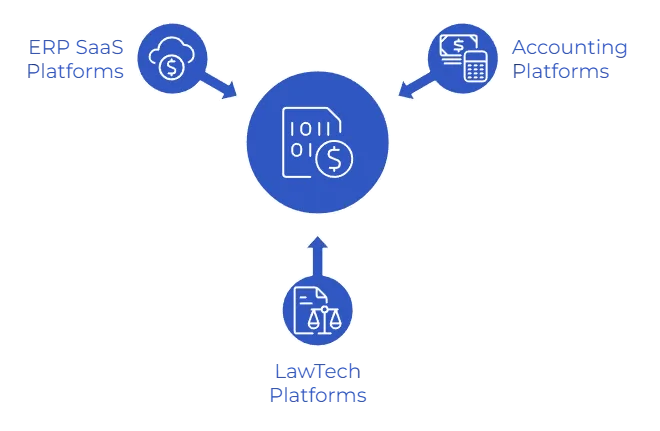
Accounting & ERP Platforms
Accounting platforms use Finexer’s AIS to replace manual client bank statement collection with automated bank statement retrieval – receiving structured transaction feeds directly from client bank accounts. Reconciliation workflows run against bank-verified data rather than manually submitted documents that may be weeks old by the time they are processed.
LawTech Platforms
LawTech platforms – including insolvency practices – use automated bank statement retrieval to access verified client financial history for source-of-funds checks and KYC compliance. Automated bank statement analysis produces a verifiable access record – consent granted, data retrieved from source, timestamp logged – that supports the audit trail regulated legal workflows required.
ERP SaaS Platforms
ERP platforms use Finexer’s AIS to synchronise financial records with live bank transaction data – replacing scheduled CSV imports and manual statement uploads with continuous automated bank statement retrieval. Financial records reflect current bank activity rather than the last manual import cycle.
What is automated bank statement analysis for financial platforms?
Automated bank statement analysis is the process of analysing financial activity using structured bank transaction data retrieved directly from the bank via Open Banking APIs – rather than manually uploaded PDF or CSV bank statements. Platforms use AIS infrastructure to retrieve the same financial information a statement contains, in structured format, without document submission.
How does automated bank statement retrieval work for UK platforms?
Automated bank statement retrieval uses Open Banking AIS APIs to retrieve bank transaction data directly from financial institutions with user consent. The user authenticates via their bank and grants consent for data access. The platform receives structured transaction data – merchant identifiers, amounts, timestamps, and category codes – without requiring document uploads.
Is Finexer suitable for platforms replacing manual bank statement workflows?
Yes. Finexer is FCA-authorised and provides AIS infrastructure covering 99% of UK banks – delivering structured bank transaction data with merchant identifiers, category codes, and up to 7 years of transaction history. Platforms integrate Finexer’s AIS to replace manual bank statement upl
Replace manual bank statement uploads with verified bank data.
About the Author

Ravi Ranjan
Ravi Ranjan is a fintech entrepreneur and growth leader with experience in building and scaling Open Banking ventures in the UK. As Co-founder and CEO of Finexer, he focuses on expanding adoption of Pay-by-Bank payments and real-time financial data infrastructure through secure API solutions. With a background in computer science engineering and an MBA from Aston Business School, Ravi combines technical insight with commercial strategy to help businesses modernise financial operations and accelerate digital payment innovation