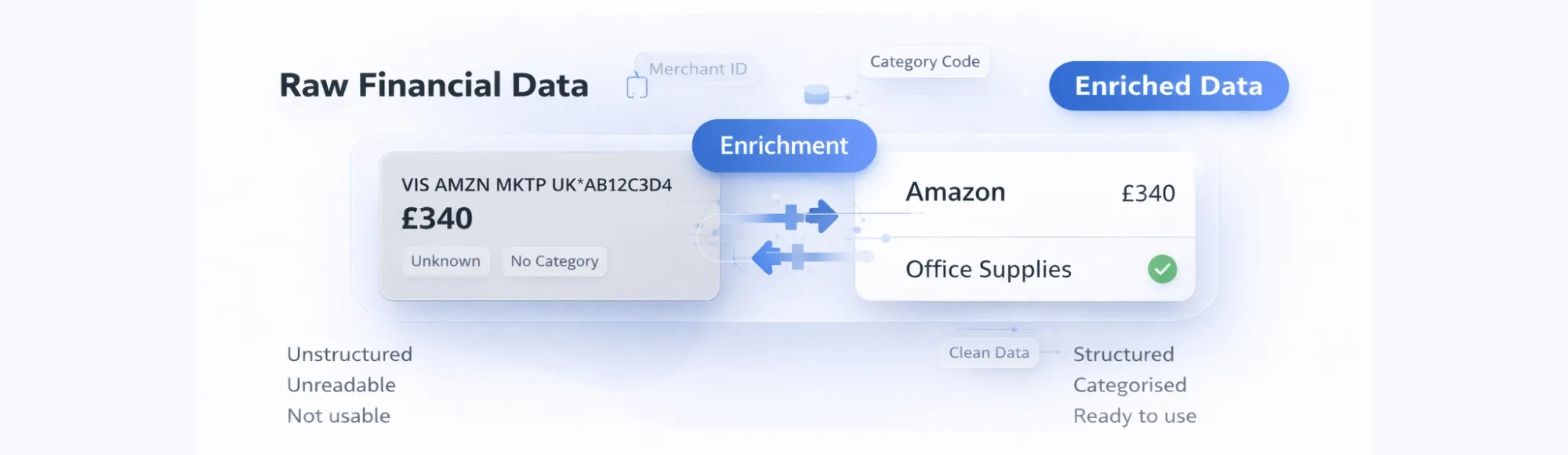
Raw data is not financial data.
Enriched bank transaction data for accounting SaaS, ERP, and financial operations platforms.
B2B data enrichment services exist because raw bank transaction data is not workable as delivered.
A transaction lands in the system. Amount: £340.00. Reference: “VIS AMZN MKTP UK*AB12C3D4”. Date: 14 March.
No category. No merchant name. No indication of whether this is an office supply, a software subscription, or a client-billable expense. The transaction is technically complete. It is operationally useless.
In my work building data infrastructure for accounting SaaS and ERP platforms at Finexer, this is the starting point of every enrichment conversation. The data is there. It just cannot be used without a layer that tells the system what it means.
TL;DR
B2B data enrichment services resolve raw bank transaction data into structured, usable financial information by applying merchant identifiers, category codes, and normalised transaction fields. Without data enriching, accounting and ERP platforms receive transaction strings that cannot be reconciled, categorised, or reported on without manual intervention. Finexer’s Data Enrichment API resolves each transaction against a 100M+ merchant database with 95%+ accuracy and under 100ms response time – returning clean, categorised data before it reaches the accounting workflow.
Key Takeaways
What are B2B data enrichment services?
B2B data enrichment services take raw financial transaction data and apply structured metadata – merchant names, category codes, and normalised fields – that make the data usable in accounting, reconciliation, and reporting workflows. The raw transaction string becomes a structured financial record with a verifiable merchant identity and expense classification.
Why is raw bank transaction data unusable without enrichment?
Raw bank descriptions are generated by payment systems for settlement purposes – not for accounting readability. They contain truncated merchant names, internal reference codes, and format variations that change across banks and payment types. Accounting platforms cannot reliably match, categorise, or report on this data without enrichment.
What does data enriching actually do to financial data?
Data enriching applies a merchant identifier and category code to each transaction, resolves the merchant name from the raw description string, and normalises transaction fields to a consistent schema. The result is structured financial data that accounting systems can process automatically without manual correction.
How does enrichment fix workflow failures in accounting and ERP platforms?
Enrichment fixes failures by resolving the data quality problem before it reaches the workflow. A reconciliation engine receiving enriched, consistently categorised transactions produces accurate results. The same engine receiving raw description strings produces mismatches. The difference is entirely in the data input quality.
Why Does Raw Financial Data Fail in B2B Workflows?
What Makes Raw Bank Transaction Data Unworkable?

Raw bank transaction data fails in accounting and ERP platforms for three structural reasons.
Inconsistent merchant descriptions – the same supplier appears with different description strings across different payment methods and banks. “AMAZON” becomes “AMZN MKTP UKAB12C3D4″ via card, “AMAZON EU SARL” via BACS, and “AMZMARKETPLACE” via direct debit. No rules engine catches all three as the same merchant without enrichment.
Missing category information – raw transactions carry no expense category. The accounting platform must infer category from the description string – which changes constantly. Every new supplier or payment method variation creates a new miss.
Format variation across banks – different UK banks return the same transaction data in different formats. Amount representations, date formats, and reference field structures differ across institutions. A platform normalised for one bank’s output breaks on another’s.
According to transaction data enrichment via structured bank APIs, the gap between raw bank output and accounting-ready data is precisely where B2B data enrichment services provide their core value.
“In my experience building financial data pipelines, raw transaction data almost never arrives in a state that accounting workflows can consume directly. Every platform I work with has spent engineering time building normalisation logic that B2B data enrichment services should be providing at the input layer.” – Yuri, Finexer
What Is the Business Impact of Unenriched Financial Data?
How Does Missing Enrichment Break Real Platform Workflows?
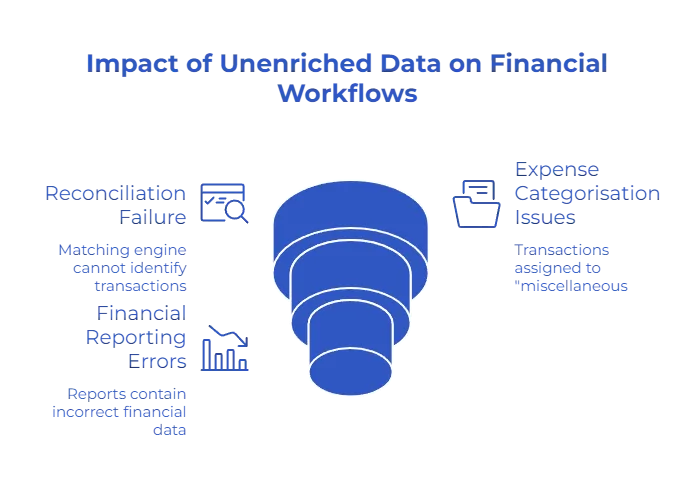
Unenriched data breaks three categories of financial workflow:
Reconciliation – matching engine receives a raw description string that does not match the invoice reference. Reconciliation fails. The finance team investigates manually. The transaction was correct. The description format was not.
Expense categorisation – accounting platform assigns “miscellaneous” to every unrecognised transaction. Month-end reports show a growing uncategorised bucket that nobody trusts. Budget analysis becomes unreliable.
Financial reporting – reports built on incorrectly categorised transactions produce wrong P&L line items, incorrect VAT calculations, and inaccurate expense summaries. The data is present. The structure is wrong.
B2B data enrichment tools for financial platforms covers how enrichment tools address these workflow failures across accounting and ERP use cases.
| Raw Data Problem | Cause | Workflow Impact | Enrichment Fix |
|---|---|---|---|
| Inconsistent merchant names | Different payment rails produce different strings | Reconciliation fails, supplier split across categories | Merchant ID normalises all variants to one entity |
| Missing category | Raw transactions carry no expense classification | Uncategorised bucket grows, reports unreliable | Category code applied per transaction at source |
| Format variation across banks | Each bank implements description fields differently | Multi-bank integrations break normalisation logic | Consistent JSON schema regardless of originating bank |
| Unknown merchants | New suppliers not in rules engine | Grows as miscellaneous, requires manual review | 100M+ merchant database resolves unknown entities |
What Do B2B Data Enrichment Services Actually Need to Deliver?
Why More Rules Do Not Replace Proper Data Enriching?
The typical response to raw data problems is more rules. More keyword matches. More manual overrides. More exception handling.
This does not fix the problem. It builds maintenance overhead on top of a broken input layer.
Rules break when merchant descriptions change. They break when a new payment method produces a new string variant. They break when a new bank is added to the integration. Every rule addition treats a symptom of the underlying data quality problem.
B2B data enrichment services that work at the input layer – resolving merchant identity and applying category codes before the data reaches the accounting system – eliminate the symptom entirely.
Data enrichment API for UK financial platforms covers how API-based enrichment at the input layer compares to rules-engine approaches for financial workflow accuracy.
How Does Finexer’s Data Enrichment API Deliver Usable Financial Data?
What Does Finexer’s Enrichment Provide for B2B Financial Workflows?
The problem: raw bank transaction descriptions are inconsistent and unworkable in accounting and ERP systems. Finexer’s Data Enrichment API resolves this by matching each transaction against a 100M+ merchant database and returning structured, categorised data before it reaches the platform.
- Merchant identifiers per transaction – normalises all description variants to a single verified entity
- Category codes per transaction – structured expense classification applied at source
- 95%+ categorisation accuracy across 100M+ merchants
- Under 100ms response time – no latency added to the data pipeline
- Consistent JSON schema – same output structure regardless of originating bank or payment method
- Works with AIS transaction feeds or existing bank data imports
Essential data enrichment tools for UK financial platforms covers how Finexer’s enrichment capability compares to alternative data enriching approaches for accounting and ERP platforms.
“B2B data enrichment services solve the problem that every accounting and ERP platform discovers after go-live: the data arrives, but it cannot be used. Merchant IDs and category codes applied at the transaction level mean the data arrives ready to work with – not ready to be fixed.” – Yuri, Finexer
What I Feel
Every financial platform I work with has the same conversation at some point.
The integration is built. The data is flowing. And then someone looks at the transactions and asks why so many are in the wrong category, or sitting in miscellaneous, or failing reconciliation.
The answer is always the same. The data was never enriched.
B2B data enrichment services are not a feature to add later. They are the prerequisite for everything that needs to work with the data.
Common Use Cases

Accounting SaaS Platforms
Client bank feeds arrive with raw descriptions that break expense categorisation rules across every account. Finexer’s Data Enrichment API applies merchant IDs and category codes per transaction – so accounting workflows receive structured, usable data from the moment it arrives.
ERP Platforms
ERP financial modules processing high supplier payment volumes need consistent transaction data to run automated reconciliation reliably. Finexer’s enrichment resolves merchant identity and category per payment – eliminating the manual correction overhead that grows with transaction volume.
Financial Operations Platforms
Financial operations tools that automate reporting, budgeting, and cash flow analysis depend on accurately categorised transaction data. Finexer’s 95%+ categorisation accuracy across 100M+ merchants means reports reflect actual financial activity rather than an enrichment gap labelled as miscellaneous.
What are B2B data enrichment services used for?
B2B data enrichment services are used to transform raw bank transaction data into structured financial records with merchant identifiers, expense categories, and normalised fields. They are used by accounting SaaS, ERP platforms, and financial operations tools to make transaction data usable in reconciliation, reporting, and automation workflows.
What is data enriching in financial workflows?
Data enriching is the process of applying structured metadata to raw transaction data – resolving merchant identity, assigning category codes, and normalising transaction fields. In financial workflows, data enriching is what converts a raw bank description string into a usable financial record that accounting systems can classify and report on automatically.
How does transaction data enrichment improve reconciliation accuracy?
Transaction data enrichment applies a merchant identifier to each transaction, normalising all description variants from the same supplier to a single entity. This means the reconciliation engine always matches the same supplier correctly – regardless of which payment method or bank produced the transaction description.
Build financial workflows on enriched, structured transaction data.
About the Author

Yuri
Yuriy Yakushko is a fintech founder and software engineer with over 20 years of experience building financial technology. He’s passionate about creating scalable, secure infrastructure that helps businesses modernise how they access financial data and manage payments.