
Evaluating bank transaction data enrichment tools for financial workflows?
Access structured transaction data with merchant identification.
Brief: Search “data enrichment tools” and you get sales software: ZoomInfo, Apollo, Clay. Those enrich CRM records. Bank transaction enrichment is a different job: turning raw bank descriptors into verified merchant names and spending categories. This guide compares the six data enrichment tools built for that job in the UK, including Finexer, Bud, Plaid and Tink.
Most people who search for data enrichment tools are looking for sales software. Tools like ZoomInfo and Apollo add contact details and company facts to CRM records. That is not what this page covers. If your platform works with bank data, you need a different kind of tool: one that reads a messy bank line like “CRV*CSTA 0392 LDN” and tells you it was a Costa Coffee purchase.
This guide compares the six tools that do that job well in the UK, what each one is built for, and how to pick between them.
B2B Data Enrichment Tools vs Bank Transaction Enrichment
The two product types do different jobs. B2B data enrichment tools take a company or contact record and add sales context: firmographics, job titles, and buying signals. Bank transaction enrichment takes a payment line from a bank feed and adds financial context: who the merchant really is, what category the spend belongs to, and how confident the match is.
| Pointer | B2B Data Enrichment Tools | Bank Transaction Enrichment |
|---|---|---|
| Input | Company and contact records | Raw transaction data from bank feeds |
| Output | Firmographics, contacts, intent data | Merchant name, category, confidence score |
| Buyer | Sales and marketing teams | Fintech, accounting and platform teams |
| Examples | ZoomInfo, Apollo, Clay, Cognism | Finexer, Bud, Plaid Enrich, Tink |
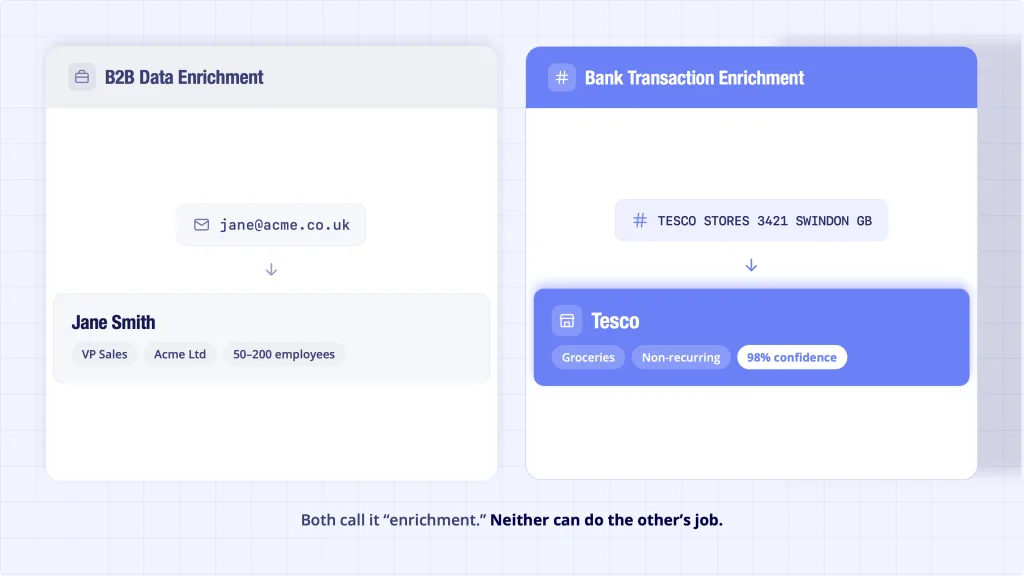
If your need is pipeline and prospecting, close this tab and go compare B2B data enrichment tools. If your platform touches bank data, read on. The rest of this page is about the transaction side only.
What Does Bank Transaction Enrichment Actually Do?
It decodes what banks write. A bank descriptor is accurate but written for bank systems, not for people or software. Transaction enrichment translates a raw descriptor like “CRV*CSTA 0392 LDN” into structured data: Merchant: Costa Coffee, Category: Eating Out, Confidence Score: 0.97. Two capabilities do the work:
- Merchant identification. The raw descriptor is matched against a large merchant database and returned as a verified business name, with details like legal entity and location.
- Transaction categorisation. Each payment gets a spending category, for personal or business use, with a confidence score so your platform knows when to trust the match.
Demand for this is rising on a schedule. From April 2026, Making Tax Digital for Income Taxrequires sole traders and landlords over £50,000 to keep digital records, and categorised transactions are the raw material of a digital record.
The pipes are already busy: Open Banking Limited’s live data shows 17.94 million active UK connections as of March 2026. Every one of those connections produces raw transaction data that something has to interpret.
The Best Data Enrichment Tools for Bank Transactions in the UK
Six tools do this job credibly for UK data. What separates the best data enrichment tools is not the demo. It is the accuracy on the long tail of small merchants, speed, and UK coverage.
1. Finexer Transaction Enrichment API
Finexer’s enrichment is built on its own FCA-authorised Open Banking infrastructure, so bank connection and enrichment come from one provider. It converts raw descriptors into verified merchant names, legal entities, spending categories, and confidence scores, delivering 95%+ categorisation accuracy with sub-100ms response times.
Its 100M+ merchant database is production-ready from day one. It handles card payments, direct debits, bank transfers, and standing orders. UK-first by design.
2. Bud Financial
A UK data intelligence platform with strong enrichment capability. Bud’s primary focus is lending and affordability data for banks and lenders, so its enrichment is tuned to credit use cases. A strong option for banks and lenders, but less suitable for platforms outside those markets.
3. Plaid Enrich
Plaid’s enrichment product, from the US-origin giant. Broad international coverage and a mature developer experience. Its models and merchant coverage grew up on US data, so UK long-tail merchant accuracy deserves your own testing. See how the data side compares in our Plaid vs Tink transaction data breakdown.
4. Tink
Visa-owned, with enrichment among its strongest suits and wide European bank connectivity. Positioned mainly at enterprise customers, with pricing to match. A serious option for platforms operating across European markets.
5. Yapily Data Plus
Yapily’s categorisation and enrichment layer on top of its developer-first Open Banking platform. European coverage across 19+ countries. Enrichment is an add-on to its data product rather than the headline act.
6. Salt Edge
A global data aggregator connecting 5,000+ banks across 60+ countries, with enrichment as part of its data toolkit. Breadth is the pitch; UK-specific depth is the thing to verify.
Here is how the six best data enrichment tools for bank transactions line up:
| Tool | Built For | UK Focus | Delivery |
|---|---|---|---|
| Finexer | UK platforms on Open Banking data | UK-first | API, real-time and batch |
| Bud | Banks and lenders | UK, lending-led | API |
| Plaid Enrich | Global fintech apps | Global, US-origin | API |
| Tink | European enterprise | Pan-European | API |
| Yapily Data Plus | European developers | Pan-European | API |
| Salt Edge | Global aggregation | Global | API |
How to Choose Between Best Data Enrichment Tools?
Four checks settle most shortlists quickly:
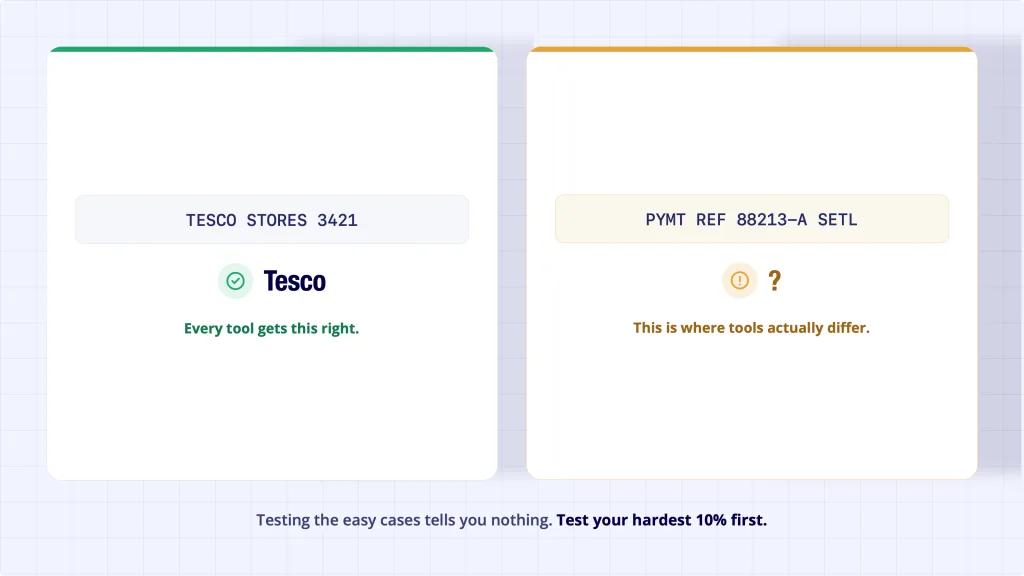
- Run your hardest transactions first. Every tool can identify Tesco. The best data enrichment tools prove themselves on regional businesses, subscriptions with cryptic billing names, and one-off merchants. Test each candidate on your real feed before you trust a demo.
- Match latency to your features. Batch enrichment suits reporting. Real-time features need real-time answers, which is where a transaction data enrichment API with per-transaction responses matters.
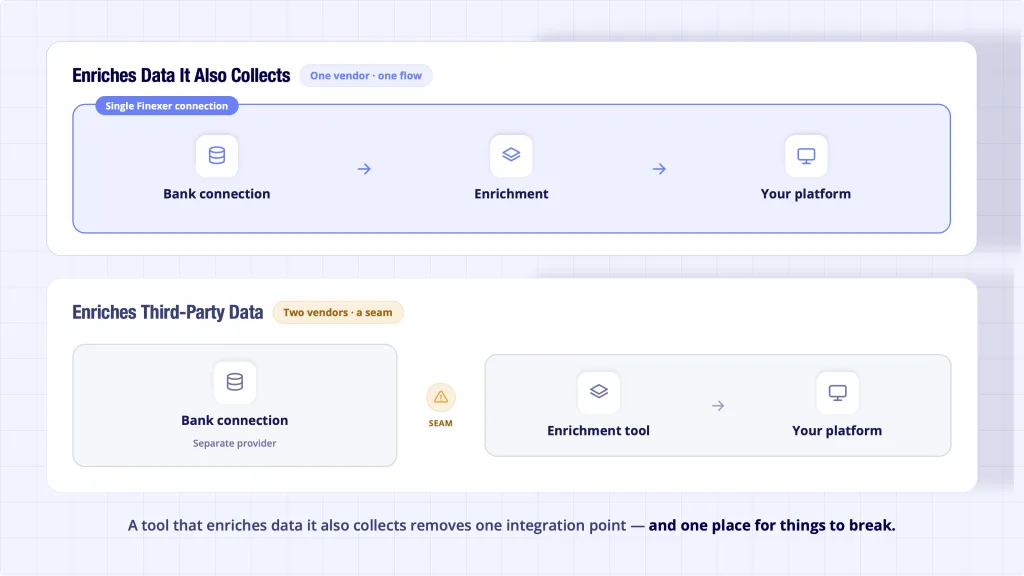
- Check where the bank data comes from. A tool that enriches data it also collects removes one integration and one point of failure. A tool that only enriches needs your feed to arrive clean.
- What price you see is what price you get. Transparent pricing (no hidden charges) based on direct, one-to-one bank connections and customization for growing platforms and enterprises alike.
For the wider shortlist beyond bank transactions, our full data enrichment tools comparison for UK fintech covers the field.
What Makes Finexer Distinctive among B2B Data Enrichment Tools?
Finexer is the option for UK platforms that want the bank connection and the enrichment from one regulated provider. Raw transactions arrive through Finexer’s Open Banking infrastructure and come back structured: verified merchant, legal entity, category, billing pattern, location, and confidence score, per transaction. The full mechanics are in Finexer’s Transaction Enrichment API guide. What platforms get, specifically:
- Transaction categorisation at 95%+ accuracy, with confidence scores
- Sub-100ms responses for real-time features, plus batch endpoints for history
- 100M+ merchant database, pre-trained and production-ready
- Coverage across card payments, direct debits, bank transfers, and standing orders
- FCA-authorised (FRN 925695) as both AISP and PISP
- Almost all UK banks covered, across high-street, challenger and business accounts
- Transparent pricing (no hidden charges), white-label deployment, 3-5 weeks of onboarding support
- 2-3x faster to deploy than building direct bank connections in-house
Accounting platforms use it for automated expense coding and MTD-ready records. Proptech platforms use it to make tenant and landlord transactions readable. Fintech apps use it for clean, human descriptions, their users stop querying.
Conclusion
Ignore the sales-software results and the choice gets small and clear. Six tools handle bank transaction enrichment credibly in the UK. Pick by geography and customer type first. Then test each one on your own worst transaction descriptors, because that is where accuracy claims are proven or broken. The best data enrichment tools are the ones that stay accurate when the merchant is small, regional, or oddly named.
What are the best data enrichment tools for bank transactions?
For UK platforms: Finexer, Bud, Plaid Enrich, Tink, Yapily Data Plus and Salt Edge. The best data enrichment tools for your case depend on where you operate and who you serve. UK-first platforms lean Finexer; lenders lean Bud; pan-European enterprises lean Tink.
What is the difference between B2B and transaction data enrichment?
B2B data enrichment tools add sales context to company records: contacts, firmographics, intent. Transaction enrichment adds financial context to bank payments: merchant identification and spending categories. Different inputs, different buyers, different products, despite sharing a name.
How much do transaction enrichment tools cost?
Pricing models vary more than headline prices. Finexer employs transparent pricing (with no hidden charges) based on direct, one-to-one bank connections and customization for scaling platforms and enterprises alike. Enterprise providers price on contracts with committed volumes. Get quotes against your real monthly transaction count, including your slowest quarter, and compare totals rather than rates.
Run Your Toughest Transactions Through Finexer
Explore with AI
About the Author

Ravi Ranjan
Ravi Ranjan is Co founder & CEO of Finexer