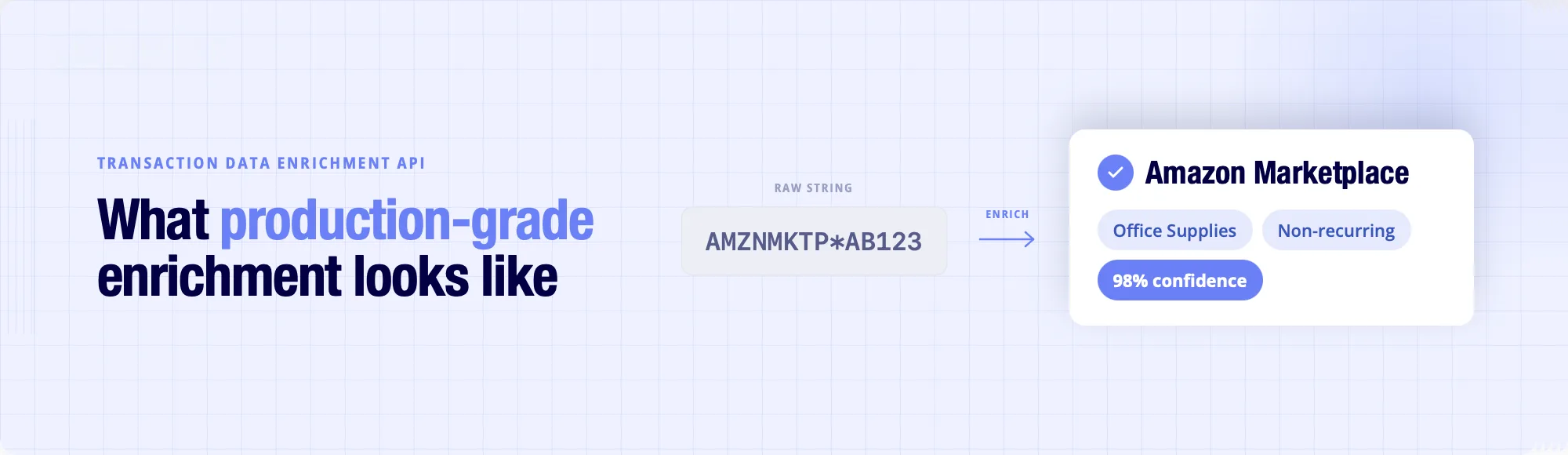
Raw bank data. Production-ready intelligence.
Turn inconsistent transaction strings into structured merchant data, consistent JSON objects and event-driven workflows your product can trust.
Introduction: Your reconciliation engine didn’t fail. It did exactly what the bank told it to do. The problem is that the bank never designed transaction descriptions for budgeting apps, accounting software, lending platforms or finance teams. It designed them for settlement.
So your customer sees AMZNMKTP*AB123. Your categorisation model sees uncertainty. Your support team sees another ticket. Your engineers see another parsing rule. None of those should be necessary.
TL;DR: A data enrichment API converts raw bank transaction descriptions into structured merchant intelligence. Compare providers on merchant-match accuracy, data enrichment API pricing, JSON schema consistency, merchant IDs, merchant category codes and real-time webhooks. The result is less engineering effort, faster reconciliation and more reliable financial applications.
“Most engineering teams don’t struggle because bank connectivity is difficult. They struggle because every downstream service expects structured financial data, while every bank returns transaction descriptions differently. The enrichment layer succeeds only when your application can trust the output without writing another parser.”
— Yuri, Technical Lead, Finexer
This guide draws on Finexer’s experience building Open Banking infrastructure for UK financial platforms. It examines the practical engineering considerations behind production-grade transaction enrichment – including merchant resolution, structured JSON responses, webhook-driven event handling, pricing models and Open Banking data – through the lens of technical buyers evaluating APIs for real-world deployment.
Why Raw Bank Data Never Reaches Production Usable
Bank transaction descriptions aren’t broken, they’re just written for the bank’s own reconciliation systems, not for the accounting platform, lending tool or fintech app trying to display them to a user.
A string like “SQ*COFFEE123 LONDON” is entirely valid banking data. It’s also useless for automated categorisation, spend analysis or a clean transaction feed a user can actually read. Every platform that skips an enrichment layer ends up building one internally or asking finance teams to fix it by hand, transaction by transaction and bank by bank.
What a Transaction Data Enrichment API Actually Needs to Return
Five things separate an enrichment API that holds up in production from one that only works on the demo dataset.
| Evaluation Criterion | What to Ask | Why It Matters |
|---|---|---|
| Merchant identification at source | Does the API resolve descriptors like “AMZNMKTP”, “AMAZON.CO.UK” and “AMZN MKT” to a single merchant? | Eliminates manual mapping rules and ensures consistent merchant recognition across banks |
| Category codes per transaction | Does every transaction include a spending category immediately, or does it require a separate lookup? | Enables instant spend analysis, budgeting and reconciliation without additional pipeline stages |
| Recurring-payment detection | Can the API identify recurring payments such as salaries, subscriptions and standing orders? | Reduces engineering effort and improves cash-flow forecasting and subscription analytics |
| Consistent JSON schema across banks | Does a transaction from Barclays return the same field structure as one from Monzo? | Simplifies integrations, reduces maintenance and creates predictable downstream workflows |
| Latency under production load | Is enrichment fast enough for live reconciliation and dashboard rendering? | Low latency is essential for responsive financial applications and real-time user experiences |
Production-grade enrichment isn’t defined by categorisation alone. The best APIs combine high merchant-match accuracy, consistent JSON responses and low latency even at production scale, not just in a sandbox environment.
What a Production-Grade Enrichment Response Looks Like
A transaction data enrichment API should return structured merchant intelligence in a consistent JSON schema, not just a readable merchant name. That allows downstream reconciliation, categorisation and analytics services to consume the same fields regardless of which UK bank supplied the transaction.
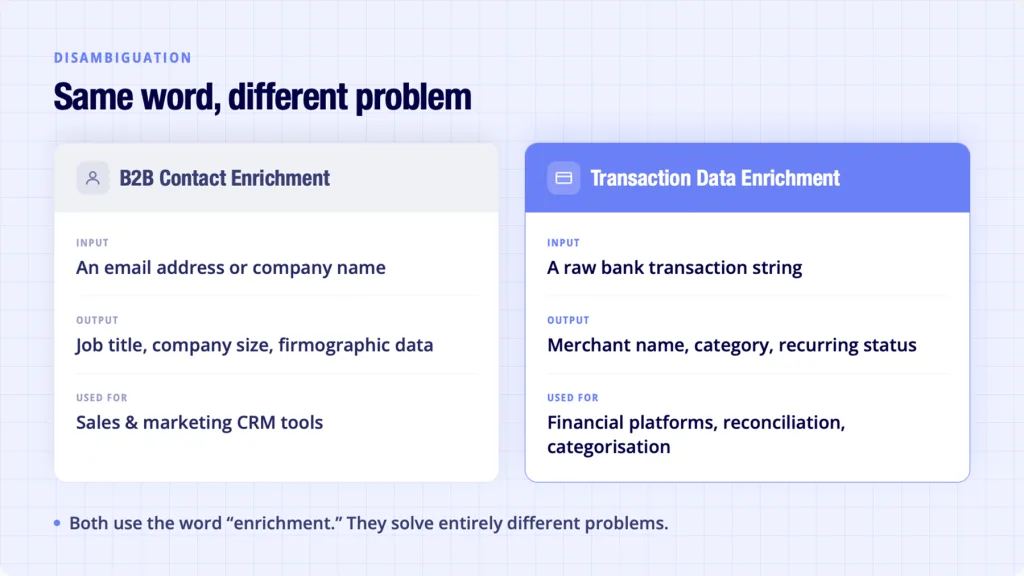
Raw transaction description
AMZNMKTP*AB123
Enriched JSON response
{
“merchant_name”: “Amazon Marketplace”,
“merchant_id”: “merchant_20491”,
“merchant_category_code”: “5942”,
“category”: “Office Supplies”,
“recurring”: false,
“confidence”: 0.98,
“country”: “GB”,
“webhook_event”: “transaction.enriched”
}
Instead of maintaining parsing rules for descriptors such as AMZNMKTP, AMAZON.CO.UK or AMZN MKT, your application consumes the same structured fields every time. When enrichment completes, a real-time webhook can notify downstream reconciliation, reporting or budgeting services immediately.
Data Enrichment API Pricing: What Actually Varies
Data enrichment API pricing splits into two models: usage-based, priced per transaction enriched, and flat-tier, priced on a fixed monthly allocation regardless of actual volume.
Usage-based pricing scales with what a platform actually processes, which matters most for platforms with seasonal or growing transaction volume, since a flat enterprise fee either overcharges in quiet months or throttles in busy ones.
The other variable that affects real cost is what counts as “enrichment” in the first place: some providers price merchant identification and categorisation together, while others charge separately for recurring-payment detection or historical re-enrichment of older transactions.
For a broader look at how providers differ on this and on merchant-match methodology, data enrichment tools compare several options across the UK market rather than a single technical deep-dive.
The Gap: Why Enrichment-Only APIs Still Leave Work on the Table
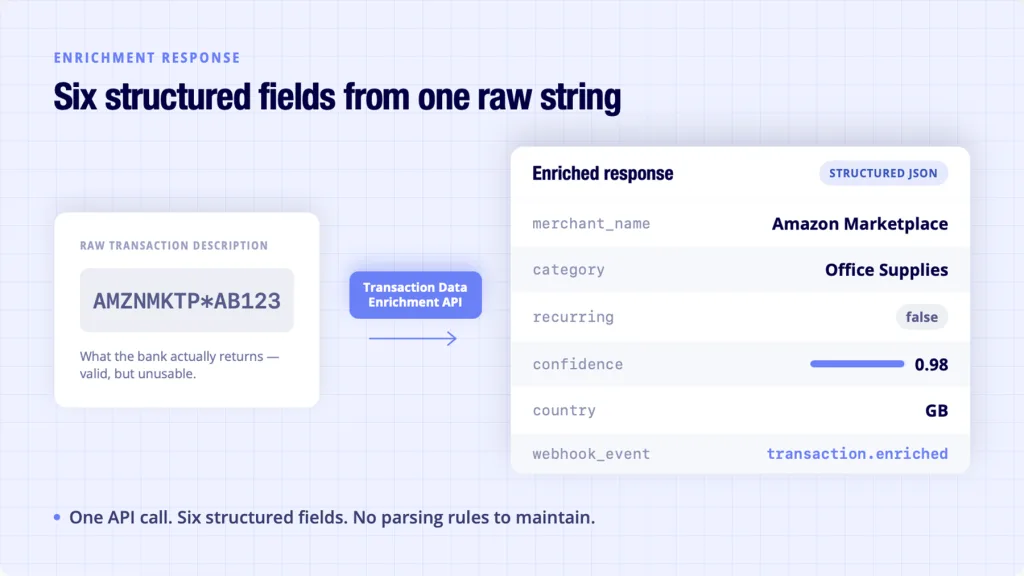
Every standalone enrichment API shares the same structural limitation: it enriches whatever transaction data you feed it but doesn’t retrieve that data from the bank in the first place.
That means a platform using an enrichment-only provider still needs a separate AISP relationship for bank connectivity, a separate contract, a separate integration and a separate point of failure if either side changes its API. Structured bank data enrichment covers this specific architecture question in more technical depth, comparing the two-vendor approach against a combined connectivity-plus-enrichment layer.
Finexer’s Transaction Enrichment API: Built on the Same Data Layer
Platforms evaluating a transaction data enrichment API need merchant accuracy and bank connectivity solved together, not as two separate integrations with two separate bills.
Finexer’s Transaction Enrichment API converts standard Open Banking transaction data into structured merchant intelligence: each transaction returns a verified merchant identity, legal entity, spending category, billing pattern, location data, transaction type and a confidence score, all in one call.
Finexer retrieves transaction data through its FCA-authorised AIS infrastructure. The enrichment engine resolves merchant identity, assigns merchant category codes (MCCs), normalises the response into a consistent JSON schema and fires a real-time webhook (transaction.enriched) as soon as enrichment completes, allowing downstream reconciliation, budgeting and lending workflows to continue automatically.
Because it sits directly on top of the underlying AIS data layer, platforms retrieve verified bank transaction data and enriched merchant intelligence through a single integration, rather than stitching together a connectivity vendor and an enrichment vendor separately.
- Merchant identification and legal entity resolved per transaction, not per bank string variant
- 95%+ categorisation accuracy, sub-100ms processing latency
- 100M+ merchant database, production-ready without a separate training period
- Covers card payments, direct debits, bank transfers and standing orders
- FCA-authorised AISP and PISP (FRN925695) for the underlying bank connectivity
- Usage-based pricing
- Almost all UK banks covered
What’s the Difference Between a Transaction Data Enrichment API and B2B Contact Enrichment?
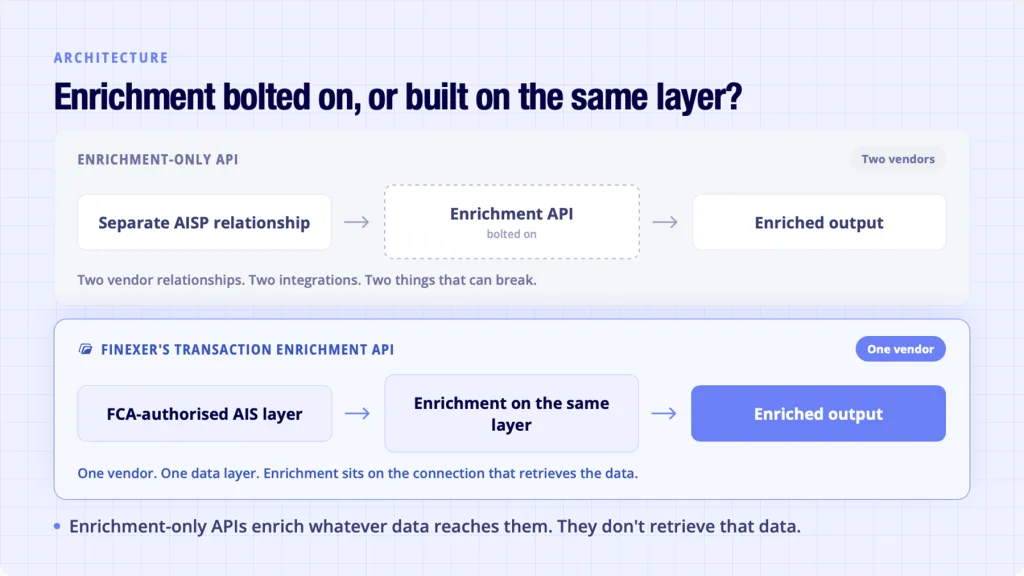
A transaction data enrichment API enriches financial transaction strings, adding verified merchant identity, category and recurring status to bank data, while B2B contact enrichment appends company and personal information, such as job titles or firmographic data, to a lead or contact record.
The two get confused in search because both use the word “enrichment,” but they solve entirely different problems for entirely different teams.
A transaction enrichment API serves finance and product engineering teams building reconciliation, budgeting or lending features; B2B enrichment serves sales and marketing teams building outbound lists. Platforms searching for one rarely need the other, and providers rarely overlap between the two.
What is a data enrichment API?
A data enrichment API converts raw, unstructured bank transaction descriptions into structured data, typically including verified merchant identity, spending category and recurring-payment flags, delivered via a single API call. It’s used by accounting, lending and fintech platforms to automate categorisation that would otherwise require manual review per transaction.
How much does a data enrichment API cost?
Data enrichment API pricing is usually either usage-based, charged per transaction enriched, or flat enterprise fees, and the two models suit different volume patterns. Usage-based pricing tends to fit platforms with variable or growing transaction volume better than flat enterprise fees.
Why do platforms need data enrichment API access?
Raw transaction descriptions prevent automation. Platforms need structured data enabling reconciliation, financial analysis, and dashboard features without operational overhead processing unclear information.
Does a transaction data enrichment API require its own bank connectivity?
Not necessarily; some providers, including Finexer, combine Open Banking AIS connectivity with enrichment in a single API, while others require a separate AISP relationship to supply the raw transaction data first. Platforms should confirm whether enrichment pricing already includes the underlying data retrieval or bills for it separately.
How accurate is transaction categorisation in a modern enrichment API?
Production-grade enrichment APIs typically report categorisation accuracy above 95% on major merchants, with lower accuracy on long-tail or highly localised merchants where the underlying merchant database has less coverage. Confidence scores returned per transaction let a platform flag lower-certainty matches for manual review rather than trusting every result equally.
Can enrichment data update if a bank changes its transaction descriptor format?
Yes, when enrichment is delivered as an API rather than a static rule-set built in-house, the provider updates matching logic centrally as bank formats change, so the platform doesn’t need to maintain per-bank parsing rules itself. This is one of the practical arguments for API-based enrichment over an internally built categorisation layer.
See the exact merchant-match accuracy and JSON schema Finexer’s Transaction Enrichment API returns, for your own transaction sample.
Explore with AI
About the Author

Yuri
Yuriy Yakushko is a fintech founder and software engineer with over 20 years of experience building financial technology. He’s passionate about creating scalable, secure infrastructure that helps businesses modernise how they access financial data and manage payments.