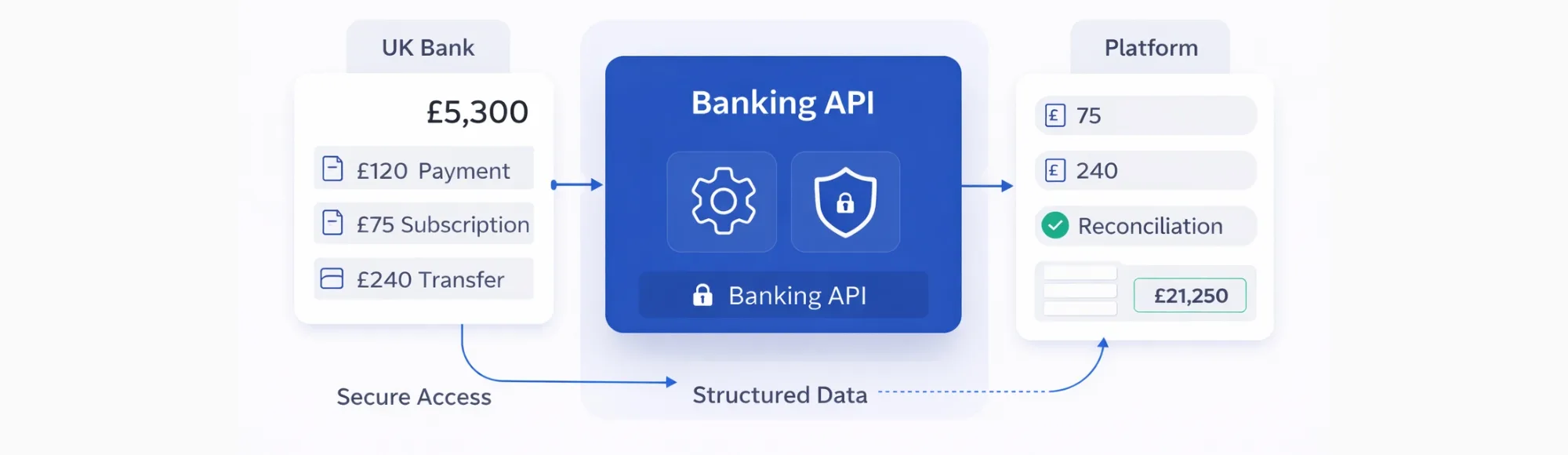
Ready to connect your platform to UK banks via API?
Finexer gives platforms FCA-authorised bank connectivity – AIS data access and PIS payments in one integration.
Most platforms that handle financial data eventually face the same architectural question. How do we get bank data into our system reliably – without asking users to upload files, export CSVs, or share credentials?
The answer is connecting to a bank with API infrastructure. Not building direct bank connections – which requires separate integrations per institution, security certifications, and ongoing maintenance. But connecting through a regulated Open Banking provider that handles bank relationships and delivers structured data via a unified API.
At Finexer, we work with UK accounting platforms, LawTech tools, EPOS systems, and payroll infrastructure that have moved from file-based bank data collection to direct API connectivity. The architectural shift is significant – financial data becomes a live input rather than a periodic import.
This blog explains how banking APIs work, what platforms can build on top of them, and what to look for when evaluating bank API infrastructure.
TL;DR
A bank with API access allows platforms to retrieve financial data and initiate payments programmatically – without manual uploads or credential sharing. Finexer provides FCA-authorised banking APIs covering 99% of UK banks, giving platforms AIS for bank transaction data access and PIS for account-to-account payments through a single integration layer.
Key Takeaways
What does it mean to connect to a bank with API?
Connecting to a bank with API means retrieving financial data or initiating payments programmatically through a regulated interface – rather than through manual bank statement collection or screen scraping. Banking APIs provide structured, consent-based access to bank account data.
What do banking APIs allow platforms to do?
Banking APIs allow platforms to retrieve account balances, transaction history, and payment confirmations directly from bank accounts – and initiate account-to-account payments without card networks. Both capabilities operate with explicit user consent under UK Open Banking regulation.
Why do platforms need a unified banking API rather than direct bank connections?
Each UK bank has different interfaces, authentication requirements, and data formats. Building individual connections per bank is not viable at scale. A unified banking API standardises access across all UK banks – one integration, consistent data formats, single maintenance responsibility.
What is the difference between AIS and PIS in banking APIs?
AIS (Account Information Services) provides read-only access to bank transaction data and account balances. PIS (Payment Initiation Services) initiates account-to-account payments directly from bank accounts. Both are regulated under UK Open Banking and available through Finexer’s API infrastructure.
Which UK platforms benefit most from bank API connectivity?
Accounting and ERP platforms, LawTech tools, EPOS systems, payroll platforms, PropTech, and utility billing infrastructure – any platform that currently collects financial data manually or processes payments through card networks.
What Is a Bank With API Access?
A bank with API access exposes its financial data and payment infrastructure to authorised third-party platforms through a programmatic interface. Instead of requiring users to download statements or log into banking portals, the platform connects directly to the bank via API – retrieving data or initiating payments with the user’s consent.
In the UK, this is standardised through Open Banking regulation. All major UK banks are required to provide API access to FCA-authorised providers. Platforms do not negotiate individual agreements with each bank – they connect through a regulated infrastructure layer that handles bank relationships, authentication, and data standardisation.
Which UK banks support Open Banking API access lists the full coverage of supported institutions.
How Banking APIs Work
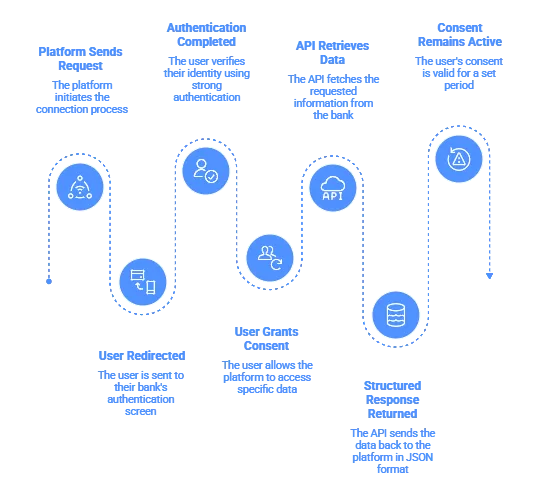
Banking APIs follow a consistent flow regardless of which bank a user holds an account with:
- Platform sends a bank connection request via the banking API
- User is redirected to their bank’s authentication screen
- Strong Customer Authentication is completed – via banking app or biometric
- User grants consent for specific access – transaction data, balances, or payment initiation
- API retrieves the requested data or executes the payment
- Structured response is returned to the platform via API
- Consent remains active for the agreed period and is revocable instantly
The platform never handles bank credentials. Data arrives in structured JSON format – consistent across all connected banks regardless of underlying bank interface differences.
Banking API integration guide for UK platforms covers the technical integration steps in detail.
What Can Platforms Build on Bank API Infrastructure?
| Capability | API Type | Platform Workflow |
|---|---|---|
| Bank Transaction Retrieval | AIS | Automatic bank feeds, reconciliation, financial reporting |
| Account Balance Access | AIS | Real-time balance monitoring, affordability checks, cash flow analysis |
| Payment Initiation | PIS | Pay by Bank invoices, supplier payments, contractor disbursements |
| Identity and Account Verification | AIS | Bank account ownership confirmation, KYC support, onboarding verification |
| Financial History Access | AIS | Source-of-funds checks, affordability assessment, income verification |
| Payment Settlement Confirmation | AIS + PIS | Post-payment verification, reconciliation against bank records |
How Does Finexer Provide Bank API Infrastructure?
Finexer is an FCA-authorised Open Banking provider offering unified banking APIs for UK platforms – combining AIS for bank data access and PIS for payment initiation in one integration.
What Finexer’s banking APIs provide:
- AIS connectivity covering 99% of UK bank accounts
- PIS for Pay by Bank and account-to-account payment initiation
- Real-time webhooks for live transaction and payment events
- Structured JSON outputs with merchant identification and category data
- FCA-compliant consent flows with granular permissions and instant revocation
- White-label capability for branded bank connection journeys within platform products
- Usage-based pricing with no fixed volume commitments
Platforms integrate once and access both data and payment infrastructure across all supported UK banks. Engineering teams maintain one integration rather than individual bank connections.
Open Banking API integration guide and popular banking API examples cover specific implementation patterns in detail.
Finexer does not provide financial analysis software, payment front-ends, or reporting tools. Platforms build those product layers on top of Finexer’s bank API infrastructure.
What I Feel
The question I hear most from engineering teams is not “which bank API should we use” – it is “how do we avoid building and maintaining 20 separate bank connections”.
That is the right question. A bank with API access is only useful if it covers the banks your users actually hold accounts with – consistently, reliably, and without your team owning the maintenance.
The value of unified Open Banking infrastructure is not just the data. It is that one integration works across the UK banking system without your platform needing to become a bank integration specialist.
Common Use Cases
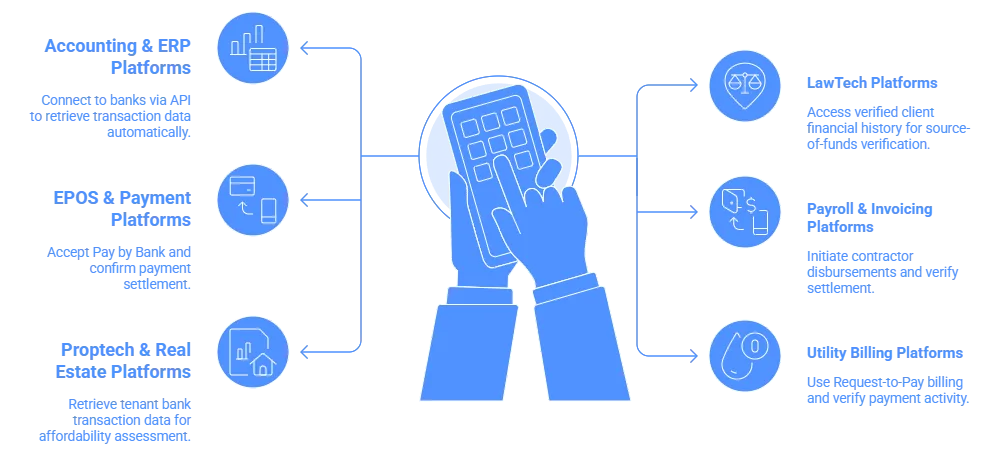
Accounting & ERP Platforms
Accounting platforms connect to a bank with API via Finexer’s AIS to retrieve client transaction data automatically – replacing manual CSV uploads with live bank feeds that power reconciliation and financial reporting.
LawTech Platforms
LawTech platforms – including insolvency practices – use banking APIs to access verified client financial history for source-of-funds verification and KYC workflows. Bank-verified transaction data replaces manually submitted statements during client onboarding.
EPOS & Payment Platforms
EPOS platforms use Finexer’s PIS banking APIs to accept Pay by Bank at point of sale and AIS to confirm payment settlement – removing card processor intermediaries from the payment and reconciliation workflow.
Payroll & Invoicing Platforms
Payroll platforms use PIS banking APIs to initiate contractor disbursements directly from within the platform and AIS to verify settlement – combining payment execution and confirmation in one bank API integration.
Proptech & Real Estate Platforms
PropTech platforms use AIS banking APIs to retrieve tenant bank transaction data for affordability assessment and income verification – replacing manual payslip and statement requests with consent-based bank data access.
Utility Billing Platforms
Utility platforms use PIS banking APIs for Request-to-Pay billing and AIS to verify customer payment activity – supporting both payment collection and billing record accuracy from a single bank API connection.
What is a bank with API access for platforms?
A bank with API access allows software platforms to retrieve financial data or initiate payments programmatically through a regulated interface with user consent. In the UK, Open Banking regulation mandates that major banks provide API access to FCA-authorised providers – giving platforms standardised bank connectivity without direct bank integrations.
What are banking APIs used for in financial platforms?
Banking APIs are used to retrieve bank transaction data, access account balances, verify account ownership, initiate account-to-account payments, and confirm payment settlement. The specific use depends on whether the platform needs AIS for data access or PIS for payment initiation.
How does Finexer provide bank API access for UK platforms?
Finexer is FCA-authorised and provides unified banking APIs covering 99% of UK banks – combining AIS for bank transaction data and PIS for payment initiation in one integration. Platforms connect once to Finexer’s infrastructure and access bank data and payments across all supported UK institutions.
Connect your platform to UK banks through a single FCA-authorised API.
About the Author

Yuri
Yuriy Yakushko is the Founder of Finexer, an FCA-authorised Open Banking platform that enables businesses to access real-time bank data and Pay-by-Bank payments through secure API infrastructure. With more than 20 years of experience in fintech and software engineering, he focuses on building scalable financial technology that helps businesses modernise payments and financial data workflows.