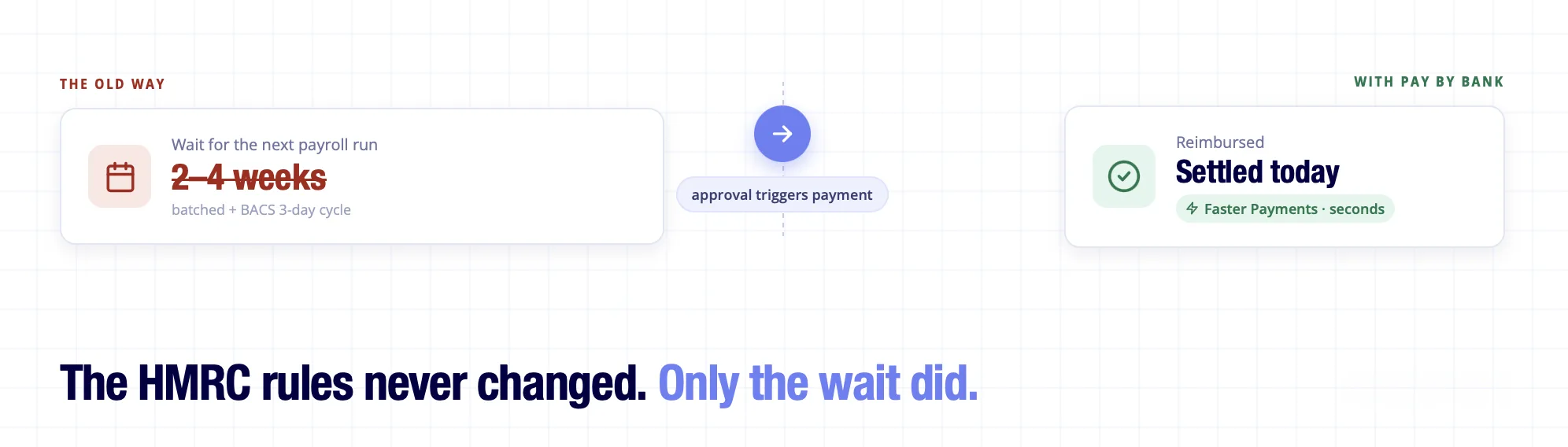
Pay People Back the Same Day. The HMRC rules behind UK employee expense reimbursement
the process most teams still run, and the same-day Pay by Bank path HR and payroll platforms are adopting.
There are two separate questions hidden inside every employee expense reimbursement. One is a tax question: is this expense tax-free? The other is a payment question: how fast does the employee get their money back?
Most guides answer only the first. The rules under HMRC ITEPA s336 are well documented and rarely change.
The second question is where the friction sits. An employee fronts £200 for a client trip, submits the claim, and waits. Approval, finance review, then the next payroll run. Two to four weeks is normal.
This guide covers both. The HMRC rules an HR or finance team must apply, and the modernisation path payroll and HR platforms are taking to close the wait.
TL;DR
Employee expense reimbursement under HMRC ITEPA s336 is tax-free when an expense is wholly, exclusively, and necessarily incurred in performing the job. The process traditionally takes two to four weeks because reimbursements are batched into the next payroll run. Same-day reimbursement via Pay by Bank settles on approval through Faster Payments, without changing any HMRC rule or approval step.
What Is Employee Expense Reimbursement?
Employee expense reimbursement is the repayment of money an employee has spent out of pocket on legitimate business costs.
A reimbursed expense is different from a benefit. A benefit is something the employer provides. A reimbursement pays the employee back for a cost they personally fronted, like a train fare to a client site or a hotel for an overnight work trip.
Whether that repayment is tax-free depends entirely on the HMRC test. Get the test right and the reimbursement is not taxable for the employee and does not need reporting. Get it wrong and it becomes taxable earnings.
“The tax treatment of an expense reimbursement and the speed of paying it back are two different problems. People conflate them. The rules are settled. The payroll-cycle delay is a process choice, not a legal requirement.” – Clare, Finexer
What Are the HMRC Rules on Expense Reimbursement?
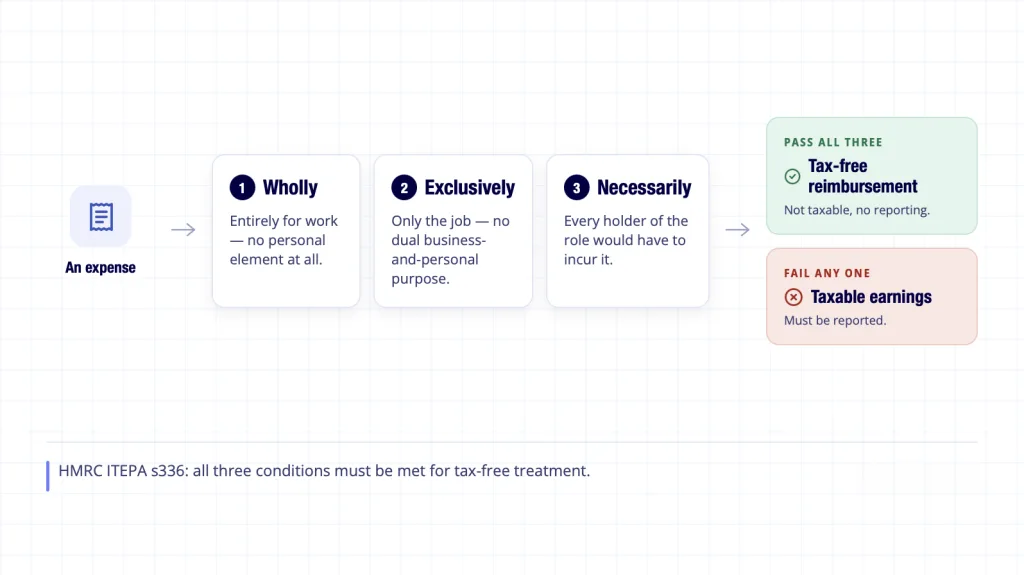
The governing rule is HMRC ITEPA s336. An expense is tax-free only when it is incurred wholly, exclusively, and necessarily in the performance of the employee’s duties.
All three words matter, and HMRC applies them strictly.
- Wholly: the cost is entirely for work, with no personal element
- Exclusively: it relates only to the job, not a dual business-and-personal purpose
- Necessarily: each and every holder of that role would have to incur it, not just this employee by choice
If even a small private element exists, the expense fails the test. The “necessarily” condition is the strictest. HMRC asks whether the job could be done without incurring the cost.
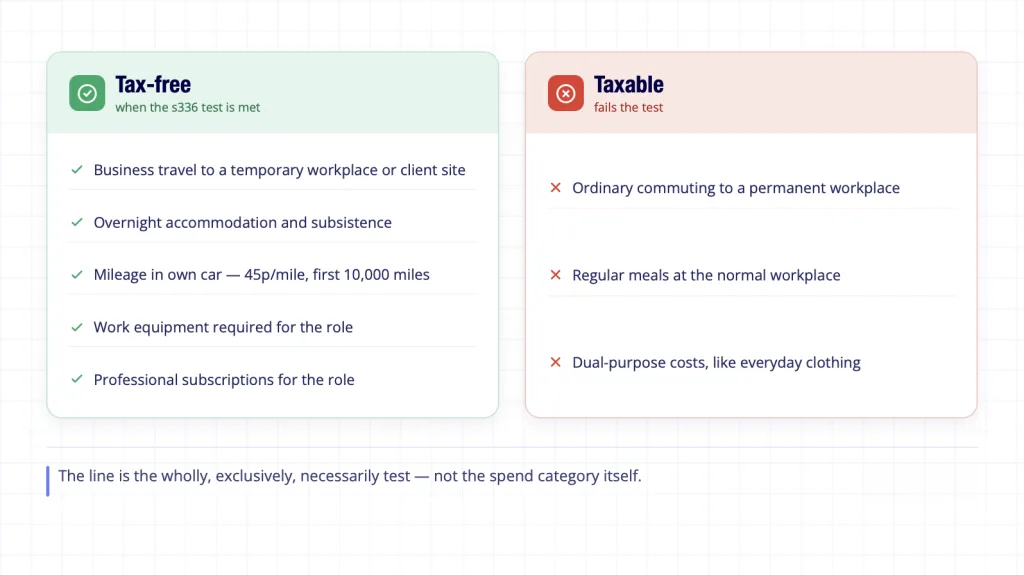
When the test is met the reimbursement is tax-free. When it fails, the same payment becomes taxable earnings. The line is the test, not the spend category itself.
| Tax-free when the s336 test is met | Taxable (fails the test) |
|---|---|
| Business travel to a temporary workplace, client site, or supplier | Ordinary commuting from home to a permanent workplace |
| Accommodation and subsistence on an overnight business trip | Regular meals at the normal workplace |
| Mileage in an own car at HMRC AMAP rates (45p per mile, first 10,000 business miles) | Anything with a dual personal purpose, such as everyday clothing |
| Work equipment and professional subscriptions required for the role | Costs incurred by personal choice rather than job requirement |
A note on timing relevant from this tax year: HMRC’s treatment of working-from-home expenses changed from 6 April 2026, so homeworking reimbursement should be checked against the current guidance rather than older flat-rate assumptions.
What Is an Expense Claim and What Should It Include?
An expense claim is the formal request an employee submits to be reimbursed. It is the document that lets finance check the HMRC test before any money moves.
A compliant expense claim records the amount, the date, the business purpose, and the receipt or evidence. For mileage, it records the route and business miles. For entertainment, it records the attendees.
HMRC can ask for this evidence later, so the expense claim is also the audit trail. Without a clear business purpose logged against each line, a reimbursement that was genuinely tax-free can be hard to defend.
How Does the Reimbursement Process Actually Work?
The standard UK process runs in five steps, and most of the elapsed time is waiting, not working.
- Submit: the employee files an expense claim with receipts and the business purpose
- Approve: the line manager checks the claim against policy
- Review: finance confirms the HMRC test and the policy limits
- Queue: the approved amount is batched for the next payroll run or a separate payment date
- Settle: payment goes out, traditionally by BACS, and the claim is recorded for audit
Each step is sensible on its own. Stacked together, with the payment leg tied to a monthly payroll cycle, they produce the two-to-four-week wait employees feel.
Why Does Reimbursement Take Two to Four Weeks?
The delay is rarely about approval. It is about the payment rail and the batching.
Most teams batch reimbursements into the monthly payroll run or a periodic BACS file. BACS itself works on a three-day clearing cycle. If a claim misses the cut-off for the current run, it waits for the next one.
So an employee who submits on the 6th, just after a payroll cut-off, can wait until the following month’s run plus the BACS cycle before the money lands. The rules did not cause that wait. The batching did.
“Decision Process Time”
How Does Same-Day Pay by Bank Change Reimbursement?
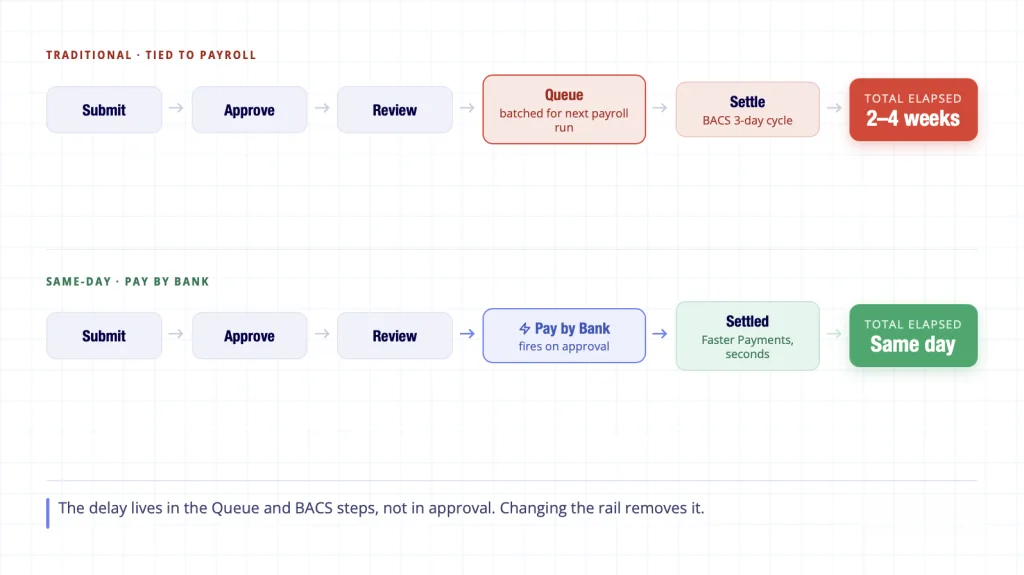
The modernisation is a payment-rail change, not a rule change. Instead of queuing an approved claim for the next payroll run, the payment fires the moment approval completes.
This runs on Open Banking payment initiation over Faster Payments, which settles in seconds rather than the BACS three-day cycle. The employee gets paid back on the day the claim clears, not weeks later.
What changes: the timing of the payment leg.
What stays exactly the same: the HMRC ITEPA s336 test, the approval workflow, the policy checks, and the audit trail. Same-day settlement does not loosen any compliance step. It only removes the batching wait.
For platform teams, the same-day leg runs on Pay by Bank, where the employer approves the payment and funds move directly to the employee’s account.
Underneath, the settlement uses an instant payments API that moves funds over Faster Payments in seconds rather than the BACS cycle.
What Do HR and Payroll Platforms Need to Build?
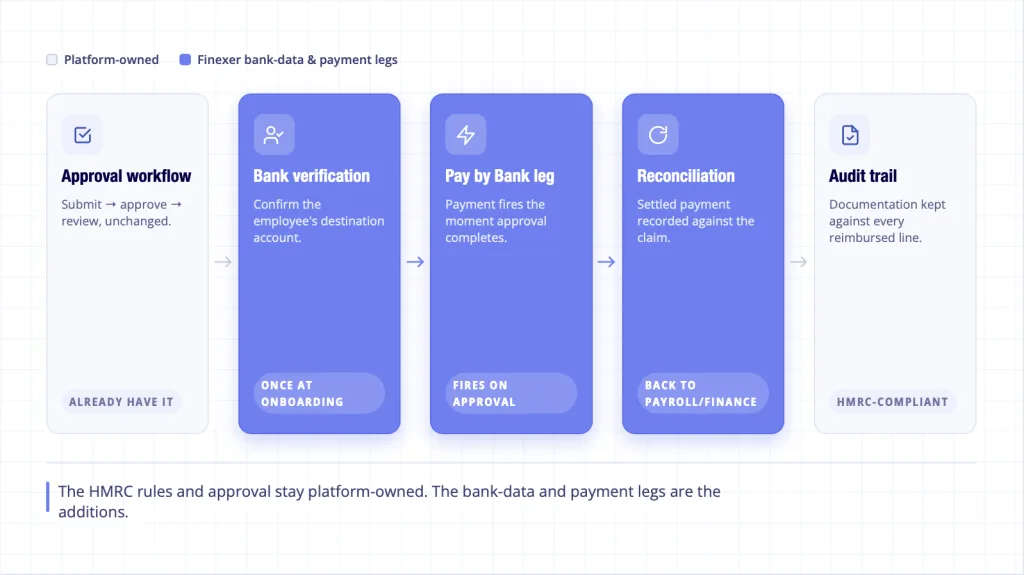
For a platform adding same-day reimbursement as a feature, five pieces have to fit together.
- Approval workflow: the existing submit-approve-review chain, unchanged
- Employee bank verification: confirm the destination account once, usually at onboarding
- Payment initiation: the Pay by Bank leg that fires on approval, settling via Faster Payments
- Reconciliation: the payment recorded back against the claim in the payroll or finance system
- Audit trail: HMRC-compliant documentation kept against every reimbursed line
The first piece most platforms already have. The middle three are where the bank-data and payments layer comes in.
Reimbursement sits inside the wider payroll stack, so payroll reconciliation is where the settled payment needs to land cleanly against the finance system.
What I Feel
The strangest thing about expense reimbursement is that the slow part is the easy part. The hard part, applying the HMRC test correctly, happens in minutes. The easy part, moving the money, takes weeks because it is chained to a payroll calendar that has nothing to do with the expense. Once you separate the payment from the payroll cycle, the whole wait just disappears.
How Does Finexer Fit Into Expense Reimbursement?
Finexer is not an HR, payroll, or expense management tool. Finexer provides the payments and bank-data rail that HR and payroll platforms use to add same-day reimbursement.
The HMRC rules, the approval policy, and the expense management workflow stay with the platform. Finexer supplies the part underneath that moves the money and confirms it.
What Finexer provides for reimbursement workflows:
- Pay by Bank payment initiation that fires on approval, settling to the employee’s account in seconds via Faster Payments
- Employee bank account verification, so the destination account is confirmed before the first payment
- Transaction data and enrichment that helps categorise the underlying expense against vendor and category for the audit trail
- Coverage across 99% of UK banks through one API connection
The mechanism: an HR or payroll platform keeps its own approval and policy engine, then calls Finexer for the payment leg. Approval completes, the Pay by Bank payment fires, the employee is reimbursed the same day, and the settled payment reconciles back into the platform.
Platforms adding reimbursement to an existing spend module sit close to the wider expense management with Open Banking landscape.
For the claim-categorisation side, transaction enrichment resolves vendor and category from the underlying transaction for the audit trail.
Finexer is FCA-authorised AISP and PISP (FRN 925695). PSD2-compliant. Usage-based pricing, commercial terms agreed based on use case. 3 to 5 weeks of hands-on onboarding support for platforms embedding the rail.
“The point people miss is that speeding up the payment does not touch the tax position. The ITEPA s336 test is applied at approval, before any money moves. Whether you settle that day or in three weeks, the compliance work is already done. Faster settlement just stops making the employee wait for something that has already been signed off.” – Clare, Finexer
Where Does Same-Day Reimbursement Get Used?
Four common patterns, each adding the instant payment leg to an existing workflow.
An HR platform builds same-day reimbursement as a retention and wellbeing feature, so staff are paid back on approval rather than next payday.
A payroll SaaS adds an instant-settlement option alongside its monthly run, for urgent or out-of-cycle claims.
An accounting tool with an expense module offers same-day payout to differentiate from card-led competitors.
An employee benefits platform integrates reimbursement so business costs and perks settle through the same rail.
How does expense reimbursement work in the UK?
An employee pays a business cost, submits an expense claim with receipts and a business purpose, a manager and finance approve it against HMRC rules, and the employer repays it – traditionally in the next payroll run, or same-day if the platform uses Faster Payments.
What is an expense claim?
An expense claim is the formal request an employee submits to be reimbursed for a business cost. It records the amount, date, business purpose, and receipt, and serves as the audit trail HMRC may later request.
What are the HMRC rules on expense reimbursement?
Under ITEPA s336, a reimbursement is tax-free only if the expense was wholly, exclusively, and necessarily incurred in performing the job. If it fails any part of that test, it becomes taxable earnings and must be reported.
Can I claim expenses without receipts in the UK?
HMRC expects evidence for reimbursed expenses. Some employers allow small claims under a set limit without a receipt, but the business purpose must still be recorded. Mileage uses a logged route rather than a receipt.
If your HR or payroll platform still pays expenses on the next payroll run, Finexer’s Pay by Bank rail can settle approved reimbursements the same day over Faster Payments.
About the Author

Clare Pearson
Clare Pearson is a senior payments professional with extensive experience across the global financial services and payments industry. She specialises in Open Banking, payment infrastructure, and financial technology transformation, with expertise spanning product delivery, operational strategy, regulatory compliance, and large-scale payments programmes. Clare currently serves as a Non-Executive Director at Finexer and a panel member for the Payment Systems Regulator (PSR), advising on the development of payment systems policy and innovation