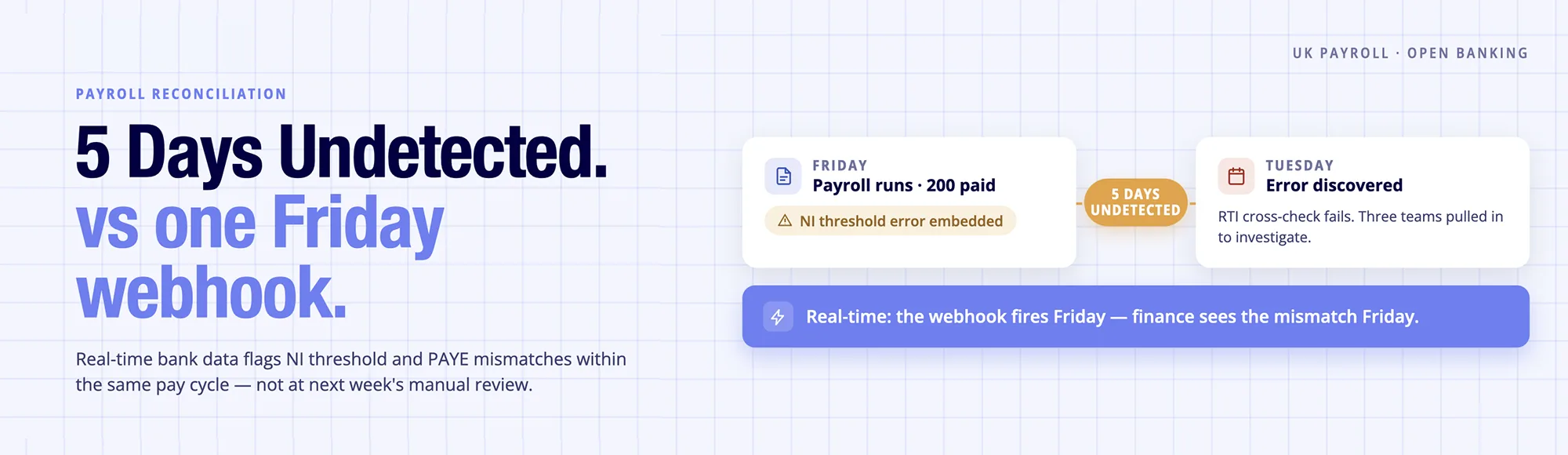
See the mismatch before payday, not after:
Real-time bank data flags payroll reconciliation errors as they happen, not during next week’s manual review.
Payroll reconciliation breaks most often at a single point: the gap between when a payroll system calculates a payment and when the bank confirms it landed correctly. A miscalculated National Insurance threshold or a mismatched PAYE reference can sit undetected for days under manual review.
In my work with UK finance teams across payroll and accounting platforms, the fix isn’t more careful checking, it’s connecting the payroll system to real-time bank data so the mismatch surfaces the moment it occurs.
By Ravi, Head of Platform Partnerships at Finexer
“Payroll reconciliation problems rarely start as one big failure. They start as one employee’s National Insurance threshold being calculated against last year’s band and nobody catching it until three people have already spent an afternoon on it.”
The Afternoon a Single NI Threshold Broke Payroll Reconciliation
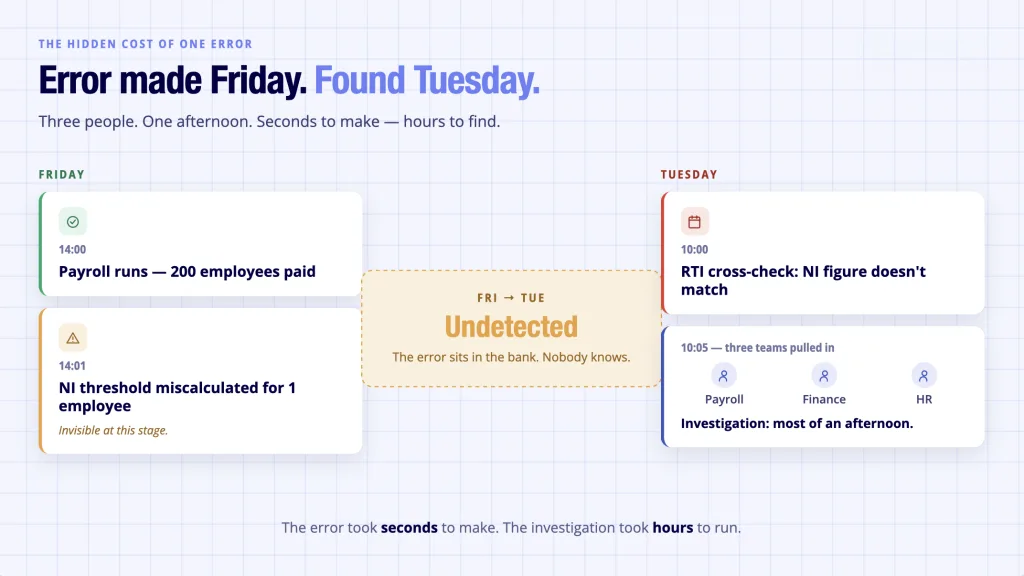
A 200-employee company runs payroll every Friday. This month, one employee crossed into a higher earnings bracket mid-year, and the payroll system applied the previous National Insurance threshold instead of the updated one.
The payment goes out. The bank processes it. Nobody notices until the following Tuesday, when the finance team runs its monthly payroll reconciliation against HMRC’s RTI submission and finds the NI figure doesn’t match what was actually deducted.
By then, three people have been pulled in: payroll to check the calculation, finance to check the bank statement and HR to explain the discrepancy to the employee, who noticed their payslip looked different from last month’s. The investigation takes most of an afternoon. The underlying error took seconds to make.
This is not a rare failure. According to the UK Payroll Efficiency Report 2026, published by Finity, based on a survey of 342 payroll professionals, 89% of payroll professionals report experiencing errors on a regular basis, and 48% attribute those errors specifically to manual processing steps.
This same pattern of a payment moving correctly while the confirming data lags is not unique to payroll – the invoice matching process breaks down for the same reason on the accounts receivable side.
What a Solution to Payroll Reconciliation Actually Needs
Five requirements separate payroll reconciliation that catches errors early from reconciliation that only confirms them after the fact.
- Pre-cycle validation – Does the system check payment details, NI thresholds, and PAYE codes against current HMRC bands before the payment file is even generated?
- During-cycle status visibility – Once payments are sent, does finance know they’ve settled correctly within the pay cycle, or only after the next bank statement arrives?
- Post-cycle RTI matching – Can the system automatically match what was actually paid against the Real Time Information submitted to HMRC, rather than relying on someone to manually cross-check figures?
- Real-time bank confirmation – Does payment data arrive as settlements happen, or only through a scheduled statement download hours or days later?
- Exception-only review – Does finance only get pulled in for genuine mismatches, or do they have to check every transaction regardless of whether it’s correct?
Most payroll systems handle the first requirement reasonably well. Very few connect cleanly to the second, third and fourth.
The Three Checkpoints Payroll Reconciliation Needs
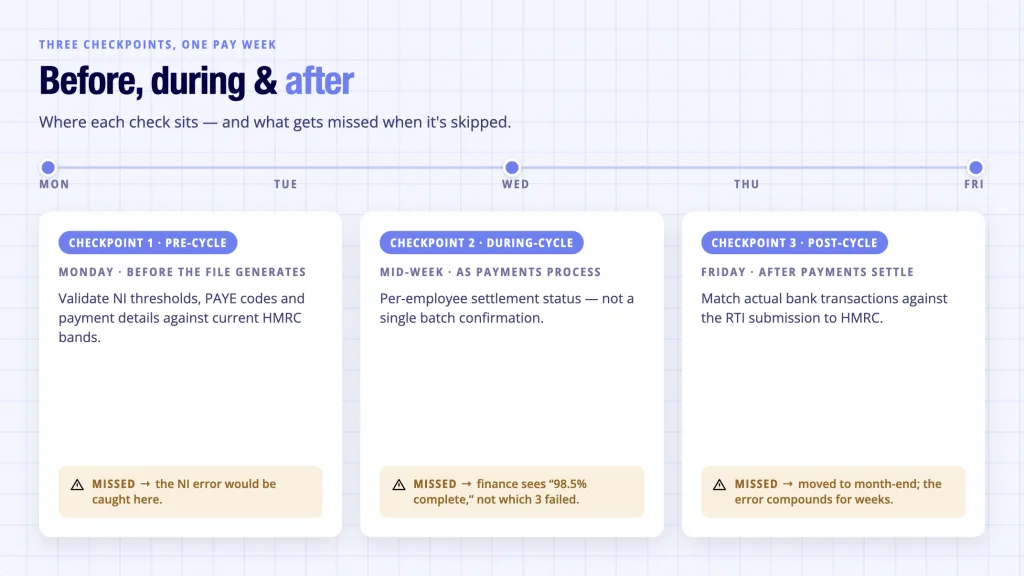
Payroll reconciliation should run at three distinct points in every pay cycle, not just at month-end.
Pre-cycle: Before the payment file generates, NI thresholds, tax codes and PAYE references should be validated against the current HMRC bands. This is where the miscalculated threshold in the scenario above should have been caught, before a single payment left the account.
During-cycle: As payments process, the platform needs visibility into settlement status per employee, not a single batch confirmation. If three payments stall while 197 succeed, finance needs to know which three, not that “the payroll run is 98.5% complete.”
Post-cycle: After payments settle, the actual bank transaction data should be matched against the RTI submission sent to HMRC. A mismatch here, as in the NI threshold example, is the last checkpoint before it becomes an employee-facing problem or a compliance question.
Most payroll reconciliation workflows run the post-cycle check well after the fact, often at month-end, when the error has already had weeks to compound.
Why Traditional Payroll Reconciliation Misses This Until Too Late
Traditional payroll reconciliation depends on scheduled bank feed downloads and manual cross-referencing against HMRC submissions, which is where errors like the NI threshold example sit undetected.
| Reconciliation Stage | Manual / Scheduled-Feed Process | Real-Time Bank Data |
|---|---|---|
| Payment settlement confirmation | Bank statement download, next business day or later | Webhook fires as the transaction settles |
| NI/PAYE mismatch detection | Found during month-end cross-check against RTI | Flagged same pay cycle, before it compounds |
| Investigation per mismatch | 30–60 minutes across payroll, finance, HR | Automatic flag with transaction detail attached |
| Data format across banks | Varies by bank statement format | Structured, normalised per transaction |
| Scaling with headcount | More employees, proportionally more manual checking | Fixed infrastructure cost regardless of volume |
Every mismatch investigated the manual way costs 30 to 60 minutes of cross-team checking, per the industry figures already cited. For platforms that have already automated the bank-matching side of reconciliation, how other firms cut reconciliation time documents the operational change once bank feeds move from scheduled to real-time.
How Finexer Supports Payroll Reconciliation
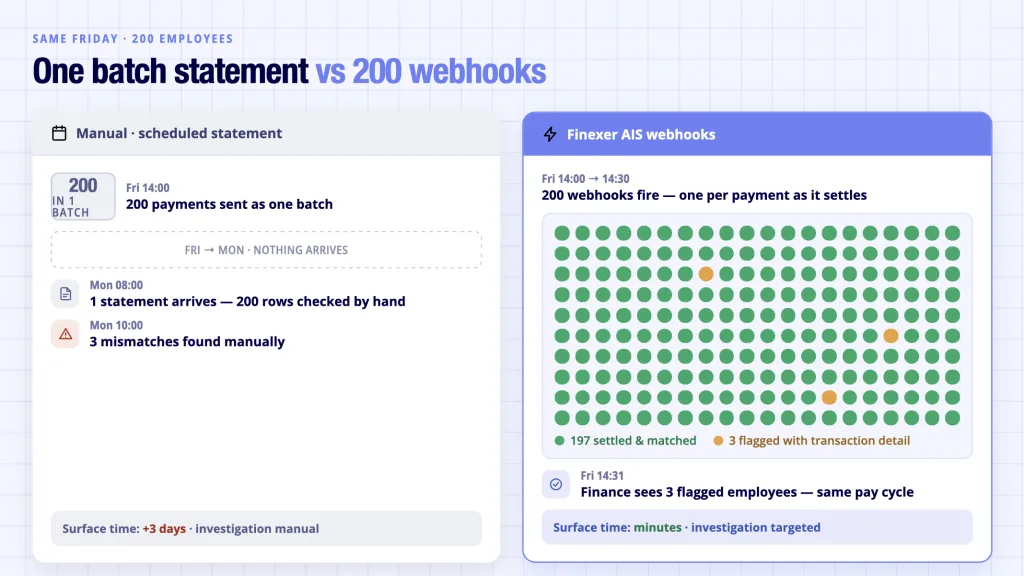
Finance teams running payroll reconciliation need the payment and the bank confirmation connected in real time, not reunited a week later during a manual review.
Finexer’s Data (AIS) product retrieves transaction data directly from the receiving bank account as it settles, structured and normalised per transaction, and delivered via webhook the moment a matching payment lands.
Instead of waiting for a scheduled statement download, the platform can flag a mismatch, a missing payment, or an incorrect amount within the same pay cycle it occurred, rather than during next month’s reconciliation run.
- Real-time bank data via webhook as payments settle, replacing scheduled statement downloads
- Structured, normalised transaction data per bank, so matching logic doesn’t break per employee’s bank
- Up to 7 years of transaction history for reconciliation and audit
- 99% UK bank coverage
- FCA-authorised AISP and PISP (FRN925695)
- 3-5 weeks onboarding support
- Transparent pricing
For platforms wanting to also automate the payment side of the cycle, not just the reconciliation, payroll API infrastructure covers how payment initiation and reconciliation connect end to end. The Payroll & Invoicing use case outlines how this fits alongside broader payroll and contractor payment workflows.
What Is Payroll Account Reconciliation?
Payroll account reconciliation is the process of matching what a payroll system calculated and instructed to pay against what actually left and landed in bank accounts.
It runs alongside, but separately from, general bank reconciliation, because payroll carries additional obligations: NI thresholds, tax codes, and RTI submissions to HMRC that general transaction matching doesn’t need to account for.
When a platform wants to automate payroll payments as well as reconcile them, the same real-time bank data that confirms settlement can also validate that the RTI figures match what was actually deducted, closing the loop between payment and compliance record in the same cycle rather than at month-end.
How often should payroll reconciliation happen?
Payroll reconciliation should run at three points every pay cycle: before payments are generated, as they settle, and after settlement when matching against the RTI submission, rather than only once, at month-end. Running it only monthly means errors like a mismatched NI threshold can go undetected for weeks.
What are the most common payroll reconciliation errors?
The most common errors are miscalculated National Insurance thresholds when an employee crosses an earnings bracket, mismatched PAYE references, and RTI submissions that don’t match what was actually paid. A 2026 industry report found 89% of UK payroll professionals experience these errors regularly, with 48% attributing them to manual processing.
How do you fix a PAYE mismatch?
A PAYE mismatch is fixed by comparing the actual bank transaction data for the payment against the RTI submission sent to HMRC, identifying where the figures diverge, and correcting the payroll record before the next submission. Real-time bank data narrows this investigation from a multi-day exercise to same-cycle detection.
Can real-time bank data replace manual payroll reconciliation entirely?
Real-time bank data automates the routine matching, confirming settlements and flagging mismatches instantly, so finance teams only investigate genuine exceptions rather than checking every transaction manually. Judgment calls, like disputed amounts or complex payment arrangements, still need human review.
Is payroll reconciliation different from general bank reconciliation?
Yes, payroll reconciliation includes obligations specific to payroll, such as NI thresholds, PAYE codes, and RTI matching against HMRC, that general bank-side transaction matching does not need to check on its own.
See how Finexer’s AIS delivers real-time bank data so payroll mismatches surface within the same pay cycle, not weeks later.
Explore with AI
About the Author

Ravi Ranjan
Ravi Ranjan is Co founder & CEO of Finexer