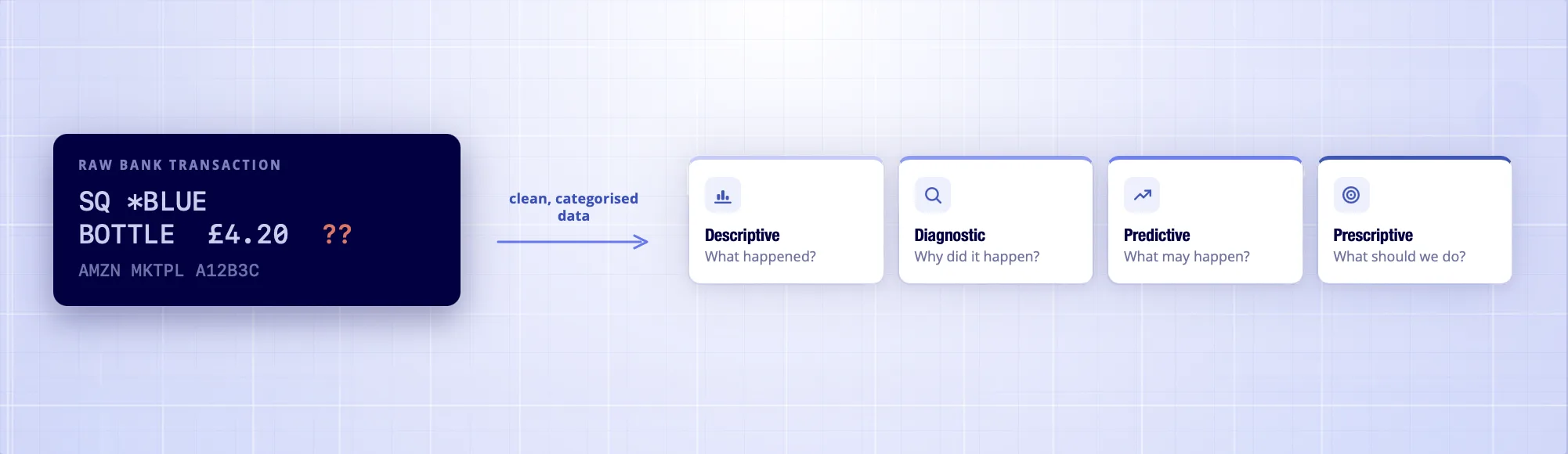
Your Model Trains on Messy Data
Finexer’s AIS and Transaction Enrichment deliver clean, categorised bank data your analysis pipeline can trust
Most finance teams think they have one analysis problem. They actually have four, and they are not interchangeable.
A quarterly revenue chart and a cash flow forecast look like the same activity. They are not – one describes what already happened, the other predicts what might.
The clearest way to think about financial data analysis is the Gartner framework: four types, each answering a different question.
Get the type right and the analysis answers the actual question. Get it wrong and you produce a beautiful chart that answers a question nobody asked.
TL;DR
Financial data analysis examines financial data to support decisions. Under the Gartner framework it falls into four types: descriptive (what happened), diagnostic (why it happened), predictive (what may happen), and prescriptive (what to do). Each builds on the last. All four depend on clean, categorised data – raw bank transactions must be structured and identified before any analysis is reliable.
What Is Financial Data Analysis?
Financial data analysis is the examination of financial data – bank transactions, revenue, costs, and cash flow – to turn raw numbers into business decisions.
Raw data on its own answers nothing – a list of 400 bank transactions is not insightful. Analysis is the work of organising, comparing, and interpreting that data so a finance team can act on it.
The term financial data analytics is often used interchangeably, though analytics tends to imply the tools and systems that run the analysis at scale, while analysis is the activity itself.
What Are the 4 Types of Financial Data Analysis?

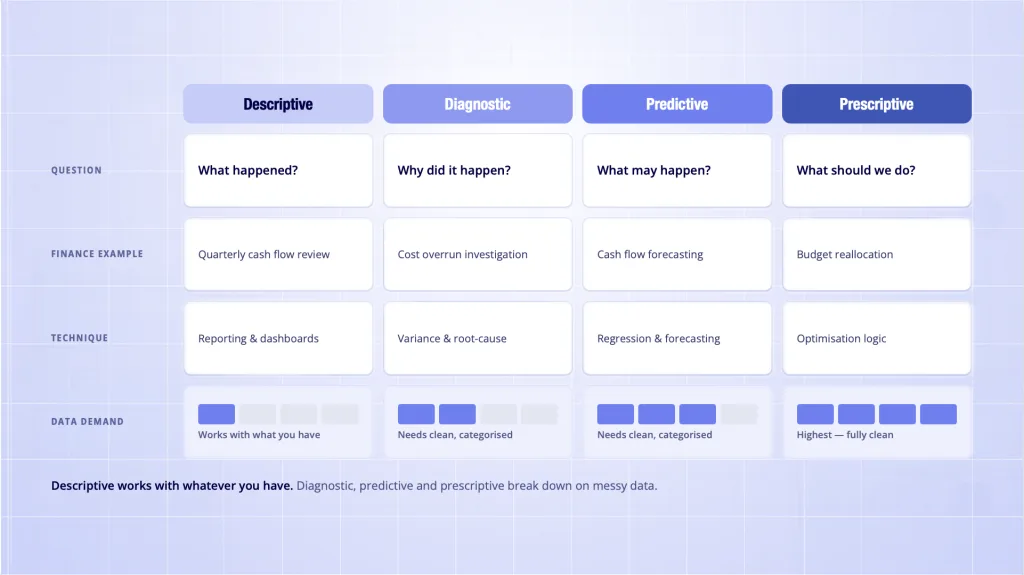
The four types come from the Gartner analytics framework and form a progression – each builds on the one before it.
| Type | Question it answers | Finance example |
|---|---|---|
| Descriptive | What happened? | Quarterly cash flow review, revenue by product |
| Diagnostic | Why did it happen? | Variance analysis, cost overrun investigation |
| Predictive | What may happen? | Cash flow forecasting, churn modelling |
| Prescriptive | What should we do? | Budget reallocation, investment decisions |
“The mistake I see most often is teams jumping to predictive models before their descriptive layer is even clean. You cannot forecast reliably on data you have not correctly described first. The four types are a sequence for a reason.” – Yuri, Finexer
Descriptive Analysis: What Happened?
Descriptive analysis summarises historical financial data into a readable picture of what already occurred.
This is where most finance teams spend their time. It turns raw transactional records into reports, dashboards, and summaries – a quarterly revenue chart, a year-on-year cost comparison, an expense breakdown by category.
It does not explain or predict. It states. A descriptive output might tell you revenue fell last quarter. It does not tell you why, or what happens next.
Diagnostic Analysis: Why Did It Happen?
Diagnostic analysis investigates the cause behind what descriptive analysis surfaced.
When revenue drops or a cost line spikes, diagnostic analysis drills into the data to find the reason. Common techniques include variance analysis, cohort drill-downs, and root-cause investigation across transactions.
This is where clean, categorised data starts to matter sharply.
To explain why marketing spend rose, every relevant transaction has to be correctly identified through transaction categorisation first. Mislabelled data produces the wrong cause.
Predictive Analysis: What May Happen?
Predictive analysis uses historical data to estimate future outcomes.
It relies on regression, forecasting, and pattern matching. In finance, this looks like cash flow forecasting, demand prediction, or customer churn modelling based on past payment behaviour.
Predictive output is a probability, not a certainty. A forecast that next quarter’s cash position will tighten is a signal to plan, built from the patterns in clean historical data.
Prescriptive Analysis: What Should We Do?
Prescriptive analysis recommends a specific action and explains why it is the best one.
It is the most advanced type, combining the other three with optimisation logic. In finance, this is a model recommending where to reallocate budget, which supplier terms to renegotiate, or when to trigger a cash action.
It sits at the top of the framework because it depends on all three earlier types being reliable. A prescriptive recommendation built on poor descriptive data is a confident answer to the wrong question.
What Tools and Techniques Does Financial Data Analysis Use?
A handful of core financial data analysis techniques recur across all four types.
- Ratio analysis: liquidity, solvency, and efficiency ratios that summarise financial health
- Trend analysis: comparing a metric period over period to spot direction
- Variance analysis: comparing budget against actual to find gaps
- Regression analysis: testing how one variable moves with another
- Scenario modelling: testing outcomes under different assumptions
Tools range from spreadsheets to dedicated financial data analytics platforms like Power BI and Tableau, and embedded analytics inside ERPs such as NetSuite and Sage Intacct.
The technique matters more than the tool. A variance analysis is the same logic in Excel or in a BI platform.
Who Uses Financial Data Analysis?
Each finance role leans on a different type of financial data analysis.
- FP&A teams lean on predictive analysis for planning and forecasting
- Finance directors and CFOs use prescriptive analysis for strategic decisions
- Controllers use descriptive and diagnostic analysis for operational efficiency
- Financial analysts use all four for reporting and insight
The common thread across every role is that the analysis is only as good as the data feeding it. Which is the part most guides skip.
In practice the modelling is rarely the bottleneck. The hours go on cleaning the data first – skilled analysts often spend longer fixing cryptic transaction descriptors than actually analysing anything. The teams that move fastest are not the ones with the cleverest models, but the ones whose data arrives clean.
Why Does Data Quality Matter in Financial Data Analysis?
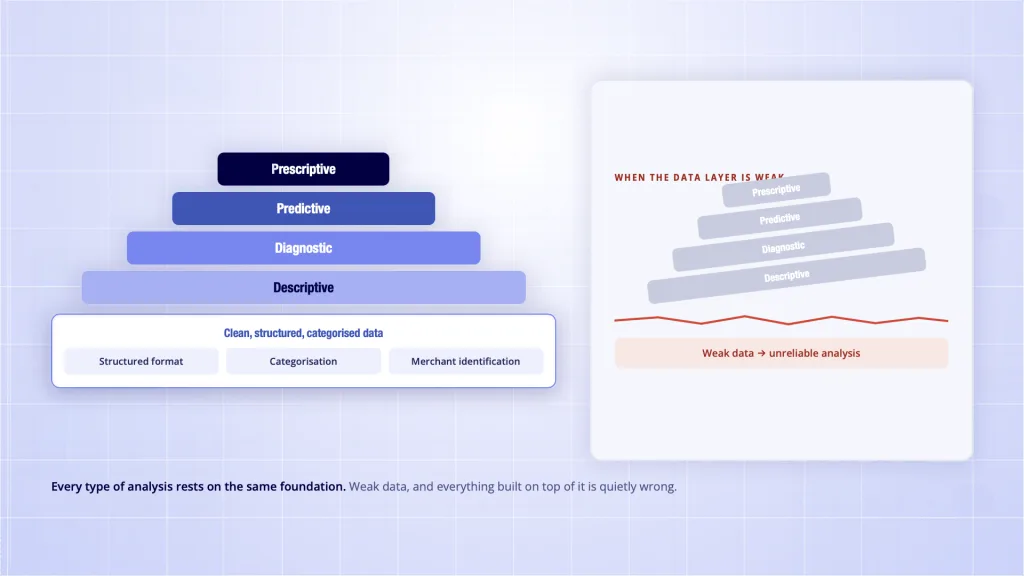
Every type of financial data analysis rests on the same foundation: clean, structured, categorised data. Descriptive analysis works with whatever data exists, but diagnostic, predictive, and prescriptive analysis all break down on messy data.
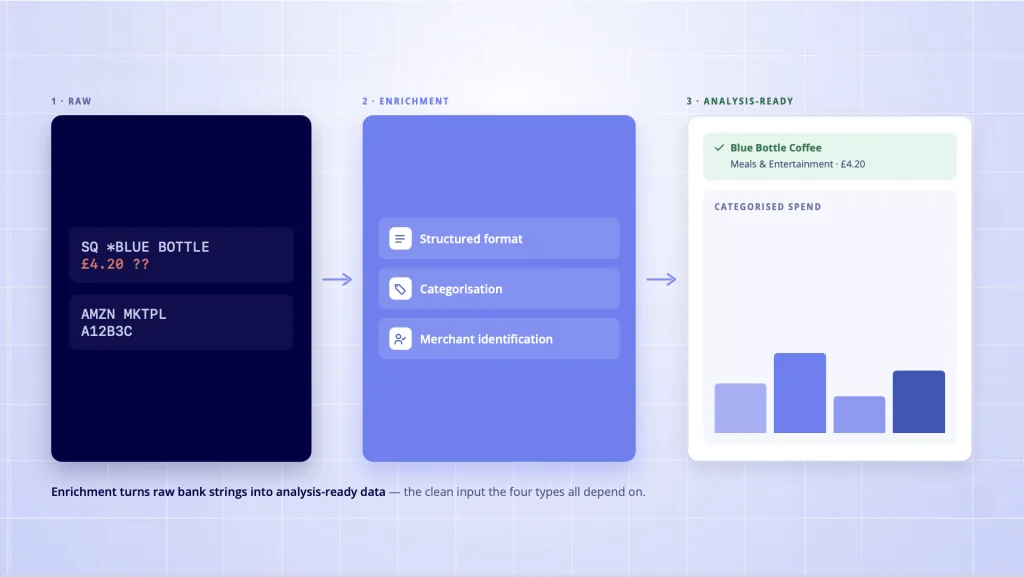
The problem is most visible in bank transaction data. A payment does not arrive labelled – it arrives as a cryptic string, something like “SQ *BLUE BOTTLE” or “AMZN MKTPL A12B3C”.
A human can guess these. An analysis pipeline cannot, not at the scale of thousands of transactions a month.
Three data quality requirements sit underneath reliable analysis:
- Structured format: transactions in a consistent, machine-readable shape, not free-text strings
- Categorisation: each transaction assigned to a spend or revenue category so it can be grouped and trended
- Merchant identification: the cryptic descriptor resolved into a real merchant name
This is the layer transaction enrichment handles, resolving raw bank strings into clean merchant names and categories.
For platforms running this at scale, automated financial data categorisation is the prerequisite that makes any four-types pipeline trustworthy.
How Does Finexer Fit Into Financial Data Analysis?
Finexer is not a financial analysis tool. Finexer provides the bank-data and enrichment infrastructure that financial data analytics tools and finance platforms run on.
The analysis itself – the dashboards, the forecasts, the models – stays with the finance team or the platform. Finexer supplies the clean, structured, categorised data feed underneath, so the analysis is built on reliable inputs rather than raw strings.
What Finexer provides for analysis pipelines:
- AIS for a real-time bank data feed across accounts, pulled directly from the source
- Transaction Enrichment that resolves cryptic descriptors into clean merchant names and categories
- Structured output that BI tools, dashboards, and analysis models can group and trend without manual cleanup
- Coverage across 99% of UK banks through one API connection
The mechanism: a finance platform or analysis pipeline connects to Finexer once, then receives bank transactions already structured and categorised. The descriptive dashboard reflects every account, the diagnostic drill-down works on correctly labelled data, and the predictive model trains on clean history.
The feed behind modern pipelines runs on real-time bank data via AIS, pulled live from the source rather than uploaded overnight.
Platforms scoping how analysis tools consume the data work with structured bank data via API.
Finexer is FCA-authorised AISP and PISP (FRN 925695). PSD2-compliant. Usage-based pricing. 3 to 5 weeks of hands-on onboarding support for platforms embedding the feed.
“Every analysis stack I have reviewed has a clean-data dependency that nobody puts on the architecture diagram. The model gets the credit. The enrichment layer underneath is what made the model trustworthy. When teams skip it, the analysis looks confident and is quietly wrong.” – Yuri, Finexer
Where Does Financial Data Analysis Get Applied?
A finance team uses descriptive analysis for monthly reporting, while an FP&A team trains predictive forecasts on categorised history. On the platform side, an accounting tool adding financial data analytics as a product feature needs a structured, categorised feed underneath.
To see how the four types of financial data analysis chain together, take a mid-market finance team reviewing a quarter where margins slipped.
- Descriptive shows gross margin fell three points versus the prior quarter
- Diagnostic drills in and finds one supplier category rose sharply, traced through categorised transactions
- Predictive projects that, left unchanged, the trend tightens cash within two quarters
- Prescriptive recommends renegotiating that supplier or switching, with the saving modelled against forecast
Get the categorisation wrong and the diagnostic step blames the wrong supplier – the most common way this chain breaks in practice.
What is financial data analysis?
It is the practice of turning raw financial data into business decisions, spanning four types – descriptive, diagnostic, predictive, and prescriptive. Each answers a different question, from what happened to what to do next.
What are the 4 types of data analysis?
Under the Gartner framework, the four types are descriptive (what happened), diagnostic (why it happened), predictive (what may happen), and prescriptive (what to do). Each builds on the previous one and needs progressively cleaner data.
What are the top skills for a financial analyst?
Core skills include financial modelling, proficiency with Excel and a BI tool, understanding of accounting and ratio analysis, statistical literacy for forecasting, and the ability to communicate findings clearly. Data preparation and judgement matter as much as modelling.
What happens if financial data is poor quality?
Diagnostic analysis points to the wrong cause, forecasts drift, and prescriptive recommendations act on bad inputs. The output still looks confident on a dashboard, which is what makes poor-quality data dangerous rather than just inconvenient.
If your analysis pipeline still cleans cryptic bank strings by hand, Finexer’s Transaction Enrichment delivers categorised, analysis-ready data from the day you connect
About the Author

Yuri
Yuriy Yakushko is a fintech founder and software engineer with over 20 years of experience building financial technology. He’s passionate about creating scalable, secure infrastructure that helps businesses modernise how they access financial data and manage payments.