Structured, enriched, validated account records for fintech platforms.
Open Banking AIS for platforms building financial data enrichment workflows.
A reconciliation workflow was producing incorrect output. The connection was live. Bank records were arriving. Merchant names were correctly identified. Everything looked right.
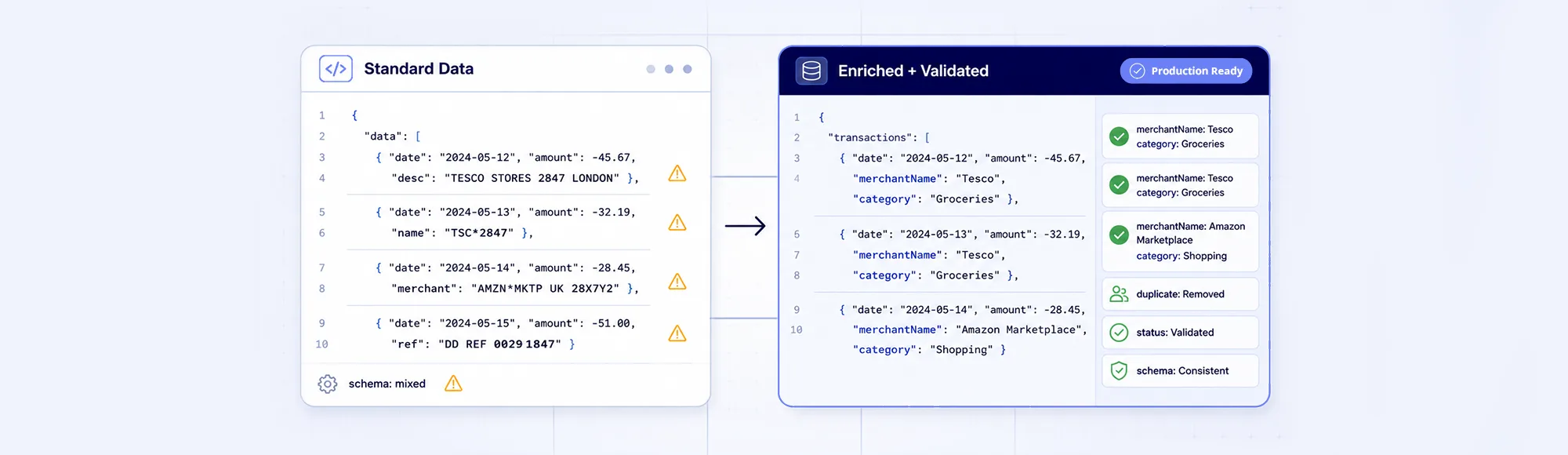
The problem was a duplicate entry from one bank. Not a connection failure. Not an output error. A validation gap – the same entry arriving twice through different webhook events, both passing the normalisation layer, both landing in the ledger.
The totals were wrong by exactly one entry for three months before anyone noticed.
This is the core distinction: financial data enrichment makes account activity readable. The other layer makes it reliable. Most platforms treat them as a single step. They are not.
“The platforms that hit production problems earliest are the ones that solved the merchant naming problem and assumed that was enough. The reliability layer is a separate problem entirely. Duplicate detection, account verification, format consistency across banks – those break in different ways.” – Yuri, Finexer
TL;DR
Standard bank transaction data gives platforms the foundation: account activity, balances, dates, amounts, and references. Financial data enrichment adds the context layer – merchant names, categories, and recurring payment signals. Validation and verification of data keeps the output consistent and complete for production use. Both happen at the infrastructure layer, before the output reaches platform logic.
What Standard Bank Transaction Data Looks Like Before Enrichment
Why do description strings vary so much across UK banks?
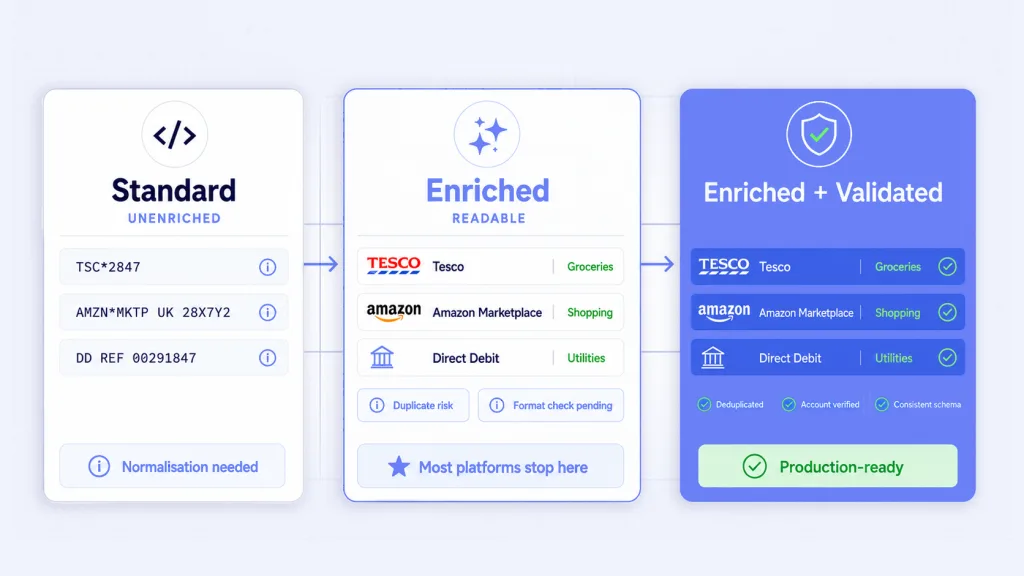
Description strings arrive in formats that vary across banks and payment types. This is normal – different institutions, connection methods, and payment rails all produce different description strings for the same underlying merchant.
A single merchant may appear like this across banks:
- TESCO STORES 2847 LONDON
- TSC*2847
- TESCO PLC DIRECT DEBIT
- AMZN*MKTP UK 28X7Y2
- AMAZON EU SARL LU
These are real description patterns. The same merchant, returned differently by different banks, on different payment rails.
Without a normalisation layer, every platform building on this output faces the same problem: normalisation logic that handles one format breaks when another appears. Initial rules cover 80% of cases. The remaining 20% – edge cases, international merchants, payment type variations, bank-specific formatting – consume engineering resources disproportionate to their volume.
These account records give platforms the foundation. Financial data enrichment adds the context layer – merchant names, categories, and recurring payment signals. When platforms discuss financial data enrichment, this is the layer they mean. Validation and verification of data handles reliability. These are three distinct stages, not one.
| Stage | What it looks like | What changes |
|---|---|---|
| Standard (unenriched) | AMZN*MKTP UK 28X7Y2 | TSC*2847 | DD REF 00291847 | Account activity and references available. Merchant names and categories not yet applied. Normalisation needed before automation logic runs. |
| Enriched | Amazon Marketplace | Tesco | Direct Debit – Ref 00291847 | Readable. Merchant names resolved, categories applied. May still contain duplicates, format inconsistencies, or unverified account ownership. |
| Enriched + validated | Amazon Marketplace | Tesco | Direct Debit – Ref 00291847 – deduplicated, account verified, consistent JSON | Production-ready. Reconciliation, categorisation, and affordability logic runs without manual correction. |
What Financial Data Enrichment Actually Covers
What does financial data enrichment add to standard bank records?
Financial data enrichment transforms description strings into structured, readable output by adding merchant context and payment metadata the bank does not provide directly. The specific operations:
Merchant normalisation. AMZN*MKTP UK 28X7Y2 becomes Amazon Marketplace. The layer maps description strings to a verified merchant database – resolving name variations, removing payment-specific suffixes, and returning a consistent identifier regardless of which bank or payment type generated the entry.
Categorisation. Each entry is assigned a category – groceries, transport, utilities, salary, rent – based on merchant type, MCC code, and payment pattern. For business platforms: operating expenses, payroll, supplier payments, tax-related categories.
Counterparty identification. Business versus personal transfers separated. Inbound versus outbound direction confirmed. Employer salary credits distinguished from other inflows.
Metadata. MCC codes, entry type, direction, settlement status – fields the standard bank description does not carry directly, added at the context layer.
Recurring payment detection. Regular patterns identified across payment history – subscriptions, direct debits, standing orders – flagged for cash flow and affordability workflows.
This is what gets added. Account activity becomes human-readable and machine-processable.
What it does not cover: completeness checks, duplicate detection, or ownership verification across connected records.
For platforms evaluating where transaction categorisation sits within the broader enrichment infrastructure – it is one step, not a complete solution.
Where Validation and Verification of Data Fits
Why does enriched output still need a separate reliability layer for production workflows?
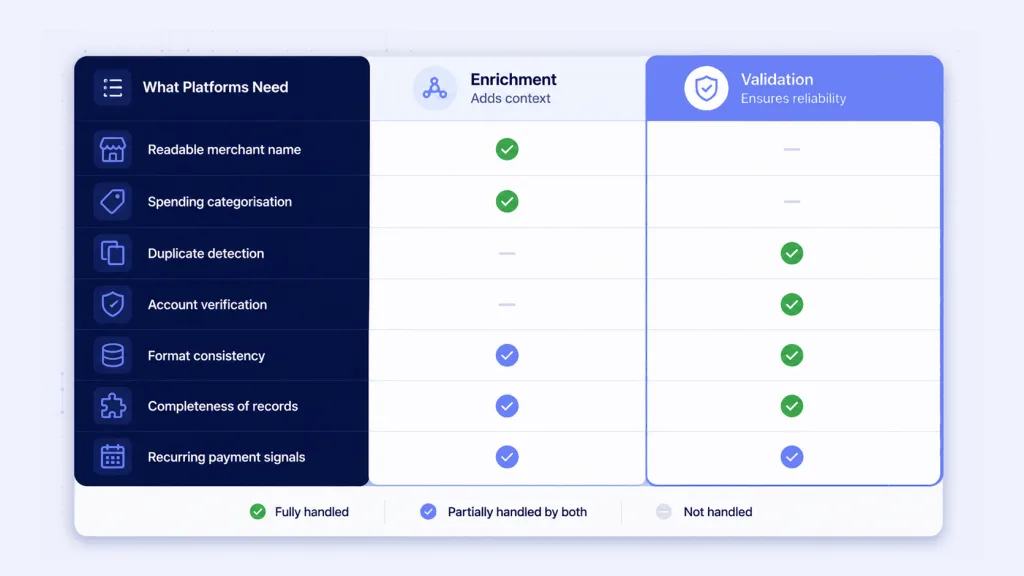
The financial data enrichment layer handles readability. Validation and verification of data handles a separate set of problems:
Duplicate detection. The same entry can arrive through multiple events – webhook delivery, polling refresh, reconnection. Without deduplication, it appears twice in the platform’s ledger. This is not caught before the record reaches the ledger. Reconciliation breaks silently.
Account verification. When a platform connects a bank account, it needs to confirm ownership. Sort code and account number verification against connected records. Ownership confirmation for onboarding workflows. Without this, a connected account belonging to a different entity clears the merchant layer and fails downstream compliance.
Format consistency across banks. UK banks return records in different formats. Barclays may return a field as a string where Monzo returns it as an integer. Date formats vary. Reference field structures differ. Merchant normalisation handles merchant names – not the structural field inconsistency that breaks parsing logic when it encounters an unexpected type.
Completeness checks. Some entries arrive with missing fields – no counterparty identifier, no reference, incomplete amounts. What context is available gets added. Missing fields are flagged before the record reaches platform logic.
| Problem | Resolved by enrichment | Resolved by validation |
|---|---|---|
| Unresolved merchant names | Yes – merchant normalisation | No |
| Missing payment categories | Yes – categorisation layer | No |
| Duplicate entries | No | Yes – deduplication logic |
| Inconsistent field formats across banks | Partial – merchant fields only | Yes – schema normalisation |
| Account ownership verification | No | Yes – account verification |
| Unreadable payment references | Partial – structured reference fields | Yes – reference check |
| Missing fields on arrival | No | Yes – completeness check |
The gap between enriched output and validated output is where financial data enrichment alone is insufficient. Not at launch. After three months of live traffic, when the edge cases arrive.
For platforms encountering inconsistencies across bank connections and evaluating what to fix at the infrastructure layer, API integration challenges in bank account workflows surface differently from connection failures – format inconsistency and webhook gaps are infrastructure-layer problems, not product bugs.
Where Each Layer Matters in Practice
Which platform workflows need financial data enrichment, which need reliability checks, and which need both?
Reconciliation. I need both. Financial data enrichment ensures categories map correctly to accounting entries. Duplicates must not inflate totals and missing entries must not create unresolved exceptions – the check layer handles that. A reconciliation workflow built on enriched-but-unvalidated records produces incorrect totals silently.
For platforms building on Open Banking AIS for reconciliation, automated payment reconciliation matching logic produces accurate outputs when the record structure is consistent – and requires manual exception review when it is not.
Affordability assessment. I need both. Salary credits must be identified and separated from other inflows – financial data enrichment handles that. The income record must be complete – missed entries or duplicated credits directly affect affordability calculations. Neither is sufficient alone.
Onboarding and identity verification. Verification-heavy. Confirmation matches the connected account to the entity being onboarded. History completeness confirms the record set covers the stated period. Income identification is supported at this step, but the compliance requirement sits with ownership verification.
Transaction monitoring and AML. I need both. The categorisation layer identifies payment types relevant to monitoring rules. A missing webhook entry creates a blind spot.
For platforms building monitoring on top of bank feeds, real-time transaction monitoring rules fire accurately only when the underlying record set is complete. Gaps at that layer become blind spots at the monitoring layer.
Expense categorisation. Primarily the financial data enrichment layer. Categories assigned from merchant and MCC context. Completeness still matters – missing entries mean incomplete records.
How Finexer Supports Financial Data Enrichment and Validation Workflows
Finexer is not a standalone merchant context tool. It does not provide a categorisation dashboard, a BI layer, or a UI for tagging.
Finexer provides two infrastructure layers relevant to financial data enrichment workflows: Open Banking AIS for bank access, and the Transaction Enrichment API for structured merchant intelligence on top of that output.
What does Finexer’s AIS provide?
FCA-authorised Open Banking AIS – the banking infrastructure that fintech platforms, accounting SaaS, and financial operations tools use to access payment history across almost all major UK banks through a single integration.
AIS delivers:
- Account activity and bank records across almost all major UK banks via a single integration
- Merchant identification and categorisation applied at the infrastructure layer
- Normalised JSON format across supported UK bank connections – one consistent schema per connection
- Up to 7 years of payment history for retrospective analysis and audit
- Webhook delivery with retry logic designed to reduce missed-event gaps – failure notifications arrive near-immediately
- Balance records across connected accounts via the same integration
What does Finexer’s Transaction Enrichment API add?
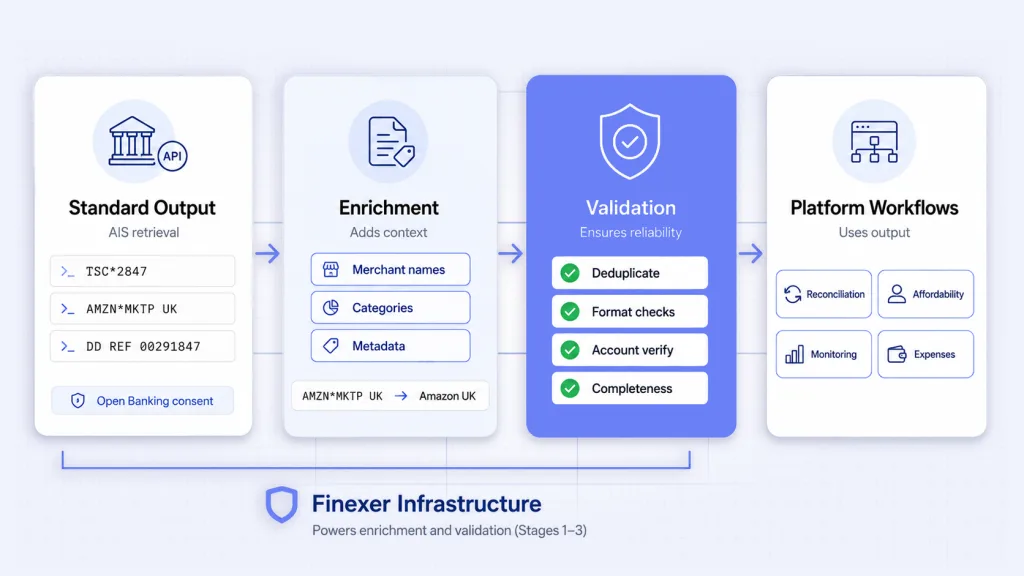
The Transaction Enrichment API adds financial data enrichment intelligence to account activity already retrieved via Open Banking AIS. Platforms already on Finexer AIS connect through a single additional endpoint – no new consent flows, no additional bank connections, no infrastructure rebuild required.
Transaction Enrichment API delivers:
- Verified merchant names and legal entities across 100M+ merchants
- Structured spending categories applied automatically to every entry
- Billing pattern detection – subscriptions and recurring payments identified without custom logic
- Location context extracted from payment descriptors
- 95%+ accuracy on merchant identification
- Sub-100ms response latency for real-time and batch workflows
- Pre-trained and production-ready – no model training or ML team required
What Finexer does not replace:
- The platform’s own reconciliation matching logic
- Affordability calculation rules
- AML decision logic or compliance policies
- Business intelligence or reporting layers
Bank records arrive structured. The financial data enrichment layer adds merchant context. This is financial data enrichment in practice: the layer between standard bank output and usable financial intelligence. The platform builds reconciliation, affordability, and monitoring logic using both.
UK Open Banking recorded 24 billion API calls and 351 million payments in 2025, up 57% year-on-year. AIS connections outnumber payment initiation by 13:1 – reflecting the scale at which platforms are building on structured bank access infrastructure.
- FCA-authorised (FRN 925695)
- 3 to 5 weeks of hands-on onboarding support
- Usage-based pricing, commercial terms agreed based on use case
“The distinction between these two layers matters most when something goes wrong. Category errors are visible and fixable. Errors from the check layer – incorrect totals, missing records, compliance gaps – are less visible and caught much later.” – Yuri, Finexer
What is financial data enrichment?
Financial data enrichment transforms standard bank description strings into structured, readable output. It adds merchant names (normalising strings like “AMZN*MKTP UK” to “Amazon Marketplace”), spending categories, counterparty classification, and payment metadata – making account activity usable for automation and reconciliation workflows.
What does validation and verification of data mean in financial platform workflows?
Validation and verification of data confirms that enriched records are complete, non-duplicate, structurally consistent, and tied to a verified account. It catches duplicate webhook events, missing entries, format inconsistencies across bank connections, and ownership mismatches – the layer that sits between enriched output and reliable production results.
How does Open Banking improve account record quality?
Open Banking AIS retrieves records directly from the bank – removing the manual upload step. When financial data enrichment and validation are both applied at the infrastructure layer, platforms receive output that is structured, categorised, and consistent without separate normalisation pipelines. Readable and reliable from the point of retrieval.
Why do platforms need both of these layers alongside standard bank records?
Standard bank account records provide the foundation – account activity, balances, dates, amounts, and payment references. Financial data enrichment adds merchant names, categories, and recurring payment signals. The check layer keeps the output consistent and complete. Without both, production workflows encounter category gaps or structural inconsistencies that surface after launch, not during testing.
Build on structured, enriched, validated account output.
About the Author

Yuri
Yuriy Yakushko is a fintech founder and software engineer with over 20 years of experience building financial technology. He’s passionate about creating scalable, secure infrastructure that helps businesses modernise how they access financial data and manage payments.