Manual audit trails creating compliance gaps?
Access verified bank transaction data for audit-ready regulatory reporting.
Financial data extraction is not a parsing problem. It is an input layer problem.
At Finexer, I work with accounting SaaS, LawTech, and ERP platforms that have invested in document parsing tools, OCR software, and CSV import pipelines – and still face data quality failures every month. The extraction tools are not the issue. The decision to extract from documents rather than retrieve from source is.
This blog covers why financial data extraction from documents fails as a foundation for platform workflows, what API financial services actually replace in the data pipeline, and how moving to direct bank data access resolves the input layer problem permanently.
TL;DR
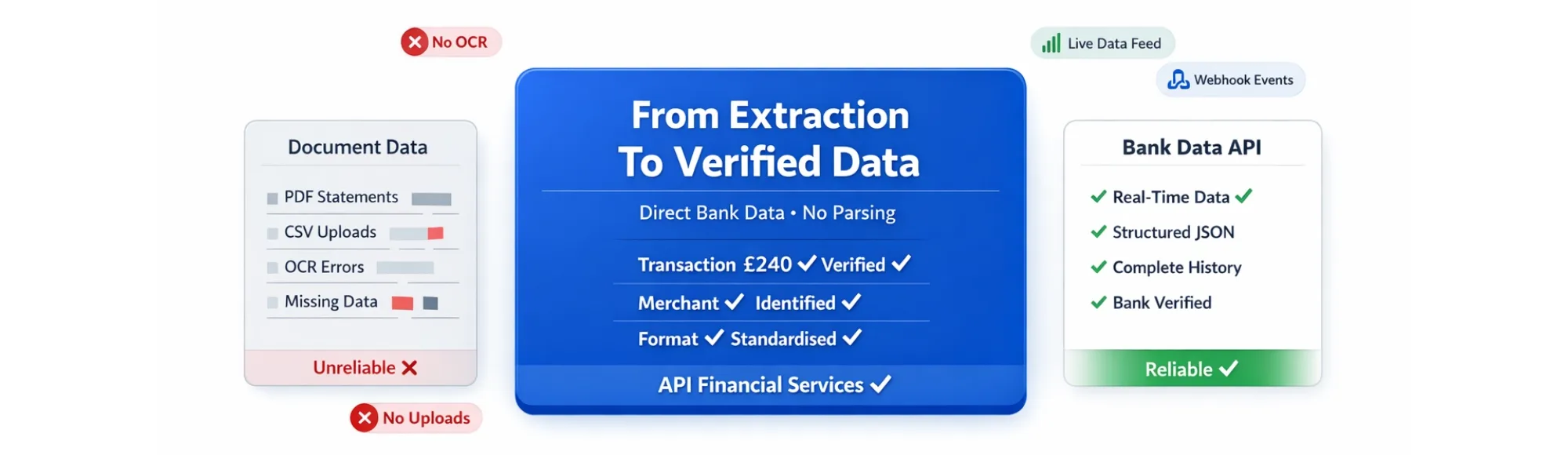
Financial data extraction from PDFs and CSVs fails because document formats are inconsistent, extracted data cannot be verified at source, and manual correction overhead compounds with client volume. API financial services via FCA-authorised AIS replace the extraction layer entirely – delivering structured, bank-verified transaction data in real time without document uploads, parsing errors, or format inconsistencies. Finexer provides that infrastructure layer for UK accounting SaaS, LawTech, and ERP platforms.
Key Takeaways
Why does financial data extraction from documents fail at platform scale?
Document formats vary across UK banks and change without notice. Parsing errors introduce inaccuracies in amounts, dates, and references. Uploaded documents are frequently incomplete. Extracted data cannot be verified against actual bank activity – requiring manual review that scales with client volume.
What do API financial services replace in the platform data pipeline?
API financial services via FCA-authorised AIS replace the document upload, parsing, and manual correction steps entirely. Bank transaction data is retrieved directly from source – structured, verified, and consistent across all connected UK banks.
What is the difference between financial data extraction and direct bank data access?
Financial data extraction pulls data from a document the client has submitted. Direct bank data access retrieves data directly from the client’s bank account. One is verified at source. The other is not.
Which platforms are most exposed to financial data extraction failures?
Accounting SaaS platforms running reconciliation workflows, LawTech platforms conducting source-of-funds checks, and ERP systems automating financial reporting – wherever accuracy and verifiability of financial data are product requirements.
Why Does Financial Data Extraction From Documents Fail at Scale?
What Makes Document-Based Extraction Structurally Unreliable?
Every UK bank produces financial statements in a different format. Column headers, date structures, transaction description styles, and balance representations vary across institutions – and change when banks update their templates.
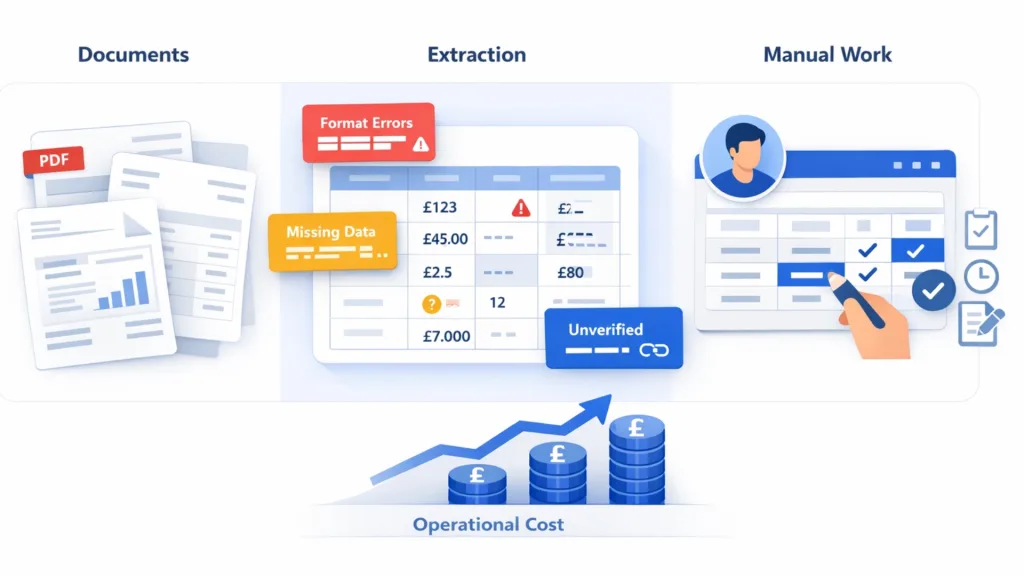
Financial data extraction tools trained on one bank’s format produce errors on another. At scale – hundreds of client accounts across multiple UK banks – this creates a correction overhead that grows with every new institution added.
The structural problems are consistent across every platform I work with:
- Format inconsistencies across banks create parsing errors on amounts, dates, and references
- Multi-page statements are frequently misaligned or partially captured
- Client-uploaded documents are often incomplete – missing periods, wrong date ranges, wrong accounts
- Extracted data cannot be cross-referenced against actual bank activity to confirm accuracy
- Manual review and correction is required before any downstream workflow can run reliably
“At Finexer, I work with platforms that describe financial data extraction as working in testing and breaking in production. That is the pattern. Real client documents arrive in fifteen different formats with inconsistent layouts. No extraction tool handles that without errors.” – Ravi, Finexer
Why Is Manual Correction Overhead the Hidden Cost of Extraction?
Platforms account for the cost of extraction tooling. They rarely account for the full cost of what happens after extraction.
Every parsing error produces a downstream correction task. Every incomplete document produces a re-upload request to the client. Every unverifiable record produces a manual review step before the data can be used in a compliance or reconciliation workflow.
Why bank statement extraction software falls short for UK platforms covers the specific failure modes of document-based extraction in detail.
At volume, the correction overhead becomes a significant operational cost – one that does not appear in the extraction tool pricing but sits directly in team resource and workflow latency.
What Does Financial Data Extraction Fail to Deliver for Platform Workflows?
Why Cannot Extracted Data Support Compliance Workflows?
For LawTech platforms running source-of-funds checks and AML reviews, extracted financial data carries a fundamental limitation. It cannot be independently verified against actual bank activity.
A PDF bank statement shows what was printed in that document. It does not confirm that the transactions shown represent the complete account activity for that period. A client can upload a statement covering three months and omit a fourth. A scanned document can be altered before upload.
Financial data extraction from documents produces a record. It does not produce a verifiable record. For regulated compliance workflows, that distinction is operationally significant.
Why Does Extraction Fail Reconciliation Accuracy Requirements at Scale?
Reconciliation workflows depend on complete, accurate, consistently structured transaction data. Financial data extraction from documents provides none of these properties reliably at scale.
Format mismatches produce phantom discrepancies – reconciliation failures that are parsing errors, not real mismatches. Missing transactions produce gaps that require manual investigation. Inconsistent date formatting produces matching errors that break automated workflows.
Historical financial data aggregation for UK platforms covers the data continuity requirements for reconciliation and reporting workflows that document-based extraction cannot meet.
| Data Property | Financial Data Extraction (Documents) | API Financial Services (AIS) |
|---|---|---|
| Data source | Client-uploaded PDF or CSV document | Verified bank transaction data at source |
| Format consistency | Varies by bank and statement version | Standardised JSON across 99% of UK banks |
| Data accuracy | Parsing errors require manual review | Bank-authenticated – no parsing layer |
| Completeness | Dependent on what the client uploads | Complete transaction history per consent scope |
| Verifiability | Cannot be verified against actual bank activity | Retrieved directly from the bank – source verified |
| Operational overhead | Manual correction, re-upload requests, format handling | Automated retrieval – no document handling |
How Do API Financial Services Replace Financial Data Extraction?
What Do API Financial Services Actually Deliver?
API financial services via FCA-authorised AIS do not improve financial data extraction. They remove the extraction layer from the data pipeline entirely.
Instead of asking a client to upload a document and then parsing that document to recover financial data, the platform retrieves verified transaction data directly from the client’s bank account through a consent-based API connection.
The data arrives structured, standardised, and bank-authenticated. No document upload step. No format inconsistency across banks. No manual correction required before downstream workflows can run.
Bank integration API for financial data access covers the technical architecture of direct bank data access and how it fits into platform financial workflows.
Why Does Structured Bank Data Replace the Extraction Layer?
FCA-authorised AIS delivers a consistent JSON output regardless of which UK bank the transaction originated from. Merchant name, amount, date, counterparty reference, category code – the same schema every time.
For platforms that have built financial workflows on extracted data, this schema consistency eliminates the normalisation step that document-based financial data extraction requires. Matching logic, compliance checks, and reporting workflows run on a consistent data structure from the first integration.
“The platforms that move from financial data extraction to API financial services do not go back. The operational overhead of managing document uploads, parsing errors, and manual corrections disappears. The data quality improvement is immediate and measurable.” – Ravi, Finexer
How Does Finexer Support API Financial Services for UK Platforms?
For accounting SaaS, LawTech, and ERP platforms that need to replace document-based financial data extraction with a reliable data layer – Finexer’s FCA-authorised AIS provides direct access to structured, bank-verified transaction data across 99% of UK banks.
Finexer’s data aggregation infrastructure covers the full AIS data capabilities available for platforms building financial data workflows.
What Does Finexer’s AIS Infrastructure Provide?
- FCA-authorised AIS – verifiable on the FCA register, read-only bank data access
- Structured JSON transaction data – consistent schema across all connected UK banks
- 99% UK bank coverage across retail, business, and challenger banks
- Up to 7 years of transaction history for historical workflows and onboarding
- Merchant identifiers and transaction category codes per transaction
- Real-time webhooks delivering transaction events as they occur
- Consent logs and timestamps per data retrieval for audit trail support
- Multi-account connectivity from a single consent-based API connection
- White-label consent flows under the platform’s own brand
- Usage-based pricing – scales with client volume
- 3-5 weeks onboarding support to reach production deployment
What I Feel
Financial data extraction from documents is still the default for most platforms not because it works well – but because it was the only option available when these workflows were built.
The infrastructure to replace it has been available since the UK Open Banking framework mandated standardised API access across major banks. API financial services via FCA-authorised AIS deliver the same financial data that document extraction attempts to recover – structured, verified, and complete – without the extraction layer that creates errors in the first place.
The platforms I work with that make this transition early spend their engineering resource building on top of reliable data. The ones that delay continue spending it managing data quality problems that are structural, not fixable.
Common Use Cases

Accounting & ERP Platforms
CSV and PDF imports create format inconsistencies and manual correction overhead that breaks reconciliation workflows at scale. Finexer’s AIS delivers real-time, standardised transaction feeds directly from client bank accounts – enabling financial data extraction to be replaced entirely with verified bank data per account.
Lawtech Platforms
Source-of-funds checks built on extracted documents cannot be independently verified. Finexer’s FCA-authorised AIS provides bank-authenticated transaction history with consent logs and timestamps – giving compliance workflows a verifiable financial data layer that document extraction cannot provide.
EPOS Platforms
EPOS platforms reconciling daily sales against bank receipts need confirmed transaction data, not parsed statement records. Finexer’s AIS delivers real-time transaction confirmation per payment event – replacing end-of-day document-based extraction with live bank data per transaction.
Payroll & Invoicing Platforms
Income verification and payment confirmation workflows built on client-submitted documents inherit the completeness gaps of those documents. Finexer’s AIS surfaces verified income patterns and payment activity directly from bank transaction history – without manual document requests.
Proptech & Real Estate Platforms
Affordability assessments built on extracted payslip or statement data miss accounts and periods the client did not include. Finexer’s AIS provides complete transaction history across all consented accounts – replacing document-based financial data extraction with verified income and payment behaviour data.
Utility Billing Platforms
Payment tracking built on statement-level extraction misses the payment timing accuracy that billing reconciliation requires. Finexer’s AIS delivers real-time payment confirmation per transaction – replacing batch document extraction with live bank data per billing event.
What is financial data extraction and why does it fail for platforms?
Financial data extraction pulls transaction data from PDFs or CSVs submitted by clients. It fails because document formats vary across banks, parsing introduces errors, and extracted records cannot be verified against actual bank activity.
What are API financial services and how do they replace document extraction?
API financial services via FCA-authorised AIS retrieve bank transaction data directly from source with user consent – delivering structured, bank-verified financial data without document uploads, parsing errors, or manual correction steps.
Do platforms need FCA authorisation to use API financial services for financial data extraction?
Platforms building on FCA-authorised AIS infrastructure inherit the regulatory compliance layer. They do not need independent FCA authorisation to access bank transaction data through Finexer’s API financial services infrastructure.
Replace document-based financial data extraction with verified bank data infrastructure.
About the Author

Ravi Ranjan
Ravi Ranjan is Co founder & CEO of Finexer