Due diligence conclusions are only as reliable as the data behind them.
Finexer provides verified bank transaction data for financial due diligence workflows.
Financial due diligence fails most often not because the analysis is wrong. It fails because the data feeding it cannot be verified at source.
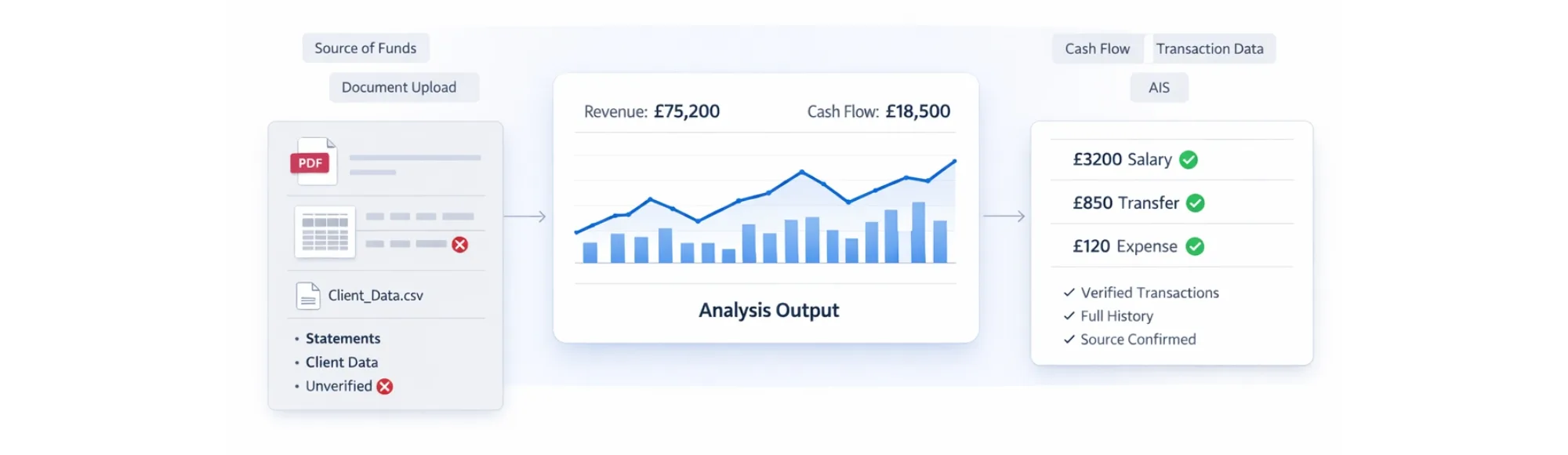
A target company submits bank statements. A client provides transaction records. A PDF is uploaded. The review team examines the figures and builds a financial picture.
Then the question arrives that document-based transaction services cannot answer: how do we know this reflects what actually happened in the accounts?
At Finexer, I work with Lawtech platforms, accounting firms, and compliance SaaS providers that run due diligence workflows on client financial data. The data quality problem is structural – and it shows up at the same point every time.
TL;DR
Financial due diligence requires verified transaction data covering income patterns, cash flow consistency, source of funds, and financial behaviour over time. Document-based transaction services – PDF statements, CSV exports, client-submitted records – cannot be verified at origin. They can be altered, incomplete, or unrepresentative of actual account activity. FCA-authorised AIS provides bank-authenticated transaction history directly from source, giving due diligence workflows a verified data layer that document submissions cannot match.
Key Takeaways
What data does financial due diligence require?
Due diligence requires verified transaction history showing income patterns, cash flow stability, source of funds, recurring obligations, and financial behaviour over a material period. The data must be confirmed against actual account activity – not declared or estimated.
What are transaction services in a due diligence context?
Transaction services refers to the financial advisory and data analysis work conducted as part of deal or compliance due diligence – covering financial position assessment, cash flow analysis, and verification of reported figures against underlying financial records.
Why do document-based inputs break financial due diligence?
Documents submitted by the subject of due diligence cannot be verified at origin. Bank statements can be altered. Exports cover selected periods. Client-supplied records reflect what the client chose to disclose. None of this confirms what actually happened in the accounts.
How does bank-verified transaction data improve due diligence accuracy?
FCA-authorised AIS retrieves transaction history directly from the client’s bank with consent. Income patterns, cash flow, source of funds, and financial behaviour are confirmed from the bank – not from a document the client prepared.
Why Does Financial Due Diligence Fail at the Data Input Layer?
What Data Is Actually Required for Reliable Due Diligence?
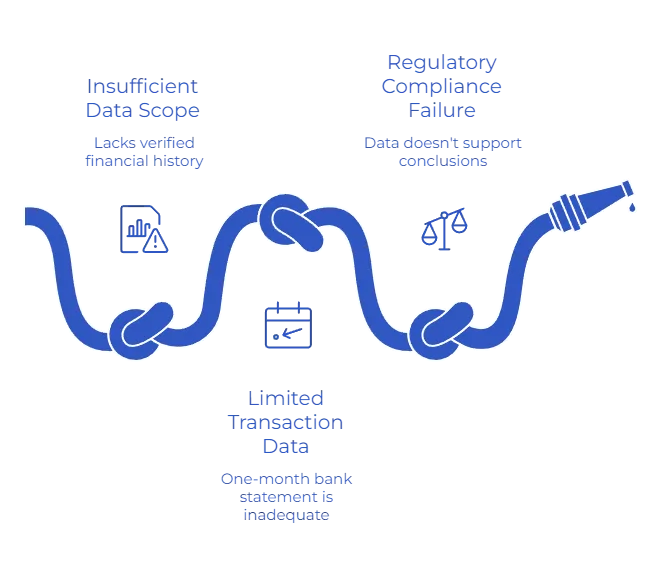
Financial due diligence needs more than reported figures. It needs verified financial history showing:
- Income sources and consistency over time
- Cash flow patterns – inflows, outflows, timing
- Source of funds for material transactions
- Recurring financial obligations and liabilities
- Account ownership and signatory confirmation
Each of these requires transaction-level data across a material lookback period. A one-month bank statement PDF addresses none of them adequately.
According to the FCA’s regulatory expectations for transaction services and client money, platforms handling client financial data must ensure the underlying data supports the conclusions drawn from it.
Why Do Document-Based Transaction Services Create Verification Gaps?
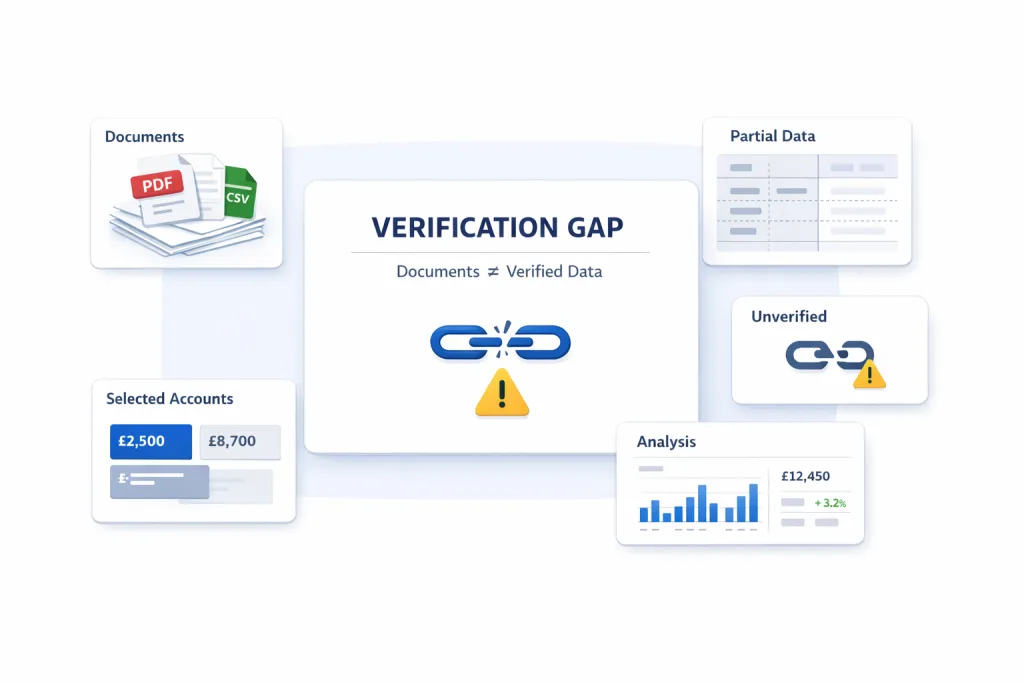
The documents most commonly used in financial due diligence – PDF bank statements, CSV exports, management accounts – share a structural problem.
They were prepared or selected by the subject of the review.
A client undergoing due diligence chooses which accounts to disclose. They select which periods to include. The PDF reflects what was generated from their banking interface on the day they downloaded it. It cannot be independently confirmed against the actual account ledger.
This is not a fraud assumption. It is a data reliability problem. Even a completely honest client may provide an incomplete picture – missing accounts, unusual periods excluded, summary formats that obscure transaction-level detail.
“At Finexer, I see due diligence workflows where the analysis is rigorous but the data it runs on is unverified. The output carries the appearance of precision without the underlying verification. That gap is where financial regulatory exposure lives.” – Ravi, Finexer
Source of funds check APIs for UK compliance workflows covers how verified source of funds data changes the accuracy of financial review and compliance assessment.
| Due Diligence Data Need | Document-Based Approach | Verification Gap | Bank Data Fix |
|---|---|---|---|
| Income verification | Payslips, management accounts | Client-selected, cannot confirm actual deposits | Salary transactions from bank history – verified at source |
| Cash flow analysis | PDF bank statements (selected period) | Period and accounts chosen by subject | Full transaction history per consented account via AIS |
| Source of funds | Declarations and supporting documents | Unverifiable against actual account origin | Transaction-level origin data from bank directly |
| Financial behaviour | Summary statements or management reports | Aggregated – individual transactions not visible | Structured transaction feeds with category codes per event |
How Does Finexer Support Financial Due Diligence Workflows?
For Lawtech platforms, accounting firms, and compliance SaaS running financial due diligence – Finexer’s FCA-authorised AIS provides the bank-verified transaction data layer that closes the document verification gap.
Transaction data enrichment via structured bank APIs covers how structured, categorised transaction data from AIS compares to unstructured document-based inputs for verification workflows.
What Does Finexer’s AIS Provide for Due Diligence?
- FCA-authorised AIS – read-only, consent-based bank data access
- Up to 7 years of transaction history per consented account
- Transaction category codes and merchant identifiers per event
- Covers almost all major UK banks – high street, challenger, business banking
- Consent logs and access timestamps – full audit trail per retrieval
- Structured JSON output – consistent schema across all connected banks
- White-label consent flows under the platform’s own brand
- Usage-based pricing, 3-5 weeks onboarding support
Finexer payment infrastructure for transaction services covers the PIS layer that complements AIS data access for platforms managing both verification and payment workflows.
“The shift from document-based to bank-verified data in due diligence is not a compliance upgrade. It is a data quality decision. The analysis does not change – the reliability of what it runs on does.” – Ravi, Finexer
What I Feel
Financial due diligence has sophisticated analytical frameworks. Income normalisation, cash flow adjustments, source of funds mapping. The methodology is often strong.
The data layer beneath it frequently is not.
Platforms that resolve this at the input stage – by using bank-verified transaction data rather than client-submitted documents – do not produce better analysis. They produce analysis that is actually defensible when scrutinised.
Common Use Cases
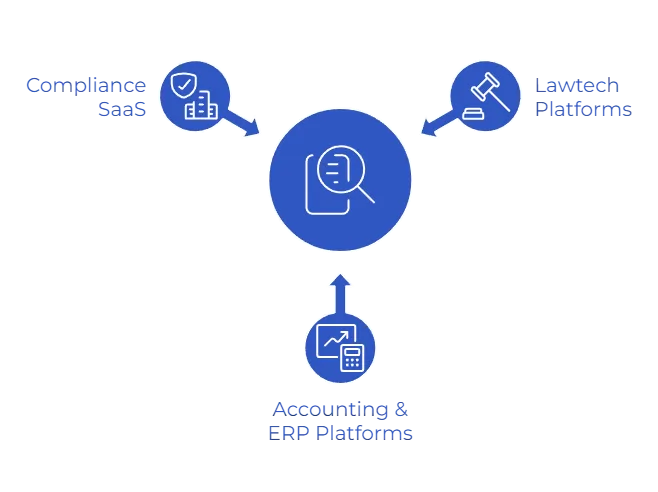
Lawtech Platforms
Source of funds verification for property transactions and legal matters requires evidence that holds under regulatory scrutiny. Finexer’s AIS provides bank-authenticated transaction history with consent logs – supporting the review with independently verifiable financial data.
Accounting & ERP Platforms
Financial review and audit workflows built on client-submitted documents inherit the gaps of those documents. Finexer’s AIS delivers verified income patterns and transaction history per account – replacing unverifiable inputs with bank-sourced records.
Compliance SaaS
Compliance platforms automating due diligence checks at scale need a data source that confirms financial position without manual document review. Finexer’s AIS provides structured transaction data across all consented accounts – enabling automated verification at volume.
What is financial due diligence and what data does it require?
Financial due diligence is the process of verifying a subject’s financial position – covering income, cash flow, source of funds, and financial behaviour. It requires transaction-level data confirmed against actual account activity, not just summarised figures from client-submitted documents.
What are transaction services in financial due diligence?
Transaction services refers to the financial advisory work conducted during deal or compliance reviews – assessing cash flow quality, verifying reported figures, and identifying financial risks. Reliable transaction services depend on verified underlying data, not document-based inputs that cannot be confirmed at source.
How does Open Banking AIS improve financial due diligence accuracy?
FCA-authorised AIS retrieves bank transaction history directly from the subject’s bank with consent. Income, cash flow, source of funds, and financial behaviour are confirmed from the bank – giving due diligence workflows a verified data foundation that PDF statements and management accounts cannot provide.
Build financial due diligence on verified bank transaction data.
About the Author

Ravi Ranjan
Ravi Ranjan is Co founder & CEO of Finexer